A $1,337 bug let anyone forge a session - if they already knew a UUID and a login was live
The 8x8 v1 API's JWT verifier did not pin the signing algorithm, so it accepted HS256 tokens signed with the public RSA key used as an HMAC secret. An attacker who knew a target user's non-enumerable UUID and had an active server-side session for that user could forge tokens and read account information from v1 read endpoints.
 Published on pawanjswal.medium.com
Cybersecurity
The full write-up lives on its author's site
It belongs to its author, so we link to it rather than copy it. The other two tabs are our own rewrites, checked against it.
Context
8x8's connect.8x8.com v1 API uses JSON Web Tokens to prove that a request comes from a logged-in user. Tokens are normally signed with RS256, an asymmetric algorithm: the server holds a private key for signing, and a public key, which is not a secret, is used to verify the signature.
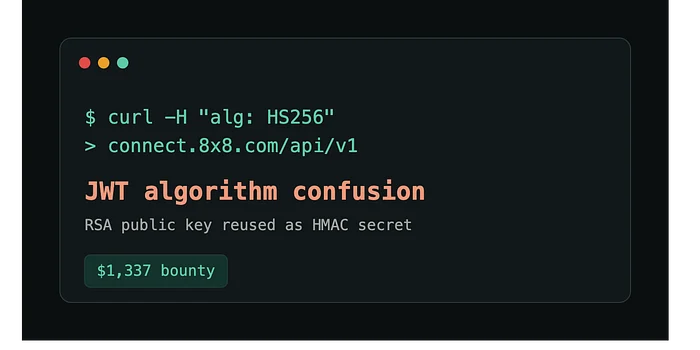
The bug is a JWT algorithm confusion issue. The verifier did not pin the algorithm, so it accepted HS256 tokens signed with the RSA public key used as an HMAC secret. The report is HackerOne #3800870, filed by kyotozzx, and it earned a $1,337 bounty.
Setup
The disclosure summary describes two preconditions for exploitation:
- Knowledge of a target user's non-enumerable UUID.
- An active server-side session for that user.
No tooling, account roles or versions are given in the disclosed material.
Finding it
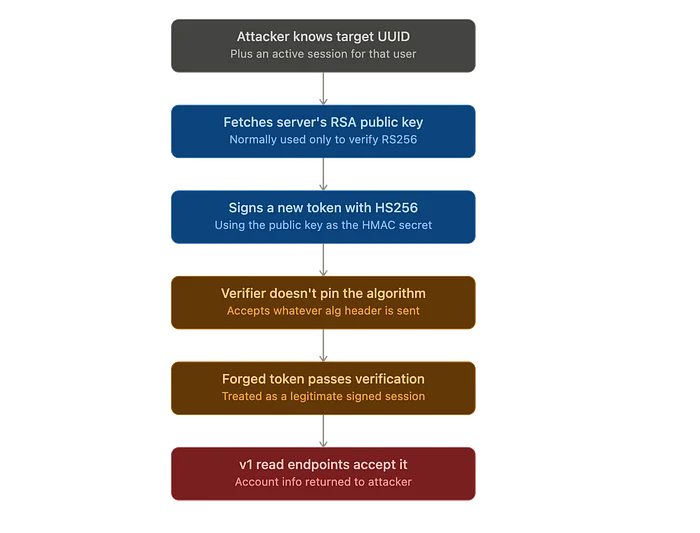
The 8x8 summary confirms that the v1 API's JWT verifier did not enforce algorithm pinning. In other words, the server trusted the alg field in the token header instead of requiring RS256. Because the RSA public key is by design not secret, anyone holding it could mint tokens that the verifier would accept.
Exploitation
The disclosed HackerOne page does not include the comment thread where the technical writeup and PoC code were posted; only the summary and timeline are visible. There is therefore no request, payload or command to reproduce here, and none has been invented. The summary does state the conditions the PoC had to establish and the result it achieved.
Step 1: Obtain the target's UUID
The UUID is non-enumerable, so it could not simply be guessed. The researcher needed a real one for the target user.
Step 2: Confirm a live session
The exploit depended on server-side session state being active for that user, so the researcher had to confirm that a live session existed.
Step 3: Forge an HS256 token with the public RSA key
The researcher forged an HS256 token using the public RSA key as the HMAC secret and sent it to a v1 read endpoint. The forged token was accepted, and the endpoint returned account information.
Root cause
The 8x8 summary confirms the mechanism directly: the JWT verifier did not enforce algorithm pinning and would accept HS256 tokens signed with the RSA public key used as an HMAC secret. The server trusted the token's own alg header rather than enforcing that only RS256 is valid. The verifier deferred to the token's own alg header rather than enforcing that only RS256 is valid.
Impact
- Read endpoints trusted the forged token and returned account information.
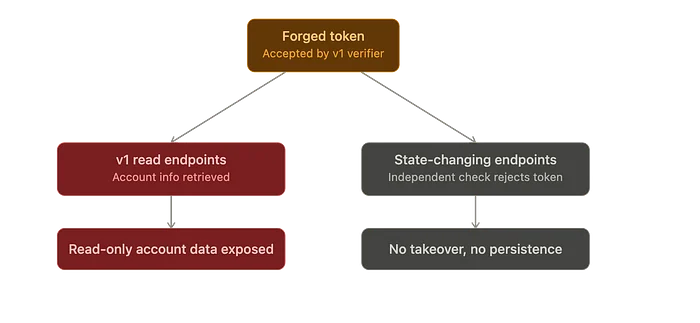
- State-changing endpoints had their own, separate check, and all of them independently rejected forged tokens. Impact was therefore limited to read-only access, with no privilege persistence and no account takeover: no password reset, no profile edit, no session creation.
- The two prerequisites, a real UUID and a live session, meant this was not a walk-up-and-exploit-anyone bug; it required prior reconnaissance or targeting.
Fix
The v1 API verifier now enforces RS256 algorithm pinning and rejects any token using an alternative signature algorithm. The fix has been deployed to production and verified effective. The server now decides which algorithm is allowed, not the token.
Variants to test
- Any API that supports both RS256 and HS256: check whether the verifier hardcodes the expected algorithm or trusts the token's
algheader. A positive result is a token withalgchanged to HS256, signed with the public key as the HMAC secret, being accepted. - Places where a public value is reused as a secret, such as an RSA public key consumed as an HMAC key. A positive result is a signature that verifies against the public value.
- Endpoints that share a trust boundary with read endpoints: test whether state-changing endpoints apply their own algorithm check. A positive result is a forged token being rejected by one endpoint class but accepted by another.
- Preconditions in your own reports: state clearly when exploitation needs a non-enumerable identifier plus an active session. A positive result is a report whose impact is scoped to what was actually proved.
What happened, in plain words
8x8 runs a service at connect.8x8.com. Part of that service is an API, which is the part of a website that other software talks to directly, rather than the part a person clicks on in a browser. When you log in to a normal website, your browser gets a small piece of data called a token and shows it back on every later request, a bit like a cloakroom ticket: you hand in the ticket, and the staff give you your coat without asking who you are again. The 8x8 API used a particular kind of token called a JSON Web Token, or JWT, to decide whether a request came from a logged-in user.
A JWT is signed. Signing is a way of stamping a document so that anyone can check it has not been altered, and so that only the holder of the right key could have produced the stamp. 8x8 normally used a signing method called RS256, which works with a pair of keys: a private key that only the server has, used to make the stamp, and a public key that anyone can have, used to check the stamp. The public key is not a secret, by design, just as a shop's official stamp-checking guide is not secret.
There is a second common signing method, HS256, where one single secret both makes the stamp and checks it. The trap is that a careless checker can be told which method to use by the token itself. If the checker reads the token's own label saying "I am signed with HS256" and then uses whatever key it has been given as the HS256 secret, an attacker can take the public RSA key, which is not secret, and use it as that HS256 secret. The server then accepts a token the attacker made up.
That is what happened here. The researcher kyotozzx found that the 8x8 v1 API did not fix the algorithm in advance. It trusted the token's own label. The bug is known as JWT algorithm confusion, and it earned a $1,337 bounty. The report is HackerOne #3800870.
The image shows the report itself: 8x8's v1 API did not check which algorithm signed your token.
The setup: what the API was supposed to do
To understand the bug you need three ideas.
- An API is the counter behind the website. Your browser, or an app, sends a request to it and gets structured data back, such as your account details. You never see the counter directly; the page you look at is built from what the counter hands over.
- A token is the proof of who you are on each request. Instead of sending your password every time, your browser sends the token. The server checks the token's signature and, if it is valid, treats the request as coming from the user named inside it.
- A signature is the tamper-evident stamp on the token. With RS256 the server stamps with its private key and everyone checks with the public key. With HS256 one shared secret does both jobs.
The important asymmetry is this: the public key is meant to be handed out. It is published so that anyone can verify signatures. It is not a password. But if a server ever uses that public key as if it were an HS256 shared secret, then everyone who has the public key can also make stamps. The lock and the key become the same object.
Finding it
The 8x8 summary confirms that the v1 API's JWT checker did not enforce algorithm pinning. Pinning means the server decides in advance which signing method is allowed, and refuses anything else. Here the server instead read the alg field in the token's header, the label at the top of the token that says which method was used, and followed it. Because the RSA public key is not secret, anyone holding it could create tokens the checker would accept.
The image illustrates how the forged token got past the verifier: the token claimed HS256, and the server used the public key as the HMAC secret to check it.
Exploitation: what the proof of concept had to show
The public HackerOne page for this report does not include the comment thread where the technical writeup and the proof-of-concept code were posted. Only the summary and the timeline are visible. So there is no request, payload or command to reproduce here, and none has been invented. What the summary does state is the conditions the proof of concept had to establish and the result it achieved.
A proof of concept, or PoC, is a small demonstration that proves a bug is real rather than theoretical. It is the difference between saying "this door looks flimsy" and actually opening it.
Step 1: Obtain the target's UUID
A UUID is a long random-looking identifier, something like a serial number, used to name a user or object. It is non-enumerable, which means you cannot simply count upwards and guess the next one, the way you might try user=1, user=2. The researcher needed a real UUID belonging to the target user.
Step 2: Confirm a live session
The exploit depended on server-side session state being active for that user. A session is the server's own record that someone is currently logged in. The server keeps it on its side, not in the token alone. This is why the bug was not a walk-up-and-exploit-anyone issue: it needed a real identifier and a user who was actually logged in at the time.
Step 3: Forge an HS256 token with the public RSA key
The researcher built an HS256 token using the public RSA key as the HMAC secret, and sent it to a v1 read endpoint. A read endpoint is one that only fetches information, such as account details, rather than changing anything. The forged token was accepted, and the endpoint returned account information. That is the proof: a token the researcher made without any private key was treated as valid and handed back data.
Root cause
The 8x8 summary confirms the mechanism directly: the JWT verifier did not enforce algorithm pinning and would accept HS256 tokens signed with the RSA public key used as an HMAC secret. The server trusted the token's own alg header rather than requiring that only RS256 is valid. The verifier deferred to the token's own alg header rather than requiring that only RS256 is valid.
In everyday terms: the bouncer asked the visitor which guest list they were on, and believed the answer.
Impact: what the forged token could and could not do
The image sets out what the forged token could reach and what stayed out of reach.
- Read endpoints trusted the forged token and returned account information.
- State-changing endpoints had their own, separate check, and all of them independently rejected forged tokens. A state-changing endpoint is one that alters something, such as changing a password or editing a profile. Because those endpoints checked separately, impact was limited to read-only access, with no privilege persistence and no account takeover: no password reset, no profile edit, no session creation.
- The two prerequisites, a real UUID and a live session, meant this was not a bug anyone could stumble on and use against any user. It required prior reconnaissance or targeting, meaning some work to find the identifier and pick a moment when the user was logged in.
This is a useful lesson in scoping. The bug was serious, because a forged token was accepted, but the damage stopped at reading what the account could already see. The report says what was proved and no more.
The fix
The v1 API verifier now enforces RS256 algorithm pinning and rejects any token using an alternative signature algorithm. The fix has been deployed to production and verified effective. The server now decides which algorithm is allowed, not the token.
In plain terms, the bouncer now checks the guest list themselves instead of asking the visitor which list they are on. One check closes the whole hole.
Variants to test
If you are learning to hunt for this kind of bug, these are the places to look. Each one is a question you can ask about a system you are allowed to test.
- Any API that supports both RS256 and HS256: check whether the verifier hardcodes the expected algorithm or trusts the token's
algheader. A positive result is a token withalgchanged to HS256, signed with the public key as the HMAC secret, being accepted. - Places where a public value is reused as a secret, such as an RSA public key consumed as an HMAC key. A positive result is a signature that verifies against the public value. The general habit is to think about every place a "public" value gets used, because context can turn a public thing into a secret by accident.
- Endpoints that share a trust boundary with read endpoints: test whether state-changing endpoints apply their own algorithm check. A positive result is a forged token being rejected by one endpoint class but accepted by another. That difference is exactly what kept this bug contained, and it is worth noting in a report even when it works in the target's favour.
- Preconditions in your own reports: state clearly when exploitation needs a non-enumerable identifier plus an active session. A positive result is a report whose impact is scoped to what was actually proved, not to what sounds most dramatic.
Glossary
- API: the part of a service that software talks to directly, sending requests and receiving structured data, as opposed to the pages a person clicks.
- Algorithm confusion: a JWT bug where the server lets the token choose its own signing method, so a public verification key can be abused as a shared secret.
- Algorithm pinning: the server deciding in advance which signing method is allowed and rejecting tokens that claim any other.
algheader: the field at the top of a JWT that names the signing method used; it is data inside the token, not a trusted instruction.- Asymmetric algorithm: a signing method using a pair of keys, one private for signing and one public for verifying, such as RS256.
- Bounty: a payment made by a company to a researcher who reports a valid security bug.
- Endpoint: a specific address on an API that performs one job, such as returning account information.
- HMAC: a way of signing with a single shared secret, used by HS256.
- HS256: a symmetric JWT signing method where one secret both signs and verifies.
- JSON Web Token (JWT): a compact token containing claims about a user, plus a signature, sent with requests to prove who is asking.
- Non-enumerable: not guessable by counting or trying a sequence, because the identifiers are random.
- Private key: the secret half of a key pair, held only by the server, used to create signatures.
- Proof of concept (PoC): a small demonstration that proves a bug can actually be exploited.
- Public key: the non-secret half of a key pair, shared so that anyone can verify signatures.
- Read endpoint: an API address that only fetches information and does not change anything.
- Reconnaissance: the preparatory work of gathering information about a target before attempting an exploit.
- RS256: an asymmetric JWT signing method using a private key to sign and a public key to verify.
- Session: the server's own record that a particular user is currently logged in.
- Signature: a tamper-evident stamp on data that lets a verifier check it was produced by the holder of the right key.
- State-changing endpoint: an API address that alters something, such as a password or profile, rather than only reading.
- Symmetric algorithm: a signing method where the same secret both signs and verifies, such as HS256.
- Token: a piece of data a client sends with requests to prove who it is, instead of resending a password.
- UUID: a long random identifier used to name a user or object, which cannot be guessed by counting.


