Belajar dari Celah RCE di NASA VDP: Dokumentasi dan Analisis Teknis
A public NASA script passed a user-supplied URL parameter into an operating-system command without proper filtering, and the filter wrongly allowed the ampersand character, which the Linux shell treats as a command separator. An unauthenticated attacker could therefore run arbitrary commands on the server as the web user.

NASA
The full write-up lives on its author's site
It belongs to its author, so we link to it rather than copy it. The other two tabs are our own rewrites, checked against it.
Context
This is a technical account of an unauthenticated OS command injection (remote code execution) found in a NASA Vulnerability Disclosure Program (VDP) target. The affected component is the script endpoint /cgi-bin/eop_series.py, which the author describes as part of NASA's International Mass Loading Service. In normal use the script acts as a bridge behind the scenes: it takes data supplied by the user through a website link and passes it to the server so that the server runs a command. Because the script sits directly against the operating system, the author treated it as a likely place for a flaw.
The report was handled through Bugcrowd and was disclosed as a coordinated disclosure by the NASA team. The author is Adiel Radithya Putra Irwana, writing as a student at SMKN 1 Kota Bengkulu, class 12 TJKT 1 (Teknik Jaringan Komputer dan Telekomunikasi).
Setup
The write-up does not describe any accounts, roles, tooling or software versions. The only precondition it makes explicit is that the vulnerable script is reachable on the public service under the nasa.gov ecosystem, and that the researcher could send requests to it with a URL parameter. No authentication was needed at any point, which is central to the finding.
Finding it
During reconnaissance the author mapped NASA's digital assets and picked the public service under https://nasa.gov as the scope of interest. The observation that mattered was the script endpoint:
[TARGET_DOMAIN]/cgi-bin/eop_series.py
The script accepts user input through a URL parameter, given in the report as eop_group, and combines that input into an operating system command. Two weaknesses stood out:
- The application reads the user's data and only lowercases it, without checking whether the characters supplied are safe or dangerous.
- A protection exists that blocks dangerous characters such as the semicolon (
;), but that protection wrongly lets the ampersand (&) through. In a Linux shell,&separates commands.
Because & survives, the server treats the combined string as two separate instructions and runs the injected extra command as-is.
Exploitation
Step 1: Confirm the semicolon is blocked
The author first tried to inject a command using a semicolon, URL-encoded as %3B. The system rejected and blocked it. This established that a filter was present and that the obvious separator would not work.
Step 2: Use the ampersand instead
Since the ampersand, URL-encoded as %26, was allowed, the author used it to append a basic system command, id, through the web link. The report does not reproduce the full request URL, only the encoded separator and the command used.
Step 3: Read the response
The server's response contained text such as:
uid=33(apache)
That output shows the appended command ran on the server, under the privileges of the apache user. The proof of concept was performed this way, with a simple command, to demonstrate the vulnerability without damaging the system.
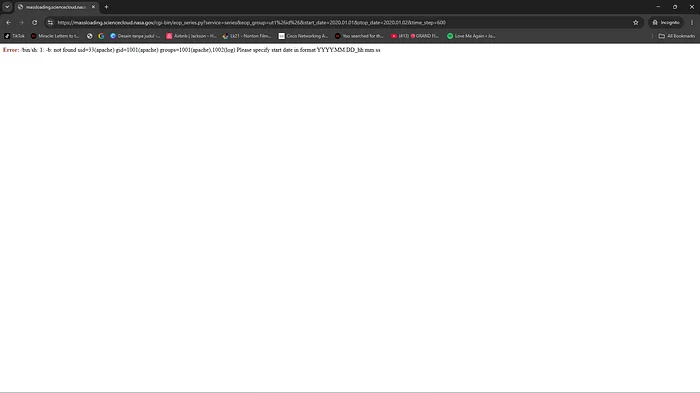
The screenshot is captioned as the proof of concept and sits directly after the description of the unauthenticated access and the server user's privileges.
Root cause
The mistake is in how the script builds its command. User input from the URL parameter is concatenated into an operating system command without proper sanitisation. The only transformation applied is lowercasing, which does nothing to neutralise shell metacharacters.
The existing defence was a character filter, and it was incomplete: it blocked ; but not &. In a Linux shell & acts as a command separator, so the filter gave a false sense of protection while leaving the injection path open. The report does not show the filter's code, so the exact implementation is not described; the behaviour above is what the author observed.
Impact
The flaw is unauthenticated: an attacker does not need to supply a password to reach it. Once the injected command runs, the attacker has the privileges of the server user, here apache, and can read, write or modify data inside the hosting system. The author describes this as full control over that user's privileges.
Fix
The author lists three mitigations, and the timeline records that the vulnerability was patched and the status changed to Resolved on 1 September 2026.
- Avoid direct concatenation. Never join user input directly into a system command. Call functions with separate arguments so the system does not misread special characters such as
&as an extra command. - Apply strict validation (allowlist). Ensure user input matches an allowed format, for example only certain letters and digits, and reject anything outside that set.
- Audit regularly. Review the code of other scripts thoroughly so a similar flaw does not reappear in other parts of the service.
Timeline
| Date | Event |
|---|---|
| 7 August 2026 | Report submitted in full with PoC to Bugcrowd |
| 7 August 2026 | Report validated and set to Triaged by Bugcrowd (lmz_bugcrowd) |
| 11 August 2026 | Ticket accepted by the NASA security team (Joel_NASA) with status Unresolved |
| 1 September 2026 | Vulnerability patched, status changed to Resolved, publication permission approved on CrowdStream together with Martin_NASA |
As recognition, the author received an official Letter of Recognition (LoR) from the NASA VDP in the name of Adiel Radithya Putra Irwana.
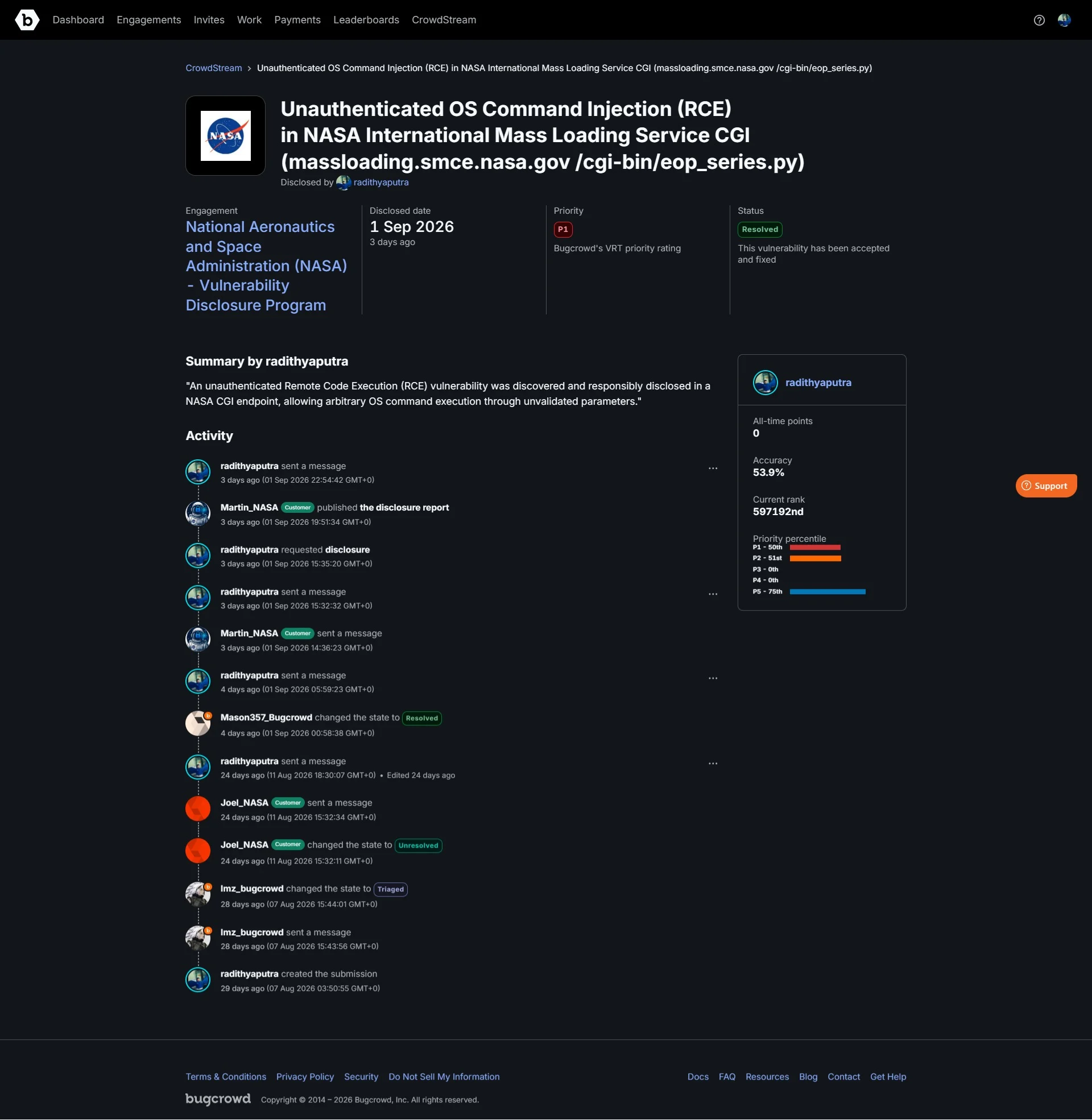
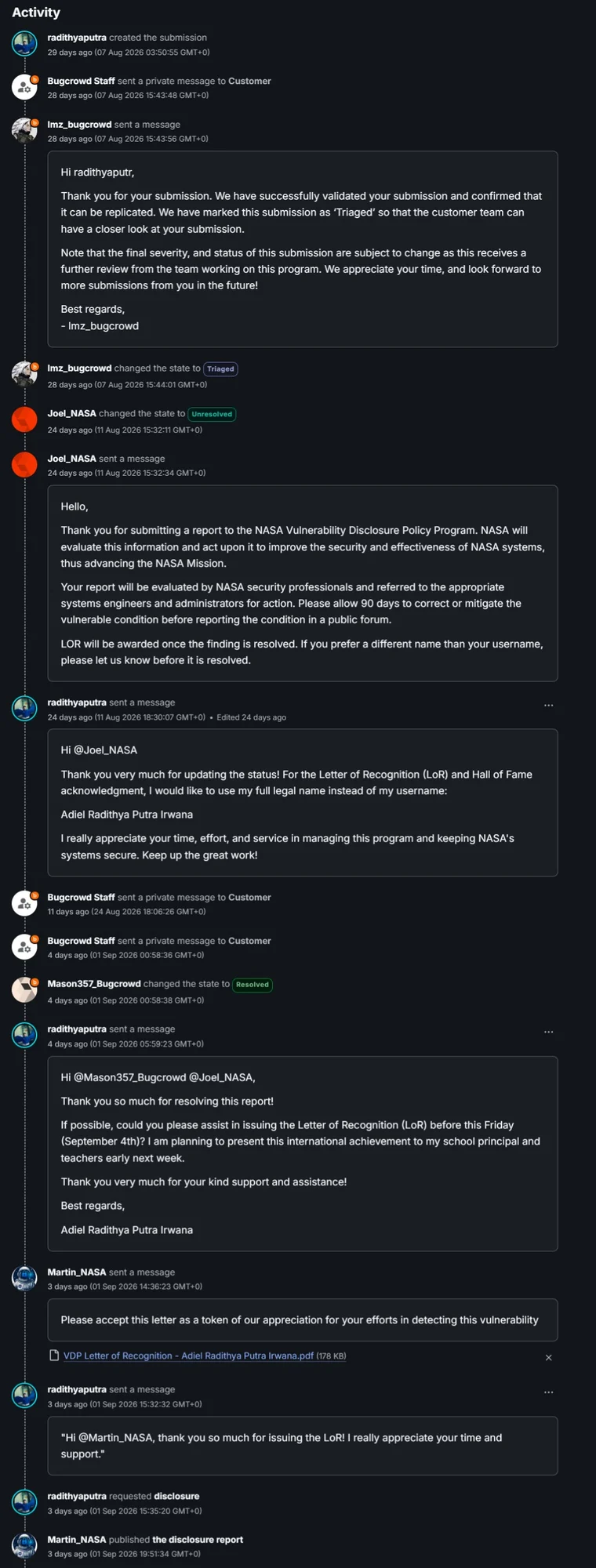
The second screenshot is captioned as further evidence from CrowdStream Bugcrowd.
Variants to test
These are concrete directions suggested by the pattern above, for use on other targets with authorisation.
- Other shell separators and operators. Try
|,||,&&, newline (%0A), backticks and$()where a filter blocks only some of them. A positive result is command output appearing in the response, as withuid=33(apache)here. - Filter bypass by encoding. If a character is blocked literally, try its URL-encoded, double-encoded or mixed-case form. A positive result is the same command executing despite the filter.
- Case handling as a clue. Where input is lowercased, check whether the lowercasing is the only transformation; if so, metacharacters and command names in lowercase still pass. A positive result is execution of a lowercase command such as
id. - Other CGI scripts in the same directory. Enumerate sibling scripts under
/cgi-bin/and test the same parameter pattern. A positive result is any script that reflects command output. - Parameter fuzzing. Test every parameter the script accepts, not only the one found, for the same concatenation behaviour. A positive result is a parameter whose value reaches the shell.
- Privilege check. Run
idand similar read-only commands to record the effective user. A positive result tells you the blast radius, asapachedid here.
What happened, in plain words
A student found a way to make a NASA web server run commands of his choosing, without logging in anywhere. The server ran a small script that was supposed to take a value from a web link and use it in a system command. The script checked the value badly: it blocked one dangerous character but let another one through, and that second character tells a Linux machine "run this as a separate command". By putting that character and a simple command into the link, the student got the server to run the command and show the result. The output showed the command ran as the server's own user, apache, which means whoever exploits this can read, write or change data on that hosting system. NASA's team fixed it and allowed the write-up to be published.
This article walks through the same story for someone who has never done security testing. You only need to know how to use a browser and a computer. Every term is explained the first time it appears, and every piece of code is copied exactly as it appeared in the report.
Background: who, what and why
The author is Adiel Radithya Putra Irwana, a student at SMKN 1 Kota Bengkulu, class 12 TJKT 1 (Teknik Jaringan Komputer dan Telekomunikasi). He describes himself as a tech enthusiast and a learner, and says he wrote the article to share knowledge and to document a technical portfolio.
The finding came from NASA's Vulnerability Disclosure Program (VDP). A VDP is a scheme where an organisation says: if you find a security problem in our systems, tell us in a responsible way instead of using it or selling it. It is close to a bug bounty, except a bounty usually pays money and a VDP may only offer recognition. NASA runs its VDP through a platform called Bugcrowd, which is a website where researchers submit reports and organisations triage them.
The report was disclosed as a coordinated disclosure. That means the organisation and the researcher agreed on when the details could become public, usually after the problem is fixed. The author notes that there had been some discussion about whether the finding was valid, and that he chose to answer it by publishing the technical data and the official evidence.
The vulnerability class is unauthenticated OS command injection, also called remote code execution (RCE). Break that down:
- OS command injection: the application takes something a user typed and puts it into a command for the operating system (the software that runs the machine, such as Linux). If the user can sneak extra command text in, the operating system runs it too. A everyday comparison: a form asks for your name and prints "Hello, NAME" on a label printer. If you write
Annaand then a special instruction that means "also print the company's salary list", and the printer obeys, that is injection. - Remote code execution: the attacker can make the server run code or commands from a distance, over the network, rather than needing to sit at the machine.
- Unauthenticated: no login, password or session is needed. Anyone who can reach the page can try it.
The affected component is a script at the endpoint /cgi-bin/eop_series.py. An endpoint is simply a specific address on a server that does something when you request it, like a particular counter in a large building. The author describes the script as part of NASA's International Mass Loading Service. In normal use the script is a bridge behind the scenes: it takes data supplied by the user through a website link and passes it to the server so the server runs a command. Because the script sits directly against the operating system, the author treated it as a likely place for a flaw. That reasoning is worth copying: the closer a piece of software is to the operating system, the more damage a mistake in it can do.
Setup
The write-up does not describe any accounts, roles, tooling or software versions. The only precondition it makes explicit is that the vulnerable script is reachable on the public service under the nasa.gov ecosystem, and that the researcher could send requests to it with a URL parameter. No authentication was needed at any point, which is central to the finding.
In plain terms: you did not need to register, log in or hold any special permission. You needed a browser (or any tool that can send a web request) and the address of the script. That is why the missing login matters so much: the barrier that normally keeps strangers out was simply not there for this path.
Finding it
During reconnaissance the author mapped NASA's digital assets and picked the public service under https://nasa.gov as the scope of interest. Reconnaissance means looking around before attacking anything: finding out which servers, pages and scripts exist, what they do, and which ones look worth a closer look. It is like walking around a building and noting which doors are open before trying any of them.
Scope is the list of systems an organisation has authorised researchers to test. Staying inside the scope is what separates a researcher from an intruder.
The observation that mattered was the script endpoint:
[TARGET_DOMAIN]/cgi-bin/eop_series.py
Line by line:
[TARGET_DOMAIN]is a placeholder for the host name of the NASA server. The report does not give the real host, so it stays as a placeholder here too./cgi-bin/is a directory name. CGI stands for Common Gateway Interface, an older but still common way for a web server to hand a request to a separate program and return that program's output. Scripts in acgi-binfolder are programs the web server is allowed to execute, which is exactly why they are interesting to a tester.eop_series.pyis the script itself. The.pyending tells you it is written in Python, a popular programming language.
The script accepts user input through a URL parameter, given in the report as eop_group. A URL parameter is the part of a web address after a question mark, made of name and value pairs, for example ?name=value. Websites use them to pass choices around: search terms, page numbers, filters. Here the script reads the value of eop_group and combines that input into an operating system command.
Two weaknesses stood out:
- The application reads the user's data and only lowercases it, without checking whether the characters supplied are safe or dangerous. Lowercasing means turning capital letters into small ones (
ABCbecomesabc). It changes how text looks, not what it means to a shell, so it is not a security check at all. - A protection exists that blocks dangerous characters such as the semicolon (
;), but that protection wrongly lets the ampersand (&) through. In a Linux shell,&separates commands.
A shell is the program on a Linux machine that reads a line of text and runs the commands in it. It has its own grammar, and some characters are punctuation in that grammar rather than ordinary text. The semicolon means "and then run the next command". The ampersand also separates commands, and additionally can send the first one to run in the background. So if a script builds a command line by gluing text together, and the user's text contains ; or &, the shell may see two commands where the programmer intended one.
Because & survives, the server treats the combined string as two separate instructions and runs the injected extra command as-is. The filter gave a false sense of protection: it stopped the most obvious separator and left a working one open.
Exploitation
Exploitation here means proving the flaw with the smallest, safest action that shows it is real. The author tested this way to prove the flaw without damaging the system.
Step 1: Confirm the semicolon is blocked
The author first tried to inject a command using a semicolon, URL-encoded as %3B. The system rejected and blocked it. This established that a filter was present and that the obvious separator would not work.
Why URL-encode? Web addresses can only carry a limited set of characters safely. URL encoding (also called percent encoding) replaces a character with a percent sign and two hexadecimal digits, so the browser and server can carry it without confusion. %3B is the encoded form of ;. The tester encodes on purpose because the raw character might be altered or rejected by the browser before it ever reaches the server.
Why try the semicolon first? Because it is the best-known command separator, so it is the natural first guess. Getting a block is useful information: it tells you a filter exists and roughly what it looks for. A rejection is not a dead end, it is a clue.
Step 2: Use the ampersand instead
Since the ampersand, URL-encoded as %26, was allowed, the author used it to append a basic system command, id, through the web link. The report does not reproduce the full request URL, only the encoded separator and the command used.
%26 is the encoded form of &. The command id is a standard Linux command that prints who the current user is, with a numeric user ID and the user name. It is the classic first command to run after an injection, because it answers the question "what am I allowed to do here?" without changing anything.
So the idea is: the script builds something like some-command <value of eop_group>. If the value contains & id, the shell reads it as some-command followed by a second command, id, and runs both.
Step 3: Read the response
The server's response contained text such as:
uid=33(apache)
Line by line:
uid=33is the numeric user ID of the account the command ran as. On many Linux systems, user ID 33 is a common choice for the web server account.(apache)is the name attached to that ID. So the command did not run as an administrator; it ran as the account the web server itself uses.
That output shows the appended command ran on the server, under the privileges of the apache user. Seeing your own command's output come back in the page is the proof: the text could only be there if the server executed it. The proof of concept was performed this way, with a simple command, to demonstrate the vulnerability without damaging the system.
The screenshot is captioned as the proof of concept and sits directly after the description of the unauthenticated access and the server user's privileges.
Root cause
The mistake is in how the script builds its command. User input from the URL parameter is concatenated into an operating system command without proper sanitisation. Concatenation means joining pieces of text end to end, like gluing words into a sentence. Sanitisation means cleaning or checking input so that it cannot change the meaning of the command it is placed into.
The only transformation applied is lowercasing, which does nothing to neutralise shell metacharacters. A metacharacter is a character that has a special meaning to a program rather than being plain text, such as ;, &, | or $ in a shell.
The existing defence was a character filter, and it was incomplete: it blocked ; but not &. In a Linux shell & acts as a command separator, so the filter gave a false sense of protection while leaving the injection path open.
A useful mental model: a filter that lists bad characters is like a door guard with a list of known troublemakers. Anyone not on the list walks in. A filter that lists allowed characters (an allowlist) is like a guard who only admits people on the guest list. The second approach fails safe; the first fails open.
Impact
The flaw is unauthenticated: an attacker does not need to supply a password to reach it. Once the injected command runs, the attacker has the privileges of the server user, here apache, and can read, write or modify data inside the hosting system. The author describes this as full control over that user's privileges.
Privileges are the permissions an account has: which files it may read, which it may change, which programs it may run. The web server account is often limited, so that a compromise of the website does not hand over the whole machine. That limit is what keeps this finding serious but bounded: serious because reading, writing and modifying the site's data is already a lot, bounded because the report does not claim control beyond that account.
Fix
The author lists three mitigations, and the timeline records that the vulnerability was patched and the status changed to Resolved on 1 September 2026.
- Avoid direct concatenation. Never join user input directly into a system command. Call functions with separate arguments so the system does not misread special characters such as
&as an extra command. In practice, many languages let you pass a command as a list of separate pieces, so the shell never re-parses the user's text as grammar. - Apply strict validation (allowlist). Ensure user input matches an allowed format, for example only certain letters and digits, and reject anything outside that set. If the parameter is only ever supposed to contain a short code, then anything that is not a short code should be refused before it reaches the command.
- Audit regularly. Review the code of other scripts thoroughly so a similar flaw does not reappear in other parts of the service. An audit is a systematic review, here of source code, looking for the same pattern elsewhere.
Timeline
| Date | Event |
|---|---|
| 7 August 2026 | Report submitted in full with PoC to Bugcrowd |
| 7 August 2026 | Report validated and set to Triaged by Bugcrowd (lmz_bugcrowd) |
| 11 August 2026 | Ticket accepted by the NASA security team (Joel_NASA) with status Unresolved |
| 1 September 2026 | Vulnerability patched, status changed to Resolved, publication permission approved on CrowdStream together with Martin_NASA |
A few of those words are worth knowing. PoC stands for proof of concept: the evidence that the flaw is real, here the request and the returned output. Triaged means the platform has checked the report and accepted it as valid and worth passing on. Unresolved means the fix is not done yet. Resolved means it is. CrowdStream is the part of the Bugcrowd platform where disclosure and publication are handled.
As recognition, the author received an official Letter of Recognition (LoR) from the NASA VDP in the name of Adiel Radithya Putra Irwana. A Letter of Recognition is a document confirming that a researcher reported a valid issue; it is not a payment, but it is evidence of the work.
The second screenshot is captioned as further evidence from CrowdStream Bugcrowd.
Variants to test
These are concrete directions suggested by the pattern above, for use on other targets with authorisation. Authorisation means you have permission, for example because the target is in a VDP or bounty scope. Testing systems you do not have permission to test is not research, it is unauthorised access.
- Other shell separators and operators. Try
|,||,&&, newline (%0A), backticks and$()where a filter blocks only some of them. A positive result is command output appearing in the response, as withuid=33(apache)here. The lesson from this report is that a filter which blocks one separator may miss its neighbours. - Filter bypass by encoding. If a character is blocked literally, try its URL-encoded, double-encoded or mixed-case form. A positive result is the same command executing despite the filter. The filter may check the text before decoding, while the shell sees it after decoding.
- Case handling as a clue. Where input is lowercased, check whether the lowercasing is the only transformation; if so, metacharacters and command names in lowercase still pass. A positive result is execution of a lowercase command such as
id. Lowercasing is a formatting step, not a safety step, and noticing it tells you the developer was not really validating. - Other CGI scripts in the same directory. Enumerate sibling scripts under
/cgi-bin/and test the same parameter pattern. A positive result is any script that reflects command output. Scripts written by the same team at the same time often share the same habit. - Parameter fuzzing. Test every parameter the script accepts, not only the one found, for the same concatenation behaviour. A positive result is a parameter whose value reaches the shell. Fuzzing means trying many inputs systematically instead of guessing one at a time.
- Privilege check. Run
idand similar read-only commands to record the effective user. A positive result tells you the blast radius, asapachedid here. Blast radius is how much damage a single compromise can cause.
Glossary
- Allowlist: a list of what is permitted; anything not on the list is rejected.
- Audit: a systematic review, here of source code, looking for flaws.
- Authentication: proving who you are, usually with a password or a session. Unauthenticated means no such proof is required.
- Authorisation: permission to test or access a system. Not the same as authentication.
- Blast radius: the extent of what an attacker can reach or damage once a flaw is exploited.
- Bug bounty: a programme that pays researchers for valid security findings.
- Bugcrowd: a platform where researchers submit vulnerability reports and organisations handle them.
- CGI (Common Gateway Interface): a way for a web server to run a separate program and return its output.
- Concatenation: joining pieces of text end to end.
- Coordinated disclosure: an agreement between researcher and organisation about when details of a flaw may be published, usually after a fix.
- CrowdStream: the Bugcrowd platform area where disclosure and publication are handled.
- Endpoint: a specific address on a server that performs an action when requested.
- Exploitation: using a flaw to demonstrate its effect, ideally with the least harmful action that proves it.
- Filter: code that blocks or allows input based on rules; a bad-character filter blocks known bad characters, an allowlist admits only known good ones.
- Fuzzing: trying many inputs systematically to find one that behaves unexpectedly.
- Letter of Recognition (LoR): a document from a programme confirming a valid report; recognition rather than payment.
- Lowercasing: converting capital letters to small ones; a formatting step, not a security check.
- Metacharacter: a character with special meaning to a program, such as
;,&,|or$in a shell. - OS command injection: making an application run extra operating system commands through input it fails to check.
- PoC (proof of concept): the evidence, such as a request and its output, that a flaw is real.
- Privileges: the permissions an account has over files, programs and data.
- Python: a popular programming language; the affected script is written in it.
- Reconnaissance: gathering information about a target before testing it.
- Remote code execution (RCE): making a remote server run code or commands of the attacker's choosing.
- Resolved / Unresolved: fixed / not yet fixed.
- Sanitisation: cleaning or checking input so it cannot change the meaning of the command it is placed into.
- Scope: the list of systems an organisation has authorised researchers to test.
- Shell: the Linux program that reads a line of text and runs the commands in it, with its own punctuation rules.
- Triaged: checked and accepted as valid by the platform.
- URL encoding (percent encoding): writing a character as a percent sign plus two hexadecimal digits, such as
%3Bfor;and%26for&. - URL parameter: a name and value pair in a web address after the question mark, used to pass data to a page or script.
- VDP (Vulnerability Disclosure Program): a scheme for reporting security problems responsibly, which may offer recognition rather than payment.



