**Check Point Scalable Platforms Privilege Escalation and Arbitrary File Write by an Authenticated Administrator**
The cluster synchronisation services on Check Point Maestro and ElasticXL gateways accept commands and file copies over an unauthenticated, unencrypted TCP protocol on the Sync interface. An attacker with Access Policy and NAT write privileges, or access to the Sync network, could execute OS commands as root and write arbitrary files on the gateway.
 Published on medium.com
Cybersecurity
The full write-up lives on its author's site
It belongs to its author, so we link to it rather than copy it. The other two tabs are our own rewrites, checked against it.
Context
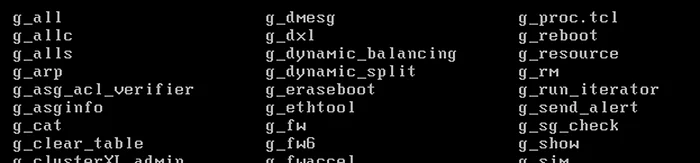
Check Point's Scalable Platforms cover two related cluster products: Maestro, where security gateway instances (SGMs) are managed by an orchestrator, and ElasticXL, introduced with R82 as a lighter cluster that needs no orchestrator, is limited to 3 members per Site and can be deployed on a virtual machine. Both rely on a set of global commands (g_fw, g_tcpdump, g_all and so on) that let an operator run a command across cluster members at once.
The researcher's interest was in how those global commands reach the members. They do not go over SSH, and they do not use cprid with SIC protection. Instead, commands travel directly between nodes over the cluster synchronization (Sync) interface, on TCP port 1130, inside the [redacted]/24 network, with no authentication and no encryption.
The affected scope, as stated in the report, is Check Point R82 security gateways with ElasticXL enabled and Maestro SGMs of all versions. The attacker model is an administrator holding Access Policy / NAT write privileges, or anyone with access to the isolated network used for cluster synchronization. Either position leads to privilege escalation, OS command execution and arbitrary file write with superuser rights.
Setup
The researcher first met Maestro several years before the write-up and noticed the global command mechanism then. No Maestro instance was available to test the idea at the time, so it was shelved. The arrival of ElasticXL in R82, deployable as a VM, made testing practical.
In R82 some commands moved from expert mode into the gClish shell, and the cluster operation logic and the member-joining process changed. The synchronization network ([redacted]/24) on the Sync interface stayed, and so did the global commands.
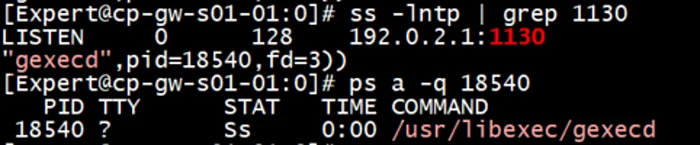
On the gateway, port 1130 is listened on by the gexecd daemon at /usr/libexec/gexecd, bound to 192.0.2.* on the Sync interface.
The matching client utility is /usr/bin/gexec, which is what the global commands use, one way or another, to send their commands.
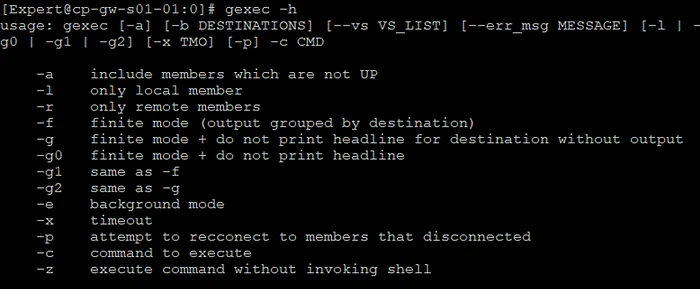
A small example of running it is shown in the report:

Finding it
The observation that started everything is that a mechanism for executing commands on cluster members used neither SSH nor SIC-protected cprid. A traffic capture showed why that mattered: the commands are plaintext and unauthenticated on the wire.
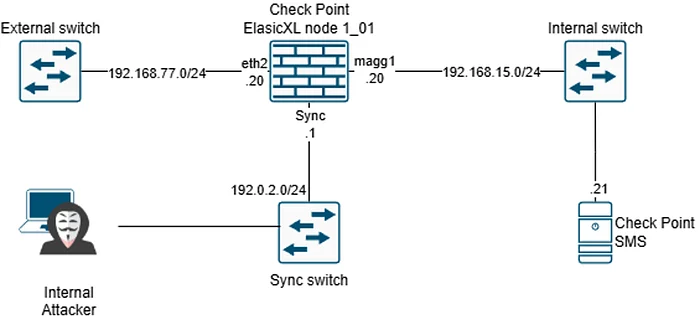
The obvious objection is that the Sync network is isolated and every node connects directly to the orchestrator, so why call it a vulnerability? The report accepts the point and then looks for the catch. On Maestro the synchronization network is isolated and wired to the orchestrator, with an open question about the dual site synchronization network that the researcher could not verify. On ElasticXL, connecting to that network between VMs is very straightforward.
Exploitation
Step 1: reach the Sync network
The service only listens on the Sync interface, so the first requirement is connectivity to that network. Between VMs this is very straightforward.
Step 2: send a command with netcat
Because the protocol is unencrypted and very simple, a single command line is enough to have a command executed and to read the result back:
echo -en ‘\xf0\x0c\x00\x00\x00<ver>2</ver>\x0a\x00\x00\x00<vs>1</vs>\x2b\x00\x00\x00<req><mode>finite</mode><cmd>id</cmd></req>’ | nc [redacted] 1130 | grep -oaP ‘</vs><outp>\K(.*)’

At this point the practical consequence is stated plainly: anyone other than the operator who has access to the ElasticXL cluster synchronization network, which is hopefully on a separate VLAN, can potentially gain privileged access to the security gateways.
Step 3: from the inside, through the gateway
For Maestro the report notes that the synchronization network is isolated and connected directly to the orchestrator. For ElasticXL, since the service is standard TCP, in purely theoretical terms any host on the inside could connect to it, provided the traffic passes through the gateway. That would require the administrator to have allowed everything for everyone, which is unlikely but not impossible.
Step 4: bypassing the Sync interface block with NAT
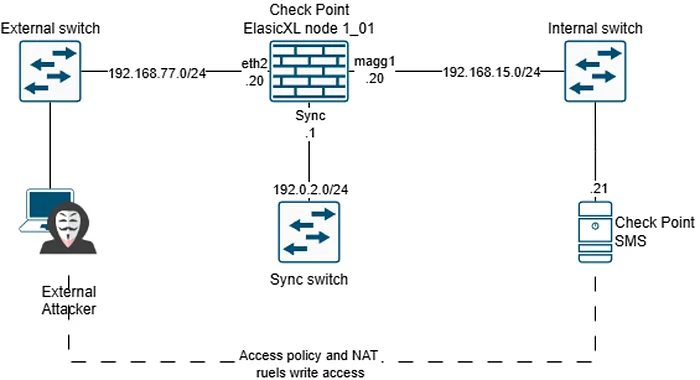
Check Point implemented a safeguard for this: access to the Sync interface is blocked at the Firewall VM kernel level, and packets are dropped with the reason 'Packet Source or Destination is Sync'. The researcher reasoned that Access policies are applied before NAT, so a NAT rule might redirect traffic to the Sync address after the access decision had already been made.
Access Log:
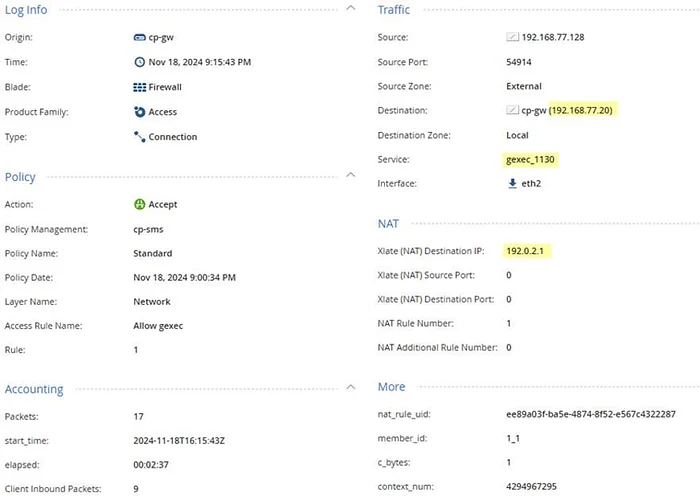
The log shows an 'Accept' event: a connection is accepted on an external IP and then forwarded to the address of the Sync interface. The conclusion is that an administrator with access to Access Policy and NAT settings, not necessarily a SuperUser, could create a backdoor to execute commands on the gateway with the privileges of the admin (root) user. The source or destination addresses do not matter, as long as they are not part of the Sync network; what matters is that the traffic passes through the gateway and the NAT rule triggers correctly.
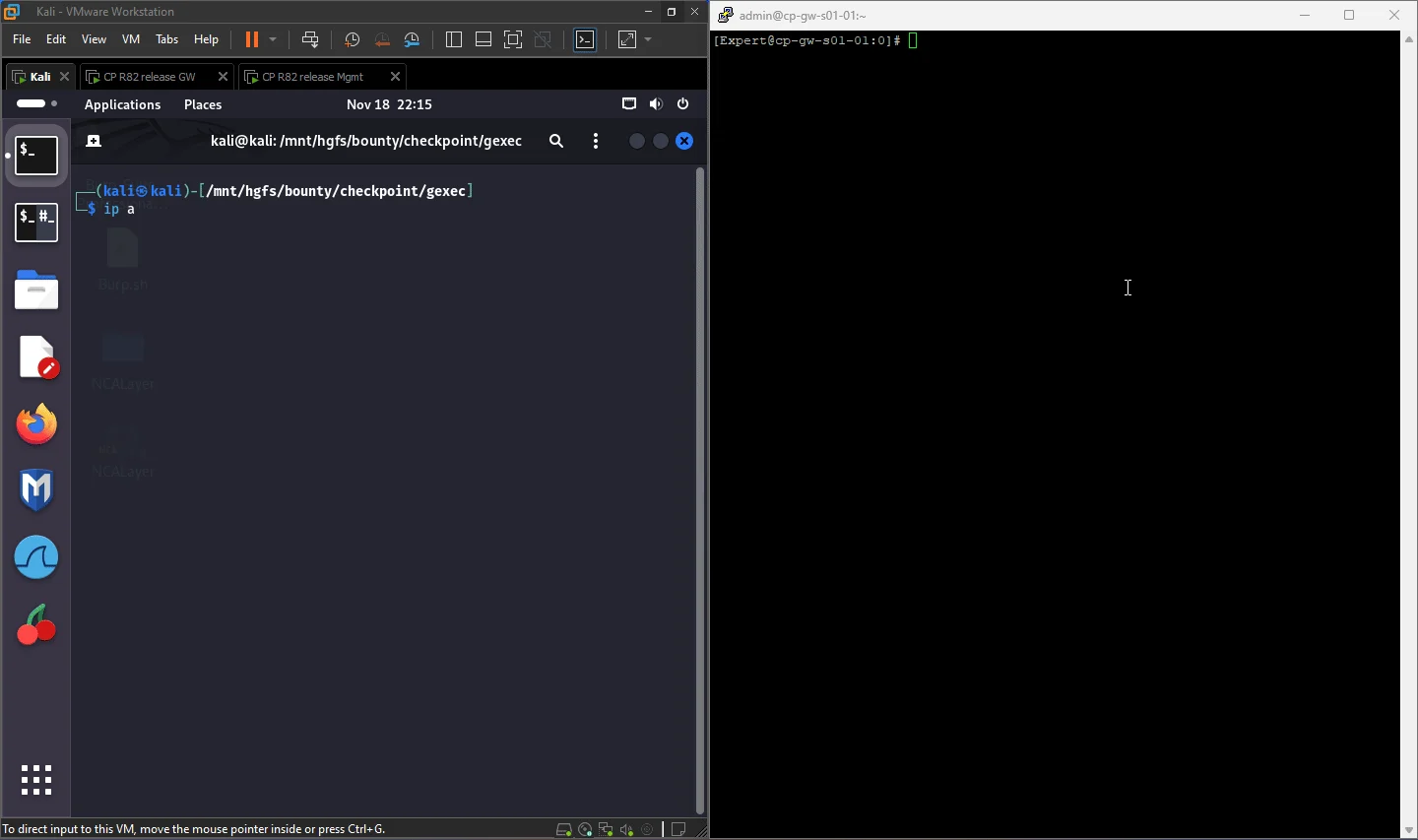
A Python script was written as a PoC for this scenario.
Step 5: arbitrary file write with gcopyd
A second service sits alongside gexec: gcopyd, which copies files between cluster nodes and runs on port 1132. It is used by the asg_cp2blades command, and the report states that its issues and the logic behind its operation are exactly the same as those of gexecd.

Daemon: /usr/libexec/gcopyd

Client: /usr/bin/gcopy
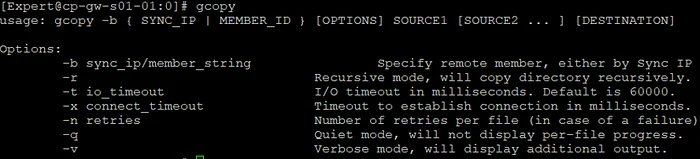
gcopy PoC:
A rough diagram of the flow:
Step 6: the rules that make it work
The access rule used for gexec and gcopy:

The NAT rule used for gexec and gcopy:

Root cause
gexecd on port 1130 and gcopyd on port 1132 accept commands and file transfers from anything that can reach them, with no authentication and no encryption, so anyone who can reach them can potentially gain privileged access to the gateway. The kernel-level block on the Sync interface is a network-position control, and because access policy is evaluated before NAT, a NAT rule can rewrite traffic towards the Sync address after the access decision has been made.
Impact
An attacker in either of the two positions named in the report, an administrator with Access Policy / NAT write privileges, or someone with access to the cluster synchronization network, can escalate privileges and execute OS commands and write arbitrary files with superuser rights on the gateway. On ElasticXL the second position is realistic because the Sync network is reachable from the VMs; on Maestro the report treats it as isolated and connected to the orchestrator, with the dual site synchronization network left as an open question. The NAT path additionally lets a policy administrator who is not a SuperUser create a backdoor to root on the gateway.
Fix
For the NAT scenario, the fix is available starting with releases R82.10 and R82.20; for R81.20 and R82 the latest JHFs must be installed. The firewall kernel now blocks access to the Sync interface even when NAT is involved (sk1000364).

For direct connection to the synchronization interface on ElasticXL, Check Point added MACsec data encryption in R82.20, which must be explicitly enabled in the configuration. The researcher suspects this adds overhead during cluster synchronization, and observes that the long fix time makes sense: the NAT deception is not hard to resolve, while implementing MACsec is significantly more complex and such changes are generally not included in a Jumbo Hotfix.

When capturing traffic, only the MACsec encrypted payload is visible:

A new interface, SecureSync, is visible:

MACsec settings can be inspected with standard Linux commands:

Variants to test
- Other global command daemons. The report names
gexecdon 1130 andgcopydon 1132 as sharing the same design. Enumerate other cluster-internal daemons on the Sync network and send a minimal length-prefixed request to each; a positive result is a response containing command output or a file transfer completing without any credential being presented. - NAT redirection to internal listeners. Take any service that is protected only by a kernel-level source or destination check, and add a NAT rule that rewrites traffic to it after the access decision. A positive result is an 'Accept' entry in the access log for traffic that the kernel check was meant to drop.
- Dual site synchronization networks. The report flags the Maestro dual site synchronization network as unverified. Test whether the two sites' Sync networks can reach each other's port 1130; a positive result is a command executed on a member of the other site.
- MACsec left disabled. Since SecureSync must be explicitly enabled in R82.20, check whether a deployment has it off. A positive result is a capture of the Sync traffic showing readable XML rather than an encrypted payload.
Timeline
| Date | Event |
|---|---|
| 25-11-2024 | Initial contact |
| 28-11-2024 | Confirmation of vulnerability and patch plans from vendor |
| 25-02-2025 | Patch status request (90 days since initial report) |
| 21-04-2025 | One more try |
| 19-08-2025 | CVE escalation for CNA issue |
| 07-10-2026 | Disclosure coordination with vendor |
| 16-11-2026 | Disclosure |
The report notes that the g_all set of commands can be traced back to R76.10SP in the upgrade manual for 60000/40000 series appliances, released in Q4 2014, so the vulnerability has likely existed in the Scalable Platform for about 12 years. CVE-2026-120490 was assigned by Check Point CNA.
What happened, in plain words
Check Point makes firewalls: boxes (or virtual machines) that sit between a network and the internet and decide which traffic is allowed through. Some of their products are sold as clusters, groups of machines that work together so that if one fails the others keep going. Two of these cluster products are called Maestro and ElasticXL.
To run a cluster, the machines have to talk to each other constantly. One of the things they do is run the same command on every member at once, for example "show me the firewall status" or "start a packet capture". These are called global commands.
The researcher looked at how those global commands travel between the machines and found something surprising: they are sent as plain, unauthenticated text over a private network that links the cluster members. There is no password, no encryption, nothing that proves who sent the command. Anyone who can reach that private network can potentially run commands on the firewall with the privileges of the admin (root) user, and write to arbitrary files.
The report also shows a second route: an administrator who is allowed to edit firewall rules (but is not a superuser) can use a clever rule to reach that private network from outside, turning a limited account into full control of the machine.
Check Point addressed both routes. The report gives the versions, the fix identifiers and a timeline.
The products and the commands
Before the details, a few words on what is involved.
- Security gateway: the machine that inspects and filters network traffic. Think of it as a security guard at a door who checks everyone's badge.
- Cluster: several gateways configured to act as one, so that the service survives a failure. Think of two guards at the same door, one backing up the other.
- Maestro: a Check Point cluster product where a separate management machine, the orchestrator, coordinates the gateway instances (called SGMs, for Security Gateway Modules).
- ElasticXL: a lighter cluster product introduced with the R82 release. It needs no orchestrator, is limited to 3 members per Site, and, importantly for the researcher, can be deployed on a virtual machine (a computer simulated in software).
- Global commands: commands such as
g_fw,g_tcpdumpandg_allthat an operator runs once and that are carried out on every cluster member. Think of a manager shouting an instruction to the whole team at once.
The researcher's question was simple: how does that instruction actually reach each team member?
Discovery
The researcher first met Maestro several years before writing this up and noticed the global command mechanism then. The commands did not travel over SSH (the usual encrypted remote-login protocol) and did not use cprid with SIC protection (another Check Point mechanism for protected communication between components). That was odd enough to be interesting.
A traffic capture, a recording of the network conversation between machines, showed what was really happening: commands are transmitted directly between nodes via the synchronization (Sync) interface, using TCP port 1130 within the [redacted]/24 network without any authentication or encryption.
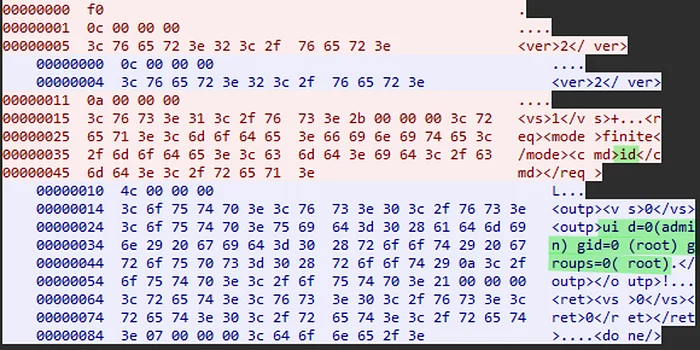
A few terms in that sentence need unpacking:
- Sync interface: a dedicated network connection used only for the cluster members to keep in step with each other. Think of a private corridor between offices that only staff use.
- TCP port: a numbered door on a machine. A computer can run many services at once, and each listens on its own number. Port 1130 is simply the door this particular service uses.
- [redacted]/24: a range of network addresses. The
/24means the first three numbers identify the network and the last one identifies the machine, so addresses run from [redacted] to 192.0.2.255. - No authentication: the service does not ask who you are. Anyone who can knock on the door is let in.
- No encryption: the conversation is readable by anyone who can watch the network, like a postcard rather than a sealed letter.
The obvious objection is: it is an isolated network, and all nodes connect directly to the orchestrator, so why call this a vulnerability? The report accepts the point and then looks for the catch. On Maestro the synchronization network is isolated and wired to the orchestrator, with an open question about the dual site synchronization network that the researcher could not verify. On ElasticXL the network is reachable from the virtual machines, which is enough to test.
No Maestro instance was available at the time, so the idea was shelved until a better moment.
ElasticXL
With the release of R82, a cheaper version of Maestro arrived, giving the researcher the chance to explore it. ElasticXL makes it possible to build a cluster similar to Maestro without an orchestrator, limited to 3 members per Site, and, most importantly, it can be deployed on a virtual machine.
In R82, some commands from expert mode have been migrated to the gClish shell (a command-line interface on the appliance). The cluster operation logic and the process for adding members to ElasticXL have changed; however, the synchronization network ([redacted]/24) on the Sync interface remains in place, as do the global commands.
Port 1130 is listened by the gexecd daemon (/usr/libexec/gexecd) at address 192.0.2.* on the Sync interface.
A daemon is a program that runs in the background and waits for requests, like a receptionist sitting by a phone. gexecd is the receptionist for global commands. The path /usr/libexec/gexecd is simply where the program file lives on disk, and 192.0.2.* means it answers on any address in that range.
There is a client utility, /usr/bin/gexec, used for sending commands. Global commands all make use of it in one way or another.
A client utility is the small program that talks to the daemon, the way a phone app talks to a call centre. Here is a small example of how to run it:
Exploitation
Step 1: reach the Sync network
Since the service listens on a port only via the Sync interface, you need to connect to that network. Fortunately, doing so between VMs is very straightforward.
Why this step matters: a service that only answers on a private corridor is safe only as long as nobody can walk into the corridor.
Step 2: send a command with netcat
Since the service operates without encryption and the protocol itself is very simple, a one-liner like this will send a command for execution and output the result:
echo -en ‘\xf0\x0c\x00\x00\x00<ver>2</ver>\x0a\x00\x00\x00<vs>1</vs>\x2b\x00\x00\x00<req><mode>finite</mode><cmd>id</cmd></req>’ | nc [redacted] 1130 | grep -oaP ‘</vs><outp>\K(.*)’
Line by line, in plain words:
echo -enprints the text that follows without adding a newline at the end. The-elets it interpret escape sequences such as\xf0.- The quoted string is the message to send. It is a mix of raw bytes and readable XML (a text format that uses tags like
<ver>and</ver>to label pieces of data). The protocol expects each piece to be announced before it arrives, like saying "a parcel of this size is coming" before handing it over.
The id command is a harmless standard Linux command that prints which user you are running as, which makes it a perfect test: if the answer says root, the service runs your command as the most powerful user.
7. The | symbol takes the output of one command and feeds it to the next, like passing a note along a chain.
8. nc [redacted] 1130 is netcat, a simple tool that opens a network connection. It connects to address [redacted] on port 1130 and sends the message.
The \K means "forget everything matched so far and show only what follows".
So the whole line builds a message, sends it to the unauthenticated service, and extracts the answer. No password is sent because none is asked for.
At this point the practical consequence is stated plainly: anyone other than the operator who has access to the ElasticXL cluster synchronization network, which is hopefully on a separate VLAN, can potentially gain privileged access to the security gateways. A VLAN is a way of splitting one physical network into separate logical ones, so that traffic in one cannot see traffic in another, like separate floors in a building.
Step 3: from the inside, through the gateway
For Maestro the report notes that the synchronization network is isolated and connected directly to the orchestrator. For ElasticXL, since the service is standard TCP, in purely theoretical terms any host on the inside could connect to it, provided the traffic passes through the gateway. That would require the administrator to have allowed everything for everyone, which is unlikely but not impossible.
Step 4: bypassing the Sync interface block with NAT
Check Point implemented a safeguard for this: access to the Sync interface is blocked at the Firewall VM kernel level, and packets are dropped with the reason 'Packet Source or Destination is Sync'.
Two concepts here:
- Kernel level: the block happens deep inside the operating system, before any normal program sees the traffic. Think of a building's main door lock rather than a sign on an office door.
- NAT (Network Address Translation): a technique where a firewall rewrites the addresses in a packet as it passes through, for example changing a public address into a private one. Think of a mail room that relabels envelopes before forwarding them.
The researcher reasoned that Access policies are applied before NAT, so a NAT rule might redirect traffic to the Sync address after the access decision had already been made. In other words, the guard checks your badge at the front desk, says yes, and only afterwards does the mail room relabel your envelope to a restricted floor.
Access Log:
The log shows an 'Accept' event: a connection is accepted on an external IP and then forwarded to the address of the Sync interface. The conclusion is that an administrator with access to Access Policy and NAT settings, not necessarily a SuperUser, could create a backdoor to execute commands on the gateway with the privileges of the admin (root) user. A backdoor here means a rule that quietly opens a path in, and root is the all-powerful account on a Linux system.
The source or destination addresses do not matter, as long as they are not part of the Sync network; what matters is that the traffic passes through the gateway and the NAT rule triggers correctly.
A Python script was written as a PoC for this scenario. PoC stands for proof of concept: a small program that demonstrates the problem really works.
Step 5: arbitrary file write with gcopyd
A second service sits alongside gexec: gcopyd, which copies files between cluster nodes and runs on port 1132. It is used by the asg_cp2blades command, and the report states that its issues and the logic behind its operation are exactly the same as those of gexecd.
"Arbitrary file write" means writing a file wherever you like on the system, with whatever content you like, as the most powerful user. That is often enough to take full control, because you can replace a program the system will later run.
Daemon: /usr/libexec/gcopyd
Client: /usr/bin/gcopy
gcopy PoC:
A rough diagram of the flow:
Step 6: the rules that make it work
The access rule used for gexec and gcopy:
An access rule is the firewall's instruction about what traffic to allow or block. The NAT rule used for gexec and gcopy:
A NAT rule is the instruction that rewrites addresses. Together, the access rule lets the traffic through and the NAT rule redirects it to the Sync address, which is how the kernel-level block is sidestepped.
Root cause
gexecd on port 1130 and gcopyd on port 1132 accept commands and file transfers from anything that can reach them, with no authentication and no encryption, so anyone who can reach them can potentially gain privileged access to the gateway. The kernel-level block on the Sync interface is a network-position control, and because access policy is evaluated before NAT, a NAT rule can rewrite traffic towards the Sync address after the access decision has been made.
Impact
An attacker in either of the two positions named in the report, an administrator with Access Policy / NAT write privileges, or someone with access to the cluster synchronization network, can escalate privileges and execute OS commands and write arbitrary files with superuser rights on the gateway. Privilege escalation means starting with limited rights and ending with more, here the highest possible.
On ElasticXL the second position is realistic because the Sync network is reachable from the VMs; on Maestro the report treats it as isolated and connected to the orchestrator, with the dual site synchronization network left as an open question. The NAT path additionally lets a policy administrator who is not a SuperUser create a backdoor to root on the gateway.
Fix
For the NAT scenario, the fix is available starting with releases R82.10 and R82.20; for R81.20 and R82 the latest JHFs must be installed. A JHF, or Jumbo Hotfix, is a cumulative package of fixes for a Check Point release. The firewall kernel now blocks access to the Sync interface even when NAT is involved (sk1000364).
For direct connection to the synchronization interface on ElasticXL, Check Point added MACsec data encryption in R82.20, which must be explicitly enabled in the configuration. MACsec is a standard for encrypting traffic on a network link itself, so that anyone tapping the cable sees only scrambled data. The researcher suspects this adds overhead during cluster synchronization, and observes that the long fix time makes sense: the NAT deception is not hard to resolve, while implementing MACsec is significantly more complex and such changes are generally not included as part of a Jumbo Hotfix.
When capturing traffic, only the MACsec encrypted payload is visible:
A new interface, SecureSync, is visible:
MACsec settings can be inspected with standard Linux commands:
Variants to test
- Other global command daemons. The report names
gexecdon 1130 andgcopydon 1132 as sharing the same design. Enumerate other cluster-internal daemons on the Sync network and send a minimal length-prefixed request to each; a positive result is a response containing command output or a file transfer completing without any credential being presented. - NAT redirection to internal listeners. Take any service that is protected only by a kernel-level source or destination check, and add a NAT rule that rewrites traffic to it after the access decision. A positive result is an 'Accept' entry in the access log for traffic that the kernel check was meant to drop.
- Dual site synchronization networks. The report flags the Maestro dual site synchronization network as unverified. Test whether the two sites' Sync networks can reach each other's port 1130; a positive result is a command executed on a member of the other site.
- MACsec left disabled. Since SecureSync must be explicitly enabled in R82.20, check whether a deployment has it off. A positive result is a capture of the Sync traffic showing readable XML rather than an encrypted payload.
Timeline
| Date | Event |
|---|---|
| 25-11-2024 | Initial contact |
| 28-11-2024 | Confirmation of vulnerability and patch plans from vendor |
| 25-02-2025 | Patch status request (90 days since initial report) |
| 21-04-2025 | One more try |
| 19-08-2025 | CVE escalation for CNA issue |
| 07-10-2026 | Disclosure coordination with vendor |
| 16-11-2026 | Disclosure |
A CVE is a public identifier for a known vulnerability, and a CNA is an organisation authorised to assign those identifiers. The report notes that the g_all set of commands can be traced back to R76.10SP in the upgrade manual for 60000/40000 series appliances, released in Q4 2014, so the vulnerability has likely existed in the Scalable Platform for about 12 years. CVE-2026-120490 was assigned by Check Point CNA.
Glossary
- Access policy: the set of firewall rules that decide which traffic is allowed or blocked.
- Arbitrary file write: the ability to create or overwrite any file on a system, with any content.
- Backdoor: a rule or mechanism that quietly opens a way into a system.
- Client utility: a small program that sends requests to a background service.
- Cluster: several machines configured to work as one, so that the service survives a failure.
- CNA: an organisation authorised to assign CVE identifiers.
- CVE: a public identifier for a known vulnerability.
- Daemon: a program that runs in the background and waits for requests.
- ElasticXL: a Check Point cluster product introduced with R82, without an orchestrator, limited to 3 members per Site, deployable on a virtual machine.
- Encryption: scrambling data so that only the intended recipient can read it.
- Global commands: commands such as
g_fw,g_tcpdumpandg_allthat run on every cluster member at once. - JHF (Jumbo Hotfix): a cumulative package of fixes for a Check Point release.
- Kernel level: inside the core of the operating system, before ordinary programs see the traffic.
- MACsec: a standard for encrypting traffic on a network link itself.
- Maestro: a Check Point cluster product where an orchestrator coordinates the gateway instances (SGMs).
- NAT (Network Address Translation): rewriting the addresses in a packet as it passes through a firewall.
- Netcat (
nc): a simple tool that opens a network connection and sends or receives data. - Orchestrator: the management machine that coordinates the members of a Maestro cluster.
- PoC (proof of concept): a small program or command that demonstrates a problem really works.
- Port: a numbered door on a machine that a particular service listens on.
- Privilege escalation: starting with limited rights and ending with more, here the highest possible.
- Root: the all-powerful account on a Linux system.
- SGM (Security Gateway Module): a gateway instance in a Maestro cluster.
- SIC: a Check Point mechanism for protected communication between components.
- SSH: the usual encrypted protocol for logging in to a remote machine.
- Superuser: an account with the highest level of rights on a system.
- Sync interface: a dedicated network connection used only for cluster members to keep in step with each other.
- TCP: the standard protocol for reliable, ordered network conversations.
- VLAN: a way of splitting one physical network into separate logical ones.
- XML: a text format that uses tags like
<ver>and</ver>to label pieces of data.



