Client-Controlled Launch, Redirect, Session, Header: Missing Bind, Pin, Cap, Allow-List, and Traversal Reject -> Boundary Bypass
This is a third-party round-up of several CVEs that share one pattern: a value the client or a document supplies (a nested sitemap location, a STDIO command, a node-type string, an identity or upstream header, a new session, a webhook URL) is dispatched as if it were already authorised. Depending on the record, an attacker could reach internal services, run commands as the service, read or write another user's memory, or exhaust server memory.
 Published on medium.com
Ai Security
The full write-up lives on its author's site
It belongs to its author, so we link to it rather than copy it. The other two tabs are our own rewrites, checked against it.
Context
This is a third-party analysis piece, not a disclosure of new findings. The author states plainly that they did not find these records, and that the primaries were re-fetched on 22 August 2026. The unifying idea is narrow and worth stating before any CVE: a product treats a client-, document- or session-controlled launch, redirect, session or header value as an already-authorised boundary. One missing control at that seam is the bug.
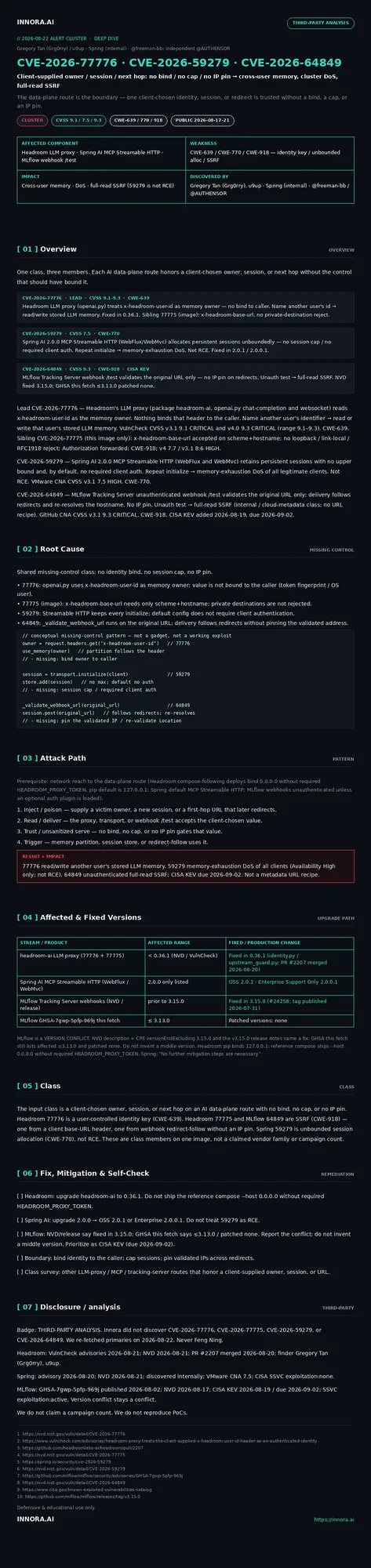
The image sits at the top of the article, just below the title, byline, reading time and date.
The records discussed span several AI-adjacent products: langchain-community's SitemapLoader, the LangBot Extensions MCP server, the @n8n/workflow-sdk MCP node-schema, the Headroom LLM proxy, Spring AI's Streamable HTTP transport, and MLflow's webhook test endpoint. Each has a different feature, but the same shape of mistake.
Setup
There is no lab, account or target setup in the usual sense. The preconditions are per record, and the article lists them as the entry condition for the attack path: reach the data plane that accepts the named value. Concretely, that means one of:
- an ingested sitemap for
SitemapLoader; - the Extensions MCP form in LangBot;
- a
global:membersession in n8n; - Headroom running on a compose
[redacted]bind; - an unauthenticated Spring AI Streamable HTTP endpoint;
- a default MLflow instance with no webhook authentication.
Versions and scores are taken from NVD, GHSA, VulnCheck, spring.io, ZDI and the CISA KEV catalogue, all re-fetched on 22 August 2026 (MYT). Where sources disagree, the author keeps the conflict rather than resolving it.
Finding it
The observation is structural. In each record, the existing control (domain restriction, login, role, header, initialize, URL validation) sits on the wrong side of the dispatch, or is not carried to the next hop. The author reduces it to two lines:
next_hop = client_or_document_value dispatch(next_hop)
The missing control is not "MCP" and not "agents". It is the decision to treat a caller-named next hop as already authorised. The records in the overview are each one instance of that seam.
The records
CVE-2026-72848, langchain-community SitemapLoader.parse_sitemap. restrict_to_same_domain is applied only to leaf <url> entries. A nested <sitemap> loc passes to scrape_all / an aiohttp GET with no domain comparison and no private, loopback or link-local check. Credit: geo-chen.
CVE-2026-54449, LangBot Extensions MCP StdioServerParameters. A logged-in user's STDIO command and args are started as a server-side subprocess. There is no who-may-change boundary and no command allow-list. The table records CWE-77; the GHSA prose also says CWE-78. The author notes this was already on @Innora_sg on 21 August and is not a new Innora find.
CVE-2026-77068, @n8n/workflow-sdk. An authenticated global:member node-type string becomes a schema module path with no traversal reject, and executes in the n8n MAIN process. The author stresses PR:L, not unauthenticated. The GHSA at fetch time said "No known CVE" and carried no CWE; VulnCheck later assigned both. It is a Pulse item, not a new Alert.
CVE-2026-77776 and CVE-2026-77775, Headroom LLM proxy. x-headroom-user-id is the memory owner with nothing binding the header to the caller. x-headroom-base-url chooses the upstream after an http/https plus hostname parse, with no loopback, link-local or RFC 1918 reject, and Authorization is forwarded unchanged. The pip install binds [redacted], but the reference compose ships --host [redacted] with no required HEADROOM_PROXY_TOKEN.
CVE-2026-59279, Spring AI MCP Streamable HTTP (WebFlux and WebMvc). Sessions are retained with no cap and, by default, no client authentication. Repeated initialize calls lead to memory exhaustion for every client. CWE-770.
CVE-2026-64849, MLflow. The unauthenticated POST /api/2.0/mlflow/webhooks/{id}/test validates the original URL, then follows redirects with no address pin. /test returns response_status and response_body. Reported by @freeman-bb on 12 June and independently by @AUTHENSOR on 26 June. Added to CISA KEV on 19 August, due 2 September.
The Hugging Face timm checkpoint pickle issue (CVE-2026-15679) does not share this class and is kept in an appendix only.
Exploitation
The article gives a generic four-step path rather than per-target request captures. The prerequisite is reaching the data plane that accepts the named value, as listed in Setup.
Step 1: Name the hop
The value that the product will later dispatch is named: a nested sitemap loc, a STDIO command, a node-type string, a user-id or base-url header, a new session, or a public HTTPS webhook URL.
Step 2: Cross the seam
The product dispatches that value as a launch, a fetch, a load, an identity or a session retain. This is the point where the caller-named value is treated as authorised.
Step 3: Skip the second check
There is no allow-list, no pin, no traversal reject, no session cap, and no re-validation of the redirect target. The existing check, where one exists, sits on the wrong side of the dispatch or is not carried to the next hop.
Step 4: Collect the impact
The outcomes the article lists are: an internal response landing in Documents; RCE as the LangBot service or the n8n MAIN process; another user's memory read or written; an upstream fetch of internal data; memory exhaustion across all clients; and /test reflecting response_body.
On impact classification, confidentiality applies to the three CWE-918 SSRF records and to the Headroom memory swap (CWE-639). Integrity and availability join on process launch (LangBot, n8n) or unbounded sessions (Spring AI).
Root cause
The mistake is a design decision, not a missing library. A value that the client, a document or a session controls is used as the next hop and is assumed to be inside the trust boundary. The control that exists is either applied to a different value (the leaf URL rather than the nested loc, the original webhook URL rather than the redirect target), applied to a different actor (login rather than the command being launched), or absent entirely (no session cap, no header-to-caller binding).
Why the existing defences did not stop it, per record:
SitemapLoaderrestricts the same domain on leaf entries only; the nested index entry is a separate code path.- LangBot authenticates the user but does not constrain what that user may launch.
- n8n requires
global:member, which is a role check, not a path check. - Headroom parses the base URL for scheme and hostname but does not reject private address space, and treats the user-id header as identity without binding it to a token or OS user.
- Spring AI authenticates nothing by default and caps nothing.
- MLflow validates the first URL and then follows redirects without pinning the resolved address.
Impact
The impact is per record and the author keeps the hedges. Confidentiality is the primary impact for the SSRF records and the Headroom memory swap. Integrity and availability appear where a process is launched or sessions are unbounded. For MLflow, CISA asserts active exploitation; the author explicitly does not invent campaign detail and does not claim a campaign around the KEV entry.
Affected and fixed
| CVE | Component | Affected (this fetch) | Fixed / note | Score | Finder |
|---|---|---|---|---|---|
| CVE-2026-72848 | SitemapLoader.parse_sitemap |
≤ 0.4.2 | No official fix. NVD unsupported-when-assigned |
8.6 v3.1 / 7.7 v4.0 | geo-chen |
| CVE-2026-54449 | LangBot mcp.py StdioServerParameters |
NVD ≤ 4.10.7; GHSA All / patched None; OX up to 4.10.0 | No official fix this review | 8.8 | OX Security |
| CVE-2026-77068 | @n8n/workflow-sdk MCP node-schema |
before 2.33.4 / 2.34.x before 2.34.1 (NVD CPE 2.0.0, <2.33.4, 2.34.0, <2.34.1) | 2.33.4 / 2.34.1 | 8.7 v4.0 | Haruna38 |
| CVE-2026-77776 | Headroom x-headroom-user-id |
< 0.36.1 | 0.36.1 | 9.1 v3.1 / 9.3 v4.0 | Gregory Tan (Grg0rry) |
| CVE-2026-77775 | Headroom x-headroom-base-url |
< 0.36.1 | 0.36.1 | 8.6 v3.1 / 7.7 v4.0 | Gregory Tan (Grg0rry) |
| CVE-2026-59279 | Spring AI Streamable HTTP sessions | 2.0.0 only | 2.0.1 OSS / [redacted] Enterprise | 7.5 | discovered internally |
| CVE-2026-64849 | MLflow webhooks /test |
NVD prior to 3.15.0; GHSA ≤ 3.13.0 / patched none | NVD: 3.15.0. GHSA: patched none | 9.3 v3.1 | freeman-bb / AUTHENSOR |
LangBot's 8.8 is a GitHub CNA score; NVD has no independent score for it.
Fix
What was changed, where a fix exists: n8n 2.33.4 and 2.34.1; Headroom 0.36.1; Spring AI 2.0.1 OSS and [redacted] Enterprise; MLflow 3.15.0 per NVD. Where no primary names a fix, namely LangBot and langchain-community SitemapLoader, the component should be treated as still exposed.
What should be done, as boundary controls: if the caller names a command, URL, module path, session or identity header, that name is untrusted until a control binds it. That means an allow-list, a pin through redirects, capped and authenticated sessions, traversal rejection, rejection of private destinations, and identity bound to a token or OS user.
Safety-net measures the article recommends: bind LLM proxies to loopback unless an explicit token is required; disable STDIO MCP when it is not a product requirement; do not ingest untrusted sitemaps into affected SitemapLoader.
Conflicts left open
The author lists disagreements rather than resolving them: LangBot versions (NVD ≤ 4.10.7 with no fix, GHSA All/patched None, OX up to v4.10.0) and CWE-77 in the table versus CWE-78 in the prose; score pairs where v3.1 and v4.0 disagree (77776 9.1/9.3, 77775 8.6/7.7, langchain 8.6/7.7, Context7 9.0/6.4); langchain's unsupported-when-assigned; MLflow NVD 3.15.0 versus GHSA patched none / ≤ 3.13.0; n8n's GHSA shipping without CVE or CWE, later assigned by VulnCheck (CVE-2026-77068, CWE-22); and timm NVD 1.0.24 versus ZDI v1.0.26.
Adjacent and appendix material
Context7 Custom AI Instructions (CVE-2026-75130, Eli Ainhorn, Noma Security; through 2.1.2; CWE-1427; CNA 9.0 v3.1 and 6.4 v4.0; Noma production sanitisation 23 February 2026) is the instruction-channel case already posted on @Innora_sg. It is adjacent, not a restatement, and not the author's find.
The appendix covers CVE-2026-15679: Hugging Face timm checkpoint parsing deserialises untrusted data (CWE-502, UI:R). ZDI/CNA CVSS 3.0 7.8 HIGH. NVD lists affected 1.0.24 at this fetch; ZDI-26-523 says fixed in v1.0.26. Credit: Michael DePlante (@izobashi), TrendAI Zero Day Initiative. It is pickle deserialisation, not a launch, redirect, session or header seam, and is Pulse only.
Variants to test
Each of these follows the same seam: a caller-named next hop that the product dispatches without a second check.
- Nested document indexes. Feed a loader that restricts domains a nested index (sitemap index, feed of feeds, manifest of manifests) whose child entries point at internal addresses.
- Redirect chains after validation. Point a webhook or URL-fetch feature at a public HTTPS URL you control that redirects to an internal target.
- Identity headers without binding. Send a user-id or tenant header with a value belonging to another account while authenticated as yourself.
- Upstream base URL headers. Supply a base-URL header pointing at loopback, link-local or RFC 1918 space and observe whether the proxy forwards your
Authorizationunchanged. - Session creation without cap or auth. Repeatedly call the session initialisation method on a Streamable HTTP MCP endpoint with no credentials.
- Role-gated path construction. As the lowest authenticated role, supply a node-type or module-name string containing traversal sequences.
- User-controlled process launch. Where a UI lets a logged-in user define a command and arguments for a local server, check whether any allow-list or ownership boundary exists.
What happened, in plain words
This article is a round-up of several security bugs found by other people in AI-related software. The author did not find them; they collected the public records, re-checked the official sources on 22 August 2026, and wrote down what those sources say. Where the sources disagree with each other, the author leaves the disagreement standing instead of picking a winner.
The one idea that ties all the bugs together is simple. Many programs let the person using them, or a document the program reads, or an existing session, supply a value that tells the program where to go next: which command to run, which web address to fetch, which user's memory to use, which session to keep. The program then treats that value as if it were already safe and approved. It is not. The value came from outside, so it needs a second check before it is used. In every bug below, that second check is missing, or it is applied to the wrong value.
The image sits at the top of the article, just below the title, author name, reading time and date.
Before the individual bugs, a few words on the vocabulary that keeps coming back.
- An API is a way for one program to talk to another over the network, like a service counter: you send a request in a fixed format, you get an answer back in a fixed format.
- A server is the computer (or program) that answers those requests. A client is the program making them, usually your browser or a script.
- A header is a small labelled line of text attached to a request or a response, carrying extra information such as who is asking or what format they want. Think of it as the note clipped to the outside of an envelope.
- A token or cookie is a short piece of text that proves who you are, so you do not have to type your password on every request. It is like a wristband at an event: show it and you get in without being checked again.
- SSRF (server-side request forgery) means tricking a server into making a request on your behalf, typically to an address you could not reach yourself, such as an internal machine.
- RCE (remote code execution) means getting your own commands to run on someone else's machine.
- A CVE is a public catalogue number for one specific security bug, so people can refer to it unambiguously.
- A CVSS score is a number from 0 to 10 that tries to express how serious a bug is. Different scoring versions (v3.1 and v4.0) can give different numbers for the same bug, which is why the table below shows pairs.
- CWE is a catalogue number for a type of weakness, for example CWE-918 for SSRF.
- NVD, GHSA, VulnCheck, ZDI and CISA KEV are public databases and advisory feeds that record these bugs. CISA KEV is a list of bugs that are known to be exploited in the real world.
Setup
There is no lab to build and no account to create. Each bug has its own precondition, meaning the situation you must already be in for the bug to matter. The article lists them as the entry point of the attack path: you must be able to reach the part of the product that accepts the value you name. In concrete terms, one of these:
- a sitemap that the product has ingested, for
SitemapLoader; - the Extensions MCP form in LangBot;
- a
global:membersession in n8n; - Headroom running on a compose
[redacted]bind; - an unauthenticated Spring AI Streamable HTTP endpoint;
- a default MLflow instance with no webhook authentication.
A sitemap is an XML file that lists the pages of a website so search engines can find them; a sitemap can also point at other sitemaps, which matters later. MCP is a protocol that lets an AI assistant call external tools; an MCP server is the program offering those tools. A compose file is a configuration file for running containers (self-contained software packages), and [redacted] as a bind address means "listen on every network interface", not just the local machine. Loopback means the machine talking to itself (address [redacted]); binding to loopback keeps a service private to that machine.
Versions and scores come from NVD, GHSA, VulnCheck, spring.io, ZDI and the CISA KEV catalogue, all re-fetched on 22 August 2026 (MYT). Where sources disagree, the conflict is kept.
Finding it
The observation is about structure, not about one product. In each record, the control that exists (a domain restriction, a login, a role, a header, a session initialisation, a URL validation) sits on the wrong side of the moment the value is used, or it is not carried along to the next step. The author reduces the whole pattern to two lines:
next_hop = client_or_document_value dispatch(next_hop)
Line by line: the first part takes a value that came from the client or from a document and stores it as next_hop, the place to go next. The second part sends the program there. There is nothing between the two: no check that the destination is allowed. That is the bug in one sentence.
The missing control is not "MCP" and not "agents". It is the decision to treat a caller-named next hop as already authorised. Each record below is one instance of that seam.
The records
CVE-2026-72848, langchain-community SitemapLoader.parse_sitemap. SitemapLoader is a component that reads a sitemap and fetches the pages listed in it. The setting restrict_to_same_domain is meant to keep it on one website. It is applied only to the leaf <url> entries, meaning the individual page addresses at the bottom of the list. A nested <sitemap> entry, which points at another sitemap file, is passed on to scrape_all and then to an aiohttp GET (an HTTP request made by the program) with no domain comparison and no check against private, loopback or link-local addresses. So the restriction covers the leaves but not the branch that leads to them. Credit: geo-chen.
CVE-2026-54449, LangBot Extensions MCP StdioServerParameters. LangBot is a chat-bot platform with an extensions system. A logged-in user can supply a STDIO command and its arguments, and the server starts them as a subprocess on the server side. STDIO means the program is launched locally and talks over standard input and output rather than the network. There is no boundary saying who may change that command and no allow-list of permitted commands. The table records CWE-77 (command injection); the GHSA prose also says CWE-78 (OS command injection). The author notes this was already published on @Innora_sg on 21 August and is not a new Innora find.
CVE-2026-77068, @n8n/workflow-sdk. n8n is a workflow automation tool. A user with the authenticated role global:member can supply a node-type string, which becomes a path to a schema module. There is no rejection of traversal sequences, meaning text such as ../ that walks out of the intended folder, and the module executes in the n8n MAIN process, the core of the application. The author stresses PR:L, meaning the attacker needs low privileges, so this is not unauthenticated. At fetch time the GHSA said "No known CVE" and carried no CWE; VulnCheck later assigned both. It is a Pulse item, not a new Alert.
CVE-2026-77776 and CVE-2026-77775, Headroom LLM proxy. Headroom is a proxy that sits between an application and a large language model. The header x-headroom-user-id decides whose memory is being used, and nothing binds that header to the caller, so anyone can claim to be anyone. The header x-headroom-base-url chooses which upstream server to talk to, after only a check that the address parses as http or https with a hostname; there is no rejection of loopback, link-local or RFC 1918 addresses (the private address ranges used inside networks), and the Authorization header is forwarded unchanged. The pip install binds to [redacted], but the reference compose file ships --host [redacted] with no required HEADROOM_PROXY_TOKEN.
CVE-2026-59279, Spring AI MCP Streamable HTTP (WebFlux and WebMvc). Spring AI is a Java framework for AI applications; Streamable HTTP is one way its MCP support carries a conversation. Sessions are kept with no cap and, by default, no client authentication. Repeating the initialize call, which is the request that opens a session, leads to memory exhaustion for every client. CWE-770 is the weakness class for allocating resources without limits.
CVE-2026-64849, MLflow. MLflow is a platform for managing machine-learning projects. The endpoint POST /api/2.0/mlflow/webhooks/{id}/test can be called without authentication. It validates the original URL, then follows redirects with no address pin, meaning it does not lock the request to the address it first approved. The /test response returns response_status and response_body, so the result of the fetched request comes back to the caller. Reported by @freeman-bb on 12 June and independently by @AUTHENSOR on 26 June. Added to CISA KEV on 19 August, due 2 September.
The Hugging Face timm checkpoint pickle issue (CVE-2026-15679) does not share this class and is kept in an appendix only.
Exploitation
The article gives a generic four-step path rather than per-target request captures. The prerequisite is reaching the data plane that accepts the named value, as listed in Setup. "Data plane" here just means the part of the product that actually handles the data, as opposed to the login screen in front of it.
Step 1: Name the hop
The value that the product will later dispatch is named: a nested sitemap loc, a STDIO command, a node-type string, a user-id or base-url header, a new session, or a public HTTPS webhook URL. This step is taken because the whole class depends on the product accepting a name from outside; without that, there is nothing to exploit.
Step 2: Cross the seam
The product dispatches that value as a launch, a fetch, a load, an identity or a session retain. This is the point where the caller-named value is treated as authorised. The step matters because it is the moment the outside value becomes an action inside the product.
Step 3: Skip the second check
There is no allow-list, no pin, no traversal reject, no session cap, and no re-validation of the redirect target. The existing check, where one exists, sits on the wrong side of the dispatch or is not carried to the next hop. In other words, the guard was standing at the wrong door.
Step 4: Collect the impact
The outcomes the article lists are: an internal response landing in Documents; RCE as the LangBot service or the n8n MAIN process; another user's memory read or written; an upstream fetch of internal data; memory exhaustion across all clients; and /test reflecting response_body.
On impact classification, confidentiality applies to the three CWE-918 SSRF records and to the Headroom memory swap (CWE-639). Confidentiality means reading data you should not see. Integrity and availability join on process launch (LangBot, n8n) or unbounded sessions (Spring AI). Integrity means changing data you should not change; availability means making the service unusable for others.
Root cause
The mistake is a design decision, not a missing library. A value that the client, a document or a session controls is used as the next hop and is assumed to be inside the trust boundary. The control that exists is either applied to a different value (the leaf URL rather than the nested loc, the original webhook URL rather than the redirect target), applied to a different actor (login rather than the command being launched), or absent entirely (no session cap, no header-to-caller binding).
Why the existing defences did not stop it, per record:
SitemapLoaderrestricts the same domain on leaf entries only; the nested index entry is a separate code path.- LangBot authenticates the user but does not constrain what that user may launch.
- n8n requires
global:member, which is a role check, not a path check. - Headroom parses the base URL for scheme and hostname but does not reject private address space, and treats the user-id header as identity without binding it to a token or OS user.
- Spring AI authenticates nothing by default and caps nothing.
- MLflow validates the first URL and then follows redirects without pinning the resolved address.
Impact
The impact is per record and the author keeps the hedges. Confidentiality is the primary impact for the SSRF records and the Headroom memory swap. Integrity and availability appear where a process is launched or sessions are unbounded. For MLflow, CISA asserts active exploitation; the author explicitly does not invent campaign detail and does not claim a campaign around the KEV entry.
Affected and fixed
| CVE | Component | Affected (this fetch) | Fixed / note | Score | Finder |
|---|---|---|---|---|---|
| CVE-2026-72848 | SitemapLoader.parse_sitemap |
≤ 0.4.2 | No official fix. NVD unsupported-when-assigned |
8.6 v3.1 / 7.7 v4.0 | geo-chen |
| CVE-2026-54449 | LangBot mcp.py StdioServerParameters |
NVD ≤ 4.10.7; GHSA All / patched None; OX up to 4.10.0 | No official fix this review | 8.8 | OX Security |
| CVE-2026-77068 | @n8n/workflow-sdk MCP node-schema |
before 2.33.4 / 2.34.x before 2.34.1 (NVD CPE 2.0.0, <2.33.4, 2.34.0, <2.34.1) | 2.33.4 / 2.34.1 | 8.7 v4.0 | Haruna38 |
| CVE-2026-77776 | Headroom x-headroom-user-id |
< 0.36.1 | 0.36.1 | 9.1 v3.1 / 9.3 v4.0 | Gregory Tan (Grg0rry) |
| CVE-2026-77775 | Headroom x-headroom-base-url |
< 0.36.1 | 0.36.1 | 8.6 v3.1 / 7.7 v4.0 | Gregory Tan (Grg0rry) |
| CVE-2026-59279 | Spring AI Streamable HTTP sessions | 2.0.0 only | 2.0.1 OSS / [redacted] Enterprise | 7.5 | discovered internally |
| CVE-2026-64849 | MLflow webhooks /test |
NVD prior to 3.15.0; GHSA ≤ 3.13.0 / patched none | NVD: 3.15.0. GHSA: patched none | 9.3 v3.1 | freeman-bb / AUTHENSOR |
LangBot's 8.8 is a GitHub CNA score; NVD has no independent score for it. A CNA is the organisation authorised to assign a CVE and its score for its own product.
Fix
What was changed, where a fix exists: n8n 2.33.4 and 2.34.1; Headroom 0.36.1; Spring AI 2.0.1 OSS and [redacted] Enterprise; MLflow 3.15.0 per NVD. Where no primary names a fix, namely LangBot and langchain-community SitemapLoader, the component should be treated as still exposed.
What should be done, as boundary controls: if the caller names a command, URL, module path, session or identity header, that name is untrusted until a control binds it. That means an allow-list (a fixed list of permitted values), a pin through redirects (sticking to the address that was checked), capped and authenticated sessions, traversal rejection, rejection of private destinations, and identity bound to a token or OS user.
Safety-net measures the article recommends: bind LLM proxies to loopback unless an explicit token is required; disable STDIO MCP when it is not a product requirement; do not ingest untrusted sitemaps into affected SitemapLoader.
Conflicts left open
The author lists disagreements rather than resolving them: LangBot versions (NVD ≤ 4.10.7 with no fix, GHSA All/patched None, OX up to v4.10.0) and CWE-77 in the table versus CWE-78 in the prose; score pairs where v3.1 and v4.0 disagree (77776 9.1/9.3, 77775 8.6/7.7, langchain 8.6/7.7, Context7 9.0/6.4); langchain's unsupported-when-assigned; MLflow NVD 3.15.0 versus GHSA patched none / ≤ 3.13.0; n8n's GHSA shipping without CVE or CWE, later assigned by VulnCheck (CVE-2026-77068, CWE-22); and timm NVD 1.0.24 versus ZDI v1.0.26.
Adjacent and appendix material
Context7 Custom AI Instructions (CVE-2026-75130, Eli Ainhorn, Noma Security; through 2.1.2; CWE-1427; CNA 9.0 v3.1 and 6.4 v4.0; Noma production sanitisation 23 February 2026) is the instruction-channel case already posted on @Innora_sg. It is adjacent, not a restatement, and not the author's find. "Instruction channel" means the text an AI model is told to follow; if an attacker can write into that text, they can steer the model.
The appendix covers CVE-2026-15679: Hugging Face timm checkpoint parsing deserialises untrusted data (CWE-502, UI:R). Deserialising means turning stored data back into live objects, and if the data is hostile, the objects can do things. UI:R means the user must take an action for it to work. ZDI/CNA CVSS 3.0 7.8 HIGH. NVD lists affected 1.0.24 at this fetch; ZDI-26-523 says fixed in v1.0.26. Credit: Michael DePlante (@izobashi), TrendAI Zero Day Initiative. It is pickle deserialisation, not a launch, redirect, session or header seam, and is Pulse only.
Variants to test
Each of these follows the same seam: a caller-named next hop that the product dispatches without a second check. They are written as things a tester would try, with the sign that tells you it worked.
- Nested document indexes. Feed a loader that restricts domains a nested index (sitemap index, feed of feeds, manifest of manifests) whose child entries point at internal addresses.
- Redirect chains after validation. Point a webhook or URL-fetch feature at a public HTTPS URL you control that redirects to an internal target.
- Identity headers without binding. Send a user-id or tenant header with a value belonging to another account while authenticated as yourself.
- Upstream base URL headers. Supply a base-URL header pointing at loopback, link-local or RFC 1918 space and observe whether the proxy forwards your
Authorizationunchanged. - Session creation without cap or auth. Repeatedly call the session initialisation method on a Streamable HTTP MCP endpoint with no credentials.
- Role-gated path construction. As the lowest authenticated role, supply a node-type or module-name string containing traversal sequences.
- User-controlled process launch. Where a UI lets a logged-in user define a command and arguments for a local server, check whether any allow-list or ownership boundary exists.
Glossary
- API: a fixed way for one program to send requests to another and receive answers.
- Server: the program or machine that answers requests from clients.
- Client: the program making requests, such as a browser or a script.
- Header: a labelled line of extra information attached to a request or response.
- Token: a short piece of text proving who you are, so you need not log in again.
- Cookie: a small piece of text a browser stores and sends back to a site, often holding a session token.
- Session: a period during which the server remembers who you are and what state you are in.
- SSRF (server-side request forgery): tricking a server into making a request to an address you choose, often an internal one.
- RCE (remote code execution): getting your own commands to run on someone else's machine.
- CVE: a public catalogue number identifying one specific security bug.
- CWE: a catalogue number identifying a type of weakness, such as CWE-918 for SSRF.
- CVSS: a 0 to 10 score expressing how serious a bug is; versions v3.1 and v4.0 can differ.
- NVD: the US National Vulnerability Database, a public record of CVEs.
- GHSA: GitHub Security Advisory, a public advisory published on GitHub.
- VulnCheck: a company that publishes vulnerability advisories.
- ZDI: Trend Micro's Zero Day Initiative, which buys and publishes vulnerability research.
- CISA KEV: a US government list of vulnerabilities known to be exploited in the wild.
- CNA: the organisation authorised to assign a CVE and score for its own product.
- Sitemap: an XML file listing a website's pages, sometimes pointing at other sitemaps.
- MCP: a protocol letting an AI assistant call external tools; an MCP server offers those tools.
- STDIO: a way to run a program locally and talk to it over standard input and output.
- Subprocess: a separate program started by another program on the same machine.
- Allow-list: a fixed list of values that are permitted, with everything else refused.
- Path traversal: using sequences such as
../to walk out of an intended folder. - Loopback: the machine talking to itself, address 127.0.0.1.
- Link-local: an address usable only on the local network segment, not routed further.
- RFC 1918: the private address ranges used inside networks, not reachable from the internet.
- Bind address: which network interfaces a service listens on;
[redacted]means all of them. - Compose file: a configuration file for running containers, self-contained software packages.
- Proxy: a program that sits between a client and a server and forwards requests.
- Upstream: the server a proxy forwards requests to.
- Authorization header: the header carrying credentials, such as a token, on a request.
- Redirect: a server's answer telling the client to go to a different address instead.
- Pin: locking a request to the address that was checked, so a redirect cannot change it.
- Webhook: a URL that a service calls automatically when something happens.
- Endpoint: one specific address and method on an API, such as
POST /api/2.0/mlflow/webhooks/{id}/test. - Data plane: the part of a product that handles the actual data, as opposed to the login screen in front of it.
- Privilege (PR:L): the level of access an attacker needs; PR:L means low privileges, so a normal logged-in user.
- Role: a named set of permissions, such as
global:member. - Confidentiality: keeping data from being read by those who should not see it.
- Integrity: keeping data from being changed by those who should not change it.
- Availability: keeping a service usable for the people who need it.
- Resource exhaustion: using up a limited resource such as memory until the service fails.
- Deserialisation: turning stored data back into live objects in a program; hostile data can make this dangerous.
- Pickle: Python's format for serialising objects, which can execute code when loaded from untrusted data.
- Instruction channel: the text an AI model is told to follow; writing into it can steer the model.
- Pulse item: a short news-style entry in a feed, as opposed to a full new alert.
- CNA score: the CVSS score assigned by the organisation that owns the CVE.




