CVE-2026-16287: The privilege boundary in Pardus Update
A local member of the pardus-update group could supply an unchecked askconf argument to a privileged helper, which inserted it into a root-owned Bash script. This allowed the attacker to execute commands as root when the script ran.

medium.com
Published on medium.com
Security Research
The full write-up lives on its author's site
It belongs to its author, so we link to it rather than copy it. The other two tabs are our own rewrites, checked against it.
Context: what Pardus Update is and what the feature does
Pardus Update is the system updater shipped with Pardus. Like any updater, it has to cross a privilege boundary to install system packages, so it combines a user-facing GUI with a privileged helper and a polkit policy that authorises the helper.
The feature at the centre of this research is the "Enable Passwordless Usage" setting, which is tied to membership of the pardus-update group. A member of that group can drive the updater without entering a password. The policy grants the broad pardus-update-sysaction action and binds it to the executable path SysActions.py, but it does not constrain the helper's subcommands or the values of its arguments.
The research record is CVE-2026-16287 against TÜBİTAK BİLGEM pardus-update, classified as CWE-78 with CVSS v3.1 7.8 High (AV:L/AC:L/PR:L/UI:N/S:U/C:H/I:H/A:H). The CNA lists 0.6.6 through versions before 0.7.0 as affected. The preserved dynamic test used 0.6.6 on Pardus 25.1.
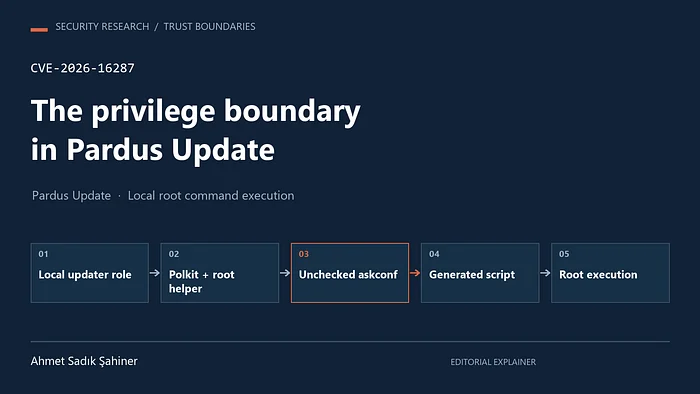
Editorial explainer of the Pardus Update privilege boundary, drawn by the author; it is not a captured test result.
The threat model is local privilege escalation. The demonstrated prerequisite is membership in the passwordless updater group. The evidence does not establish a remote attack path.
Setup: roles, versions and preconditions
The test environment was a disposable Pardus VM running the installed helper and polkit configuration from 0.6.6 on Pardus 25.1. The attacker role is a local user who belongs to the pardus-update group, and therefore holds the passwordless grant for pardus-update-sysaction.
The lab harness redirected update-related filesystem paths, and the effects on APT, systemd and reboot, into a private mount namespace with inert targets. That let the generated script be exercised without performing a real system upgrade or reboot. The production boot-time execution route is established separately, from the captured service source rather than from a live reboot.
Finding it: configuration that becomes shell text
The starting observation is a mismatch of contracts. Permission to operate an updater should be narrower than permission to supply shell syntax to a root script. The GUI normally produced a constrained set of configuration choices, but nothing stopped a caller from invoking the privileged interface directly, so any validation had to live in the helper itself.
In the captured 0.6.6 source, the group rule returned polkit.Result.YES for pardus-update-sysaction. The policy bound the executable path to SysActions.py and stopped there: subcommands and argument values were unconstrained.
Exploitation
The source-to-sink capture documents the complete chain.
Step 1: call the privileged helper
A local member of the pardus-update group supplies arguments to SysActions.py. The polkit rule authorises the call because the executable path matches, and the caller is in the group.
Step 2: dispatch the argument
Dispatch passes sys.argv[3] into distupgradeoffline as askconf.
Step 3: substitute into the template
The helper substitutes the value into the script template with:
contents.replace("@@askconf@@", askconf)
Step 4: the placeholder sits inside a quoted dpkg option
The template uses that placeholder inside a double-quoted Dpkg::Options value. The caller's string is therefore interpreted by the eventual shell as part of an executable script, not as a configuration value.
Step 5: root writes an executable script
The helper writes the generated script and sets mode 0755.
Step 6: a service runs it
A system service points ExecStart at that script, and the service template contains no User= override, so the script runs as root.
The controlled proof
The 10 July 2026 evidence uses the installed helper and polkit configuration in the disposable VM. The positive transcript records:
POC_MODE proofGENERATED_SCRIPT uid=0 gid=0 mode=755CANARY uid=0(root) gid=0(root) groups=0(root)CANARY_MARKER_COUNT 1REAL_APT_UNCHANGED yesREAL_SYSTEMD_UNCHANGED yes
The generated script is owned by root with mode 755, and the canary shows execution in a root context (uid=0(root) gid=0(root) groups=0(root)). The marker count is 1, and the real APT and systemd state were left unchanged.
The negative control
The matching control used the ordinary --force-confnew input. It generated a root-owned script but recorded CANARY absent and CANARY_MARKER_COUNT 0. Holding the harness constant and changing only the argument supports attribution to the template substitution path, rather than to an unconditional canary in the privileged wrapper.
The post-run integrity capture also records root ownership of the generated artifacts, absence of generated files at the real host paths, and unchanged hashes for the installed helper, template and rule. The environment capture establishes group membership. A separate runtime transcript showing rejection of a non-member was not located, so that rejection is not presented as an observed control.
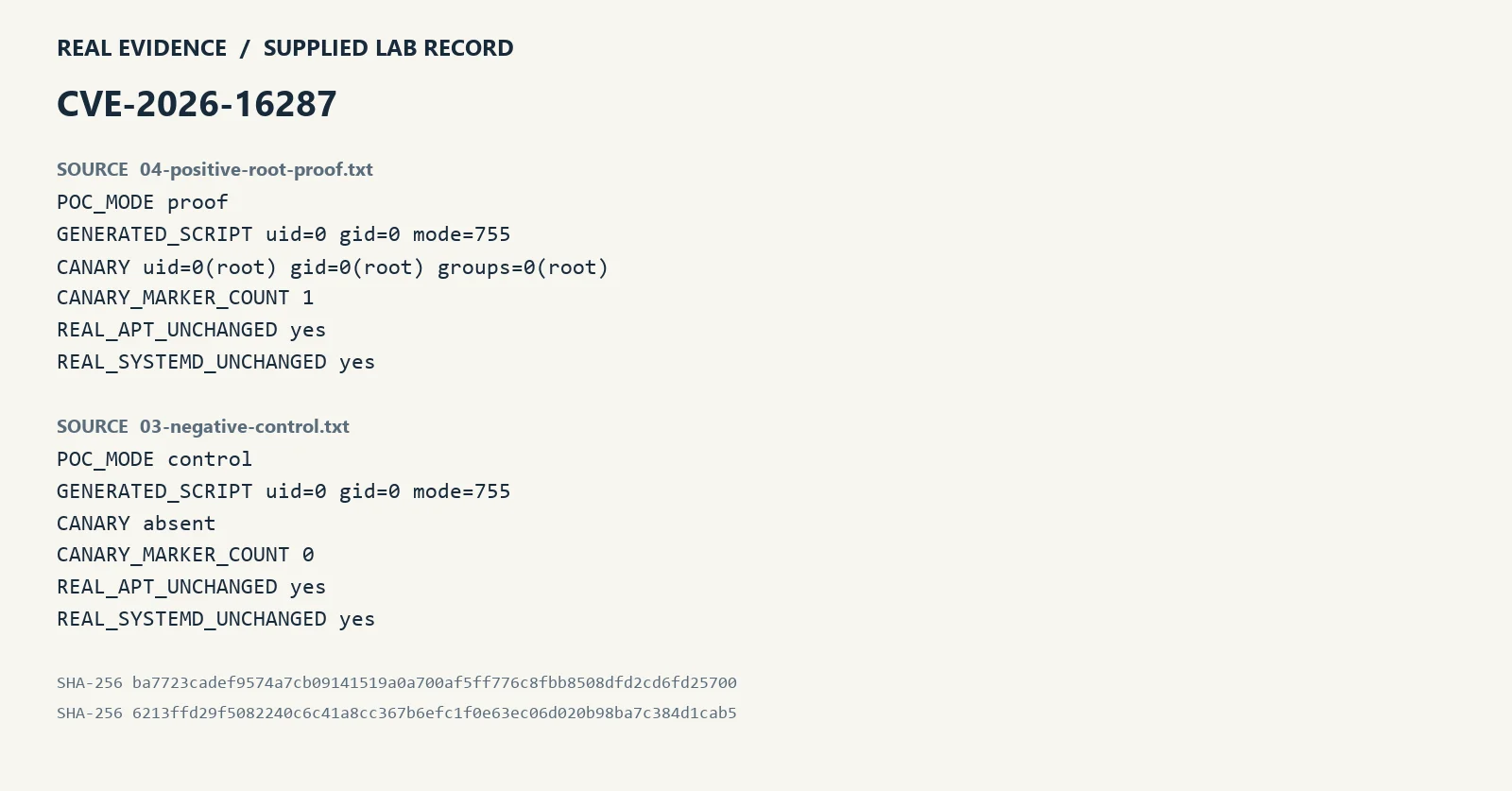
Real evidence: positive and negative controls from the isolated Pardus test, with exact historical excerpts and source hashes.
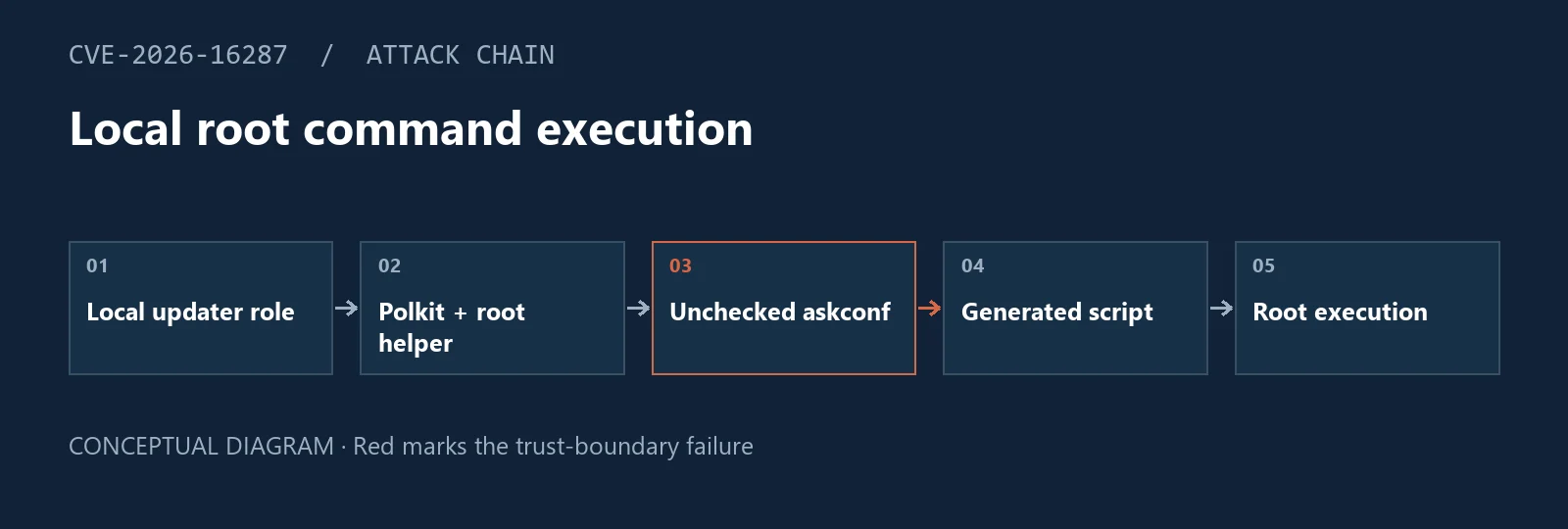
Conceptual attack chain: the updater role reaches executable root-owned script text through unchecked askconf.
Root cause
The helper treated its argument as configuration, while the eventual shell treated the same string as executable text. The GUI was restrictive, but a restrictive GUI cannot enforce a contract that the helper does not implement.
The polkit policy compounded this. It authorised an executable path rather than a set of subcommands and argument shapes, so a grant whose user-facing name suggests routine updating also authorised supplying shell syntax to a root-owned script. Validation needed to live in the helper, and it did not.
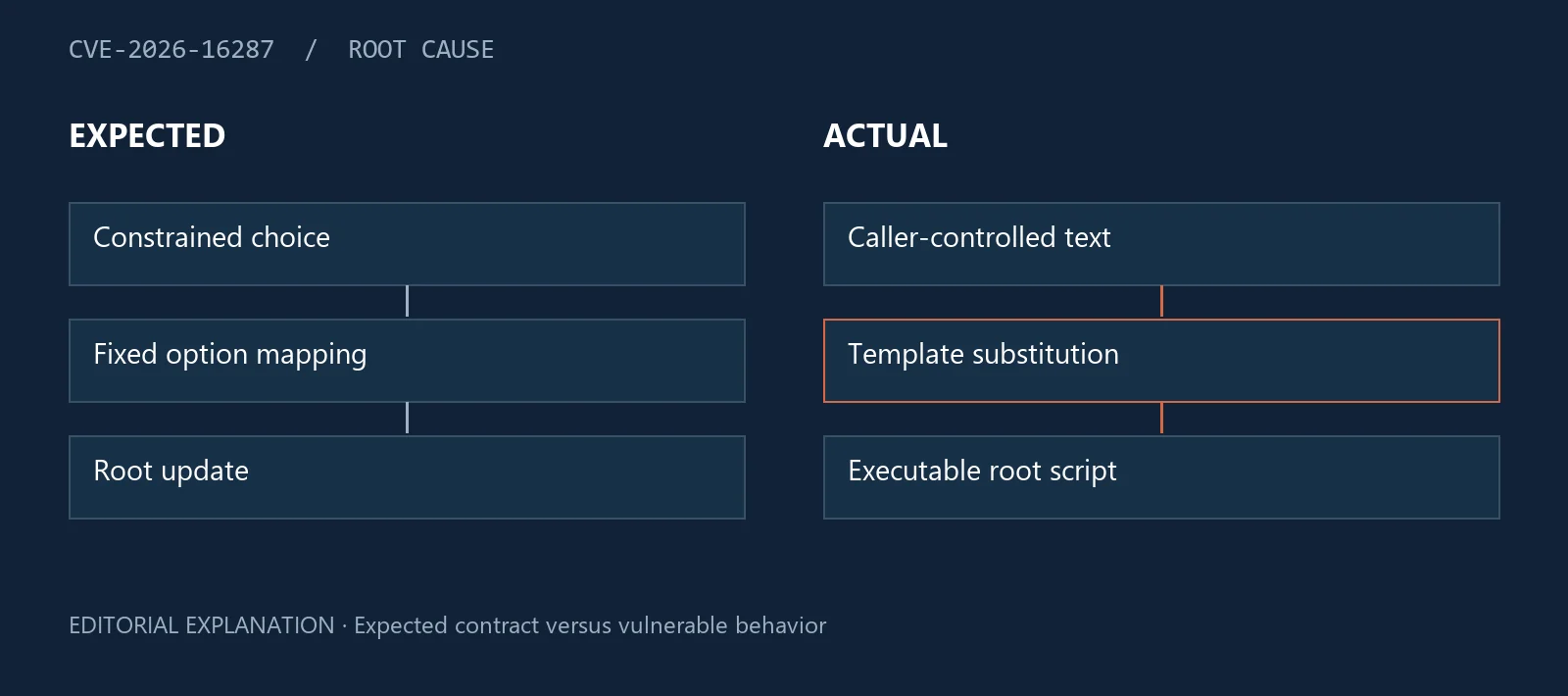
Conceptual root cause: constrained configuration choices versus free-form executable template substitution.
Impact
The observed canary proves root-context command execution in the controlled environment. The CNA's high confidentiality, integrity and availability assessment describes the potential privilege escalation impact; the test itself only wrote an identity canary.
The attacker is a local user in the pardus-update group, and in the controlled test the result was root-context command execution through a root-written script. The package describes an isolated, marker-only test. It records no production exploitation, reverse shell or persistence, and a fresh exploit run was not performed during the publication review.
Fix
The inspected 0.7.0 helper accepts new or old, maps them to fixed dpkg options, and exits for an invalid value before generating the script. The template replacement receives the mapped value, askconf_arg, rather than the caller's unrestricted string. The 0.7.0 changelog documents argument validation and further action and policy changes.
The official affected-range boundary is 0.7.0. Patch inspection supports the enum-based correction; the package does not contain a full dynamic retest of the original controlled chain on 0.7.0, and those are separate claims.
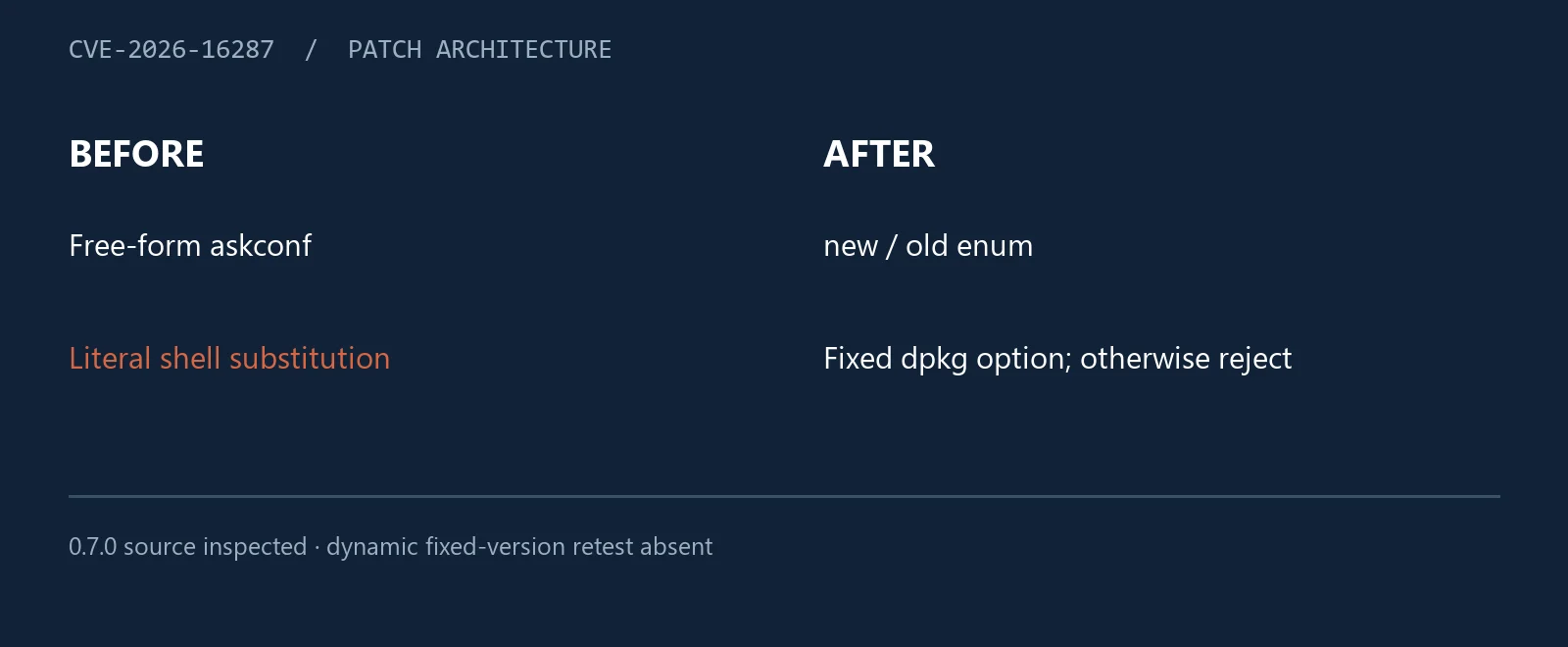
Conceptual patch comparison: 0.7.0 maps new/old to fixed options. A full patched-version dynamic retest is not claimed.
The durable design lesson is to give privileged interfaces a small, typed contract: validate direct calls, reject unknown values before privileged writes, and keep configuration as data where possible. Review policy grants together with every subcommand they expose, because an executable-level grant can authorise more behaviour than its user-facing name suggests.
Timeline
- 10 July 2026: preserved version, source, positive and control captures, and integrity captures.
- 23 July 2026: official CVE publication; researcher credit names Ahmet Sadık Şahiner.
- 26 September 2026: publication of the evidence and review of public references.
Variants to test
- Other polkit-gated helpers with free-form arguments. Look for policies that bind an executable path but not its subcommands, then check whether any argument reaches a template, a shell string or a config file that is later executed. A positive result is a generated root-owned artifact whose content reflects your input.
- Template substitution in generated scripts. Search for placeholder replacement such as
replace("@@...@@", value)in code that writes files with mode0755and is later run by a service withoutUser=. A positive result is a canary executed in a root context, with a matching negative control that does not fire. - Passwordless group grants. Enumerate groups whose membership yields
polkit.Result.YESand compare the granted action name with what the helper can actually do. A positive result is a capability reachable by a group member that the action name does not suggest. - Service templates without
User=. Check units whoseExecStartpoints at generated or writable files. A positive result is execution of your generated content as root at service start.
References
- Official CVE record and CNA metadata:
https://github.com/CVEProject/cvelistV5/blob/main/cves/2026/16xxx/CVE-2026-16287.json - Pardus Update 0.7.0 privileged helper:
https://github.com/pardus/pardus-update/blob/debian/0.7.0/src/SysActions.py - Pardus Update 0.7.0 changelog:
https://github.com/pardus/pardus-update/blob/debian/0.7.0/debian/changelog - Evidence: controlled laboratory records retained by the author.
What happened, in plain words
Pardus Update is the program that installs software updates on Pardus, a Linux-based operating system. Installing updates means changing files that only the most powerful account on the computer, called root, is allowed to touch. So the updater has two parts: a friendly window you click on, and a behind-the-scenes helper that does the privileged work. A separate component called polkit decides whether a given person is allowed to ask that helper to act.
Pardus Update has a setting called "Enable Passwordless Usage". If your account is in a group named pardus-update, you can run updates without typing your password. That is convenient, and it is also the starting point of this research: the permission was granted for the whole helper program, but nobody checked what the person asked the helper to do.
The helper accepted a piece of text from the caller and pasted it into a script that root would later run. A script is a list of commands the computer executes. Because the pasted text ended up inside that script, a member of the pardus-update group could get text of their choosing into a script that root would run; the controlled test showed a marker command running as root. In security terms this is local privilege escalation: a normal user on the machine gains the powers of root. The researcher's controlled test recorded a marker showing that a command ran as root.
The problem is tracked as CVE-2026-16287. A CVE is a public catalogue entry for a known vulnerability, so people can look it up and track fixes. It is classified as CWE-78, the category for operating-system command injection, and rated CVSS v3.1 7.8 High. CVSS is a scoring system for how serious a flaw is; 7.8 out of 10 is in the High band. The affected versions listed by the CNA, the organisation that assigns the CVE, are 0.6.6 through versions before 0.7.0. The preserved test used 0.6.6 on Pardus 25.1.
Editorial explainer of the Pardus Update privilege boundary, drawn by the author; it is not a captured test result.
The diagram above is a drawing made to explain the idea, not a screenshot of a real attack. It shows the path from the updater role, through polkit and the root helper, to the generated update script that root runs.
Context: what Pardus Update is and what the feature does
Every operating system needs a way to install and update software. On Pardus, that job belongs to Pardus Update. Like any updater, it has to cross a privilege boundary: an ordinary user is not allowed to modify system files, but installing packages requires exactly that. The usual design is a split. The user-facing GUI (graphical user interface, the window with buttons) collects your choices, and a privileged helper performs the actual work after polkit has approved the request.
Polkit is the part of a Linux desktop that answers the question "is this user allowed to perform this privileged action?". It works from rules called policies. A policy names an action, such as pardus-update-sysaction, and says who may trigger it. The helper in this story is a Python program called SysActions.py.
The feature at the centre of the research is the "Enable Passwordless Usage" setting, tied to membership of the pardus-update group. A group is simply a named collection of user accounts; putting someone in a group is a common way to give several people the same permission at once. A member of pardus-update can drive the updater without entering a password. The policy grants the broad pardus-update-sysaction action and binds it to the executable path SysActions.py, but it does not constrain the helper's subcommands or the values of its arguments. In plain words: the rule checks which program is being run, not what it is being asked to do.
The research record is CVE-2026-16287 against TÜBİTAK BİLGEM pardus-update, classified as CWE-78 with CVSS v3.1 7.8 High (AV:L/AC:L/PR:L/UI:N/S:U/C:H/I:H/A:H). The CNA lists 0.6.6 through versions before 0.7.0 as affected. The preserved dynamic test used 0.6.6 on Pardus 25.1.
The string in brackets is the CVSS vector: a compact code describing the conditions of the flaw. AV:L means the attacker needs local access to the machine, not a network connection. AC:L means the attack is easy to carry out. PR:L means the attacker needs low privileges, here the group membership. UI:N means no action by another user is required. S:U means the impact stays within the same security scope. C:H/I:H/A:H means high impact on confidentiality (secrecy of data), integrity (trustworthiness of data) and availability (whether the system keeps working).
The threat model is local privilege escalation. The demonstrated prerequisite is membership in the passwordless updater group. The evidence does not establish a remote attack path, meaning nobody has shown this being done from another machine over the internet.
Setup: roles, versions and preconditions
The test environment was a disposable Pardus VM running the installed helper and polkit configuration from 0.6.6 on Pardus 25.1. A VM, or virtual machine, is a computer simulated inside another computer; "disposable" means it can be thrown away afterwards, so a test cannot damage a real system.
The attacker role is a local user who belongs to the pardus-update group, and therefore holds the passwordless grant for pardus-update-sysaction.
The lab harness redirected update-related filesystem paths, and the effects on APT, systemd and reboot, into a private mount namespace with inert targets. Three terms need unpacking. APT is the package manager, the tool that actually installs software on Debian-based systems such as Pardus. systemd is the program that starts and manages services, the background processes a system runs. A mount namespace is an isolated view of the filesystem: the test could make the updater believe it was writing to the real system locations while the writes landed somewhere harmless. "Inert targets" means the redirected destinations did nothing when touched. That let the generated script be exercised without performing a real system upgrade or reboot. The production boot-time execution route is established separately, from the captured service source rather than from a live reboot.
Finding it: configuration that becomes shell text
The starting observation is a mismatch of contracts. A contract here means the promise a piece of software makes about what it will accept. Permission to operate an updater should be narrower than permission to supply shell syntax to a root script. Shell syntax means the special characters and words a command interpreter understands, such as separators that start a second command. The GUI normally produced a constrained set of configuration choices, but nothing stopped a caller from invoking the privileged interface directly, so any validation had to live in the helper itself. Validation means checking input before acting on it.
In the captured 0.6.6 source, the group rule returned polkit.Result.YES for pardus-update-sysaction. polkit.Result.YES is polkit's way of saying "allowed, no password needed". The policy bound the executable path to SysActions.py and stopped there: subcommands and argument values were unconstrained.
Exploitation
The source-to-sink capture documents the complete chain. "Source" is where untrusted input enters, and "sink" is the dangerous place it ends up. The chain has six steps.
Step 1: call the privileged helper
A local member of the pardus-update group supplies arguments to SysActions.py. The polkit rule authorises the call because the executable path matches, and the caller is in the group. Arguments are the extra words given to a program on the command line, telling it what to do.
Step 2: dispatch the argument
Dispatch passes sys.argv[3] into distupgradeoffline as askconf. In Python, sys.argv is the list of words typed on the command line, so sys.argv[3] is the fourth one (counting starts at zero). distupgradeoffline is the helper routine for an offline distribution upgrade, and askconf is the name it gives to the caller's text. The point of this step is that the caller's text is carried, unchanged, from the command line into the routine that builds the script.
Step 3: substitute into the template
The helper substitutes the value into the script template with:
contents.replace("@@askconf@@", askconf)
Line by line: contents is the text of the script template held in memory. .replace is a Python string method that finds one piece of text and swaps it for another. "@@askconf@@" is the placeholder written into the template, a marker showing where the caller's value should go. askconf is the caller's text. So the line means: take the template and put the caller's text wherever the placeholder appears. Nothing here checks what the text contains.
Step 4: the placeholder sits inside a quoted dpkg option
The template uses that placeholder inside a double-quoted Dpkg::Options value. dpkg is the low-level tool that installs individual packages, and Dpkg::Options is a setting that passes extra options to it. The caller's string is therefore interpreted by the eventual shell as part of an executable script, not as a configuration value. This is the heart of the bug: the same characters that look like a harmless setting to the helper are read as commands by the shell.
Step 5: root writes an executable script
The helper writes the generated script and sets mode 0755. File modes are the permission bits on a file. 0755 means the owner can read, write and execute it, and everyone else can read and execute it. Because the helper runs with root's power, the file belongs to root.
Step 6: a service runs it
A system service points ExecStart at that script, and the service template contains no User= override, so the script runs as root. ExecStart is the line in a systemd service file that names the command to launch. User= is the optional line that would say "run this as some less powerful account". Without it, the service runs as root. This is the step that turns a written file into root-level execution.
The controlled proof
The 10 July 2026 evidence uses the installed helper and polkit configuration in the disposable VM. The positive transcript records:
POC_MODE proofGENERATED_SCRIPT uid=0 gid=0 mode=755CANARY uid=0(root) gid=0(root) groups=0(root)CANARY_MARKER_COUNT 1REAL_APT_UNCHANGED yesREAL_SYSTEMD_UNCHANGED yes
Line by line, reading each label and value: POC_MODE proof says this run was the proof-of-concept attempt. GENERATED_SCRIPT uid=0 gid=0 mode=755 says the generated script is owned by user 0 and group 0, which is root, with mode 755. CANARY uid=0(root) gid=0(root) groups=0(root) is the canary output: a canary is a harmless marker command planted to show whether code ran and as whom, and here it reports root identity. CANARY_MARKER_COUNT 1 says the marker appeared once. REAL_APT_UNCHANGED yes and REAL_SYSTEMD_UNCHANGED yes say the real package manager and service manager were not altered, which is what the isolated setup was for.
The generated script is owned by root with mode 755, and the canary shows execution in a root context (uid=0(root) gid=0(root) groups=0(root)). The marker count is 1, and the real APT and systemd state were left unchanged.
The negative control
The matching control used the ordinary --force-confnew input. A negative control is a second run where everything is kept the same except the one thing being tested, so that a difference in the result can be credited to that thing. --force-confnew is a normal dpkg option that tells it to keep the new version of a configuration file. It generated a root-owned script but recorded CANARY absent and CANARY_MARKER_COUNT 0. Holding the harness constant and changing only the argument supports attribution to the template substitution path, rather than to an unconditional canary in the privileged wrapper. In other words: the marker fired because of the caller's text, not because the privileged wrapper always prints it.
The post-run integrity capture also records root ownership of the generated artifacts, absence of generated files at the real host paths, and unchanged hashes for the installed helper, template and rule. A hash is a short fingerprint of a file's contents; if the file changed, the fingerprint would change too. The environment capture establishes group membership. A separate runtime transcript showing rejection of a non-member was not located, so that rejection is not presented here as an observed control.
Real evidence: positive and negative controls from the isolated Pardus test, with exact historical excerpts and source hashes.
The panel above reproduces the positive and negative control records from the isolated test.
Conceptual attack chain: the updater role reaches executable root-owned script text through unchecked askconf.
This second diagram is again an explanation rather than a capture. It traces the chain from the updater role to executable root-owned script text.
Root cause
The helper treated its argument as configuration, while the eventual shell treated the same string as executable text. The GUI was restrictive, but a restrictive GUI cannot enforce a contract that the helper does not implement. Anyone can skip a window and talk to the helper directly, so the check has to be where the privileged work happens.
The polkit policy compounded this. It authorised an executable path rather than a set of subcommands and argument shapes, so a grant whose user-facing name suggests routine updating also authorised supplying shell syntax to a root-owned script. Validation needed to live in the helper, and it did not.
Conceptual root cause: constrained configuration choices versus free-form executable template substitution.
The figure contrasts constrained configuration choices with free-form executable template substitution.
Impact
The observed canary proves root-context command execution in the controlled environment. The CNA's high confidentiality, integrity and availability assessment describes the potential privilege escalation impact; the test itself only wrote an identity canary.
The attacker is a local user in the pardus-update group, and in the controlled test the result was root-context command execution through a root-written script. The package describes an isolated, marker-only test. It records no production exploitation, reverse shell or persistence, and a fresh exploit run was not performed during the publication review. A reverse shell would be a connection that lets an attacker type commands on the victim machine from elsewhere; persistence would be a way of surviving a reboot. Neither appears in the evidence.
Fix
The inspected 0.7.0 helper accepts new or old, maps them to fixed dpkg options, and exits for an invalid value before generating the script. An enum, short for enumeration, is a fixed list of permitted values; anything outside the list is refused. The template replacement receives the mapped value, askconf_arg, rather than the caller's unrestricted string. The 0.7.0 changelog documents argument validation and further action and policy changes. A changelog is the file where a project records what changed in each release.
The official affected-range boundary is 0.7.0. Patch inspection supports the enum-based correction; the package does not contain a full dynamic retest of the original controlled chain on 0.7.0, and those are separate claims. Reading the fixed code and running the old attack against the fixed code are two different kinds of evidence, and only the first is presented here.
Conceptual patch comparison: 0.7.0 maps new/old to fixed options. A full patched-version dynamic retest is not claimed.
The last figure is a conceptual comparison: 0.7.0 maps new/old to fixed options, and no full patched-version dynamic retest is claimed.
The durable design lesson is to give privileged interfaces a small, typed contract: validate direct calls, reject unknown values before privileged writes, and keep configuration as data where possible. Review policy grants together with every subcommand they expose, because an executable-level grant can authorise more behaviour than its user-facing name suggests.
Timeline
- 10 July 2026: preserved version, source, positive and control captures, and integrity captures.
- 23 July 2026: official CVE publication; researcher credit names Ahmet Sadık Şahiner.
- 26 September 2026: publication of the evidence and review of public references.
Variants to test
These are starting points for checking similar software, written for someone learning to look.
- Other polkit-gated helpers with free-form arguments. Look for policies that bind an executable path but not its subcommands, then check whether any argument reaches a template, a shell string or a config file that is later executed. A positive result is a generated root-owned artifact whose content reflects your input.
- Template substitution in generated scripts. Search for placeholder replacement such as
replace("@@...@@", value)in code that writes files with mode0755and is later run by a service withoutUser=. A positive result is a canary executed in a root context, with a matching negative control that does not fire. - Passwordless group grants. Enumerate groups whose membership yields
polkit.Result.YESand compare the granted action name with what the helper can actually do. A positive result is a capability reachable by a group member that the action name does not suggest. - Service templates without
User=. Check units whoseExecStartpoints at generated or writable files. A positive result is execution of your generated content as root at service start.
References
- Official CVE record and CNA metadata:
https://github.com/CVEProject/cvelistV5/blob/main/cves/2026/16xxx/CVE-2026-16287.json - Pardus Update 0.7.0 privileged helper:
https://github.com/pardus/pardus-update/blob/debian/0.7.0/src/SysActions.py - Pardus Update 0.7.0 changelog:
https://github.com/pardus/pardus-update/blob/debian/0.7.0/debian/changelog - Evidence: controlled laboratory records retained by the author.
Glossary
- APT: the package manager on Debian-based Linux systems, the tool that installs and removes software.
- Argument: an extra word given to a program on the command line to tell it what to do.
- Canary: a harmless marker command planted in a test to show whether code ran and under which account.
- Changelog: a file where a project records what changed in each release.
- CNA: the organisation that assigns a CVE identifier and publishes its details.
- Command injection (CWE-78): a flaw where untrusted input is treated as commands by a shell or interpreter.
- Contract: the promise a piece of software makes about what input it accepts and what it will do.
- CVE: a public catalogue entry for a known vulnerability, so people can look it up and track fixes.
- CVSS: a scoring system for the severity of a vulnerability, from 0 to 10.
- CVSS vector: the compact code describing the conditions of a flaw, such as local versus remote access.
- dpkg: the low-level tool that installs individual software packages on Debian-based systems.
- Enum: a fixed list of permitted values; anything outside the list is refused.
- ExecStart: the line in a systemd service file that names the command to launch.
- Group: a named collection of user accounts, used to give several people the same permission at once.
- GUI: graphical user interface, the window with buttons that a person clicks.
- Hash: a short fingerprint of a file's contents; if the file changes, the fingerprint changes too.
- Helper: a privileged program that performs work on behalf of a user-facing interface.
- Local privilege escalation: a normal user on a machine gaining the powers of a more powerful account, such as root.
- Mount namespace: an isolated view of the filesystem, so a program can be made to write somewhere harmless.
- Negative control: a second test where everything is kept the same except the one thing being tested, so a difference in the result can be credited to that thing.
- Package: a bundle of software files plus instructions for installing them.
- Persistence: a way for an attacker to keep access after a reboot.
- Polkit: the part of a Linux desktop that decides whether a user may perform a privileged action.
polkit.Result.YES: polkit's answer meaning "allowed, no password needed".- Privilege boundary: the line between what an ordinary user may do and what only a powerful account such as root may do.
- Reverse shell: a connection that lets an attacker type commands on the victim machine from elsewhere.
- Root: the most powerful account on a Linux system, allowed to change anything.
- Script: a list of commands the computer executes in order.
- Service: a background process that the system starts and manages.
- Shell: the program that reads and executes typed commands, and interprets special characters in them.
- Sink: the dangerous place where untrusted input ends up, such as a shell or an executed file.
- Source: the place where untrusted input enters a program.
- systemd: the program that starts and manages services on most modern Linux systems.
- Template: a piece of text with placeholders that get filled in to produce a final file.
- Threat model: a description of who might attack, what they start with, and what they could achieve.
User=: the optional line in a systemd service file that says which account the service runs as; without it, the service runs as root.- Validation: checking input before acting on it.
- VM (virtual machine): a computer simulated inside another computer, which can be thrown away after a test.
- Vulnerability: a weakness in software that someone can use to make it behave in a way its author did not intend.



