CVE-2026-61704: A DNS check is not a connection guarantee
The link-preview-js library validated a DNS-resolved address for loopback before fetching, but then fetched the original hostname, so a second DNS lookup could point to a different destination. An attacker controlling DNS answers could make the server fetch a loopback-only resource and return its content in the preview.

medium.com
Published on medium.com
Security Research
The full write-up lives on its author's site
It belongs to its author, so we link to it rather than copy it. The other two tabs are our own rewrites, checked against it.
Context
link-preview-js is a library that extracts information from web links. In a server-side integration, an application may accept a user-influenced URL and fetch it from a network context that can reach resources unavailable to that user. That makes the library's SSRF defences part of the security boundary: they must constrain the actual destination of the fetch, not just the string that was submitted.
The issue described here is CVE-2026-61704, tracked as CWE-918 and rated CVSS v3.1 7.5 High (AV:N/AC:L/PR:N/UI:N/S:U/C:H/I:N/A:N). The affected range is every version before 4.0.4. The preserved real-DNS test ran against 4.0.3, and the fix shipped in 4.0.4.
The threat model assumes an attacker who controls the DNS answers for the URL and who has the opportunity for resolution to occur again between the check and the connection. The attacker does not need to submit a loopback literal to the initial check. Whether a particular application's preview endpoint is publicly reachable, what authentication it requires and what its egress policy allows all remain deployment-specific.
Setup
The primary evidence is a Linux VM console log dated 22 June 2026, supported by a readable evidence summary. The environment was:
| Component | Version |
|---|---|
| OS | Alpine Linux 3.24.1 |
| Runtime | Node.js 24.16.0 |
| Package | [redacted] |
The package records hashes for the installed library files. Two pieces of local infrastructure were used:
- A local UDP/53 DNS server that answered the first A query for the test name with a public address and a later A query with loopback.
- An HTTP canary listening only on
[redacted]:9878.
The evidence describes no monkey-patching of dns.lookup, fetch or the library for this Linux run.
Finding it
The documented mitigation in the vulnerable path was resolveDNSHost. It resolved the hostname and passed the resulting address to throwOnLoopback, which rejected loopback destinations. The problem was what happened next: the fetch target was still derived from the original detected URL, not from the address that had just been validated.
That means the name stayed the same while its meaning as a network destination could change. A correct classification of the first DNS answer could coexist with an unsafe second connection. It is a TOCTOU-like gap between validation and use, and it is exactly the shape a DNS-rebinding attack needs.
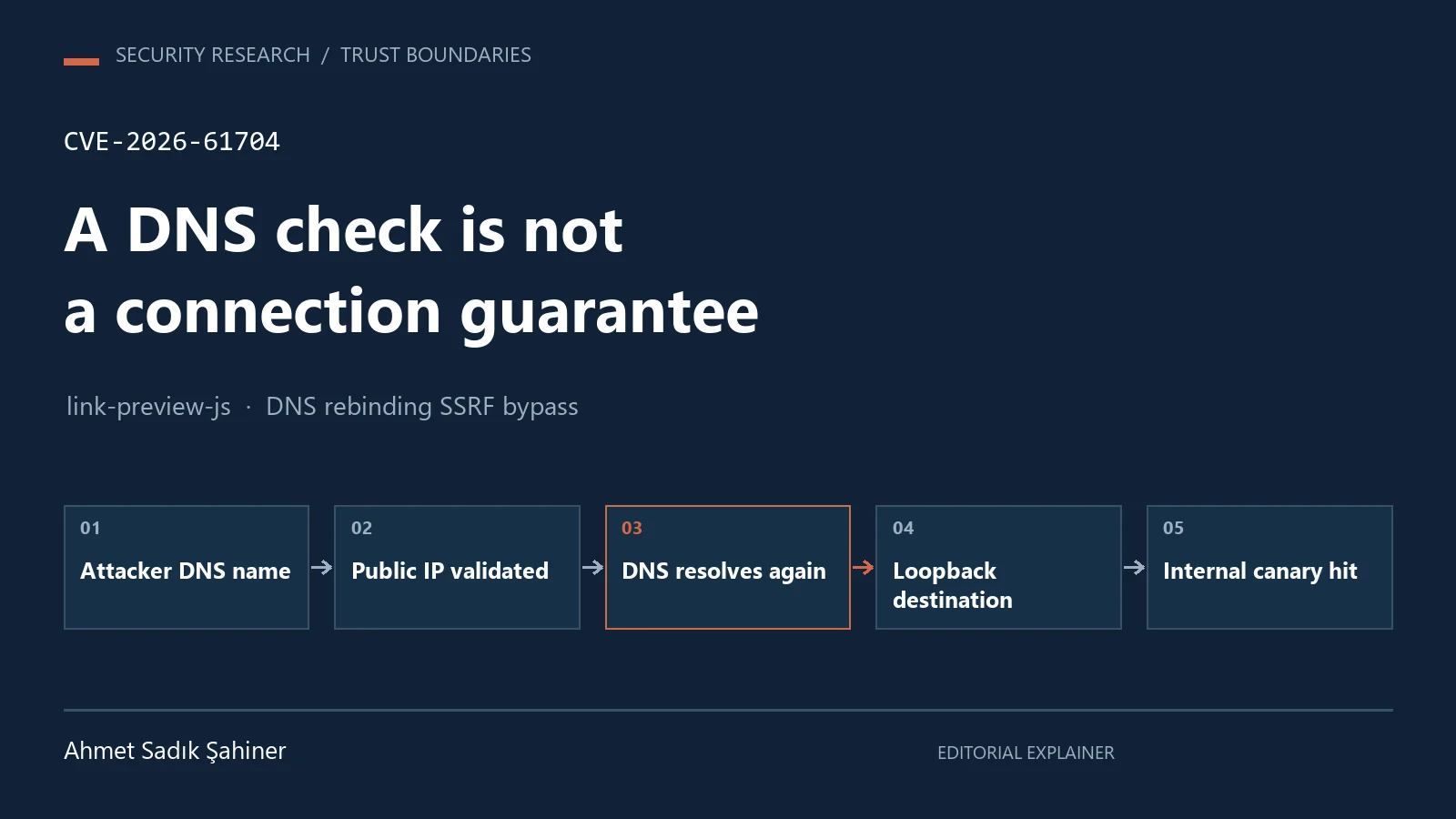
The invariant the code was missing is simple: the destination used by the connection must be the destination that passed validation.
Exploitation
Step 1: serve two different answers for the same name
The local DNS server was configured so that the first A query for rebind.test returned a public address, and a later A query for the same name returned loopback. The library's validation step saw the public address and accepted it.
Step 2: let the library fetch the original hostname
Because the fetch target was derived from the original URL rather than the validated address, the HTTP client performed its own resolution. That second lookup received loopback, and the request went to the canary on [redacted]:9878.
Step 3: read the preserved console log
The captured log shows the two DNS answers, the guard's decision, the canary hit and the parsed result:
REAL DNS UDP A #1: rebind.test -> [redacted] client=[redacted]:45035GUARD RESOLVED: 93.184.216.34REAL DNS UDP A #2: rebind.test -> [redacted] client=[redacted]:50382REAL DNS UDP type=28: rebind.test -> NOERROR/NODATACANARY HIT: remote=[redacted] host="rebind.test:9878"RESULT: title="INTERNAL-CANARY-HIT"
Read line by line, the log records:
REAL DNS UDP A #1returned[redacted], a public address, forrebind.test.GUARD RESOLVED: [redacted]shows the mitigation resolving and accepting that public address.REAL DNS UDP A #2returned[redacted]for the same name, from a different client port, which is the second resolution performed by the connection path.REAL DNS UDP type=28returnedNOERROR/NODATAfor the AAAA query, so no IPv6 answer interfered with the test.CANARY HIT: remote=[redacted] host="rebind.test:9878"shows the request arriving at the loopback-only canary.RESULT: title="INTERNAL-CANARY-HIT"shows the returned preview containing the canary's title, so the response was not only fetched but parsed.
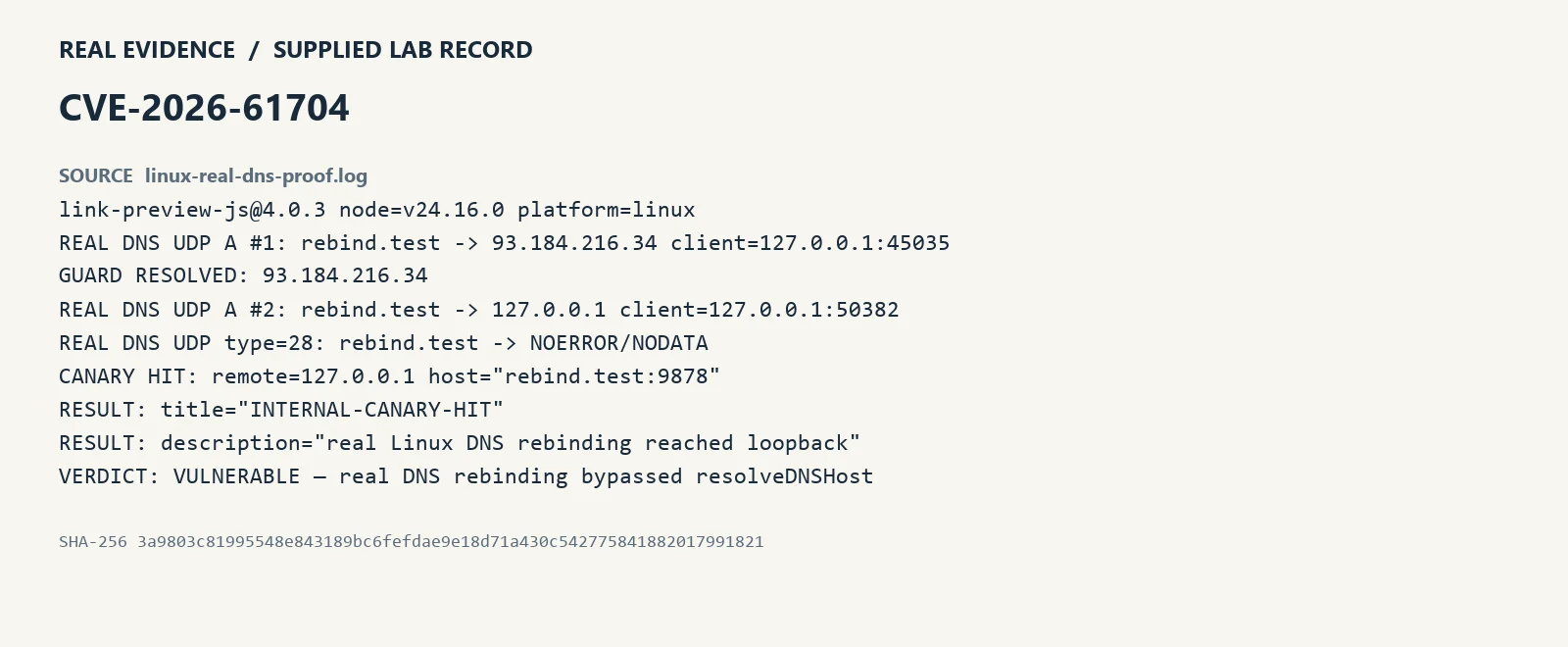
Together with the two DNS answers, this supports an end-to-end validation-to-connection mismatch rather than merely a suspicious input accepted by a parser.
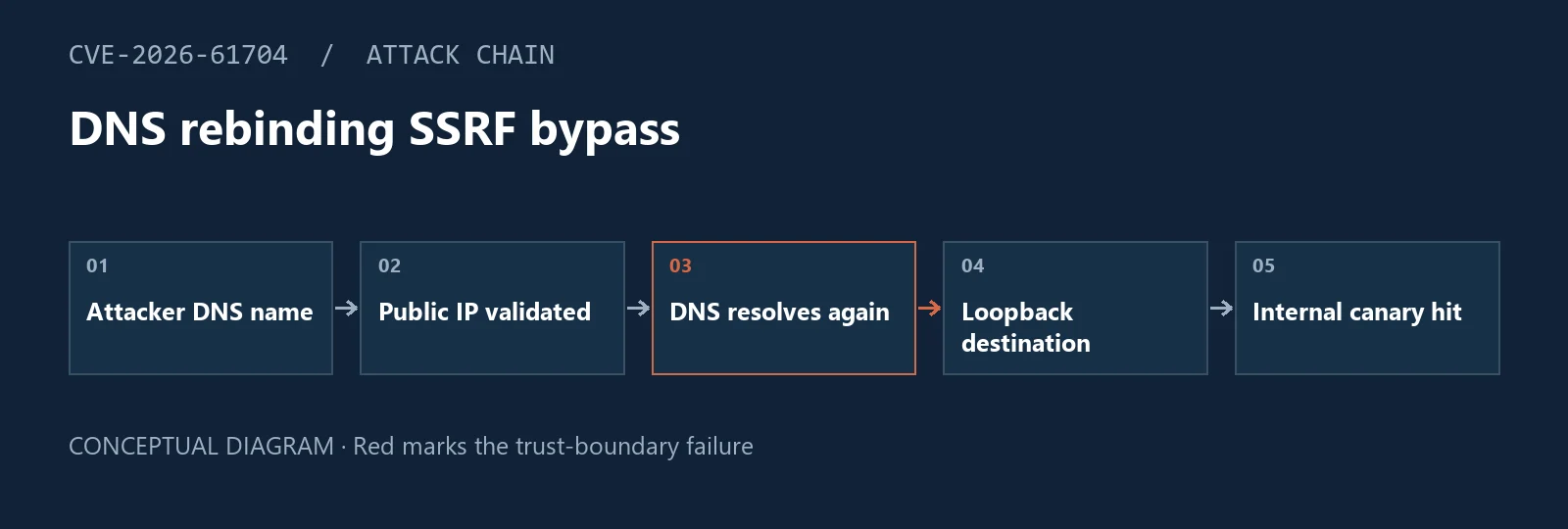
Negative control
A separate EVIDENCE.txt records a direct-loopback control that was rejected with the message SSRF request detected, trying to query host. That supports the distinction between an absent guard and a guard applied to an address different from the one ultimately used. The control is preserved in the Windows validation summary, not in the real-DNS Linux console excerpt. Other summarised address-format checks are supplementary and are not required to establish this DNS-rebinding result.
Root cause
In the vulnerable 4.0.3 path, the resolution callback produced an address that was passed to throwOnLoopback. The fetch target was still derived from the original detected URL. Validating a result did not bind the later connection to it, so the HTTP client was free to resolve the name again and reach a different destination.
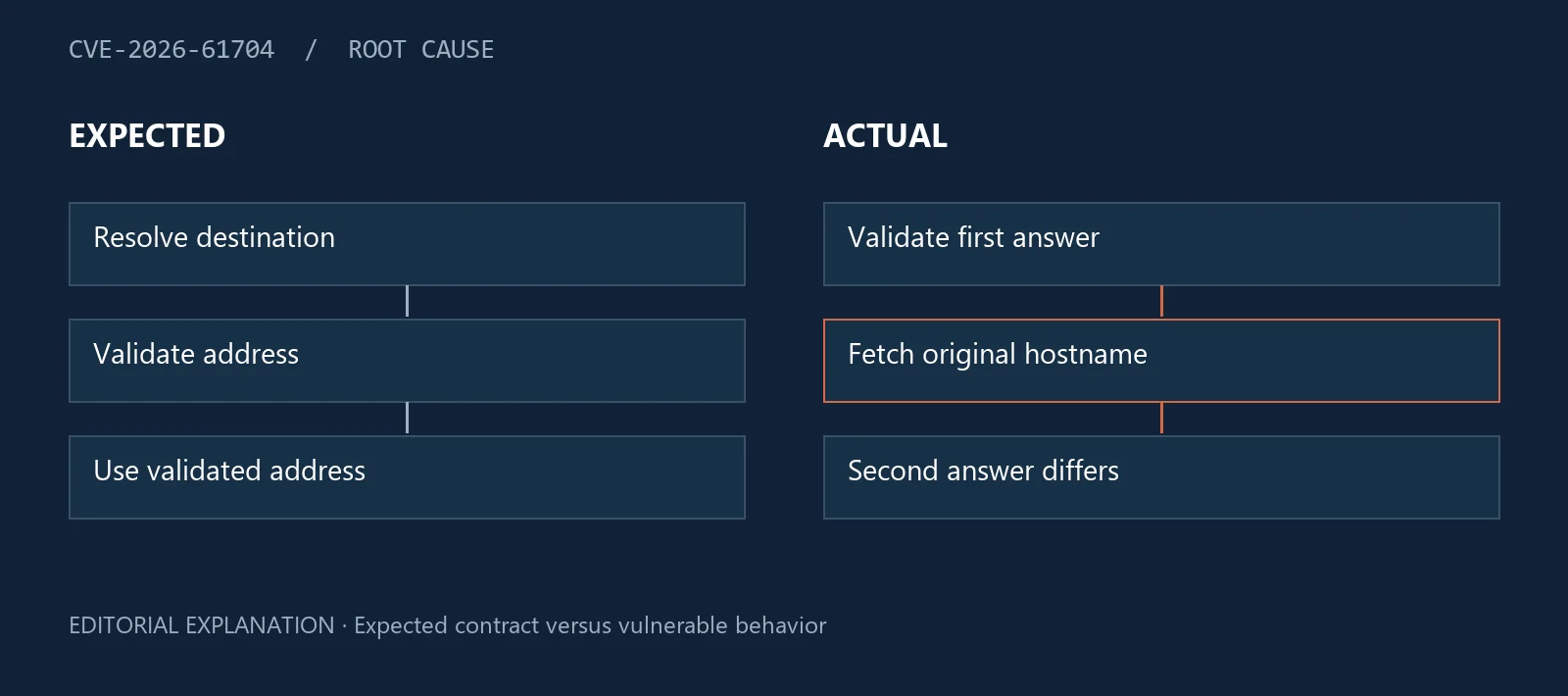
The existing defence failed because it checked a value that was never carried into the transport decision. The guard was correct about the address it saw; the connection simply did not use that address.
Impact
The controlled result demonstrates access to and parsing of a loopback HTTP resource. The CNA rates confidentiality impact as high and does not assign integrity or availability impact in this vector. Access to cloud metadata, credential theft or code execution was not demonstrated by this test.
In a real deployment, the exposure depends on what the server-side fetch context can reach and on how the preview endpoint is exposed. Public reachability of a particular application's preview endpoint, authentication requirements and egress policy remain deployment-specific.
Fix
PR #181 was merged on 23 June 2026. Its history matters for describing the fix accurately. The initial change, commit 6ee25043, used a pinned dispatcher. The later change, commit f3a3dd84, removed Node-specific dependencies and constructed the fetch URL from the validated resolved address. Describing the final implementation as still using the earlier dispatcher would be inaccurate.
The final diff also applies the validated-address conversion to the explicitly handled redirect target and expands address normalisation checks. Redirect validation is a separate decision point: approval of the initial destination does not authorise a subsequent one. This source analysis concerns the shown manual-redirect path and does not claim universal protection for arbitrary proxies or every redirect configuration.
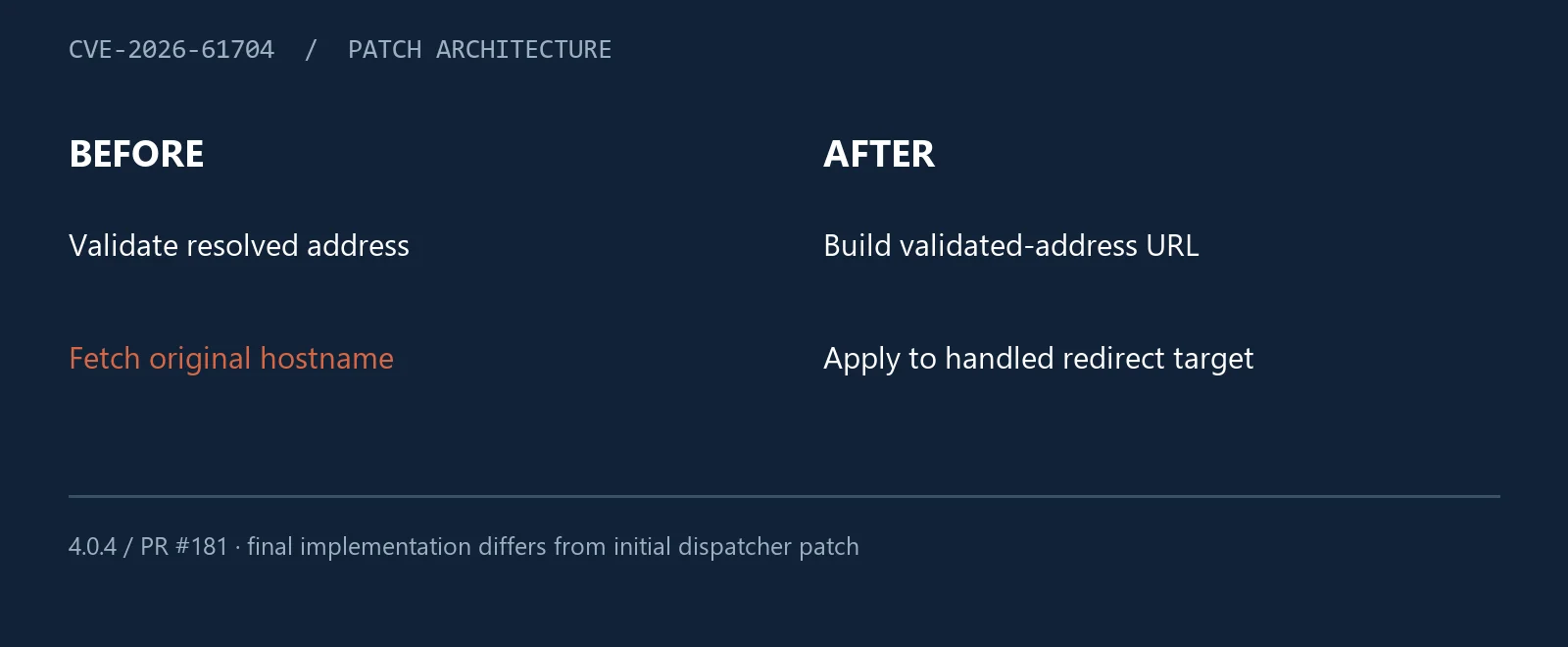
The 4.0.4 release was published on 23 June 2026 and references the PR. Its source changes and regression assertions support the fix architecture, but they are not a replacement for a fresh real-network retest in each consumer's deployment, including HTTPS identity handling, redirects and any proxy path.
The defensive lesson generalises: an SSRF boundary must cover resolution and connection together. Carry the validated address into the transport decision, reapply the contract at redirect boundaries, and account for normalised IPv4 and IPv6 forms. Egress restrictions provide a separate layer of containment.
CVE identity and chronology
This research followed the earlier CVE-2026-43897 mitigation. The authoritative CVE-2026-61704 record identifies the new issue and links GHSA-cpjf-6666-r8fx. The advisory page retrieved during the review still displayed CVE-2026-43897 in its CVE field, despite describing the rebinding report and 4.0.4. That display discrepancy is recorded in the verification report, and the write-up uses the dedicated CVE-2026-61704 record as its identifier authority.
The advisory credits the reporter account ahmet-sahiner, and the PR identifies the same account as author. The CVE JSON itself does not include a finder-credit field.
Timeline:
- 22 June 2026: preserved controlled DNS evidence.
- 23 June 2026: PR merge and 4.0.4 release; the retrieved advisory displays this publication date.
- 20 August 2026: CVE-2026-61704 publication in the official record.
- 26 September 2026: evidence and reference review for the write-up.
The evidence used a local canary and no third-party HTTP target. No production probing was performed during publication preparation, and the publication does not claim a new test run or a complete fixed-version retest.
Variants to test
- Second-resolution rebinding against other preview or fetch libraries. Point a hostname at a public address for the first query and at loopback or an internal address for the second. A positive result is a log showing the guard accepting the public address and the canary receiving the request.
- Redirect targets. Submit a URL that passes validation and then redirects to a name you control. A positive result is the redirect target being fetched without the validated-address treatment, which would show that the contract is not reapplied at the redirect boundary.
- IPv6 and normalised forms. Answer with AAAA records or unusual IPv4 encodings after the first accepted answer. A positive result is a connection to an address the guard would have rejected had it seen that form.
- Direct-loopback control. Submit a loopback literal to confirm the guard is present at all. A rejection with
SSRF request detected, trying to query hostshows the guard exists, which makes a successful rebinding result meaningful rather than a sign of a missing check. - Proxy paths. Route the fetch through a configured proxy and observe whether the validated address is still the one used. A positive result is the proxy resolving the original hostname independently of the validation step.
What happened, in plain words
A small piece of software called link-preview-js is used by websites to build link previews. You have seen the result: you paste a link into a chat app or a social network, and a moment later a little card appears with the page title, a description and maybe an image. link-preview-js is one of the tools that does that job on the server side.
To build that card, the server has to visit the link you gave it. That is the interesting part from a security point of view: the server is now fetching an address chosen by a user. If the server is careless, a user can make it fetch something it should never reach, such as a page that only exists inside the company network.
The defence against that is called SSRF protection (Server-Side Request Forgery protection). The idea is simple: before fetching, check where the address points, and refuse if it points somewhere private.
In version 4.0.3 of link-preview-js, that check existed but was done in a way that could be bypassed. The library looked up the address once, decided it was fine, and then made the actual request using the original name. Between the check and the request, the name could be looked up again and give a completely different answer. The preserved test showed exactly this: the check saw a public address, and the request ended up on a private one.
The trick is called DNS rebinding, and the fix shipped in version 4.0.4. The lesson is short: checking an address is not the same as connecting to it.
The product, and why its defences matter
What link-preview-js does
link-preview-js is a library: a bundle of code that other programs can include instead of writing the same logic themselves. Its job is to take a web link and extract information from it, such as the page title, a description and images, so an application can show a preview card.
What "server-side" means here
When you use a website, two computers are involved. Your browser runs code on your machine (the client side), and the website's own computer runs code somewhere in a data centre (the server side). A server-side integration means the preview is built by the website's server, not by your browser.
That matters because the server usually sits inside a private network. It can often reach internal pages, admin panels and internal services that you, sitting at home, cannot reach at all. So when the server fetches a URL on your behalf, it may be able to reach places you cannot.
What SSRF is, in everyday terms
Imagine a hotel concierge who will fetch anything you ask for. Normally that is a helpful service. But if the concierge has a master key and will also walk into any guest room you name, then asking him to "fetch the newspaper from room 302" becomes a way to get into a room you do not have a key for.
SSRF is exactly that: you convince a server to make a request to a destination of your choosing, using the server's own access rights. The server is the concierge, and its network position is the master key.
The threat model
A threat model is a short description of who the attacker is and what they can do. Here the attacker is assumed to control the DNS answers for the URL they submit, and to be able to make the name be looked up again between the check and the connection. They do not need to submit an obviously private address such as [redacted] to the first check.
Whether a particular application's preview feature is reachable from the internet, whether it requires a login, and what its network is allowed to reach are all things that depend on how that application is deployed. The flaw is in the library, but the real-world exposure depends on the deployment.
The identifiers on this report
Before the technical part, a few labels that appear on every published vulnerability:
| Label | Meaning here |
|---|---|
| CVE-2026-61704 | A CVE is a public catalogue number for a known vulnerability. This is the entry for this issue. |
| CWE-918 | A CWE is a category label. CWE-918 is the category for server-side request forgery. |
| CVSS v3.1 7.5 High | CVSS is a scoring system from 0 to 10. 7.5 is in the "High" band. |
AV:N/AC:L/PR:N/UI:N/S:U/C:H/I:N/A:N |
The score broken into parts, explained below. |
| before 4.0.4 | Every version of the library older than 4.0.4 is affected. |
| 4.0.3 | The version used in the preserved test. |
| 4.0.4 | The version that contains the fix. |
The CVSS string is worth decoding, because each part is a small statement about the attack:
AV:N(attack vector: network): the attacker works over the network, not by sitting at the machine.AC:L(attack complexity: low): no special conditions are needed beyond the setup described.PR:N(privileges required: none): the attacker does not need an account.UI:N(user interaction: none): no victim has to click anything.S:U(scope: unchanged): the impact stays within the affected component.C:H(confidentiality: high): data can be read that should not be readable.I:NandA:N(integrity and availability: none): the score does not claim data can be changed or that the service can be knocked offline.
The setup used for the test
The main evidence is a console log from a Linux virtual machine, dated 22 June 2026, backed by a readable summary of the evidence. A virtual machine is a computer simulated in software, so the test could be run in a controlled, disposable environment.
| Component | Version |
|---|---|
| OS | Alpine Linux 3.24.1 |
| Runtime | Node.js 24.16.0 |
| Package | [redacted] |
A runtime is the program that executes the code; Node.js is the runtime that runs JavaScript outside a browser. The package records hashes for the installed library files.
Two pieces of local infrastructure were used:
- A local DNS server on UDP port 53. DNS is the internet's phone book: it turns a name like
example.cominto a numeric address. Port 53 is the standard port for DNS queries. This local server was configured to answer the first lookup for the test name with a public address, and a later lookup for the same name with a loopback address. - An HTTP canary listening only on
[redacted]:9878. A canary here is a small web server set up purely to record whether anyone reaches it.[redacted]is the loopback address, meaning "this same machine"; a server bound only to it is not reachable from other computers. Port 9878 is simply the port it was told to listen on.
The evidence describes no monkey-patching of dns.lookup, fetch or the library for this Linux run. Monkey-patching means replacing a function at runtime with your own version, which is a common shortcut in tests but would weaken the result. The evidence describes no monkey-patching for this Linux run.
Finding the flaw
What the defence did
The documented mitigation in the vulnerable path was a function called resolveDNSHost. A mitigation is a protective measure added to reduce risk. This function looked up the hostname and passed the resulting address to another function, throwOnLoopback, which rejected loopback destinations.
In plain words: "look up the name, and if the answer is a private address, refuse".
What went wrong
The problem was what happened next. The fetch target was still derived from the original detected URL, not from the address that had just been validated. So the check examined one thing, and the connection used another.
That means the name stayed the same while its meaning as a network destination could change. A correct classification of the first DNS answer could coexist with an unsafe second connection.
TOCTOU, explained with a shop queue
This is a TOCTOU gap: "time of check to time of use". The classic everyday version: a bouncer checks your ticket at the door, you walk in, and by the time you reach the bar someone has swapped your ticket for a different one. The check was correct when it happened; the thing being checked changed afterwards.
Here, the "ticket" is the DNS answer. The check saw a public address. The connection asked again and got a private one.
The invariant the code was missing is simple: the destination used by the connection must be the destination that passed validation. An invariant is a rule that must always hold. If the check approves address A, the connection must go to address A, not to whatever the name resolves to next time.
How the attack was carried out
Step 1: serve two different answers for the same name
The local DNS server was configured so that the first A query for rebind.test returned a public address, and a later A query for the same name returned loopback.
An A query asks DNS for the IPv4 address of a name. IPv4 is the older, four-number address format, like [redacted]. rebind.test is a made-up test name; the .test ending is reserved for testing and is not a real internet domain.
Why this step: the attacker needs the first answer to look harmless, so the guard says yes. The second answer is the one that actually matters, and it is the one the guard never sees.
Step 2: let the library fetch the original hostname
Because the fetch target was derived from the original URL rather than the validated address, the HTTP client performed its own resolution. That second lookup received loopback, and the request went to the canary on [redacted]:9878.
An HTTP client is the part of the program that actually makes the web request. It has its own DNS lookup step. That is the whole bug in one sentence: two separate lookups, one for the check and one for the connection.
Why this step: this is the moment the mismatch turns into a real request. The guard has already finished and said yes; nothing re-checks the second answer.
Step 3: read the preserved console log
The captured log shows the two DNS answers, the guard's decision, the canary hit and the parsed result:
REAL DNS UDP A #1: rebind.test -> [redacted] client=[redacted]:45035GUARD RESOLVED: 93.184.216.34REAL DNS UDP A #2: rebind.test -> [redacted] client=[redacted]:50382REAL DNS UDP type=28: rebind.test -> NOERROR/NODATACANARY HIT: remote=[redacted] host="rebind.test:9878"RESULT: title="INTERNAL-CANARY-HIT"
Line by line, in plain words:
REAL DNS UDP A #1: rebind.test -> [redacted] client=[redacted]:45035is the first lookup. The namerebind.testis answered with[redacted], a public address.UDPis the transport protocol DNS normally uses, andclient=[redacted]:45035records which local port asked the question, so the two lookups can be told apart.GUARD RESOLVED: [redacted]is the mitigation's own lookup and its decision. The guard saw the public address and accepted it.REAL DNS UDP A #2: rebind.test -> [redacted] client=[redacted]:50382is the second lookup, for the same name, from a different local port. This time the answer is[redacted], the loopback address. This is the connection path asking again.REAL DNS UDP type=28: rebind.test -> NOERROR/NODATAis an AAAA query, which asks for the IPv6 address of a name.NOERROR/NODATAmeans the query was valid but there was no IPv6 answer, so no IPv6 address interfered with the test.CANARY HIT: remote=[redacted] host="rebind.test:9878"is the canary reporting that a request arrived. The request came from[redacted]and was addressed to the namerebind.teston port 9878.RESULT: title="INTERNAL-CANARY-HIT"is the preview that came back. The title of the canary page was extracted, so the response was not only fetched but also parsed.
Together with the two DNS answers, this supports an end-to-end validation-to-connection mismatch rather than merely a suspicious input accepted by a parser. In other words: it is not just that the library accepted an odd-looking URL. The request really arrived somewhere it should not have.
The negative control
A negative control is a test you expect to fail, run to prove that your test setup can tell the difference. If you want to show that a lock is broken, you first show that the lock works when used normally.
A separate EVIDENCE.txt records a direct-loopback control that was rejected with the message SSRF request detected, trying to query host. That supports the distinction between an absent guard and a guard applied to an address different from the one ultimately used.
The control is preserved in the Windows validation summary, not in the real-DNS Linux console excerpt. Other summarised address-format checks are supplementary and are not required to establish this DNS-rebinding result.
Why this matters: without the control, a successful rebinding test could just mean "there is no guard at all". With the control, it means "the guard exists, it simply checked the wrong thing".
The root cause
In the vulnerable 4.0.3 path, the resolution callback produced an address that was passed to throwOnLoopback. The fetch target was still derived from the original detected URL. Validating a result did not bind the later connection to it, so the HTTP client was free to resolve the name again and reach a different destination.
The existing defence failed because it checked a value that was never carried into the transport decision. The guard was correct about the address it saw; the connection simply did not use that address.
A useful comparison: a courier checks the address on a parcel, approves it, and then hands the parcel to a driver who is told only the recipient's name and looks the address up again himself. The check was real. It just had no effect on where the parcel went.
What the impact actually was
The controlled result demonstrates access to and parsing of a loopback HTTP resource. The CNA rates confidentiality impact as high and does not assign integrity or availability impact in this vector.
A CNA is the organisation authorised to assign CVE numbers for a product area; it also fills in the scoring. Confidentiality means reading data, integrity means changing it, availability means keeping the service running. Here only the first is claimed.
Access to cloud metadata, credential theft or code execution was not demonstrated by this test. Cloud metadata is an internal service that cloud machines can query for information about themselves, and it is a well-known SSRF target; credential theft means stealing passwords or keys; code execution means getting your own code to run on the server. None of those were shown here.
In a real deployment, the exposure depends on what the server-side fetch context can reach and on how the preview endpoint is exposed. Public reachability of a particular application's preview endpoint, authentication requirements and egress policy remain deployment-specific. Egress policy is the set of rules about what a network is allowed to connect out to.
The fix
PR #181 was merged on 23 June 2026. A PR (pull request) is a proposed change to a code repository, which can be reviewed and discussed before it is accepted. Merged means it was accepted into the main code.
Its history matters for describing the fix accurately. The initial change, commit 6ee25043, used a pinned dispatcher. A commit is a saved change with an identifier. A dispatcher is the component that decides how a network connection is actually made.
The later change, commit f3a3dd84, removed Node-specific dependencies and constructed the fetch URL from the validated resolved address. Describing the final implementation as still using the earlier dispatcher would be inaccurate. In plain words: the later change removed Node-specific dependencies and builds the URL from the address that was checked.
The final diff also applies the validated-address conversion to the explicitly handled redirect target and expands address normalisation checks. A diff is the list of lines changed. A redirect is when a server answers "not here, go there instead". Normalisation means writing an address in one standard form, because the same address can be spelled several ways.
Redirect validation is a separate decision point: approval of the initial destination does not authorise a subsequent one. This source analysis concerns the shown manual-redirect path and does not claim universal protection for arbitrary proxies or every redirect configuration. A proxy is an intermediary that makes requests on your behalf, and it can do its own DNS lookup, which is why it is called out separately.
The 4.0.4 release was published on 23 June 2026 and references the PR. Its source changes and regression assertions support the fix architecture, but they are not a replacement for a fresh real-network retest in each consumer's deployment, including HTTPS identity handling, redirects and any proxy path. Regression assertions are automated checks written to fail if the old behaviour comes back. HTTPS identity handling means checking that the certificate belongs to the name you intended to reach, which gets subtle once you connect to a numeric address instead of a name.
The defensive lesson generalises: an SSRF boundary must cover resolution and connection together. Carry the validated address into the transport decision, reapply the contract at redirect boundaries, and account for normalised IPv4 and IPv6 forms. Egress restrictions provide a separate layer of containment. Defence in depth is the idea behind that last sentence: even with a correct check, limit what the server can reach at the network level too.
CVE identity and chronology
This research followed the earlier CVE-2026-43897 mitigation. The authoritative CVE-2026-61704 record identifies the new issue and links GHSA-cpjf-6666-r8fx. A GHSA identifier is a GitHub security advisory number, the repository platform's own tracking entry.
The advisory page retrieved during the review still displayed CVE-2026-43897 in its CVE field, despite describing the rebinding report and 4.0.4. That display discrepancy is recorded in the verification report, and the write-up uses the dedicated CVE-2026-61704 record as its identifier authority. In plain words: one page displayed the wrong CVE label, so the author relied on the official CVE record instead.
The advisory credits the reporter account ahmet-sahiner, and the PR identifies the same account as author. The CVE JSON itself does not include a finder-credit field. JSON is a plain text format for structured data, and the CVE record is published in it.
Timeline:
- 22 June 2026: preserved controlled DNS evidence.
- 23 June 2026: PR merge and 4.0.4 release; the retrieved advisory displays this publication date.
- 20 August 2026: CVE-2026-61704 publication in the official record.
- 26 September 2026: evidence and reference review for the write-up.
The evidence used a local canary and no third-party HTTP target. No production probing was performed during publication preparation, and the publication does not claim a new test run or a complete fixed-version retest. Production probing means testing against real, live systems belonging to someone else, which was deliberately avoided.
Variants worth testing
These are follow-up tests suggested by the same idea, for anyone checking similar software:
- Second-resolution rebinding against other preview or fetch libraries. Point a hostname at a public address for the first query and at loopback or an internal address for the second. A positive result is a log showing the guard accepting the public address and the canary receiving the request.
- Redirect targets. Submit a URL that passes validation and then redirects to a name you control. A positive result is the redirect target being fetched without the validated-address treatment, which would show that the contract is not reapplied at the redirect boundary.
- IPv6 and normalised forms. Answer with AAAA records or unusual IPv4 encodings after the first accepted answer. A positive result is a connection to an address the guard would have rejected had it seen that form.
- Direct-loopback control. Submit a loopback literal to confirm the guard is present at all. A rejection with
SSRF request detected, trying to query hostshows the guard exists, which makes a successful rebinding result meaningful rather than a sign of a missing check. - Proxy paths. Route the fetch through a configured proxy and observe whether the validated address is still the one used. A positive result is the proxy resolving the original hostname independently of the validation step.
Glossary
- AAAA query: a DNS question asking for the IPv6 address of a name.
- A query: a DNS question asking for the IPv4 address of a name.
- API: a defined way for one program to ask another program to do something, without knowing how it works inside.
- Canary: a small server or file set up only to record whether something reaches it.
- CNA: the organisation authorised to assign CVE numbers and fill in the scoring for a product area.
- Commit: a saved change in a code repository, identified by a hash.
- Cookie: a small piece of data a website stores in your browser so it can recognise you on the next request.
- Credential theft: stealing passwords, keys or tokens so an attacker can act as someone else.
- CVE: a public catalogue number for a known vulnerability.
- CVSS: a scoring system that rates the severity of a vulnerability from 0 to 10.
- CWE: a category label for a type of weakness, such as CWE-918 for SSRF.
- Defence in depth: using several independent protective layers so one failure does not open everything.
- Diff: the list of lines changed between two versions of code.
- Dispatcher: the component that decides how a network connection is actually made.
- DNS: the internet's phone book, turning names into numeric addresses.
- DNS rebinding: an attack where a name resolves to a harmless address during a check and to a different address when the connection is made.
- Egress policy: the rules about what a network is allowed to connect out to.
- HTTP client: the part of a program that makes web requests.
- HTTPS identity handling: checking that a server's certificate matches the name you meant to reach.
- Invariant: a rule that must always hold true.
- IPv4 / IPv6: the two address formats for internet destinations; IPv4 uses four numbers, IPv6 uses a longer hexadecimal form.
- JSON: a plain text format for structured data.
- Library: a bundle of code that other programs include instead of writing the same logic themselves.
- Loopback: the address
[redacted], meaning "this same machine"; a service bound only to it is not reachable from other computers. - Merged: accepted into the main line of a code repository.
- Mitigation: a protective measure added to reduce risk.
- Monkey-patching: replacing a function at runtime with your own version.
- Negative control: a test you expect to fail, run to prove your setup can tell the difference.
- Normalisation: rewriting a value in one standard form so equivalent spellings compare equal.
- Port: a number that identifies which service on a machine a connection is meant for.
- PR (pull request): a proposed change to a code repository, reviewed before being accepted.
- Production probing: testing against real, live systems belonging to someone else.
- Proxy: an intermediary that makes requests on your behalf.
- Regression assertion: an automated check written to fail if an old bug comes back.
- Runtime: the program that executes code, such as Node.js for JavaScript outside a browser.
- Server-side: code that runs on the website's own computer rather than in your browser.
- SSRF: Server-Side Request Forgery, making a server fetch a destination of your choosing using its own access.
- Threat model: a short description of who the attacker is and what they can do.
- TOCTOU: "time of check to time of use", a gap where the thing checked changes before it is used.
- Token: a piece of data, often a string, that proves who you are or grants access, similar in role to a cookie.
- UDP: a simple transport protocol, used by DNS, that sends a message without setting up a connection first.
- Virtual machine: a computer simulated in software, useful for controlled, disposable tests.