CVE-2026–61500: Forging an HFS Admin Session Without Logging In
HFS used JavaScript's non-cryptographic Math.random() to generate both the cookie-signing key and a login-handshake identifier that was returned to clients. An unauthenticated attacker could recover the PRNG state from those exposed values, rebuild the signing key, forge an admin session and then run arbitrary code through the server_code feature.

medium.com
Published on medium.com
Cybersecurity
The full write-up lives on its author's site
It belongs to its author, so we link to it rather than copy it. The other two tabs are our own rewrites, checked against it.
Context
Rejetto HFS (HTTP File Server) is a file-sharing server. Versions 3.0.0 through 3.2.0 carry a flaw that lets an unauthenticated attacker forge an administrator session and, from there, execute arbitrary code on the server through HFS's own server_code configuration feature. The issue is tracked as CVE-2026-61500 and rated CVSS 3.1 9.8 (Critical), CVSS 4.0 9.3, CWE-338 (Use of a cryptographically weak PRNG).
HFS runs on Koa. Two values that are supposed to be secret were generated with plain JavaScript Math.random(): the cookie-signing key and a login-handshake identifier. Because both come from the same deterministic generator, the identifier that the server hands to any client leaks the state needed to reconstruct the signing key.

The bug was found by Zach Hanley at Horizon3.ai in September 2026 while using Claude for the analysis, and real-world exploitation started on October 1.
Setup
The attack needs no account and no credentials; the attacker targets a known account, for example admin, because the first login step is keyed on an account. The attacker needs the ability to send HTTP requests to the server and to read the cookies it returns. In the validated environment, running id through this path returned uid=0(root).
Finding it
The weak spots are in three short pieces of code. The signing key is derived at startup from randomId(30) unless COOKIE_SIGN_KEYS is set:
import { randomId } from './misc'const keys = process.env.COOKIE_SIGN_KEYS?.split(',') || [randomId(30)] export const app = new Koa({ keys })
randomId is a thin wrapper over Math.random():
export function randomId(len = 10): string { if (len > 10) return randomId(10) + randomId(len - 10) return Math.random().toString(36).slice(2, 2 + len)}
The login handshake uses the same generator for its session identifier:
const { srpServer, ...rest } = await srpServerStep1(account)const sid = Math.random() ongoingLogins[sid] = srpServerctx.session.loggingIn = { username, sid }
What makes this exploitable is the combination:
randomId(30)callsMath.random()three times and concatenates the results as base-36 strings. This runs once at server startup and becomes the secret key used to sign every session cookie afterward.loginSrp1, the first step of login, is callable by anyone with no authentication. It generates a freshMath.random()value on every call and ships it back to the client assid, sitting in plain sight inside the session cookie.
Both values come from the same PRNG. V8's Math.random() is not cryptographically secure: it is xorshift128+, a fully deterministic algorithm. Recover its 128-bit internal state and you can compute every value it has ever produced or ever will produce.
Exploitation
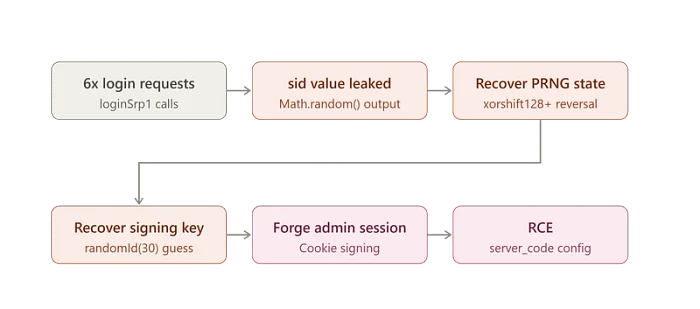
Step 1-2: Harvest PRNG outputs
The attacker sends six unauthenticated loginSrp1 requests for a known account (for example admin). Each response's cookie carries the current sid, which is a raw Math.random() output at that exact moment. The server is handing out fragments of its own secret PRNG state on every request.
Step 3: Reverse the PRNG state
V8's Math.random() exposes only the 53-bit mantissa of a 64-bit double; the remaining 11 bits are dropped during rounding. The attacker takes five consecutive observed values, recovers their 53 visible bits each, brute-forces the missing 11 bits (only 2,048 combinations, trivial), and reverses V8's xorshift128+ recurrence until it finds the single internal state consistent with every observation. Once that state is known, every past and future Math.random() output becomes predictable.
Step 4: Recover the cookie-signing key
Rewinding that same PRNG state back to server startup reproduces the exact randomId(30) call that produced the cookie-signing key. Because V8 rounds strings to their shortest representation, a few candidate keys can come out of this. The attacker disambiguates by checking which one matches the HMAC on an actual cookie the server sent, which also pins down the server's startup offset.
Step 5: Forge the admin session
With the signing key in hand, the attacker builds a session object containing { username: "admin" } and signs it the same way Koa does. Handing that forged cookie to an admin-only endpoint like get_config gets a clean HTTP 200 back, with no login ever taking place.
Step 6: RCE via server_code
HFS officially lets admins register a server_code JavaScript snippet that the server executes. With the forged session, the attacker calls set_config to install their own payload, and it runs immediately with the server process's privileges.
Note what the attacker never touches directly: the filesystem, process memory, or environment variables. The entire chain is a black-box reconstruction of secret internal state from values the server itself returned over HTTP.
Root cause
The mistake is using a non-cryptographic PRNG for values with a security role. Math.random() in V8 is xorshift128+, which is deterministic and has a small enough state (128 bits) that it can be recovered from a handful of outputs. The signing key and the handshake identifier were drawn from the same stream, so exposing the identifier to clients exposed the key. The existing defence, signing session cookies with a secret key, is only as strong as the secrecy of that key, and here the key was recoverable from public responses. The report does not describe any other control that would have stopped the chain.
Impact
An unauthenticated attacker can forge an administrator session and then execute arbitrary code on the server through server_code, with the privileges of the server process. In the validated environment that was root. The attacker never touches the filesystem, process memory or environment variables directly; the chain is a black-box reconstruction of secret internal state from values the server returned over HTTP. Real-world exploitation started on October 1, 2026.
Fix
HFS 3.2.1 replaces both weak spots with Node's cryptographically secure primitives. The signing key now comes from randomBytes:
import { randomBytes } from 'node:crypto'const keys = process.env.COOKIE_SIGN_KEYS?.split(',') || [randomBytes(32).toString('base64url')] export const app = new Koa({ keys })
The handshake identifier now comes from randomUUID:
import { randomUUID } from 'node:crypto'const sid = randomUUID() ongoingLogins[sid] = srpServer
randomBytes(32) pulls 256 bits straight from the OS-level CSPRNG, so observing the output gives an attacker nothing to reverse. sid is now a randomUUID(), so it no longer hands out a clue to the PRNG's internal state at all. The lesson generalizes cleanly: any value with a security role, including a session identifier that looks like throwaway metadata, needs a CSPRNG, and nothing a PRNG produces should ever be exposed to a client.
Variants to test
- Other Node/Koa applications that fall back to
randomId-style helpers forkeys. Look for a startup path whereCOOKIE_SIGN_KEYSis unset and the fallback isMath.random()-based. A positive result is a cookie-signing key you can reproduce from observed outputs. - Login or handshake endpoints that return a
Math.random()value in a cookie or body. Send several unauthenticated requests and check whether the returned identifiers are consistent with a recoverable PRNG stream. A positive result is a sequence from which you can predict the next value. - Applications exposing both a PRNG-derived secret and a PRNG-derived public value from the same process. If the public value is observable, try rewinding to startup to recover the secret. A positive result is a candidate secret that validates against a real HMAC.
- Admin-only endpoints reachable with a forged session. After recovering a key, sign a session for a known admin username and call an endpoint such as
get_config. A positive result is an HTTP 200 without any login. - Features that execute administrator-supplied code, such as
server_code. If a forged admin session reaches a configuration setter likeset_config, install a harmless command and observe the output. A positive result is command output returned with the server's privileges.
What happened, in plain words
Rejetto HFS is a program you install on a computer to share files over the web. Think of it as a small private website that lets people download and upload files. It is often used by people who want a simple file server without setting up anything complicated.
Versions 3.0.0 through 3.2.0 of HFS have a serious flaw. Someone who has never logged in, and who has no username or password, can pretend to be the administrator. Once they are in as the administrator, they can make the server run their own code, with the privileges of the server process.
The flaw is tracked as CVE-2026-61500. A CVE is a public catalogue number given to a known security bug so people can talk about it and look it up. It is rated CVSS 3.1 9.8 (Critical), CVSS 4.0 9.3, and CWE-338 (Use of a cryptographically weak PRNG). CVSS is a scoring system for how bad a bug is, where 10 is the worst. CWE-338 is a label for the type of mistake: using a random number generator that is not good enough for security.
The bug was found by Zach Hanley at Horizon3.ai in September 2026 while using Claude for the analysis. Real-world exploitation started on October 1.
The pieces you need to know first
Before the details make sense, here are a few everyday ideas.
A server is a computer program that waits for requests from other computers and answers them. When you open a website, your browser sends a request and the server sends back a page.
An HTTP request is the message your browser sends to a server: "please give me this page" or "please do this action". An HTTP response is the server's answer, which includes a status code such as 200 (meaning "OK, here you go").
A cookie is a small piece of text that a server asks your browser to keep and send back with every later request. It works like a cloakroom ticket: the server gives you a ticket, and later you show the ticket to prove you are the same person who came in earlier. Websites use cookies to remember that you are logged in.
A session is the server's memory of "this visitor is logged in as this user". The cookie is how the visitor proves which session is theirs.
A signature on a cookie is like a wax seal on an envelope. The server writes the session details, then seals them with a secret key. When the cookie comes back, the server checks the seal. If the seal is intact, the server trusts the contents. If someone edited the contents, the seal no longer matches and the server rejects it. The seal is made with a mathematical function called an HMAC, which takes the contents plus the secret key and produces a short code. Only someone who knows the key can produce a valid code.
A key here is just a long secret string, like a very long password that only the server knows.
Koa is a framework for building web servers in JavaScript. HFS is built on top of it. A framework is a set of ready-made building blocks so the programmer does not have to write everything from scratch.
JavaScript is a programming language, mostly used in browsers but also usable on servers through a program called Node.js.
A PRNG is a pseudo-random number generator. Computers cannot easily produce truly random numbers, so they use a formula that produces a long stream of numbers that look random. The catch is that the formula is deterministic: if you know its internal state (a set of numbers it keeps inside), you can calculate every number it will produce next, and every number it produced before. It is like a very complicated shuffle of a deck of cards: if you know the exact starting order and the exact shuffling rule, you can predict every card.
A CSPRNG is a cryptographically secure pseudo-random number generator. It is built so that seeing some of its output tells you nothing about the next output. It is the kind you must use for anything secret.
V8 is the JavaScript engine inside Node.js and Chrome. It is the part that actually runs JavaScript code, and it is the part that implements Math.random().
Math.random() is the standard JavaScript function for getting a random number. It is fine for games and animations, but it is not a CSPRNG.
xorshift128+ is the specific formula V8 uses inside Math.random(). It keeps 128 bits of internal state and is fully deterministic.
A bit is a single 0 or 1. A 64-bit double is the way computers store decimal numbers: 64 bits in total, of which 53 are used for the significant digits (the mantissa) and the rest for the exponent and sign.
Base 36 is a way of writing numbers using the digits 0 to 9 and the letters a to z. It is like base 10 (our normal counting) but with 36 symbols instead of 10.
Brute force means trying every possibility until one works. It is only practical when the number of possibilities is small.
RCE stands for remote code execution: an attacker can make the server run commands of their choosing.
Root is the all-powerful administrator account on Linux and similar systems. A program running as root can do anything on the machine.
Setup: what the attacker needs
The attack needs no account and no credentials; the attacker targets a known account, for example admin, because the first login step is keyed on an account. The attacker needs the ability to send HTTP requests to the server and to read the cookies it returns. In the validated environment, running id through this path returned uid=0(root).
In plain terms: the attacker only needs to be able to talk to the server over the network, the same way a browser does, and to know that a user called admin exists.
Finding it: the three pieces of code
The weak spots are in three short pieces of code. The signing key is derived at startup from randomId(30) unless COOKIE_SIGN_KEYS is set:
import { randomId } from './misc'const keys = process.env.COOKIE_SIGN_KEYS?.split(',') || [randomId(30)] export const app = new Koa({ keys })
Line by line:
import { randomId } from './misc'brings in a helper function calledrandomIdfrom another file in the project. It is the function that will produce the secret key.const keys = process.env.COOKIE_SIGN_KEYS?.split(',')looks at an environment variable calledCOOKIE_SIGN_KEYS. An environment variable is a setting passed to a program when it starts, a bit like a note left on the desk before the program begins work. If that setting exists, it is split on commas into a list of keys. The?.means "only do the split if the setting exists".|| [randomId(30)]is the fallback: if the setting does not exist, generate a key withrandomId(30). This is the dangerous path, because it uses the weak generator.export const app = new Koa({ keys })creates the Koa application and hands it the key list. Koa will use these keys to sign session cookies.
So the secret key that protects every session cookie is, by default, produced by randomId.
randomId is a thin wrapper over Math.random():
export function randomId(len = 10): string { if (len > 10) return randomId(10) + randomId(len - 10) return Math.random().toString(36).slice(2, 2 + len)}
Line by line:
export function randomId(len = 10): string {defines a function that takes a length, defaulting to 10, and returns text.if (len > 10)checks whether the requested length is more than 10.return randomId(10) + randomId(len - 10)if it is, it calls itself for 10 characters and again for the rest, then glues the two pieces together. So asking for 30 characters means three calls of 10.return Math.random().toString(36).slice(2, 2 + len)otherwise, it asksMath.random()for a number, converts it to base 36 text, cuts off the leading0.(the first two characters) and keepslencharacters.
The key point: every character of the secret key comes from Math.random().
The login handshake uses the same generator for its session identifier:
const { srpServer, ...rest } = await srpServerStep1(account)const sid = Math.random() ongoingLogins[sid] = srpServerctx.session.loggingIn = { username, sid }
Line by line:
const { srpServer, ...rest } = await srpServerStep1(account)runs the first step of the login process for the given account and pulls out a value calledsrpServer. Theawaitmeans "wait for this to finish". SRP is a way of logging in without sending the password itself over the network; the first step sets up the exchange.const sid = Math.random()creates a session identifier,sid, using the weak generator. This is the value that will be handed to the client.ongoingLogins[sid] = srpServerstores the half-finished login in a table, filed under that identifier, so the next step can find it again.ctx.session.loggingIn = { username, sid }records in the visitor's session that a login is in progress, along with the username and the identifier.
What makes this exploitable is the combination:
randomId(30)callsMath.random()three times and concatenates the results as base-36 strings. This runs once at server startup and becomes the secret key used to sign every session cookie afterward.loginSrp1, the first step of login, is callable by anyone with no authentication. It generates a freshMath.random()value on every call and ships it back to the client assid, sitting in plain sight inside the session cookie.
Both values come from the same PRNG. V8's Math.random() is not cryptographically secure: it is xorshift128+, a fully deterministic algorithm. Recover its 128-bit internal state and you can compute every value it has ever produced or ever will produce.
Think of it this way: the server has one long tape of numbers coming out of a machine. It cuts a piece of the tape at startup to make the secret key, and it hands out small pieces of the same tape to anyone who asks. If you can work out where on the tape those public pieces came from, you can wind the tape back to the beginning and read the piece that became the key.
Exploitation: walking the attack chain
Step 1-2: Harvest PRNG outputs
The attacker sends six unauthenticated loginSrp1 requests for a known account (for example admin). Each response's cookie carries the current sid, which is a raw Math.random() output at that exact moment. The server is handing out fragments of its own secret PRNG state on every request.
Each request is just a normal HTTP request to the login endpoint, sent without any login. The server answers with a cookie, and inside that cookie is the sid. The attacker writes down each sid in order.
Step 3: Reverse the PRNG state
V8's Math.random() exposes only the 53-bit mantissa of a 64-bit double; the remaining 11 bits are dropped during rounding. The attacker takes five consecutive observed values, recovers their 53 visible bits each, brute-forces the missing 11 bits (only 2,048 combinations, trivial), and reverses V8's xorshift128+ recurrence until it finds the single internal state consistent with every observation. Once that state is known, every past and future Math.random() output becomes predictable.
In plain words: each number the server hands out is slightly incomplete. The attacker knows most of the digits but not all of them. There are only 2,048 possible ways to fill in the missing part for each number, which a computer can try in an instant. For each guess, the attacker runs the generator's formula backwards and checks whether the result also explains the other observed numbers. Only one internal state fits all of them. Once that state is found, the whole tape is readable in both directions.
Step 4: Recover the cookie-signing key
Rewinding that same PRNG state back to server startup reproduces the exact randomId(30) call that produced the cookie-signing key. Because V8 rounds strings to their shortest representation, a few candidate keys can come out of this. The attacker disambiguates by checking which one matches the HMAC on an actual cookie the server sent, which also pins down the server's startup offset.
In plain words: the attacker now winds the tape back to the moment the server started and reads off the numbers that were used to build the key. Because of small rounding differences when numbers are turned into text, a handful of slightly different keys may come out. To pick the right one, the attacker takes a real cookie the server sent earlier, which already carries a valid seal, and tries each candidate key against it. Only the correct key reproduces the seal. That also confirms exactly how far back the tape was wound.
Step 5: Forge the admin session
With the signing key in hand, the attacker builds a session object containing { username: "admin" } and signs it the same way Koa does. Handing that forged cookie to an admin-only endpoint like get_config gets a clean HTTP 200 back, with no login ever taking place.
In plain words: the attacker writes a cloakroom ticket that says "admin", seals it with the stolen key, and shows it to the server. The server checks the seal, finds it valid, and believes the ticket. An endpoint is a specific address on the server that does one job; get_config is the one that returns the server's settings, and only an administrator should be allowed to call it. A 200 response means the server accepted the request and answered normally. No password was ever typed.
Step 6: RCE via server_code
HFS officially lets admins register a server_code JavaScript snippet that the server executes. With the forged session, the attacker calls set_config to install their own payload, and it runs immediately with the server process's privileges.
In plain words: HFS has a legitimate feature where an administrator can paste in a small JavaScript program and the server will run it. That feature exists so admins can customise behaviour. The attacker uses the forged admin session to call set_config, the endpoint that saves settings, and stores their own program there. The server runs it straight away, with the same powers the server itself has. The id command is a standard Linux command that reports which user you are; it answered uid=0(root), meaning the attacker's code was running as the all-powerful root user.
Note what the attacker never touches directly: the filesystem, process memory, or environment variables. The entire chain is a black-box reconstruction of secret internal state from values the server itself returned over HTTP.
That last point matters. The attacker did not break into the machine first and look around. They only sent ordinary web requests and read ordinary web responses. Everything they needed was handed to them by the server, in public, one small piece at a time.
Root cause
The mistake is using a non-cryptographic PRNG for values with a security role. Math.random() in V8 is xorshift128+, which is deterministic and has a small enough state (128 bits) that it can be recovered from a handful of outputs. The signing key and the handshake identifier were drawn from the same stream, so exposing the identifier to clients exposed the key. The existing defence, signing session cookies with a secret key, is only as strong as the secrecy of that key, and here the key was recoverable from public responses. The report does not describe any other control that would have stopped the chain.
In plain words: the seal on the cookie was a good idea, but the key used to make the seal was generated by a machine whose output can be predicted. A lock is only as strong as its key, and this key could be worked out from public information. The deeper mistake is sharing one generator between something secret and something public.
Impact
An unauthenticated attacker can forge an administrator session and then execute arbitrary code on the server through server_code, with the privileges of the server process. In the validated environment that was root. The attacker never touches the filesystem, process memory or environment variables directly; the chain is a black-box reconstruction of secret internal state from values the server returned over HTTP. Real-world exploitation started on October 1, 2026.
In plain words: anyone who can reach the server over the network and target a known account name can end up running commands on the machine with the server process's privileges. They do not need a password, and they do not need to touch the machine directly.
Fix
HFS 3.2.1 replaces both weak spots with Node's cryptographically secure primitives. The signing key now comes from randomBytes:
import { randomBytes } from 'node:crypto'const keys = process.env.COOKIE_SIGN_KEYS?.split(',') || [randomBytes(32).toString('base64url')] export const app = new Koa({ keys })
Line by line:
import { randomBytes } from 'node:crypto'brings inrandomBytesfrom Node's built-in cryptography module. This is the secure generator.const keys = process.env.COOKIE_SIGN_KEYS?.split(',')still honours a key supplied through the environment variable, if one is set.|| [randomBytes(32).toString('base64url')]is the new fallback: 32 random bytes, written as text using base64url, a compact way of representing binary data with letters, digits and a couple of symbols that are safe in URLs.export const app = new Koa({ keys })hands the key list to Koa as before.
The handshake identifier now comes from randomUUID:
import { randomUUID } from 'node:crypto'const sid = randomUUID() ongoingLogins[sid] = srpServer
Line by line:
import { randomUUID } from 'node:crypto'brings inrandomUUID, which produces a universally unique identifier: a long string in a standard format, generated securely.const sid = randomUUID()creates the session identifier with the secure generator instead ofMath.random().ongoingLogins[sid] = srpServerstores the half-finished login under that identifier, exactly as before.
randomBytes(32) pulls 256 bits straight from the OS-level CSPRNG, so observing the output gives an attacker nothing to reverse. sid is now a randomUUID(), so it no longer hands out a clue to the PRNG's internal state at all. The lesson generalizes cleanly: any value with a security role, including a session identifier that looks like throwaway metadata, needs a CSPRNG, and nothing a PRNG produces should ever be exposed to a client.
In plain words: the operating system has a proper random number source, and the fix uses it for both values. Even if an attacker sees a thousand identifiers, they learn nothing about the key, because the secure generator's output cannot be used to work backwards.
Variants to test
These are the same patterns to look for in other software.
- Other Node/Koa applications that fall back to
randomId-style helpers forkeys. Look for a startup path whereCOOKIE_SIGN_KEYSis unset and the fallback isMath.random()-based. A positive result is a cookie-signing key you can reproduce from observed outputs. - Login or handshake endpoints that return a
Math.random()value in a cookie or body. Send several unauthenticated requests and check whether the returned identifiers are consistent with a recoverable PRNG stream. A positive result is a sequence from which you can predict the next value. - Applications exposing both a PRNG-derived secret and a PRNG-derived public value from the same process. If the public value is observable, try rewinding to startup to recover the secret. A positive result is a candidate secret that validates against a real HMAC.
- Admin-only endpoints reachable with a forged session. After recovering a key, sign a session for a known admin username and call an endpoint such as
get_config. A positive result is an HTTP 200 without any login. - Features that execute administrator-supplied code, such as
server_code. If a forged admin session reaches a configuration setter likeset_config, install a harmless command and observe the output. A positive result is command output returned with the server's privileges.
Glossary
- API: a defined set of addresses and actions a program offers so other programs can talk to it.
- Base 36: a way of writing numbers using 0 to 9 and a to z, 36 symbols in total.
- Base64url: a way of writing binary data as text using letters, digits and URL-safe symbols.
- Bit: a single 0 or 1, the smallest unit of computer data.
- Black box: testing something only through its outside behaviour, without seeing its internals.
- Brute force: trying every possible option until one works.
- Cookie: a small piece of text a server asks a browser to store and send back on later requests.
- CSPRNG: a random number generator designed so its output cannot be used to predict other output.
- CVE: a public catalogue number for a known security vulnerability.
- CVSS: a scoring system for the severity of a vulnerability, from 0 to 10.
- CWE: a catalogue of categories of software weakness.
- Deterministic: producing the same result every time from the same starting conditions.
- Endpoint: a specific address on a server that performs one particular action.
- Environment variable: a setting passed to a program when it starts.
- Framework: a set of ready-made building blocks for writing software.
- HMAC: a short code computed from some data plus a secret key, used to prove the data was not changed.
- HTTP: the language browsers and servers use to exchange requests and responses.
- HTTP 200: the status code meaning the request succeeded.
- JavaScript: a programming language used in browsers and, via Node.js, on servers.
- Koa: a framework for building web servers in JavaScript.
- Mantissa: the significant digits of a decimal number as stored by a computer.
- Math.random(): JavaScript's standard random number function, not suitable for security.
- Node.js: a program that runs JavaScript outside the browser, on a server.
- PRNG: a pseudo-random number generator, a formula that produces numbers that look random but are predictable if its internal state is known.
- RCE: remote code execution, when an attacker can make a server run their own commands.
- Root: the all-powerful administrator account on Linux and similar systems.
- Session: a server's record that a particular visitor is logged in as a particular user.
- Signature: a code attached to data that proves it came from someone holding the secret key and was not altered.
- SRP: a login method that avoids sending the password itself over the network.
- State: the internal numbers a generator keeps between outputs.
- V8: the JavaScript engine used by Node.js and Chrome.
- xorshift128+: the specific deterministic formula V8 uses inside
Math.random().



