StyleSmuggler: The Magento Flaw That Turns a Template Into a Backdoor
A maximum-severity template-injection flaw in Adobe Commerce and Magento Open Source lets an unauthenticated attacker inject PHP into the flow that builds a routine payment-failed reminder email, achieving remote code execution on the store's server. Observed payloads included a Rust backdoor and a PHP web shell.

Pci Dss
The full write-up lives on its author's site
It belongs to its author, so we link to it rather than copy it. The other two tabs are our own rewrites, checked against it.
Context
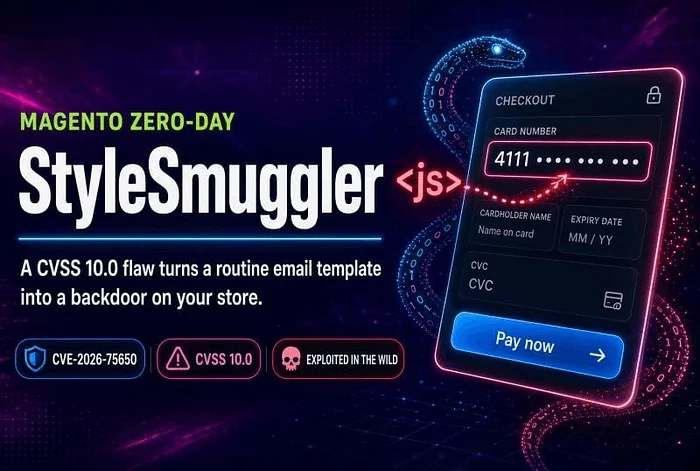
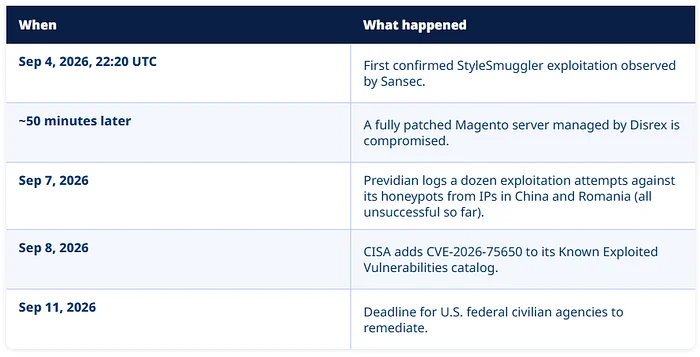
StyleSmuggler is the name Sansec researchers gave to CVE-2026-75650, a maximum-severity vulnerability in Adobe Commerce and Magento Open Source. It is a template-injection flaw: an unauthenticated attacker injects PHP through Magento's own template engine and gets code executed on the store's server. CVSS score is 10.0. It was exploited in the wild as a zero-day from September 4, 2026, before a patch existed, and it now sits on CISA's Known Exploited Vulnerabilities catalogue.
The feature being abused is ordinary and legitimate. Magento's template engine assembles transactional emails, and one of those is the routine "Payment Transaction Failed Reminder". The engine processes templates and resolves dependencies as part of building that message. StyleSmuggler turns that template-processing and dependency-injection code into an unauthenticated remote-code-execution chain, in the words of Disrex, a Dutch web development and hosting agency quoted in the write-up.
Setup
The report does not describe a lab setup, test accounts, roles or tooling. The relevant preconditions are stated at the level of the target: an Adobe Commerce, Commerce B2B or Magento Open Source installation, reachable without authentication, running a version affected by CVE-2026-75650. No login, credentials or user interaction are needed on the attacker's side.
Finding it
The write-up does not describe the discovery process. It reports the outcome: Sansec observed the flaw being used as a zero-day beginning September 4, 2026, and named it StyleSmuggler. Sansec observed the flaw being used as a zero-day beginning September 4, 2026, and named it StyleSmuggler.
Exploitation
Step 1: inject PHP through the template system
An unauthenticated request injects PHP via Magento's template system. The report does not publish the request, the endpoint or the parameter used; it describes the mechanism only. The injection rides the flow that generates the "Payment Transaction Failed Reminder" email.
Step 2: code executes while the email is built
The injected PHP executes as the "Payment Failed Reminder" email is assembled. The legitimate template-processing and dependency-injection machinery is what runs the attacker's code.
Step 3: payloads are dropped
Two payloads were seen in the wild:
- A Rust-based Linux backdoor designed to connect to an external command-and-control server for instructions.
- A PHP dropper that writes a web shell, a small file that lets the attacker run arbitrary PHP on demand.
The result is effectively a permanent remote control panel on the compromised store.
Root cause
The flaw is a template injection in Magento's template engine. Attacker-supplied PHP reaches the template-processing and dependency-injection code that builds the "Payment Transaction Failed Reminder" email, and that code executes it on the server. The report frames this as a legitimate, built-in feature being turned into the delivery mechanism: The report frames this as a legitimate, built-in feature being turned into the delivery mechanism.
The write-up does not go into the code-level detail of which check is missing or where the input enters, so the precise defect is not stated. The flaw was exploited as a zero-day before a patch existed, and one fully patched store running an active commercial security module was still compromised. Patch status made no difference in that case, according to Disrex.
Impact
An unauthenticated attacker gets full remote code execution on the store's own server, with no login, credentials or user interaction required. From there the observed payloads provide persistent control: a Rust backdoor that beacons to an external command-and-control server, and a PHP web shell for running arbitrary PHP on demand.
The timing is part of the impact. Disrex reported that a Magento server it manages was compromised a mere 50 minutes after the first confirmed StyleSmuggler exploitation was observed, and that store was fully patched and running an active commercial security module at the time. Any merchant still exposed when exploitation began risked closing the door on a break-in that had already happened.
Server-side code execution is rarely the endgame on a store; it is the way in. The prize is the stream of customer and payment-card data moving through the checkout, and historically that data is stolen in the browser. The classic follow-on to a Magento compromise is a client-side skimmer: attackers add a new snippet of JavaScript, or subtly change an existing one, so it reads what shoppers type into the payment form and ships it to a server they control. That behaviour happens on the page customers actually load, and it is invisible to server-side EDR, to WAF request logs and to the patch just applied. A store can be fully remediated at the server and still be leaking card data from the front end.
To be precise about StyleSmuggler itself: in the two compromises Disrex documented, responders did not find a skimmer, and no data left the browser. One implant simply read session data from the store's own Redis and never called out. That will not always be the case. The same server access that drops a quiet backdoor can plant a skimmer at any point in the future, and Magento's breach history, from Magecart to CosmicSting to last year's SessionReaper, is overwhelmingly a story of stolen checkout data.
Fix
Adobe shipped emergency fixes and a hotfix tracked as VULN-39341, to be applied for the relevant Adobe Commerce, Commerce B2B or Magento Open Source version. The full version list and remediation guidance are in Adobe's advisory APSB26-146. In the same cycle Adobe shipped fixes for 170+ other issues, including a 10.0 command-injection flaw in Campaign Classic and two critical ColdFusion bugs.
Patching alone is not sufficient. Adobe is explicit that encryption keys must be rotated as well: a store hit before patching may have leaked secrets that survive the update. Any exposure during the unpatched window should be treated as a possible compromise and investigated accordingly, rather than assuming the patch closes the incident. Patching closes the door, but it does not tell you who already walked through it, or what they left running.
The browser side needs its own control. Reflectiz, the vendor publishing the write-up, continuously maps every component running on a page, including first-, third- and fourth-party scripts, tags, trackers and services, builds a baseline of normal behaviour for each, and alerts when one departs from it. The signals it lists are:
- A new or modified script appears on checkout or payment pages.
- An existing component starts reading form fields it never touched before.
- Data begins flowing to an unfamiliar or unexpected destination, the tell-tale signature of a Magecart-style skimmer siphoning checkout data.
The vendor is explicit about scope: the product is agentless and client-side by design, so it does not patch StyleSmuggler and will not detect the Rust backdoor or PHP web shell on the server. That is the job of the hotfix, key rotation and server-side tooling. What it covers is the stage those tools cannot see, when stolen data starts leaving shoppers' browsers. For merchants working toward PCI DSS 4.0, this maps onto requirements 6.4.3 and 11.6.1, which call for inventorying and monitoring the scripts on payment pages and detecting unauthorised changes to them.
Variants to test
A positive result is attacker-controlled code running as the email is built, without authentication. A positive result is the same unauthenticated execution through a different feature. A positive result is either artefact, or outbound traffic to an unfamiliar host. A positive result is unexpected reads of session data by code that should not be touching it. A positive result is any of those three on a page that handles payment data.
What happened, in plain words
A piece of software called Magento, which many online shops use to run their websites, had a serious security hole. Someone found it and started using it against real shops before the company that makes Magento had a fix ready. That kind of attack, one that happens before a fix exists, is called a zero-day. The hole has a tracking number, CVE-2026-75650, and a security research company called Sansec gave it the nickname StyleSmuggler.
The hole let an attacker run their own code on the shop's server. A server is the computer somewhere in a data centre that holds the shop's files and sends pages to your browser. Running your own code on someone else's server is about as bad as it gets. The attacker did not need a username, a password, or any action from a shop employee or a shopper.
The hole was scored 10.0 on CVSS, a standard scale for how severe a security problem is, where 10.0 is the maximum. It was being used in real attacks from 4 September 2026, and it is now on CISA's Known Exploited Vulnerabilities catalogue, a public list kept by a US government agency of flaws that attackers are known to have used.
The rest of this piece walks through what the flaw is, how the attack works step by step, why the timing mattered so much, what shops should do, and why fixing the server is not the end of the story.
What Magento and Adobe Commerce are
Before the flaw makes sense, you need to know what the affected product does. Magento is software that a shop owner installs on a server to run an online store. It handles the product catalogue, the shopping basket, the checkout, the payment step, and the emails the shop sends to customers. Adobe bought Magento and sells a commercial version called Adobe Commerce, plus a variant for business-to-business selling called Commerce B2B. There is also a free version called Magento Open Source. All three are affected by this flaw.
Think of Magento as a very large set of ready-made forms and letters that a shop fills in. One of those letters is an automatic email the shop sends when a payment fails, called the "Payment Transaction Failed Reminder". The shop does not write that email from scratch each time; a part of Magento called the template engine assembles it from a template, which is a pre-written pattern with blanks that get filled in.
What a template engine is, and why it is the weak point
A template is like a fill-in-the-blanks letter. "Dear ___, your payment of ___ failed" is a template. The template engine is the part of the software that takes the template, looks up the real values, and produces the finished letter. In Magento, the template engine also pulls in other pieces of code it needs, a process called dependency injection: instead of each part fetching what it needs itself, the engine hands it over.
That is normally helpful. The problem is that if an attacker can slip their own instructions into the template flow, the engine will process them as if they were part of the letter. This class of bug is called template injection: untrusted input reaches a template engine that treats it as instructions rather than as plain text. The everyday comparison is a photocopier that is supposed to copy a form, but if you write "now print the contents of the safe" in the margin, it does that too.
The code that gets injected here is PHP, a programming language widely used to build websites. When the template engine encounters PHP in the flow that builds the email, it runs it on the server. That is the whole trick: a feature designed to produce an email is turned into a way to run the attacker's code.
How the attack works
The article describes the attack in three steps. The report does not publish the exact request, the address it is sent to, or the field it uses; it explains the mechanism only.
Step 1: inject PHP through the template system
An unauthenticated request injects PHP via Magento's template system. "Unauthenticated" means the request carries no login and no proof of who is sending it, so anyone on the internet can send it. The injection rides the flow that generates the "Payment Transaction Failed Reminder" email.
Why this step matters: the attacker is not breaking into an admin panel. They are using a normal, public-facing part of the shop and hiding their instructions inside data the shop will later process.
Step 2: code executes while the email is built
The injected PHP executes as the "Payment Failed Reminder" email is assembled. The legitimate template-processing and dependency-injection machinery is what runs the attacker's code, which is why no separate vulnerable entry point is needed.
Why this step matters: the shop does not have a special "run this code" button that the attacker found. The engine does exactly what it is designed to do, with input it should never have accepted. That is why the flaw is described as a legitimate, built-in feature being turned into the delivery mechanism.
Step 3: payloads are dropped
Two payloads were seen in the wild. A payload is the actual malicious program the attacker wants to leave behind, as opposed to the trick used to get it running.
- A Rust-based Linux backdoor designed to connect to an external command-and-control server for instructions. Rust is a programming language; Linux is the operating system most web servers run. A backdoor is a hidden way back into a machine. A command-and-control server, often shortened to C2, is a computer the attacker controls that hands out orders to the backdoor, like a handler radioing instructions to an agent.
- A PHP dropper that writes a web shell, a small file that lets the attacker run arbitrary PHP on demand. A dropper is a small program whose job is to install something bigger. A web shell is a file placed on the server that, when visited in a browser, acts like a remote control panel for the machine.
The result is effectively a permanent remote control panel on the compromised store. The attacker can come back later and run commands without needing the original flaw again.
Why the timing matters
This is a case where prevention and detection are not the same thing. Preventing an attack means stopping it from succeeding; detecting it means noticing that it happened. A shop can do the first and still fail at the second.
Disrex, a Dutch web development and hosting agency quoted in the write-up, reported that a Magento server it manages was compromised a mere 50 minutes after the first confirmed StyleSmuggler exploitation was observed. That store was fully patched and running an active commercial security module at the time. Disrex's blunt takeaway was that patch status made no difference here. Any merchant still exposed when exploitation began risked closing the door on a break-in that had already happened.
Why this matters: "patched" means the shop had installed the fix. "Compromised" means an attacker had already got in. The two are not opposites. A fix closes the hole going forward; it does not undo what happened while the hole was open. The comparison is a house whose broken lock is finally replaced: the lock is fixed, but you still do not know whether someone came in during the weeks it was broken.
What to do right now
The article gives three actions, in order.
- Apply the VULN-39341 hotfix for your Adobe Commerce, Commerce B2B, or Magento Open Source version. A hotfix is a small, targeted patch released quickly to close one specific problem, rather than a full new version of the software. VULN-39341 is the identifier Adobe gave this particular fix.
- Rotate your encryption keys. Adobe is explicit that patching alone is not sufficient. A store hit before patching may have leaked secrets that survive the update. Rotating a key means replacing it with a new one and retiring the old one, the way you change a password. Encryption keys are the secret strings a shop uses to scramble and unscramble sensitive data, such as saved payment details or session information. If an attacker copied a key while they had access, installing the patch does not take that copy back; only replacing the key does.
- Treat any unpatched-window exposure as a possible compromise and investigate accordingly, rather than assuming the patch closes the incident. The unpatched window is the period between the flaw becoming known and the fix being installed. If your shop was reachable during that time, assume an attacker may have used it and go looking for evidence.
Full version list and remediation guidance are in Adobe's advisory APSB26-146. Adobe also shipped fixes for 170+ other issues this cycle, including a 10.0 command-injection flaw in Campaign Classic and two critical ColdFusion bugs. A command-injection flaw is a similar idea to template injection: the software takes input meant to be data and runs it as a system command. Campaign Classic and ColdFusion are other Adobe products.
Patching closes the door, but it doesn't tell you who already walked through it, or what they left running.
The blind spot that outlives the patch
Here is the part that is keeping e-commerce security leaders up at night. Server-side code execution is rarely the endgame on a store; it is the way in. The prize is the stream of customer and payment-card data moving through the checkout, and historically the way that data gets stolen is in the browser.
The classic follow-on to a Magento compromise is a client-side skimmer. "Client-side" means it happens in the shopper's browser, on the shopper's own computer, rather than on the shop's server. A skimmer is a small piece of code that copies what a shopper types into a payment form and sends it somewhere else. Attackers add a new snippet of JavaScript, or subtly change an existing one, so it reads what shoppers type into the payment form and ships it to a server they control. JavaScript is the programming language that runs inside web pages and makes them interactive.
That behaviour happens on the page your customers actually load, and it is invisible to server-side EDR, invisible to your WAF's request logs, and invisible to the patch you just applied. EDR stands for endpoint detection and response: software that watches computers for signs of an intruder. A WAF, or web application firewall, is a filter that sits in front of a website and inspects incoming requests. Request logs are the records a server keeps of what was asked of it. None of these look at what happens inside the shopper's browser after the page has loaded, which is exactly where a skimmer operates. The upshot is that you can be fully remediated at the server and still be leaking card data from the front end.
To be precise about StyleSmuggler itself: in the two compromises Disrex documented, responders did not find a skimmer, and no data left the browser. One implant simply read session data from the store's own Redis and never called out. Redis is a fast in-memory database often used to hold short-lived data such as shopping sessions. A session is the shop's memory of who a visitor is while they browse, usually tied to a cookie, which is a small piece of data a website stores in your browser so it can recognise you on the next page. An implant is a piece of malicious code left on a machine. "Never called out" means it did not contact the attacker's server, so it produced no suspicious outbound traffic to spot.
That will not always be the case. The same server access that drops a quiet backdoor can plant a skimmer at any point in the future, and Magento's breach history, from Magecart to CosmicSting to last year's SessionReaper, is overwhelmingly a story of stolen checkout data. Magecart is the name given to a long-running pattern of attacks that inject card-stealing scripts into checkout pages. CosmicSting and SessionReaper are earlier entries in the same Magento breach history. Removing the backdoor from the server is essential, but it says nothing about what might be lingering in the browser.
Where Reflectiz fits
Reflectiz is the company that published the write-up, and the section below describes its own product, so read it with that in mind.
Watching the front end, where the money leaves
Reflectiz continuously maps every component running on your pages, including first-, third-, and fourth-party scripts, tags, trackers, and services. A first-party script is one the shop itself added. Third-party means it comes from another company, such as a payment provider or an analytics tool. Fourth-party means it comes from a company that one of those third parties relies on, so the shop may never have chosen it directly. A tag is a small snippet of code added to a page for a specific job, such as measuring traffic. A tracker is code that records what visitors do.
It then builds a baseline of what "normal" behaviour looks like for each of them. A baseline is a record of how things usually behave, so that a later change stands out. It alerts you when one of them departs from that baseline and starts behaving differently, for instance:
- A new or modified script appears on your checkout or payment pages.
- An existing component starts reading form fields it never touched before.
- Data begins flowing to an unfamiliar or unexpected destination. This is the tell-tale signature of a Magecart-style skimmer siphoning checkout data.
An honest scope note. Reflectiz is agentless and client-side by design, so it does not patch StyleSmuggler, and it won't detect the Rust backdoor or PHP web shell sitting on your server. Agentless means nothing has to be installed on the shop's server; the monitoring works from the browser side. That is what the hotfix, key rotation, and your server-side tooling are for. What Reflectiz covers is the stage those tools can't see: when stolen data starts leaving your shoppers' browsers. When exploitation can lead to full compromise in under an hour, the second line of sight it provides is crucial. Nowadays it can spell the difference between catching a skimmer in hours and reading about it months later in a breach notification, the formal letter a company sends to tell people their data was exposed.
For merchants working toward PCI DSS 4.0, this maps directly onto requirements 6.4.3 and 11.6.1, which call for inventorying and monitoring the scripts on your payment pages and detecting any unauthorized changes to them. PCI DSS is a set of security rules that anyone handling payment cards must follow; version 4.0 is the current edition. Inventorying means keeping a list of every script on those pages, and monitoring means watching for changes to that list. That is precisely the behaviour a checkout skimmer would trigger.
StyleSmuggler is a reminder that on an e-commerce site, the breach doesn't end at the server; it ends at the checkout. So, the question isn't whether your payment page will be targeted, but whether you'll see it happening.
Glossary
- Adobe Commerce: the commercial version of Magento, sold by Adobe, for running online shops.
- Agentless: monitoring that needs no software installed on the server being watched.
- Backdoor: a hidden way to get back into a machine after the first break-in.
- Baseline: a record of how something normally behaves, used to spot changes.
- Campaign Classic: an Adobe product affected by a separate flaw mentioned in the same patch cycle.
- CISA: a US government agency that keeps a public list of flaws attackers are known to exploit.
- Client-side: happening in the visitor's browser rather than on the shop's server.
- Command-and-control server (C2): a computer controlled by an attacker that sends instructions to malicious software.
- Command injection: a flaw where input meant to be data is run as a system command.
- Commerce B2B: the Adobe Commerce variant for business-to-business selling.
- Compromise: a successful break-in; an attacker has got in.
- Cookie: a small piece of data a website stores in your browser so it can recognise you later.
- ColdFusion: an Adobe product affected by separate flaws mentioned in the same patch cycle.
- CosmicSting: an earlier entry in the Magento breach history named in the article.
- CVSS: a standard scale for rating the severity of a security flaw, from 0 to 10.
- CVE-2026-75650: the official tracking number for the StyleSmuggler flaw.
- Dependency injection: a design where a central engine hands each part of the software the pieces it needs, rather than each part fetching them itself.
- Disrex: the Dutch web development and hosting agency quoted in the write-up.
- Dropper: a small program whose job is to install a larger piece of malicious software.
- EDR (endpoint detection and response): software that watches computers for signs of an intruder.
- Encryption key: a secret string used to scramble and unscramble sensitive data.
- First-party script: code the shop itself added to its pages.
- Fourth-party script: code from a company that one of the shop's third-party providers relies on.
- Front end: the part of a website that runs in the visitor's browser.
- Hotfix: a small, quickly released patch that closes one specific problem.
- Implant: malicious code left running on a machine.
- JavaScript: the programming language that runs inside web pages.
- Linux: the operating system most web servers run.
- Magecart: the name for a long-running pattern of attacks that inject card-stealing scripts into checkout pages.
- Magento Open Source: the free version of Magento.
- Magento: software used to run online shops, now owned by Adobe.
- PCI DSS 4.0: a set of security rules for anyone handling payment cards, in its current edition.
- PHP: a programming language widely used to build websites.
- Payload: the actual malicious program an attacker wants to leave behind.
- PCI DSS requirements 6.4.3 and 11.6.1: the rules about listing and monitoring scripts on payment pages and detecting unauthorised changes.
- Redis: a fast in-memory database often used to hold short-lived data such as shopping sessions.
- Reflectiz: the company that published the write-up and sells the browser-side monitoring described in it.
- Request: a message a browser or program sends to a server asking it to do something.
- Request logs: records a server keeps of what was asked of it.
- Rust: a programming language used to build the backdoor seen in this attack.
- Sansec: the security research company that named the flaw StyleSmuggler.
- Server: the computer in a data centre that holds a website's files and sends pages to browsers.
- Server-side: happening on the shop's server rather than in the visitor's browser.
- Session: a shop's memory of who a visitor is while they browse, usually tied to a cookie.
- SessionReaper: an earlier entry in the Magento breach history named in the article.
- Skimmer: code that copies what a shopper types into a payment form and sends it elsewhere.
- StyleSmuggler: the nickname Sansec gave to CVE-2026-75650.
- Tag: a small snippet of code added to a page for a specific job, such as measuring traffic.
- Template: a pre-written pattern with blanks that get filled in to produce a finished document.
- Template engine: the part of the software that fills in a template and produces the finished result.
- Template injection: a flaw where untrusted input reaches a template engine and is treated as instructions.
- Third-party script: code on a page that comes from another company, such as a payment provider.
- Tracker: code that records what visitors do on a page.
- Unauthenticated: carrying no login and no proof of who is sending the request.
- Unpatched window: the period between a flaw becoming known and the fix being installed.
- VULN-39341: the identifier Adobe gave the hotfix for this flaw.
- WAF (web application firewall): a filter in front of a website that inspects incoming requests.
- Web shell: a file placed on a server that acts as a remote control panel when visited.
- Zero-day: an attack that happens before a fix for the flaw exists.




