The Story of a Novel Supply Chain Attack
The researcher discovered that many companies use private package names that are not registered on public package registries, and by uploading malicious packages with those names, he could execute code on internal build servers and developer machines. This allowed remote code execution and potentially backdoors in builds.
 Published on medium.com
Ever since I started learning how to code, I have been fascinated by the level of trust we put in a simple command like this one:
The full write-up lives on its author's site
It belongs to its author, so we link to it rather than copy it. The other two tabs are our own rewrites, checked against it.
Context
Package managers such as npm, pip and RubyGems let a developer pull third-party code into a project with a single command. The author opens with the example that started it all:
pip install package_name
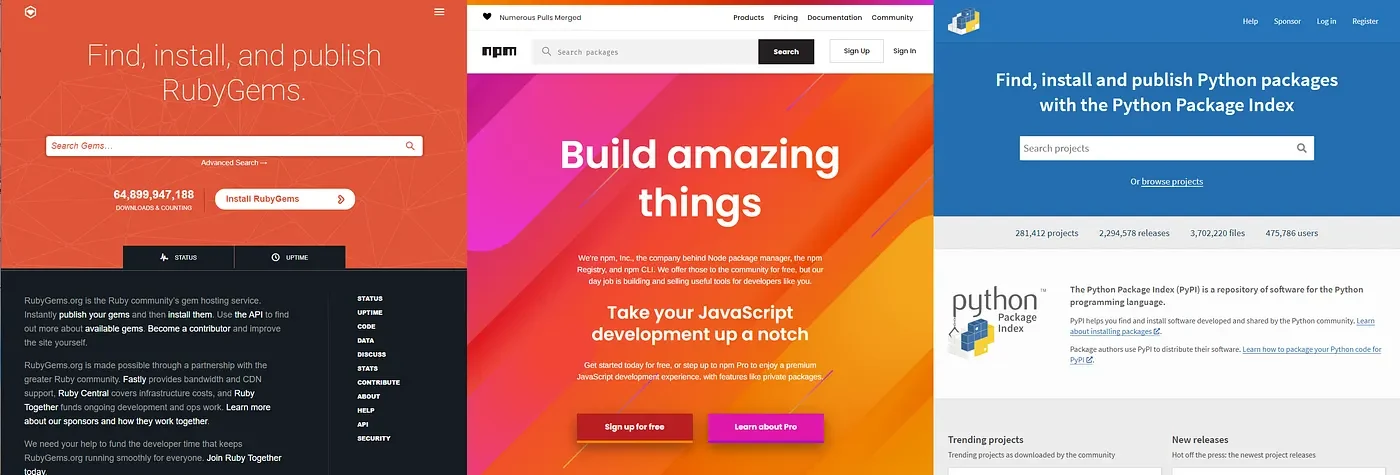
Node uses npm and the npm registry, Python's pip uses PyPI (Python Package Index), and Ruby's gems live on RubyGems. When you install from any of these sources you are trusting the publisher to run code on your machine. The question the research sets out to answer is whether that blind trust can be exploited.
It can. The package hosts cannot guarantee that uploaded code is malware-free, and earlier work on typosquatting showed that typo'd versions of popular package names can be very effective at reaching random PCs. Other known dependency chain paths include compromising existing packages or uploading malicious code under the names of dependencies that no longer exist.
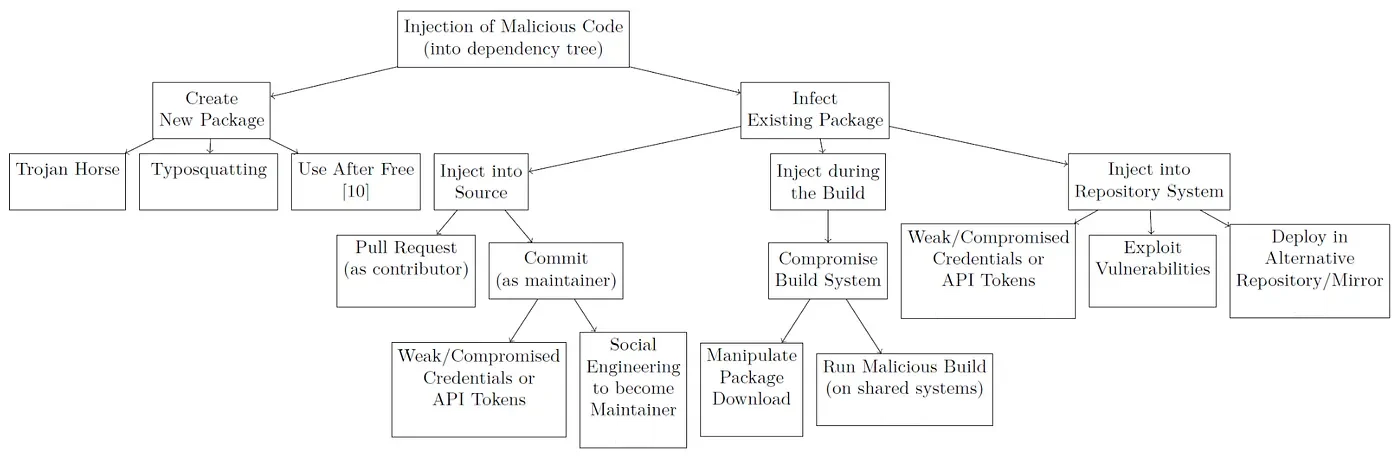
The author calls it dependency confusion.
Setup
The idea came from Justin Gardner (@Rhynorater), who shared a piece of Node.js source code found on GitHub while the two were working on PayPal during the summer of 2020. The code was meant for internal PayPal use, and its package.json appeared to mix public npm packages with non-public package names, most likely hosted internally by PayPal. Those names did not exist on the public npm registry at the time.
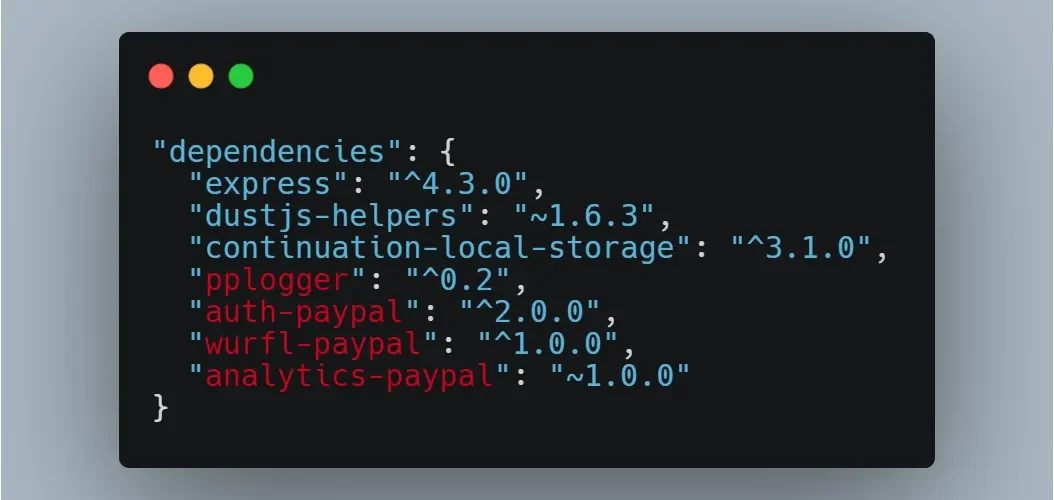
The logic deciding which package is sourced from where was unclear, which raised the questions the research set out to answer:
- What happens if malicious code is uploaded to npm under these names? Could some of PayPal's internal projects start defaulting to the new public packages instead of the private ones?
- Will developers, or even automated systems, start running the code inside the libraries?
- If this works, can we get a bug bounty out of it?
- Would this attack work against other companies too?
Every organisation targeted during the research had given permission for its security to be tested, either through public bug bounty programs or private agreements. The author explicitly asks readers not to attempt this kind of test without authorisation.
Finding it
The plan was to upload "malicious" Node packages to the npm registry under all the unclaimed internal names, with each package phoning home from every machine it was installed on. If any package landed on a PayPal-owned server, or anywhere else, the code would notify the author immediately.
npm allows arbitrary code to run automatically on installation, so a package can collect basic information about the machine through its preinstall script. To balance identifying an organisation against collecting too much sensitive data, the author logged only the username, hostname and current path of each unique installation. Together with the external IPs, that was enough for security teams to identify possibly vulnerable systems from the reports, while keeping the testing from looking like a real attack.
The remaining problem was getting the data back. Most targets would sit deep inside well-protected corporate networks, so the author chose DNS exfiltration.
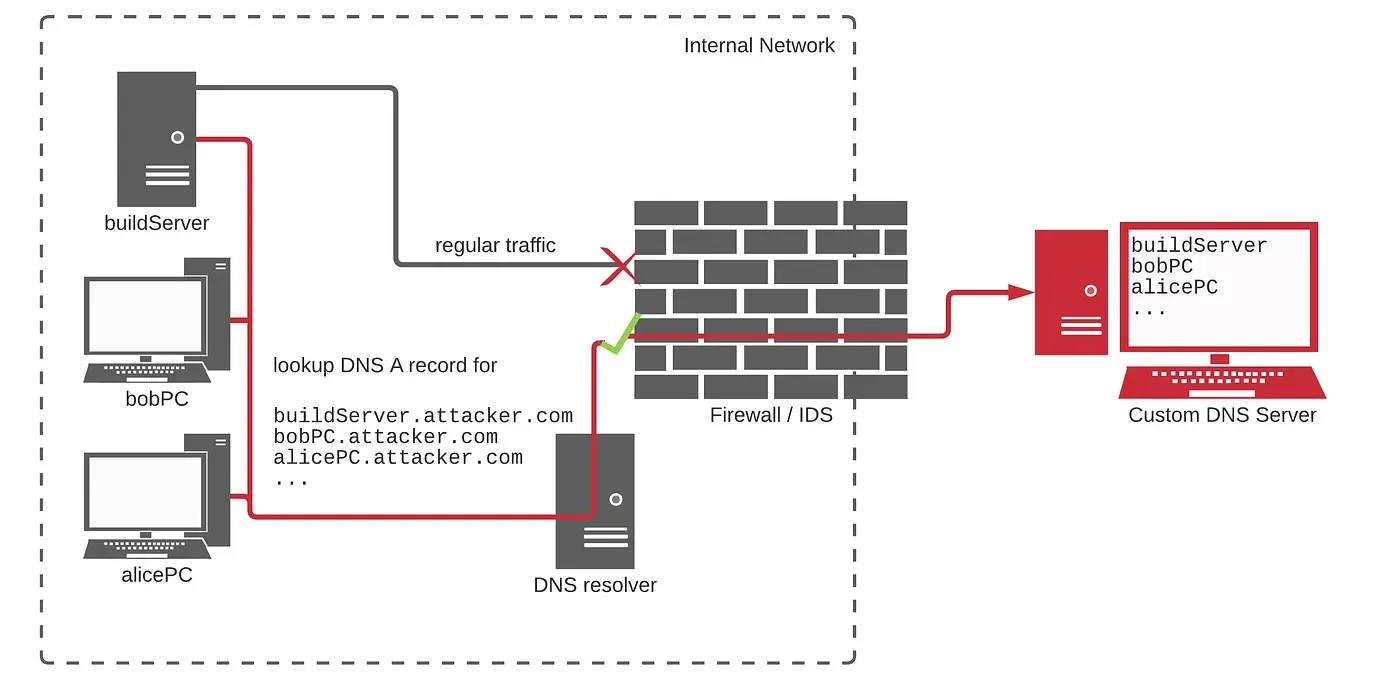
DNS was not essential for the test to work, but it made the outbound traffic less likely to be blocked or detected. The data was hex-encoded and used as part of a DNS query that reached a custom authoritative name server, either directly or through intermediate resolvers. The server logged every received query, keeping a record of each machine where the packages were downloaded.
Exploitation
Step 1: port the code to other ecosystems
The first strategy for finding more targets was to attack alternate ecosystems. The author ported the code to Python and Ruby so that similar packages could be uploaded to PyPI and RubyGems respectively.
Step 2: harvest internal package names
Finding as many relevant dependency names as possible was arguably the most important part of the test. A few full days of searching for private package names belonging to the targeted companies showed that names could be found on GitHub, on the major package hosting services inside internal packages that had been accidentally published, and even in posts on internet forums.
By far the best source, however, was inside JavaScript files. Internal package.json files, which list a project's dependencies, are commonly embedded into public script files during the build process, exposing internal package names. Leaked internal paths or require() calls in those files can contain dependency names too. Apple, Yelp and Tesla are a few examples of companies whose internal names were exposed this way.
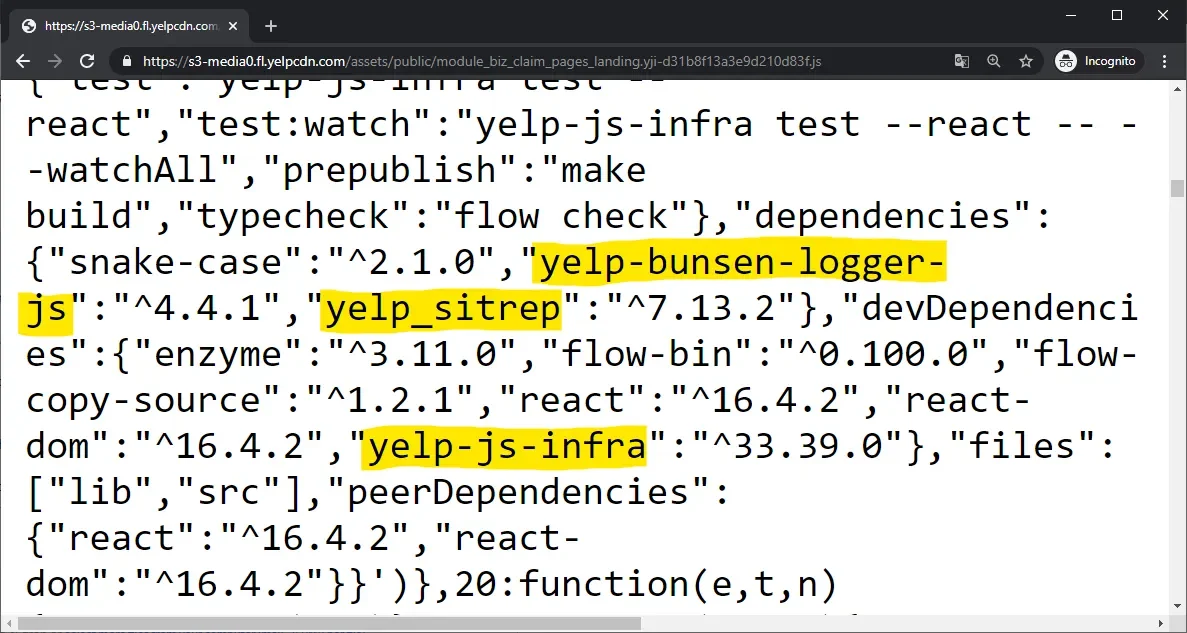
During the second half of 2020, with help from @streaak and his recon skills, the author automatically scanned millions of domains belonging to the targeted companies and extracted hundreds of additional JavaScript package names that had not yet been claimed on the npm registry.
Step 3: upload and wait for callbacks
The code was uploaded to the package hosting services under all the found names, and the author waited for callbacks.
Results
The success rate was, in the author's words, astonishing. Callbacks came from one-off mistakes made by developers on their own machines, from misconfigured internal or cloud-based build servers, and from systemically vulnerable development pipelines. Squatting valid internal package names turned out to be a nearly sure-fire way into the networks of some of the biggest tech companies, gaining remote code execution and possibly allowing attackers to add backdoors during builds.
Dependency confusion was detected inside more than 35 organisations, across all three tested languages. The vast majority of affected companies fall into the 1000+ employees category, which most likely reflects the higher prevalence of internal library usage in larger organisations.
Because JavaScript dependency names were easier to find, almost 75% of all logged callbacks came from npm packages. That does not necessarily mean Python and Ruby are less susceptible: only eight organisations' internal Ruby gem names were identified during the searches, and four of those companies turned out to be vulnerable through RubyGems.
| Company | Ecosystem | Detail | Bounty |
|---|---|---|---|
| Shopify | RubyGems | Build system installed a gem named shopify-cloud a few hours after upload, then tried to run its code; fix ready within a day |
$30,000 |
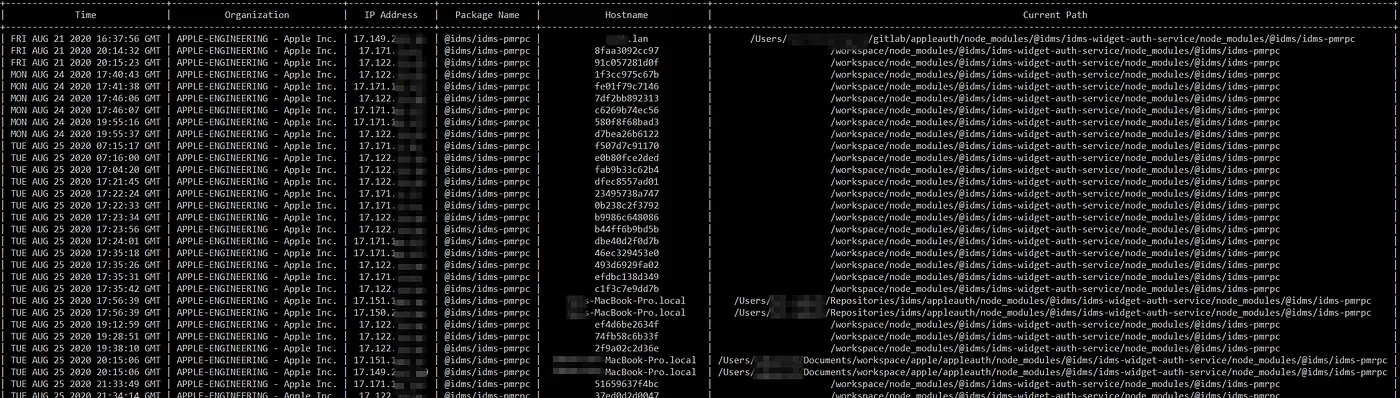
| Apple | npm | Node package uploaded in August 2020 executed on multiple machines inside its network; affected projects appeared related to Apple ID | $30,000 |
| PayPal | npm | The names that started it all worked | $30,000 |
| Microsoft (Office 365) | not stated | Attack on Microsoft's own cloud-based Office 365 led to improvements in Azure Artifacts | $40,000 (Azure's highest possible reward) |
Other affected companies include Netflix, Yelp and Uber. The same theme of npm packages being installed on both internal servers and individual developers' PCs appeared across several other successful attacks, with some installs happening hours or even minutes after upload.
Most awarded bounties were set at the maximum amount allowed by each program's policy, and sometimes higher, which the author reads as confirmation of the generally high severity of dependency confusion bugs.
Apple's response
When the author raised the possibility that the bug could have allowed a threat actor to inject backdoors into Apple ID, Apple did not consider that level of impact to accurately represent the issue:
Achieving a backdoor in an operational service requires a more complex sequence of events, and is a very specific term that carries additional connotations.
Apple did confirm that remote code execution on Apple servers would have been achievable with the npm package technique. Based on the flow of package installs, the issue was fixed within two weeks of the report, but the bounty was awarded less than a day before the post was published.
Root cause
Most affected organisations were reluctant to share technical details about their root causes and mitigations, but some details emerged from the research and from conversations with security teams.
Python: --extra-index-url
The main culprit in Python dependency confusion appears to be incorrect use of an "insecure by design" command line argument called --extra-index-url. When you use it with pip install library to point at your own package index, it may look like it works as expected, but pip actually does the following:
- Checks whether
libraryexists on the specified (internal) package index. - Checks whether
libraryexists on the public package index (PyPI). - Installs whichever version is found. If the package exists on both, it defaults to installing from the source with the higher version number.
So uploading a package named library 9000.0.0 to PyPI would hijack the dependency in that example. The behaviour was already commonly known, yet simply searching GitHub for --extra-index-url was enough to find vulnerable scripts belonging to large organisations, including a bug affecting a component of Microsoft's .NET Core. That vulnerability, which may have allowed adding backdoors to .NET Core, was found to be out of scope in the .NET bug bounty program.
Ruby's gem install --source works in a similar way, but the author could not confirm whether its usage was the root cause of any of the findings.
JFrog Artifactory
Changing --extra-index-url to --index-url is a quick fix, but other variants proved much harder to mitigate. JFrog Artifactory, widely used for hosting internal packages of all types, can mix internal and public libraries into the same "virtual" repository, which simplifies dependency management. Multiple customers stated that Artifactory uses the exact same vulnerable algorithm described above to decide between serving an internal and an external package with the same name. At the time of writing there is no way to change this default behaviour.
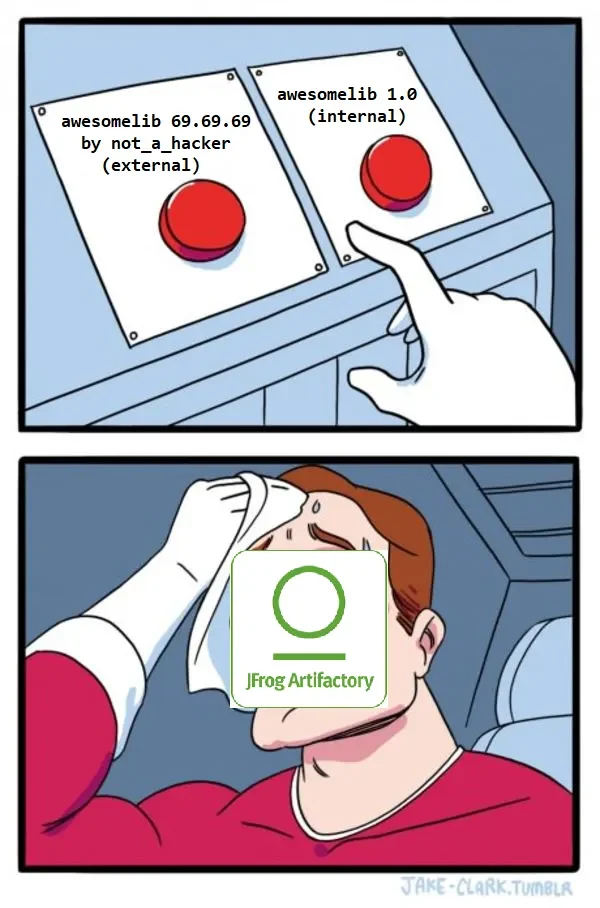
JFrog is reportedly aware of the issue but has been treating a possible fix as a "feature request" with no ETA, while some customers have applied systemic policy changes to dependency management to mitigate dependency confusion in the meantime.
Azure Artifacts
Microsoft's Azure Artifacts is a similar package hosting service. As a result of one of the reports, some minor improvements were made to it so that it can provide a reliable workaround for dependency confusion. The issue was not found by testing Azure Artifacts itself, but by successfully attacking Microsoft's own cloud-based Office 365.
Impact
The author observed this leading to remote code execution inside corporate networks, with the possibility of adding backdoors during builds. Apple disputed the characterisation of the Apple ID finding as a backdoor, while confirming that remote code execution on its servers would have been achievable.
Fix
- Changing
--extra-index-urlto--index-urlis a quick and straightforward fix. - For Artifactory, no configuration change was available at the time of writing; some customers applied systemic policy changes to dependency management instead.
- Azure Artifacts received minor improvements to provide a reliable workaround.
- Microsoft published a white paper, "3 Ways to Mitigate Risk When Using Private Package Feeds", with root cause and prevention advice.
Variants to test
- Other ecosystems.
- JavaScript bundle mining.
- Registry and forum searches.
- Version-number hijack.
- Ruby source resolution.
- Virtual repositories.
For further reading the author points to Microsoft's white paper and to the "Backstabber's Knife Collection" paper on open source supply chain attacks.
What happened, in plain words
Imagine you are building a piece of furniture. You do not cut down the tree and mill the wood yourself; you buy ready-made parts from a shop and screw them together. Software works the same way. Instead of writing every line of code from scratch, a developer downloads ready-made chunks of code, called packages, from a public shop on the internet and uses them in their project. The tool that fetches and installs those packages is called a package manager.
This article is about a researcher who noticed something worrying about that shop. When a company builds software, it often uses some packages that are public (anyone can download them) and some that are private (only the company can see them, kept on its own internal server). The researcher discovered that if he uploaded a package to the public shop using the exact name of one of a company's private packages, the company's computers would sometimes download his package instead of their own. His package then ran code on their machines and quietly reported back to him.
He called this trick dependency confusion. A dependency is simply a package that your project depends on to work. The "confusion" is the build system not being sure whether to take the private package or the public one with the same name, and sometimes choosing the public one.
He tried it against dozens of companies, with permission, and it worked far more often than anyone expected. This is the story of how he found the idea, how he tested it, what happened, and why the software involved behaves this way.
The trust we put in one command

The author starts with a single command that millions of developers type every day:
pip install package_name
Here is what each part means, for someone who has never seen a terminal:
pipis the package manager for the Python programming language. Think of it as an app store, but for code libraries instead of phone apps.installis the instruction: fetch this package and put it on my computer.package_nameis a placeholder for the real name of whatever package you want. It is not a literal name; it stands for "whatever you are installing".
When you run that command, pip goes to a public website called PyPI (Python Package Index), finds the package with that name, downloads it, and sets it up on your machine. The key point is that the code inside the package will then run on your computer, as part of your project.
Each programming language has its own version of this. Node (a way of running JavaScript outside a browser) uses a tool called npm and a public shop called the npm registry. Python uses pip and PyPI. Ruby uses gems, which live on a site called RubyGems. In every case, the pattern is the same: one command pulls code from a public repository where anyone in the world can upload.
That last part is the important bit. When you install a package from any of these public shops, you are trusting a stranger to run code on your machine. The shop cannot guarantee that everything uploaded is free of malware. It cannot promise that everything uploaded is free of malware (malicious software). So the question the research asks is simple: can that blind trust be abused?
Yes, it can. The author points to earlier research showing that typosquatting works well. Typosquatting means registering a package name that is a small typo away from a popular one, for example a name with a letter swapped or doubled. A developer who mistypes the name when installing gets the attacker's package instead of the real one, and the attacker's code runs. That approach has been shown to reach random computers around the world effectively.
Other known ways to attack this chain of dependencies include compromising existing packages or uploading malicious code under the names of dependencies that no longer exist.
The attack in this article is different from all of those. It does not rely on a typo, and it does not take over an existing package. It abuses the way a company's internal build system decides which package to use when a name exists both privately and publicly. That is the trick the author named dependency confusion.
Where the idea came from
In the summer of 2020 the author was working on hacking PayPal together with Justin Gardner (@Rhynorater). Gardner shared a piece of Node.js source code that he had found on GitHub, a public website where developers store and share code.
The code was meant for internal PayPal use. Inside it was a file called package.json. In the Node world, package.json is a small manifest that lists a project's dependencies: the names of all the packages the project needs. This particular manifest appeared to mix two kinds of names: public packages from npm, and names that were not public at all, most likely hosted on PayPal's own internal servers. Those internal names did not exist on the public npm registry at the time.
That raised a set of questions, which became the plan for the whole research:
- What happens if someone uploads malicious code to npm under those internal names? Could some of PayPal's internal projects start defaulting to the new public packages instead of the private ones?
- Will developers, or even automated systems, start running the code inside those libraries?
- If this works, can we get a bug bounty out of it? A bug bounty is a reward that a company pays to someone who finds and reports a security problem in its systems, instead of suing them or ignoring them.
- Would this attack work against other companies too?
Before going further, the author makes an important point: every organisation targeted during this research had given permission for its security to be tested, either through public bug bounty programs or through private agreements. He explicitly asks readers not to attempt this kind of test without authorisation. Testing someone's systems without permission is a crime in most countries, even if you mean well.
The plan: packages that phone home
The idea was straightforward. The author would upload his own "malicious" Node packages to the public npm registry, using all the unclaimed internal names he had found. Each package would phone home: when installed, it would send a message back to him from whatever machine it landed on. If any of those packages ended up on a PayPal-owned server, or anywhere else, the code would notify him immediately.
For this to work, the package needs to run code at the moment it is installed, not only when the developer later uses it. npm allows exactly that: a package can declare a preinstall script, which is a small program that npm runs automatically before the package is set up. The author used that hook to collect some basic information about each machine the package was installed on.
He had to be careful about what he collected. On one hand, he needed enough data to identify which organisation a callback came from. On the other hand, he did not want to collect sensitive information, both for ethical reasons and so that his testing would not be mistaken for a real attack. He settled on logging only three things for each unique installation: the username, the hostname (the computer's name on the network), and the current path (the folder the install was running from). Together with the external IP address (the public address the machine uses on the internet), that was just enough for a company's security team to identify which of its systems might be vulnerable, based on his reports.
One problem remained: how does the data get back to him? Most of the possible targets would sit deep inside well-protected corporate networks, behind firewalls and monitoring. The author considered that DNS exfiltration was the way to go.
DNS, the Domain Name System, is the internet's address book. When you type a website name into your browser, your computer asks a DNS server "what is the numeric address for this name?" and gets an answer back. That question travels out through the network, and it is usually allowed through firewalls because without it nothing on the internet would work. DNS exfiltration means hiding stolen data inside those questions: instead of asking for a normal website name, the package asks for a name that contains the data, and the attacker's own DNS server receives the question and reads the data out of it.
DNS was not essential for the test to work. But using DNS made the outbound traffic less likely to be blocked or detected on the way out, because DNS lookups are so common that they rarely raise suspicion.
The data was hex-encoded, meaning each character was turned into a pair of hexadecimal digits (0 to 9 and a to f), so it could safely be part of a domain name. That encoded data was used as part of a DNS query, which reached a custom authoritative name server run by the author. An authoritative name server is the server that holds the official answers for a particular domain; if the author controls it, he sees every question asked about that domain. The query could arrive either directly or through intermediate resolvers (other DNS servers that pass questions along). The server was configured to log every query it received, which effectively kept a record of every machine where the packages were downloaded.
Finding more targets
With the basic plan in place, it was time to find more possible targets.
Step 1: port the code to other ecosystems
The first strategy was to look at other package ecosystems. If the trick worked for Node packages, it might work for Python and Ruby too. So the author ported the code, meaning he rewrote the same logic in another programming language, to both Python and Ruby. That let him upload similar packages to PyPI and RubyGems respectively.
Why bother? Because each ecosystem has its own users and its own internal package names. A company that is careful with npm might be careless with Python. Covering three ecosystems multiplies the number of organisations he could reach.
Step 2: harvest internal package names
Arguably the most important part of the test was finding as many relevant dependency names as possible. Without a real internal name, there is nothing to squat. A few full days of searching for private package names belonging to the targeted companies revealed several sources:
- GitHub, where code and configuration files are often left public by mistake.
- The major package hosting services, where internal packages had been accidentally published.
- Posts on various internet forums, where developers sometimes mention internal names.
But by far the best place to find private package names turned out to be inside JavaScript files. This deserves an explanation. When a company builds a JavaScript project, the build process often bundles many files together into one big script file that a browser can download. During that bundling, internal package.json files, which list the project's dependencies, can get embedded into the public script file. The result is that a file anyone can download from the company's website quietly contains the names of the company's private packages. Similarly, leaked internal paths or require() calls within these files may also contain dependency names. A require() call is simply the line of JavaScript that says "load this other module", and the name inside it is a package name.
Apple, Yelp and Tesla are just a few examples of companies whose internal names were exposed in this way.
During the second half of 2020, the author got help from @streaak, whose recon skills (the art of mapping out what a company has exposed on the internet) made a bigger search possible. Together they automatically scanned millions of domains belonging to the targeted companies and extracted hundreds of additional JavaScript package names that had not yet been claimed on the npm registry. "Unclaimed" is the key word: a name that exists internally but is still free on the public registry is exactly what the attack needs.
Step 3: upload and wait
The author then uploaded his code to the package hosting services under all the found names and waited for callbacks. A callback here means the message the package sends home when it is installed somewhere. Every callback is evidence that a real machine, belonging to a real organisation, ran his code.
What happened
The success rate was, in the author's words, simply astonishing. Callbacks came from three kinds of places:
- One-off mistakes made by developers on their own machines, for example installing a package by hand while working on a laptop.
- Misconfigured internal or cloud-based build servers, which are the machines that automatically assemble and test software.
- Systemically vulnerable development pipelines, meaning the whole process of building software was set up in a way that made the confusion happen every time.
Squatting valid internal package names turned out to be a nearly sure-fire method to get into the networks of some of the biggest tech companies. It gave remote code execution, which means the ability to run your own code on someone else's machine from a distance, and it could possibly allow attackers to add backdoors during builds. A backdoor is a hidden way into a system that the owner does not know about.
This type of vulnerability, which the author started calling dependency confusion, was detected inside more than 35 organisations, across all three tested programming languages. The vast majority of the affected companies fall into the 1000+ employees category, which most likely reflects the higher prevalence of internal library usage within larger organisations: the more private packages you have, the more names there are to squat.
Because JavaScript dependency names were easier to find, almost 75% of all the logged callbacks came from npm packages. That does not necessarily mean Python and Ruby are less susceptible to the attack. In fact, despite only being able to identify internal Ruby gem names belonging to eight organisations during his searches, four of those companies turned out to be vulnerable to dependency confusion through RubyGems.
Here are the specific cases the author describes:
| Company | Ecosystem | What happened | Bounty |
|---|---|---|---|
| Shopify | RubyGems | The build system automatically installed a Ruby gem named shopify-cloud only a few hours after it was uploaded, then tried to run the code inside it. The team had a fix ready within a day. |
$30,000 |
| Apple | npm | A Node package uploaded in August 2020 was executed on multiple machines inside Apple's network. The affected projects appeared to be related to Apple's authentication system, externally known as Apple ID. | $30,000 |
| PayPal | npm | The names that started it all worked too. | $30,000 |
| Microsoft (Office 365) | not stated | Attacking Microsoft's own cloud-based Office 365 led to improvements in Azure Artifacts. | $40,000, Azure's highest possible reward |
Other affected companies include Netflix, Yelp and Uber. The same theme of npm packages being installed on both internal servers and individual developers' PCs appeared across several other successful attacks, with some installs happening hours or even minutes after the packages had been uploaded.
The majority of awarded bug bounties were set at the maximum amount allowed by each program's policy, and sometimes even higher. The author reads that as confirmation of the generally high severity of dependency confusion bugs: when a company pays its maximum, it is saying the problem is serious.
Apple's response
When the author brought up the idea that this bug may have allowed a threat actor to inject backdoors into Apple ID, Apple did not consider that level of impact to accurately represent the issue. Apple stated:
Achieving a backdoor in an operational service requires a more complex sequence of events, and is a very specific term that carries additional connotations.
In plain words, Apple was saying: yes, someone ran code on our servers, but calling that a backdoor overstates it, because a real backdoor in a live service would take a longer and more specific chain of events. Apple did confirm that remote code execution on Apple servers would have been achievable by using this npm package technique. Based on the flow of package installs, the issue was fixed within two weeks of the report, but the bug bounty was only awarded less than a day prior to publishing the post.
Why does this happen? The root causes
Most of the affected organisations were understandably reluctant to share further technical details about their root causes and mitigation strategies. Nobody likes to publish a map of their mistakes. But a few interesting details did emerge during the research and from conversations with security teams.
Python: the --extra-index-url argument
The main culprit in Python dependency confusion appears to be incorrect usage of a command line argument called --extra-index-url. The author calls it "insecure by design", meaning the tool behaves in a way that is dangerous by default, not because of a bug but because of how it was built.
Here is the situation. A company keeps its private packages on its own internal package index, a private version of PyPI. When a developer runs pip install library and wants pip to look at that private index, they add the argument to point at it. It may look like it works as expected, but what pip is actually doing behind the scenes goes something like this:
- Checks whether
libraryexists on the specified (internal) package index. - Checks whether
libraryexists on the public package index (PyPI). - Installs whichever version is found. If the package exists on both, it defaults to installing from the source with the higher version number.
That third step is the trap. Version numbers are labels like 1.2.3 or 2.0.0, and software treats a higher number as newer. So if an attacker uploads a package named library 9000.0.0 to PyPI, that version number is far higher than anything the company's internal package will ever have. When pip compares the two, it picks the attacker's package and installs it. The dependency has been hijacked.
Although this behaviour was already commonly known, simply searching GitHub for --extra-index-url was enough to find a few vulnerable scripts belonging to large organisations, including a bug affecting a component of Microsoft's .NET Core. That vulnerability, which may have allowed adding backdoors to .NET Core, was unfortunately found to be out of scope in the .NET bug bounty program. "Out of scope" means the program's rules did not cover that particular system, so no reward was paid even though the problem was real.
Ruby's gem install --source works in a similar way, but the author was unable to confirm whether its usage was the root cause of any of his findings.
JFrog Artifactory
Changing --extra-index-url to --index-url is a quick and straightforward fix: it tells pip to look only at the intended index and never at the public one. But some other variants of dependency confusion were proven much harder to mitigate.
JFrog Artifactory is a piece of software widely used for hosting internal packages of all types. Think of it as a private warehouse for a company's code packages. It offers the possibility to mix internal and public libraries into the same "virtual" repository, which greatly simplifies dependency management: developers can ask for any package by name and Artifactory fetches it from wherever it lives. However, multiple customers have stated that Artifactory uses the exact same vulnerable algorithm described above to decide between serving an internal and an external package with the same name. At the time of writing, there is no way to change this default behaviour.
JFrog is reportedly aware of the issue, but has been treating its possible fix as a "feature request" with no ETA in sight. An ETA is an estimated time of arrival, a promised date for a fix. Meanwhile, some of its customers have resorted to applying systemic policy changes to dependency management, meaning they changed their internal rules about how packages are chosen, rather than waiting for the software to change.
Azure Artifacts
Microsoft also offers a similar package hosting service named Azure Artifacts. As a result of one of the author's reports, some minor improvements have been made to this service to ensure that it can provide a reliable workaround for dependency confusion vulnerabilities. Funnily enough, this issue was not discovered by testing Azure Artifacts itself, but rather by successfully attacking Microsoft's own cloud-based Office 365. That report resulted in Azure's highest possible reward of $40,000.
What this means for security
The author observed this leading to remote code execution inside corporate networks, with the possibility of adding backdoors during builds.
- The internal name must be discoverable, for example leaked in a public JavaScript file.
- The name must be unclaimed on the public registry, so the attacker can register it.
- The victim's tooling must resolve the public package over the private one, for example because of the higher version number.
Apple disputed the characterisation of the Apple ID finding as a backdoor, while confirming that remote code execution on its servers would have been achievable.
How to fix it
- Changing
--extra-index-urlto--index-urlis a quick and straightforward fix. - For Artifactory, no configuration change was available at the time of writing; some customers applied systemic policy changes to dependency management instead.
- Azure Artifacts received minor improvements to provide a reliable workaround.
- Microsoft published a white paper, "3 Ways to Mitigate Risk When Using Private Package Feeds", with root cause and prevention advice.
Variants worth testing
If you want to understand this class of bug better, here are the angles the author explored, each with the sign that tells you it worked:
- Other ecosystems.
- JavaScript bundle mining.
- Registry and forum searches.
- Version-number hijack.
- Ruby source resolution.
- Virtual repositories.
For further reading the author points to Microsoft's white paper and to the "Backstabber's Knife Collection" paper on open source supply chain attacks.
Glossary
- API: an agreed way for one piece of software to ask another for something, like a waiter taking your order to the kitchen.
- Authoritative name server: the DNS server that holds the official answers for a domain; whoever controls it sees every question asked about that domain.
- Backdoor: a hidden way into a system that its owner does not know about.
- Bug bounty: a reward a company pays to someone who finds and reports a security problem in its systems.
- Build server: a machine that automatically assembles, tests and packages software from source code.
- Build system: the collection of tools and settings that turn source code into a finished program.
- Callback: in this article, the message a package sends home when it is installed somewhere.
- Dependency: a package that a project needs in order to work.
- Dependency confusion: an attack where a public package is uploaded under the same name as a private internal package, so the build system may install the public one instead.
- DNS (Domain Name System): the internet's address book, which turns names like example.com into numeric addresses.
- DNS exfiltration: hiding data inside DNS questions so it can leave a network without being noticed.
- Firewall: a filter that decides which network traffic is allowed in or out.
- Hex-encoded: written using hexadecimal digits (0 to 9 and a to f), a safe way to put arbitrary data into a name or string.
- Hostname: the name a computer is known by on a network.
- IP address: the numeric address a machine uses on a network or on the internet.
- Malware: malicious software, code written to cause harm or gain unauthorised access.
- Mitigation: a change that reduces the risk from a problem, even if it does not remove the problem entirely.
- npm: the package manager and public registry used for Node.js packages.
- Out of scope: outside the rules of a bug bounty program, so no reward is paid even if the problem is real.
- Package: a ready-made chunk of code that a developer downloads and uses in a project.
- Package manager: the tool that fetches and installs packages, such as
pip,npmor RubyGems. package.json: a manifest file in a Node.js project that lists its dependencies.pip: the package manager for Python.preinstallscript: a small program that npm runs automatically before a package is set up.- PyPI (Python Package Index): the public registry of Python packages.
- Recon: the work of mapping out what a company has exposed on the internet.
- Remote code execution: the ability to run your own code on someone else's machine from a distance.
require(): the line of JavaScript that loads another module, naming the package it needs.- Resolver: a DNS server that passes questions along towards the authoritative server.
- RubyGems: the public registry of Ruby packages, called gems.
- Supply chain attack: an attack that targets not the victim directly but the tools and components the victim trusts and downloads.
- Typosquatting: registering a package name that is a small typo away from a popular one, hoping someone mistypes it.
- Version number: the label attached to a release of a package, such as
1.2.3or9000.0.0; a higher number is treated as newer. - Virtual repository: a repository manager feature that presents several repositories, internal and public, as one place to fetch packages from.





