Fitness Apps & The Hidden Security Risks
The ZEPP fitness app used a predictable user ID as the OAuth state parameter, so an attacker could change it to another user's ID and link that victim's account to the attacker's partner app. This let the attacker receive the victim's synced workout and location data, effectively spying on them.

Bugbounty Writeup
The full write-up lives on its author's site
It belongs to its author, so we link to it rather than copy it. The other two tabs are our own rewrites, checked against it.
Context
Fitness apps and wearables collect sensitive data, including GPS location for outdoor sports, and many of them integrate with partner apps. The direction of that integration matters: an app that only receives data from a partner is exposed to less risk than one that also sends data out. The author argues that integration logic is interesting to attackers for two reasons: a developer mistake can send data to the wrong entity, and a secure app can still leak a user's data through an insecure partner.
Data flow between a main fitness app and a partner app can be unidirectional or bidirectional depending on each app's role.
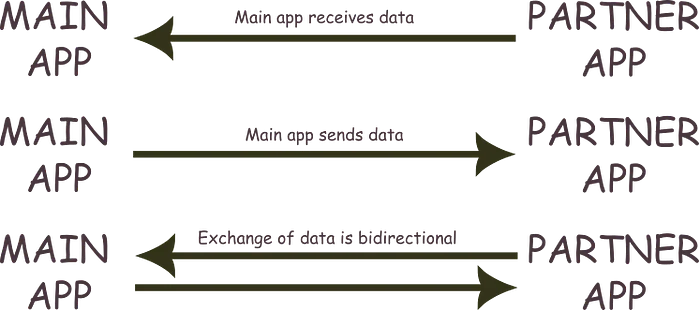
The article describes two real-world findings from testing these integrations. The first was in a well-known app tested through a private Bugcrowd program: an integration flaw gave access to any user's precise GPS location, among other things, without user interaction. It was treated as serious and paid a $1250 bounty.
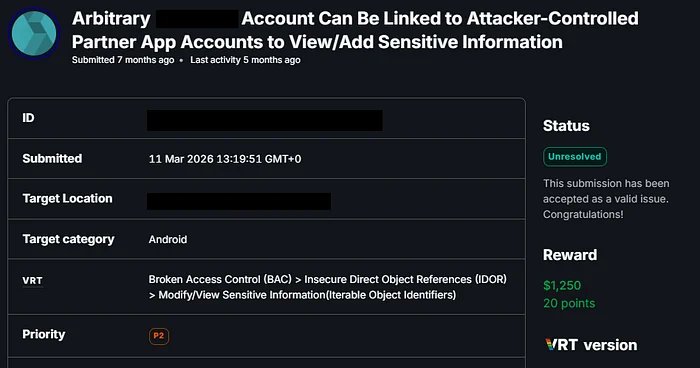
The second finding, described in detail below, was in the integration logic of ZEPP, the app used by Amazfit wearables to sync and manage data collected by the watch.
Setup
The researcher is an Amazfit user, which allowed practical testing of the ZEPP integration. The ZEPP app does not use SSL pinning, which removed the need for an SSL pinning bypass during testing. No further tooling, versions or account details are given.
Finding it
ZEPP used predictable user IDs in the OAuth state parameter. The state parameter normally carries a random, unpredictable value that the app sends with the request and checks when the service responds, so that an attacker cannot trick the app into accepting a fake response or a request the user never started. Because the value here was a user ID, changing it to another user's ID was enough to connect that user's ZEPP account to the attacker's partner app.
The predictability has two parts:
- The user ID is 10 digits long but not completely random. The researcher holds two accounts whose first seven digits are the same, so modifying only the last three digits can find a number of users.
- The user ID is persistent, so basic OSINT, using information that is already publicly available, can reveal a large number of real users' IDs. The researcher deliberately omits the steps to avoid targeting real user data.
Exploitation
Step 1: Change the state value
With the attacker's partner app initiating the connection to ZEPP, the state parameter, which contains the user ID, is replaced with the victim's user ID. The report does not include the raw request, so the exact parameter placement and endpoint are not shown.
Step 2: The victim's account is linked
Because the value is accepted as valid, the victim's ZEPP account is connected to the attacker's partner app. No interaction from the victim is described.
Step 3: Data flows to the attacker
ZEPP sends data to its partner app rather than only receiving it. When an Amazfit user goes for an outdoor run and syncs watch data with ZEPP, the data is also synced to the attacker's partner app, exposing their location and other details. In effect, the attacker can spy on the victim.
The researcher confirmed the issue with different partner apps, including Strava and Adidas Running.
Root cause
The OAuth state parameter was populated with a predictable, persistent user ID instead of a random, unpredictable value. The check that the returned state matches the one originally sent therefore proves nothing about who initiated the flow: anyone who knows or guesses a victim's ID can supply it. The absence of SSL pinning made interception and manipulation easier during testing.
Impact
An attacker can connect their own partner app to another ZEPP user's account and receive that user's synced workout data, including location, whenever the victim syncs their watch. The exposure lasts as long as the integration remains in place and the victim keeps syncing data. The researcher rates this as very serious precisely because ZEPP sends data to partner apps rather than only receiving it.
Fix
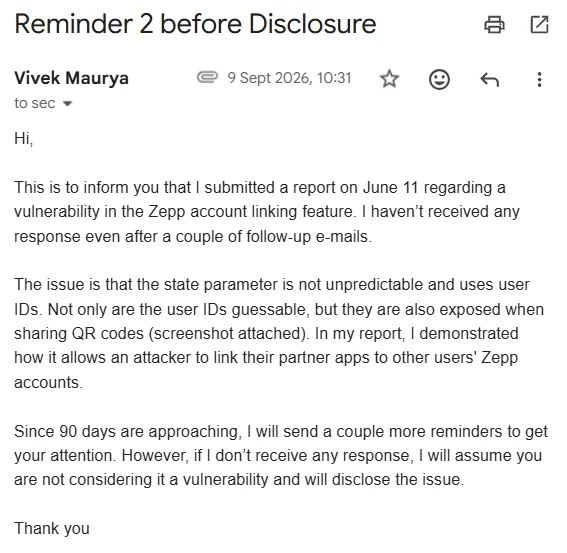
The report does not state that a fix was made. The report does not describe a fix. The issue was reported on June 11, 2026, with no response and a couple of unanswered follow-ups. After more than 90 days without a response, the researcher moved on, and the issue was still unresolved when the article was posted.
Variants to test
- Inspect the
stateparameter in OAuth flows between a fitness app and its partner apps. A positive result is a value tied to an account identifier, such as a user ID. - Create two accounts and compare their identifiers. A positive result is a shared prefix, as with the two accounts whose first seven digits matched, meaning only the remaining digits need changing.
- Search public sources for the identifier format. A positive result is a large set of real, persistent IDs that can be substituted into the flow.
- Check whether the integration is bidirectional. A positive result is data being pushed to the partner app, which turns a linking flaw into ongoing location exposure.
- Repeat the substitution against several partner apps. The researcher confirmed the issue with partner apps such as Strava and Adidas Running.
- The ZEPP app does not use SSL pinning, which saved the hassle of an SSL pinning bypass.
What happened, in plain words
Fitness apps and smartwatches collect a lot of information about you, including where you run or cycle. Many of these apps can also connect to other apps, called partner apps, so that your workout data is shared between them. This article is about what can go wrong when that connection is built badly.
The author tested these connections and found two real problems. In the first, a flaw in a well-known app let him reach any user's precise GPS location, without the user doing anything. That one was treated as serious and paid a $1250 bounty. In the second, the ZEPP app, which Amazfit watches use to store and manage watch data, used a predictable number to identify users during the connection process. By swapping that number for someone else's, an attacker could link a victim's ZEPP account to the attacker's own partner app, and then receive the victim's workout data, including location, every time the victim synced their watch.
The author reported the ZEPP issue on June 11, 2026, got no response, sent a couple of follow-ups, and after more than 90 days moved on. The issue was still unresolved when the article was posted.
Why fitness apps are worth looking at
Health and fitness have received increasing attention as obesity has become a worldwide issue, and in several countries an epidemic. Fitness apps and trackers are no longer used only by fitness enthusiasts. People use apps, smartwatches and other devices to keep track of their workouts, and those devices usually send the data to a designated app for long-term storage. That is convenient, but it also means the app holds sensitive information, such as location data used to provide GPS navigation for outdoor sports.

Another common feature is integration with partner apps. Each app tends to specialise, and letting them work together benefits the user. Depending on each app's role, data can travel in one direction only, or in both directions.
Think of it like two shops that share a delivery van. If one shop only receives parcels, a mistake in the arrangement mostly affects what arrives. If the van also carries parcels out, a mistake can send your parcel to the wrong address. The picture above shows the two possible directions of data flow between a main fitness app and a partner app.
From a security point of view, the integration logic is interesting for two reasons:
- Any developer mistake in the integration logic means data can be shared with the wrong entity.
- One app may be secure, but if the partner app is not, the user's data is in danger simply because they chose the wrong partner app.
The direction of data flow matters, especially when sensitive data is involved. When the app only receives data from the partner app, the risk is significantly lower than when it also sends data out.
Receiving data is not automatically harmless, though. Many apps let users share their data with the community. An attacker could store data containing the GPS location of a shady or sensitive place where the victim was never actually present. When the victim's app receives that data, it may be displayed to the community as the victim's own activity, potentially damaging their reputation. So what matters is not only the direction of the flow, but also which data is exposed and how creatively an attacker can use it.
The two real-world findings
The author came across two examples while testing these integrations.
While testing a renowned app through a private program on Bugcrowd (a platform where companies invite researchers to test their systems), he found an integration flaw that allowed him to gain access to any user's precise GPS location, among other things, without any user interaction. The vulnerability was considered serious, and he was rewarded a $1250 bounty.
The screenshot above shows the submission containing that issue and the bounty amount.
During another test, he came across a flaw in ZEPP's integration logic. Amazfit is a wearable brand, and its watches use the ZEPP app to sync and manage the data collected by the watch. Being an Amazfit user himself, the author could test this integration practically. The ZEPP app also does not use SSL pinning, which saved him the hassle of dealing with an SSL pinning bypass.
Two ideas to know before going further
SSL pinning. Normally, an app trusts any certificate that a recognised authority has issued, a bit like accepting any ID card from a recognised government. SSL pinning means the app only trusts one specific certificate, the one belonging to its own server. That makes it harder for someone in the middle of the connection to read or change the traffic. When pinning is absent, as in ZEPP, observing and modifying the flow during testing is easier.
OAuth and the state parameter. When an app uses another service, such as Google or Facebook, to sign you in, or asks for permission to access certain information from your account, it often uses a state parameter as a security check. The app generates a random, unpredictable value and sends it along with the request. When the service sends a response back, the app checks whether the state value matches the one it originally sent. This helps protect against attackers who might try to trick the app into accepting a fake response, or a request the user never started. The value must be unpredictable so that an attacker cannot easily guess it and use it to trick the app into accepting a malicious request.
A simple comparison: a cloakroom gives you a ticket with a random number, and when you come back it checks that your ticket matches the coat. If the ticket number were just your name, anyone who knows your name could collect your coat.
Finding the ZEPP flaw
ZEPP was using predictable user IDs in the state parameter. By changing the ID to another user's ID, it was possible to connect that user's ZEPP account to the attacker's partner app.
The predictability has two parts:
- The user ID is 10 digits long, but it is not completely random. The author has two accounts whose first seven digits are the same, so it is possible to find a number of users by modifying only the last three digits.
- Because the user ID is persistent (it does not change), basic OSINT, meaning gathering information that is already publicly available, can reveal a large number of real users' IDs online. The author deliberately does not mention the steps, to avoid real user data being targeted.
How the attack works
Step 1: Change the state value
The attacker's partner app starts the connection to ZEPP. The state parameter, which contains the user ID, is replaced with the victim's user ID. The report does not include the raw request, so the exact parameter placement and endpoint are not shown.
Why this step: the whole security check rests on the state value being something only the real user's flow could contain. If that value is simply a user ID, anyone who knows or guesses a victim's ID can supply it.
Step 2: The victim's account is linked
Because the value is accepted as valid, the victim's ZEPP account is connected to the attacker's partner app. No interaction from the victim is described.
Why this matters: the victim does not have to click anything or approve anything. The link is created on the strength of a number the attacker supplied.
Step 3: Data flows to the attacker
ZEPP sends data to its partner app rather than only receiving it. When an Amazfit user goes for an outdoor run and syncs watch data with ZEPP, the data is also synced to the attacker's partner app, exposing their location and other details. In effect, the attacker can spy on the victim.
The author confirmed the issue with different partner apps, including Strava and Adidas Running.
Why this is serious: because the integration is bidirectional, the linking flaw does not just let the attacker see something once. It turns into an ongoing feed of the victim's activity, including where they are.
Root cause
The OAuth state parameter was filled with a predictable, persistent user ID instead of a random, unpredictable value. The check that the returned state matches the one originally sent therefore proves nothing about who started the flow: anyone who knows or guesses a victim's ID can supply it. The absence of SSL pinning made interception and manipulation easier during testing.
Impact
An attacker can connect their own partner app to another ZEPP user's account and receive that user's synced workout data, including location, whenever the victim syncs their watch. The exposure lasts as long as the integration remains in place and the victim keeps syncing data. The author rates this as very serious precisely because ZEPP sends data to partner apps rather than only receiving it.
Fix
The report does not state that a fix was made. The report does not describe a fix.
The issue was reported on June 11, 2026, with no response and a couple of unanswered follow-ups. After more than 90 days without a response, the author moved on, and the issue was still unresolved when the article was posted.
What users can do
A vulnerability in fitness apps can allow attackers to spy on users, so users should take care about which apps they use.
- Use reputable apps. No app can be guaranteed to be secure, but a reputable app has a lot to lose from bad security publicity, which gives it more incentive to take security seriously.
- When integrating with partner apps, consider whether the app only receives data from the partner app or sends data to it too. The risk when data is only received is much lower than when it is sent as well.
- Review which third-party applications you have connected to your fitness apps, and revoke integrations you no longer use, especially when those integrations have access to sensitive data such as location or workout history.
Variants to test
- Inspect the
stateparameter in OAuth flows between a fitness app and its partner apps. A positive result is a value tied to an account identifier, such as a user ID. - Create two accounts and compare their identifiers. A positive result is a shared prefix, as with the two accounts whose first seven digits matched, meaning only the remaining digits need changing.
- Search public sources for the identifier format. A positive result is a large set of real, persistent IDs that can be substituted into the flow.
- Check whether the integration is bidirectional. A positive result is data being pushed to the partner app, which turns a linking flaw into ongoing location exposure.
- Repeat the substitution against several partner apps. The researcher confirmed the issue with partner apps such as Strava and Adidas Running.
- The ZEPP app does not use SSL pinning, which saved the hassle of an SSL pinning bypass.
The wider picture
There are lots of emerging apps in the fitness industry. As connected fitness apps and devices become more popular, many applications still lack designated bug bounty or vulnerability disclosure programs on reputable platforms, which makes testing those applications difficult.
It is tiring to keep sending follow-up emails without any responses, especially now that the rise of AI-generated submissions has disrupted even the biggest and most reputable bug bounty programs. The author expects the situation to improve a lot in the near future, making this one of the most interesting areas for bug hunters and security researchers.
Until then, users must be extra cautious about which apps they install and integrate, and what data they share. Someone reading this may be under surveillance without knowing it, simply because of the apps they have installed.
Glossary
- API: a way for one piece of software to talk to another, like a waiter taking your order to the kitchen and bringing back the food.
- Bounty: a reward, here $1250, paid by a company to a researcher who reports a valid security problem.
- Bug bounty program: a scheme where a company invites researchers to test its systems and pays for valid findings.
- Bugcrowd: a platform that hosts bug bounty programs for companies.
- Certificate: a digital document that proves a server is who it claims to be, like an ID card for a website.
- GPS: the satellite system that tells a device where it is on Earth.
- Integration: a connection that lets two apps exchange data.
- OAuth: a standard way for one app to get permission to access your account on another service, without you handing over your password.
- OSINT: open-source intelligence, meaning information gathered from sources that are already publicly available.
- Partner app: a separate app that a fitness app is connected to, and with which it shares data.
- Persistent: a value that stays the same over time instead of changing each time.
- Predictable: a value that can be guessed or worked out, rather than being random.
- Private program: a bug bounty program that only invited researchers can take part in.
- Root cause: the underlying mistake that makes a vulnerability possible.
- SSL pinning: a setting where an app trusts only one specific certificate, its own server's, instead of any recognised certificate.
- SSL pinning bypass: a technique for getting around SSL pinning so that traffic can still be observed or changed.
stateparameter: a value an app sends with an OAuth request and checks when the response comes back, to confirm the response belongs to a request it actually started.- Strava: a fitness tracking app named in the report as one of the partner apps used to confirm the issue.
- Adidas Running: another fitness tracking app named in the report as a partner app used to confirm the issue.
- Sync: copying data from a device, such as a watch, to an app so it is stored and managed there.
- Unidirectional: data flows in one direction only.
- Bidirectional: data flows in both directions.
- User ID: the number or string that identifies a particular account.
- Vulnerability: a weakness in software that an attacker can use to do something the owner did not intend.
- Wearable: a device you wear, such as a smartwatch, that collects data.
- ZEPP: the app used by Amazfit wearables to sync and manage the data collected by the watch.
- Amazfit: a wearable brand whose watches use the ZEPP app.



