HTTP Request Smuggling (TE.CL) to Session Hijacking via GraphQL
A TE.CL HTTP request smuggling flaw let the attacker desynchronise the back-end connection and smuggle a GraphQL mutation whose final form parameter absorbed the next user's request. That request, including its session cookie, was stored in the attacker's support conversation, enabling session hijacking.

medium.com
Published on medium.com
Bug Bounty Writeup
The full write-up lives on its author's site
It belongs to its author, so we link to it rather than copy it. The other two tabs are our own rewrites, checked against it.
Context
This write-up describes an authorised assessment of a web application whose support functionality was reachable both through a conventional JSON API and through a GraphQL endpoint. The support feature lets a signed-in user open a conversation and post messages into it; the message text is what the application stores and later renders back to that user.
The bug class is HTTP request smuggling, specifically a TE.CL desynchronisation between a front-end proxy and a back-end server. On its own that gives a parser disagreement that may look like a 400 Bad Request or a dropped connection. The write-up is about turning that disagreement into a reliable cross-request interaction: a smuggled GraphQL mutation that stores the next request arriving on the same back-end connection, including its Cookie header, inside the attacker's own support conversation.
The full chain as the author describes it:
TE.CL desync → poisoned back-end connection → smuggled GraphQL request → next request absorbed into the body → victim request stored in the attacker's support conversation → session cookie disclosure → session hijacking / account takeover.
Setup
The assessment was authorised. The author used Burp Repeater, with the two requests placed in a single Repeater tab group and sent over a single TCP connection. An attacker account with a support conversation was needed, plus the conversation or message identifier for that conversation. The victim side is represented by a second, ordinary request that has to land on the same poisoned back-end connection.
No product versions, proxy software names or back-end stack details are given in the write-up.
Finding it
The starting point was a framing disagreement. The front-end processed the request using:
Transfer-Encoding: chunked
while the back-end interpreted the request boundary using:
Content-Length
Conceptually, the front-end saw:
Transfer-Encoding: chunked
and therefore treated:
as the end of the chunked body. The back-end, however, was still willing to interpret bytes that followed according to a different request boundary.
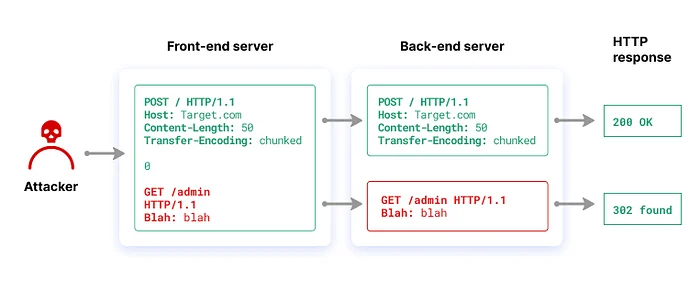
The image is captioned as an illustration of the HTTP request smuggling (TE.CL) concept.
A simplified version of the desync trigger looked like this:
POST /api/stich_transitionState?localeCode=en-US HTTP/1.1Host: target.example.comConnection: keep-aliveX-Csrf-Token: xTransfer-Encoding: chunked
0POST /graphql HTTP/1.1Host: target.example.com...
The outer request carries Transfer-Encoding: chunked; the 0 terminates the chunked body as far as the front-end is concerned, and everything after it is what the back-end still treats as part of the request stream. The author is explicit that the exact endpoint name is not the important observation. What matters is that the connection could be left in a state where the back-end expected more bytes than the front-end considered part of the first request. A follow-up request producing an abnormal response was enough to establish the underlying desynchronisation. At that stage there was no account takeover yet.
Exploitation
Step 1: try a state-changing JSON API
The first weaponisation attempt targeted a state-changing JSON API directly. The endpoint expected a valid JSON document such as:
{ "request": { "message": { "text": "hello" } }}
If a victim request was appended after the JSON object:
{"request":{"message":{"text":"hello"}}}GET /...
the back-end JSON parser rejected the body. The smuggling primitive existed, but the application-layer payload could not survive the appended bytes. That raised the question of whether another endpoint performs the same application action while accepting a less rigid body format.
Step 2: switch to the GraphQL endpoint
The support functionality was also exposed through a GraphQL endpoint:
POST /graphqlContent-Type: application/x-www-form-urlencoded
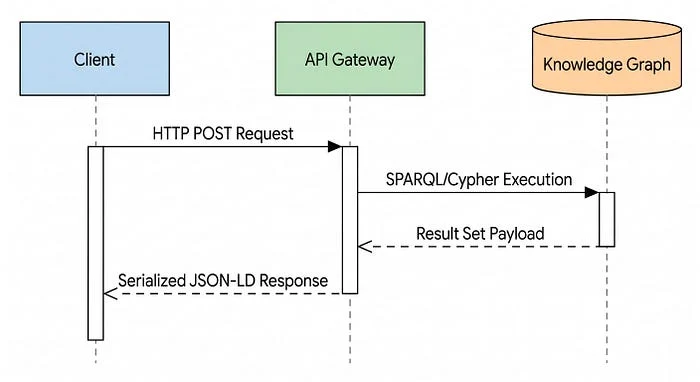
This changed the situation completely. Instead of sending the nested structure as strict JSON, the request could be represented as bracketed URL-encoded parameters. This logical object:
{ "variables": { "request": { "message": { "text": "myMessage" } } }}
could be represented as:
variables[request][message][text]=myMessage
That gives a controllable parameter at the end of the request body. The final parameter can absorb the bytes of the next request while remaining syntactically acceptable to the application: the HTTP parser is desynchronised at the transport layer, while the application parser still receives something that looks like a valid form-encoded request. The author calls this the missing link.
Step 3: build the smuggled request
The crafted request uses the vulnerable request as the outer desynchronisation trigger and then injects a second request targeting /graphql. A sanitised representation:
POST /api/stich_transitionState?localeCode=en-US HTTP/1.1Host: target.example.comConnection: keep-aliveX-Csrf-Token: xTransfer-Encoding: chunked
0POST /graphql HTTP/1.1Host: target.example.comContent-Type: application/x-www-form-urlencodedX-Csrf-Token: xCookie: cookie1=[ATTACKER_cookie1]; cookie2=[ATTACKER_cookie2]; cookie3=[ATTACKER_cookie3]Content-Length: [SMUGGLED_BODY_LENGTH + VICTIM_REQUEST_LENGTH]operationName=updateMobileContact_deprecated&variables[request][contactID]=[ATTACKER_CONTACT_ID]&query=[GRAPHQL_MUTATION]&variables[request][message][text]=HIJACKED_REQUEST_BEGINS:
The smuggled request carries the attacker's own cookies, the attacker's contact identifier, the mutation in the query parameter, and a final form parameter whose value is the marker HIJACKED_REQUEST_BEGINS:. The exact GraphQL mutation can be represented conceptually as:
mutation updateMobileContact_deprecated($request: UpdateMobileContactRequest) { updateMobileContact_deprecated(request: $request) { __typename ... on UpdateMobileContactResponse { mobileMessage { text } } }}
The final form parameter is the key:
variables[request][message][text]=HIJACKED_REQUEST_BEGINS:
Because it is the last field, the next HTTP request can become part of its value.
Step 4: make the back-end hungry
The critical detail is the Content-Length. The length declared by the smuggled /graphql request has to account for the smuggled body length plus the complete length of the following request:
Content-Length = attacker-controlled GraphQL body + victim request bytes
This causes the back-end to keep reading after the attacker's form body has already reached its logical end. The next request arriving on that same back-end connection is therefore consumed as additional request-body data. The author calls this the "hungry" behaviour that turns a parser desynchronisation into cross-request data capture.
Step 5: the victim request
The second request was intentionally ordinary. For demonstration, a victim-style request can be represented as:
GET /path/inbox HTTP/1.1Host: target.example.comCookie: session_cookie=VICTIM_SESSION_VALUECache-Control: no-cache
The important requirement is that the victim request reaches the same poisoned back-end connection. When that happens, its bytes are appended to the body of the smuggled GraphQL request. From the application's perspective, the result resembles a support message containing attacker-controlled text followed by the raw HTTP request.
Step 6: the request is stored
The application accepted the attacker-controlled message text through the GraphQL mutation. Because the final parameter was a form value rather than a rigid JSON field, the additional bytes did not immediately invalidate the entire message object. The back-end processed the mutation and stored the resulting text in the attacker's support conversation. The stored message effectively became:
HIJACKED_REQUEST_BEGINS:GET /path/inbox HTTP/1.1Host: target.example.comCookie: session_cookie=VICTIM_SESSION_VALUECache-Control: no-cache...
The critical security boundary had now been crossed: a request generated by another user became readable data inside the attacker's authenticated account.
The image is captioned as illustrating session hijacking via a stored request.
Step 7: verification
The verification flow was straightforward:
- Create a support conversation as the attacker.
- Obtain the conversation/message identifier.
- Prepare the two requests in a single Burp Repeater tab group.
- Send them using a single TCP connection.
- Ignore the immediate Repeater responses.
- Refresh the support inbox in the browser.
- Open the conversation used during the test.
- Observe the newly stored message containing the appended request.
The key evidence was the presence of the victim request and its Cookie header inside the attacker's own support thread.
Root cause
The transport-layer disagreement is the classic TE.CL one: the front-end honours Transfer-Encoding: chunked and stops at the terminating 0, while the back-end frames the request with Content-Length and keeps reading. The application-layer mistake is what makes the desync exploitable. The support action is reachable through a form-encoded GraphQL request whose last parameter, variables[request][message][text], accepts arbitrary text. A trailing parameter of that shape absorbs whatever bytes follow it without breaking the form syntax, so the appended victim request is stored as part of the message value rather than rejected.
The JSON variant failed because a strict JSON parser rejects trailing bytes after the closing brace. The form-encoded GraphQL variant survived because the trailing bytes simply became part of the last parameter's value. The write-up does not describe any defence that was present and bypassed; the implication is that the front-end and back-end simply disagreed on framing and that the application accepted the resulting body.
Impact
Under the conditions described, an attacker who can trigger the desync and get a victim request onto the same back-end connection can capture that request, including its Cookie header, and read it back inside their own authenticated support conversation. The author frames the outcome as session cookie disclosure leading to session hijacking and account takeover. The victim must reach the poisoned connection, and the attacker needs a support conversation and its identifier. The write-up does not quantify how many victims or which accounts are affected, and it does not show a completed hijack against a real victim session; the evidence is the stored request containing the victim's cookie.
Fix
No fix is described in the write-up. No fix is described in the write-up. The obvious directions are to make the front-end and back-end agree on request framing and to stop the application accepting a trailing form parameter that can absorb following bytes.
Variants to test
- Other form-encoded GraphQL endpoints. Look for
POST /graphqlwithContent-Type: application/x-www-form-urlencodedand bracketedvariables[...]parameters. A positive result is a final parameter that accepts appended bytes and stores them as message text. - Other text-accepting last parameters. Any mutation whose last parameter is free text (message body, comment, note, description) is a candidate. A positive result is the appended request appearing verbatim in the stored value.
- The JSON variant on other endpoints. Try the same chain against a strict JSON API. A negative result, as in this write-up, is a parser rejection; a positive result would be a JSON endpoint that tolerates trailing data.
- Different outer triggers. The write-up uses
/api/stich_transitionState?localeCode=en-USas the desync trigger. Any endpoint that the front-end frames withTransfer-Encoding: chunkedwhile the back-end usesContent-Lengthis worth testing; a positive result is an abnormal response to a follow-up request on the same connection. - Content-Length tuning. Vary the declared length to cover the smuggled body plus the following request. A positive result is the back-end consuming the next request as body data rather than treating it as a new request.
What happened, in plain words
Imagine a building with a receptionist at the front door and a mailroom behind it. The receptionist decides where one visitor's paperwork ends and the next visitor's begins. The mailroom has its own idea about where that boundary is. If the two disagree, a clever visitor can hand over paperwork that the receptionist thinks is finished, but the mailroom keeps reading, and the next person's paperwork gets stapled to the end of the clever visitor's form. That is the whole idea behind the bug in this write-up.
In web terms, a website is often built from two pieces: a front-end proxy (the receptionist) that sits between the internet and the actual application, and a back-end server (the mailroom) that does the real work. Both read the same HTTP request, but they can disagree about where one request stops and the next begins. That disagreement is called HTTP request smuggling, and the specific flavour here is TE.CL.
The author found this disagreement on a web application during an authorised assessment. The application had a support feature: a signed-in user could open a conversation and post messages into it. The same support action was reachable through two different interfaces, a normal JSON API and a GraphQL endpoint. The author used the GraphQL one because its body format was flexible enough to swallow the next request that arrived on the same connection. That next request, belonging to another user, ended up stored as a message inside the attacker's own support conversation, including its Cookie header. A cookie is the small piece of data a browser sends to prove who is signed in, so leaking it can mean taking over the account.
The full chain, as the author describes it:
TE.CL desync → poisoned back-end connection → smuggled GraphQL request → next request absorbed into the body → victim request stored in the attacker's support conversation → session cookie disclosure → session hijacking / account takeover.
Each arrow is explained below, step by step, with the same requests the author used.
The pieces you need to know first
Before the steps, a few everyday ideas.
- HTTP is the language a browser and a website use to talk. A request looks like a short letter: a first line saying what you want (
GET /inbox HTTP/1.1), then headers (extra labels such asHost:orCookie:), then an optional body (the data you are sending, for example a message). - An API is a way for one program to ask another program to do something, without a human clicking buttons. The support feature in this write-up is an API: the browser sends a request, the server stores a message.
- A cookie is a small label the server gives your browser after you sign in. Your browser shows it on every later request so the server knows it is still you. If someone else gets your cookie, they can often pretend to be you. That is session hijacking, and if it lets them control your account fully, account takeover.
- A proxy is a server that sits in front of the real application and forwards traffic to it. Many sites use one for caching, filtering or load balancing.
- HTTP request smuggling is when the proxy and the real server disagree about where a request ends. One of them sees two requests; the other sees one long request with the second one hidden inside the first. The hidden one is the "smuggled" request.
- TE.CL is one specific disagreement.
TEstands for theTransfer-Encodingheader,CLfor theContent-Lengthheader. The front-end trustsTransfer-Encoding: chunked; the back-end trustsContent-Length. They therefore cut the request at different places. - Chunked encoding is a way of sending a body in pieces. Each piece starts with its size in hexadecimal, and a piece of size
0means "the body is finished". - Content-Length is a header that simply says how many bytes the body contains. The receiver reads exactly that many bytes and stops.
- GraphQL is a query language for APIs. Instead of many fixed URLs, a GraphQL API usually has one endpoint, often
/graphql, and the client sends aquerydescribing what it wants. A mutation is a GraphQL request that changes data, for example storing a message. - JSON is a text format for structured data, using curly braces and quotes, for example
{"text": "hello"}. It is strict: anything after the closing brace is an error. - Form-encoded is another body format, the kind a browser uses when you submit a plain HTML form. It looks like
name=value&name2=value2. It is much more forgiving than JSON. - Burp Repeater is a tool that lets you write an HTTP request by hand and send it, then look at the response. A Repeater tab group lets you keep several requests together and send them over one connection.
- A TCP connection is the underlying pipe between your computer and the server. Requests sent over the same pipe arrive in order, one after another. That matters here: the smuggled request and the victim's request must travel on the same pipe.
1. The starting point: two servers, two opinions
The author's first job was to show that the front-end and the back-end disagreed about where a request ends. The front-end processed the request using:
Transfer-Encoding: chunked
while the back-end interpreted the request boundary using:
Content-Length
Line by line: the first header tells the front-end "this body is sent in chunks, and a chunk of size zero ends it". The second header tells the back-end "this body is exactly this many bytes long". If both headers are present and the two servers trust different ones, they can stop reading at different points.
Conceptually, the front-end saw:
Transfer-Encoding: chunked
and therefore treated:
as the end of the chunked body. The back-end, however, was still willing to interpret bytes that followed according to a different request boundary.
In plain words: the front-end reads the 0, says "done, that request is complete", and passes the request on. The back-end never looks at the 0 as an end marker, because it is counting bytes according to Content-Length. So whatever comes after the 0 is still, to the back-end, part of the same incoming stream.
The image is captioned as an illustration of the HTTP request smuggling (TE.CL) concept.
A simplified version of the desync trigger looked like this:
POST /api/stich_transitionState?localeCode=en-US HTTP/1.1Host: target.example.comConnection: keep-aliveX-Csrf-Token: xTransfer-Encoding: chunked
0POST /graphql HTTP/1.1Host: target.example.com...
Line by line for the first block:
POST /api/stich_transitionState?localeCode=en-US HTTP/1.1is the request line: send data (POST) to that path, with a query parameterlocaleCode=en-US, using HTTP version 1.1.Host: target.example.comsays which website this is for.Connection: keep-aliveasks the server to keep the pipe open after this request, so more requests can follow on the same connection. This is essential: the whole trick depends on the next request using the same pipe.X-Csrf-Token: xis a header the application expects. A CSRF token is a value the site gives your browser to prove a form submission really came from the site. Here it is justx.Transfer-Encoding: chunkedtells the front-end the body is chunked.
Line by line for the second block:
0is the zero-size chunk. To the front-end, this ends the body of the first request.POST /graphql HTTP/1.1is the start of a second request, hidden right after the0. To the back-end, which is still counting bytes, this text is not a new request yet; it is just more data in the stream.Host: target.example.comand the...stand for the rest of that hidden request.
The author is explicit that the exact endpoint name is not the important observation. What matters is that the connection could be left in a state where the back-end expected more bytes than the front-end considered part of the first request. A follow-up request producing an abnormal response was enough to establish the underlying desynchronisation. At that stage there was no account takeover yet: the author had proved the two servers disagree, nothing more.
Why this step first? Because without a proven disagreement, everything that follows is guesswork. The abnormal response to a follow-up request is the signal that the pipe is now in a strange state.
2. First attempt: a strict JSON API says no
The natural next idea is to use the smuggling to make the server perform an action, for example store a message. The author first tried a state-changing JSON API directly. The endpoint expected a valid JSON document such as:
{ "request": { "message": { "text": "hello" } }}
Line by line: the outer { opens an object. "request" is a key whose value is another object, which contains "message", which contains "text" with the value "hello". This is a nested structure: a request containing a message containing text. The server's JSON parser reads it strictly, from the first brace to the matching last brace.
If a victim request was appended after the JSON object:
{"request":{"message":{"text":"hello"}}}GET /...
the back-end JSON parser rejected the body. In plain words: the JSON parser reaches the closing } and expects nothing more. The moment it sees GET /... after it, it declares the body invalid and throws the whole thing away. The smuggling primitive existed, but the application-layer payload could not survive the appended bytes.
Why does that matter? Because the goal is not just to confuse the servers; it is to make the application store the next request as data. A strict parser refuses to store anything once extra bytes appear. That raised the question of whether another endpoint performs the same application action while accepting a less rigid body format.
3. The GraphQL endpoint changes everything
The support functionality was also exposed through a GraphQL endpoint:
POST /graphqlContent-Type: application/x-www-form-urlencoded
Line by line: POST /graphql means send data to the GraphQL endpoint. Content-Type: application/x-www-form-urlencoded tells the server the body is in form format, the same format a plain HTML form uses, not JSON.
This changed the situation completely. Instead of sending the nested structure as strict JSON, the request could be represented as bracketed URL-encoded parameters. This logical object:
{ "variables": { "request": { "message": { "text": "myMessage" } } }}
could be represented as:
variables[request][message][text]=myMessage
Line by line: the JSON version nests variables → request → message → text. The form version writes the same path with square brackets: variables[request][message][text], then =myMessage. Many server frameworks understand this bracket notation and rebuild the nested object for you. So the same data reaches the application, but in a format that is far more relaxed about what comes after it.
That gives a controllable parameter at the end of the request body. The final parameter can absorb the bytes of the next request while remaining syntactically acceptable to the application: the HTTP parser is desynchronised at the transport layer, while the application parser still receives something that looks like a valid form-encoded request. The author calls this the missing link.
Why is a trailing form parameter so useful? Because in form format, a value runs until the next & or the end of the body. If the next request's bytes arrive after the =, the form parser simply treats them as more of the value. Nothing is rejected. The text is stored as the message.
4. Building the smuggled request
The crafted request uses the vulnerable request as the outer desynchronisation trigger and then injects a second request targeting /graphql. A sanitised representation:
POST /api/stich_transitionState?localeCode=en-US HTTP/1.1Host: target.example.comConnection: keep-aliveX-Csrf-Token: xTransfer-Encoding: chunked
0POST /graphql HTTP/1.1Host: target.example.comContent-Type: application/x-www-form-urlencodedX-Csrf-Token: xCookie: cookie1=[ATTACKER_cookie1]; cookie2=[ATTACKER_cookie2]; cookie3=[ATTACKER_cookie3]Content-Length: [SMUGGLED_BODY_LENGTH + VICTIM_REQUEST_LENGTH]operationName=updateMobileContact_deprecated&variables[request][contactID]=[ATTACKER_CONTACT_ID]&query=[GRAPHQL_MUTATION]&variables[request][message][text]=HIJACKED_REQUEST_BEGINS:
Line by line for the first block: this is the same outer trigger as before. It is a POST to /api/stich_transitionState?localeCode=en-US, with Connection: keep-alive so the pipe stays open, a CSRF token header, and Transfer-Encoding: chunked so the front-end uses chunked framing.
Line by line for the second block:
0ends the chunked body as far as the front-end is concerned. Everything after it is the smuggled request.POST /graphql HTTP/1.1starts the hidden request, aimed at the GraphQL endpoint.Host: target.example.comidentifies the site.Content-Type: application/x-www-form-urlencodedsays the hidden request's body is form-encoded.X-Csrf-Token: xis the CSRF token header for the hidden request.Cookie: cookie1=[ATTACKER_cookie1]; cookie2=[ATTACKER_cookie2]; cookie3=[ATTACKER_cookie3]carries the attacker's own cookies, so the hidden request acts as the attacker's signed-in session. The values are placeholders in the write-up.Content-Length: [SMUGGLED_BODY_LENGTH + VICTIM_REQUEST_LENGTH]is the crucial number: the declared body length covers both the attacker's form body and the victim's request that will arrive later. This is what makes the back-end keep reading.operationName=updateMobileContact_deprecatednames the GraphQL operation to run.variables[request][contactID]=[ATTACKER_CONTACT_ID]sets the contact identifier to the attacker's own contact.query=[GRAPHQL_MUTATION]carries the mutation itself.variables[request][message][text]=HIJACKED_REQUEST_BEGINS:is the last parameter. Its value starts with the markerHIJACKED_REQUEST_BEGINS:and, because it is last, it will keep absorbing whatever bytes follow.
The exact GraphQL mutation can be represented conceptually as:
mutation updateMobileContact_deprecated($request: UpdateMobileContactRequest) { updateMobileContact_deprecated(request: $request) { __typename ... on UpdateMobileContactResponse { mobileMessage { text } } }}
Line by line: mutation updateMobileContact_deprecated($request: UpdateMobileContactRequest) declares a mutation named updateMobileContact_deprecated that takes one argument, $request, of type UpdateMobileContactRequest. The body calls updateMobileContact_deprecated(request: $request) and asks for fields back: __typename (the type name of the result), and inside ... on UpdateMobileContactResponse, the mobileMessage object with its text. In plain words: "run this update, and tell me the text of the resulting message".
The final form parameter is the key:
variables[request][message][text]=HIJACKED_REQUEST_BEGINS:
Because it is the last field, the next HTTP request can become part of its value. The final parameter's value starts with the marker HIJACKED_REQUEST_BEGINS:.
5. Making the back-end hungry
The critical detail is the Content-Length. The length declared by the smuggled /graphql request has to account for:
smuggled body length + complete length of the following request
Conceptually:
Content-Length = attacker-controlled GraphQL body + victim request bytes
Line by line: the first line says the declared length is the sum of two things. The second line spells them out: the attacker's own GraphQL body, plus the bytes of the victim's request. If the declared length were only the attacker's body, the back-end would stop reading at the end of the form and the victim's request would be treated as a new request. By declaring the larger number, the author makes the back-end wait for more data.
This causes the back-end to keep reading after the attacker's form body has already reached its logical end. The next request arriving on that same back-end connection is therefore consumed as additional request-body data. The author calls this the "hungry" behaviour that turns a parser desynchronisation into cross-request data capture.
Why does this work? Because the back-end trusts Content-Length and counts bytes. It has been told to expect more bytes than the attacker actually sent, so it sits there reading. The next thing to arrive on that pipe is the victim's request, and the back-end swallows it as if it were the rest of the form value.
6. The victim request
The second request was intentionally ordinary. For demonstration, a victim-style request can be represented as:
GET /path/inbox HTTP/1.1Host: target.example.comCookie: session_cookie=VICTIM_SESSION_VALUECache-Control: no-cache
Line by line:
GET /path/inbox HTTP/1.1is a normal page request: fetch the inbox page.Cookie: session_cookie=VICTIM_SESSION_VALUEis the victim's session cookie, the value that proves who they are. In the write-up it is a placeholder.Cache-Control: no-cacheasks that the response not be served from a cache.
The important requirement is that the victim request reaches the same poisoned back-end connection. When that happens, its bytes are appended to the body of the smuggled GraphQL request. From the application's perspective, the result resembles a support message containing attacker-controlled text followed by the raw HTTP request.
Why does the victim request have to be ordinary? Because the attack is not about the victim doing anything unusual. It is about where their request lands. If it lands on the poisoned pipe, it becomes data. If it lands on a fresh connection, nothing happens.
7. Why the request was successfully stored
The application accepted the attacker-controlled message text through the GraphQL mutation. Because the final parameter was a form value rather than a rigid JSON field, the additional bytes did not immediately invalidate the entire message object. The back-end processed the mutation and stored the resulting text in the attacker's support conversation. The stored message effectively became:
HIJACKED_REQUEST_BEGINS:GET /path/inbox HTTP/1.1Host: target.example.comCookie: session_cookie=VICTIM_SESSION_VALUECache-Control: no-cache...
Line by line: the stored text starts with the marker HIJACKED_REQUEST_BEGINS:, then the victim's request line GET /path/inbox HTTP/1.1, then the victim's Host header, then the victim's Cookie header with the session value, then Cache-Control: no-cache, and the ... shows it continues. In plain words: the victim's whole request, cookie included, is now text inside a message the attacker can read.
The critical security boundary had now been crossed: a request generated by another user became readable data inside the attacker's authenticated account.
The image is captioned as illustrating session hijacking via a stored request.
Why is this the moment that matters? Because up to here, the author had only confused the servers. Now another user's secret has crossed from their session into the attacker's account, where the attacker can simply open the conversation and read it.
8. Verification
The verification flow was straightforward:
- Create a support conversation as the attacker.
- Obtain the conversation/message identifier.
- Prepare the two requests in a single Burp Repeater tab group.
- Send them using a single TCP connection.
- Ignore the immediate Repeater responses.
- Refresh the support inbox in the browser.
- Open the conversation used during the test.
- Observe the newly stored message containing the appended request.
Why each step:
- The attacker needs a conversation of their own, because that is where the stolen request will be stored and where they can read it.
- The identifier is needed to point the mutation at that exact conversation, via
variables[request][contactID]. - A Repeater tab group keeps the two requests together so they can be sent over one connection.
- One TCP connection is the whole point: the victim's request must arrive on the same pipe the back-end is still reading from.
- The immediate responses are not the evidence. The evidence is what got stored, so the author ignores them.
- Refreshing the inbox shows the conversation as the application now sees it.
- Opening the conversation shows the stored message.
- The stored message contains the appended request, which is the proof.
The key evidence was the presence of the victim request and its Cookie header inside the attacker's own support thread.
9. Why it worked, and why the JSON version did not
The transport-layer disagreement is the classic TE.CL one: the front-end honours Transfer-Encoding: chunked and stops at the terminating 0, while the back-end frames the request with Content-Length and keeps reading. The application-layer mistake is what makes the desync exploitable. The support action is reachable through a form-encoded GraphQL request whose last parameter, variables[request][message][text], accepts arbitrary text. A trailing parameter of that shape absorbs whatever bytes follow it without breaking the form syntax, so the appended victim request is stored as part of the message value rather than rejected.
The JSON variant failed because a strict JSON parser rejects trailing bytes after the closing brace. The form-encoded GraphQL variant survived because the trailing bytes simply became part of the last parameter's value. The write-up does not describe any defence that was present and bypassed; the implication is that the front-end and back-end simply disagreed on framing and that the application accepted the resulting body.
In everyday terms: the JSON parser is a strict form checker who refuses the whole form if there is scribbling after the signature. The form parser is a relaxed clerk who just keeps writing whatever you hand over into the last box.
10. What an attacker could do with this
Under the conditions described, an attacker who can trigger the desync and get a victim request onto the same back-end connection can capture that request, including its Cookie header, and read it back inside their own authenticated support conversation. The author frames the outcome as session cookie disclosure leading to session hijacking and account takeover. The victim must reach the poisoned connection, and the attacker needs a support conversation and its identifier. The write-up does not quantify how many victims or which accounts are affected, and it does not show a completed hijack against a real victim session; the evidence is the stored request containing the victim's cookie.
Why the caveats matter: the chain is real, but it depends on the victim's request landing on the poisoned pipe. That is a timing and traffic condition, not something the attacker fully controls. The write-up shows the capture of the victim's request, not a completed hijack.
11. How to fix it
No fix is described in the write-up. No fix is described in the write-up. The obvious directions are to make the front-end and back-end agree on request framing and to stop the application accepting a trailing form parameter that can absorb following bytes.
In plain words: either make the receptionist and the mailroom use the same rulebook, or make the last box on the form impossible to keep writing into.
12. Variants worth testing
- Other form-encoded GraphQL endpoints. Look for
POST /graphqlwithContent-Type: application/x-www-form-urlencodedand bracketedvariables[...]parameters. A positive result is a final parameter that accepts appended bytes and stores them as message text. - Other text-accepting last parameters. Any mutation whose last parameter is free text (message body, comment, note, description) is a candidate. A positive result is the appended request appearing verbatim in the stored value.
- The JSON variant on other endpoints. Try the same chain against a strict JSON API. A negative result, as in this write-up, is a parser rejection; a positive result would be a JSON endpoint that tolerates trailing data.
- Different outer triggers. The write-up uses
/api/stich_transitionState?localeCode=en-USas the desync trigger. Any endpoint that the front-end frames withTransfer-Encoding: chunkedwhile the back-end usesContent-Lengthis worth testing; a positive result is an abnormal response to a follow-up request on the same connection. - Content-Length tuning. Vary the declared length to cover the smuggled body plus the following request. A positive result is the back-end consuming the next request as body data rather than treating it as a new request.
Why these variants: the technique is not tied to one URL. It is tied to two conditions, a framing disagreement and a body format that can absorb extra bytes. Anywhere both conditions appear, the same chain is worth a try.
Glossary
- API: a way for one program to ask another program to do something, without a human clicking buttons.
- Account takeover: when an attacker gains full control of another person's account.
- Back-end server: the server that actually runs the application logic, behind the front-end proxy.
- Body: the data part of an HTTP request, after the headers.
- Burp Repeater: a tool for writing an HTTP request by hand, sending it, and inspecting the response.
- Burp Repeater tab group: a Repeater feature that keeps several requests together and can send them over one connection.
- Chunked encoding: a way of sending a body in pieces, each prefixed with its size, ending with a zero-size chunk.
- Content-Length: a header stating exactly how many bytes the body contains.
- Cookie: a small value a browser stores and sends back to prove who is signed in.
- CSRF token: a value the site gives your browser to prove a form submission really came from the site.
- Desynchronisation (desync): a state where two parties disagree about where a request ends, so one sees a different stream from the other.
- Form-encoded: a body format like
name=value&name2=value2, used by plain HTML forms. - Front-end proxy: a server in front of the application that forwards traffic to it.
- GraphQL: a query language for APIs, usually served from one endpoint such as
/graphql. - Header: a labelled line in an HTTP request or response, such as
Host:orCookie:. - HTTP: the language browsers and websites use to talk.
- HTTP request smuggling: making a proxy and a back-end disagree about request boundaries so that a hidden request is processed.
- JSON: a strict text format for structured data using braces, quotes and colons.
- Mutation: a GraphQL request that changes data, as opposed to reading it.
- Session hijacking: using someone else's session cookie to act as them.
- TCP connection: the underlying pipe between two computers over which HTTP requests travel in order.
- TE.CL: a request-smuggling flavour where the front-end trusts
Transfer-Encodingand the back-end trustsContent-Length. - Transfer-Encoding: a header saying how the body is encoded, for example
chunked. - Victim request: the ordinary request from another user that gets absorbed into the smuggled body.




