I Couldn’t Read the Chat, So I Invited Someone Who Could
An unverified clinician who was a participant in a group conversation but lacked inbox entitlements could call the addParticipantsToGroupConversation mutation to add any verified clinician to the conversation. The added clinician could then read the full message history, including patient clinical information, and could repeat the mutation to add further clinicians.

Cybersecurity
The full write-up lives on its author's site
It belongs to its author, so we link to it rather than copy it. The other two tabs are our own rewrites, checked against it.
Context
The target is a professional network for physicians and clinicians, described in the write-up as the medical equivalent of LinkedIn, with real patient communications running through it. The feature in scope is the Inbox system, which lets clinicians hold group conversations: coordinating care, sharing lab results, discussing cases. Those conversations can contain patient names, diagnoses, test results and clinical decisions.
Access to the Inbox is modelled in two layers:
- Account verification status. Accounts go through a verification process. A verified clinician has confirmed their identity and credentials. An unverified provider account exists in the system but has not been credentialed. Unverified accounts have restricted access across the platform and are denied inbox entitlements by default.
- Conversation participation. Separately from account-level verification, a user can hold participant status in a specific conversation. This happens when a verified clinician adds them, an action that gives the account a seat in the conversation, tracked in the conversation's participant list.
The design intent is explicit: participant status and inbox entitlement are not the same thing. A user can be in a conversation's member list while being denied the inbox permissions that allow them to read or write. Being added to a room does not mean you are authorised to use it.
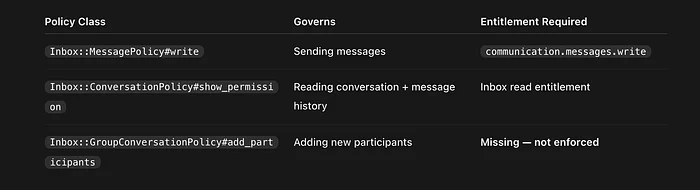
Inbox authorisation is enforced through three separate policy classes in the backend, each responsible for a different operation. The first two were implemented and working. The third was absent.
Setup
Three accounts were used, all on the staging environment. No real patient data was involved.
| Account | Role | State |
|---|---|---|
| ATK | Attacker | Unverified provider account, legitimately added to a group conversation as a participant by a verified clinician. Denied inbox entitlements: cannot read the conversation and cannot send messages. Holds participant status. |
| DO | Ground truth | Verified, fully entitled clinician and a legitimate authorised participant in the conversation. Used to establish what a real member with full inbox entitlements could see. |
| MD | Injection target | Verified clinician with no prior connection to the conversation. Removed from the conversation before the test to establish a clean denial baseline. |
The backend is a Rails application using Pundit for authorisation, exposed through GraphQL. Each GraphQL mutation or query is evaluated against a policy method that returns true (allow) or false (deny).
Finding it
The researcher's observation was structural. The platform had two policy classes protecting two operations, reading and writing, and both required the same three conditions: the caller is authenticated, the caller holds an inbox entitlement, and the caller is a participant. A third operation in the same authorisation family, addParticipantsToGroupConversation, was protected by a presence check only. It asked whether the caller was authenticated and held participant status, but never whether the caller had inbox entitlement.
That means an unverified participant, denied both reading and writing, could still call the mutation that determines who else gets access. Participant status is the prerequisite for the bug, not the authorisation for the action.
Exploitation
Step 1: Control A, message sending blocked
ATK attempts to send a message to the conversation. The backend evaluates this against Inbox::MessagePolicy#write, the policy that checks whether the caller holds the communication.messages.write permission.
{  "errors": [{    "message": "Unauthorized access to type Inbox_SendMessage",    "extensions": {      "[REDACTED]": {        "aggregated": {          "pundit_policy.check.failed": [{            "warn": "Requires Permissions: [\"communication.messages.write\"]",            "type": "permissions"          }, {            "kind": "type",            "name": "Inbox_SendMessage",            "pundit_policy_class": "Inbox::MessagePolicy",            "pundit_role": "write"          }]        }
      }
    }
  }],  "data": null}
The error is explicit: pundit_policy_class: Inbox::MessagePolicy, pundit_role: write. The MessagePolicy#write? method evaluated to false for ATK because the account lacks the communication.messages.write permission. ATK cannot send messages.
Step 2: Control B, conversation read blocked
ATK attempts to read the conversation's metadata. The backend evaluates this against Inbox::ConversationPolicy#show_permission, the policy that controls whether a user can access a conversation's content.
{  "errors": [{    "message": "Unauthorized access to type Inbox_Conversation",    "extensions": {      "[REDACTED]": {        "aggregated": {          "pundit_policy.check.failed": [{            "kind": "type",            "name": "Inbox_Conversation",            "pundit_policy_class": "Inbox::ConversationPolicy",            "pundit_role": "show_permission"          }]        }
      }
    }
  }],  "data": {"conversation": null}}
Again explicit: pundit_policy_class: Inbox::ConversationPolicy, pundit_role: show_permission. The ConversationPolicy#show_permission? method evaluated to false, so ATK cannot see the conversation or any of its messages. This is a different policy class from the one that blocked message sending: read and write are enforced through independent checks, not a single permission gate.
Two policy classes, two independently denied operations. ATK's inbox entitlement was confirmed absent before any exploit step was run.
Step 3: Ground truth with DO
DO, a legitimate authorised participant, reads the conversation to establish what it actually contains.
{  "data": {    "conversation": {      "subject": "Group case discussion",      "messages": {        "edges": [          {"node": {"body": "Patient case: Labs indicate elevated troponin. Follow-up with cardiology ordered.", "createdAt": "2026-08-28T18:47:52Z"}},          {"node": {"body": "POST-JOIN MESSAGE: patient needs ICU transfer", "createdAt": "2026-08-15T07:07:46Z"}},          {"node": {"body": "Patient [REDACTED], labs show elevated troponin - please review urgently", "createdAt": "2026-08-15T07:07:04Z"}},          {"node": {"body": "Group message test", "createdAt": "2026-08-14T21:31:53Z"}}        ]      }
    }
  }}
The conversation held 12 messages in total, the oldest dated 2026-08-14. Content included patient identifiers and clinical information. This is what an authorised participant could see, and exactly what an unauthorised injection would expose.
Step 4: Baseline for MD
MD was removed from the conversation using an authorised removal call, so that MD had no participant status before the exploit and no access to the conversation. MD's read attempt before injection:
{  "errors": [{    "message": "Unauthorized access to type Inbox_Conversation",    "extensions": {      "[REDACTED]": {        "aggregated": {          "pundit_policy.check.failed": [{            "kind": "type",            "name": "Inbox_Conversation",            "pundit_policy_class": "Inbox::ConversationPolicy",            "pundit_role": "show_permission"          }]        }
      }
    }
  }],  "data": {"conversation": null}}
MD is not a participant, so the request is denied. Baseline confirmed.
Step 5: The exploit
ATK, denied read access and denied message sending, calls addParticipantsToGroupConversation with MD's user ID.
{"data": {"addParticipantsToGroupConversation": {"success": true, "errors": []}}}
The mutation accepted the request with success: true. No entitlement check, no role check, no ownership check. ATK, the account that could not read the conversation and could not send a message, had just granted a third party full participant access.
Step 6: MD reads the full history
MD repeats the identical request that returned Unauthorized in step 4, now after being injected by ATK.
{  "data": {    "conversation": {      "subject": "Group case discussion",      "messages": {        "edges": [          {"node": {"body": "Patient case: ************"}},          {"node": {"body": "Patient follow-up: *************"}},          {"node": {"body": "Confirming patient follow-up for case", }},          {"node": {"body": "POST-JOIN MESSAGE: patient needs **********"}},          {"node": {"body": "Patient [REDACTED], **********"}},          {"node": {"body": "Group message test"**************"}}        ]      }
    }
  }}
The identical 12-message history that DO saw in step 3 came back, including every message sent before MD was added. The same request that returned Unauthorized access to type Inbox_Conversation minutes earlier now returned the full conversation, including historical patient clinical communications.
Step 7: The chain propagates
MD, just injected by ATK, immediately calls the same mutation to add a third clinician with no prior relationship to the conversation.
{"data": {"addParticipantsToGroupConversation": {"success": true, "errors": []}}}
success: true again. The chain is ATK (no authorisation) grants MD access, then MD grants a third clinician access. Two calls, with no approval gate at either step. The mutation accepts an array of user IDs and can be called repeatedly, expanding access to any verified clinician on the platform.
Root cause
For the two operations ATK was denied, the policy methods required three conditions: the caller is authenticated, the caller holds an inbox entitlement, and the caller is a participant. All three gates had to pass.
def write? authenticated? && has_entitlement?(:inbox_write) && participant_in?(conversation)end
def show_permission? authenticated? && has_entitlement?(:inbox_read) && participant_in?(conversation)end
For addParticipantsToGroupConversation, the policy looked like this:
def add_participants? authenticated? && participant_in?(conversation) end
The entitlement gate was never checked. Participant status alone was sufficient. The mismatch, as the write-up lays it out:
sendMessage: authenticated? AND has_inbox_entitlement? AND participant_in? ✓read conversation: authenticated? AND has_inbox_entitlement? AND participant_in? ✓addParticipants: authenticated? AND participant_in? ← BUG
An unverified account denied both reading and writing, because it lacked has_inbox_entitlement?, could still call the mutation that controls who gets participant status, because that mutation never consulted the entitlement check. The authorisation model was sound in design: two separate policy classes protected two separate operations. The gap was a third operation in the same authorisation family that was never wired to either of those policies. It was protected by a presence check, not an entitlement check.
Impact
On a platform where conversations carry patient clinical content, the distinction between being a participant and being authorised is the entire security model. An unverified account that had been added to a conversation could add arbitrary verified clinicians to it, and each of those could repeat the call, so access could expand arbitrarily with no notification to the conversation owners.
The write-up states that on production the damage could have been HIPAA-scope: unauthorised disclosure of patient identifiers, diagnoses and clinical decisions to clinicians with no treating relationship to those patients.
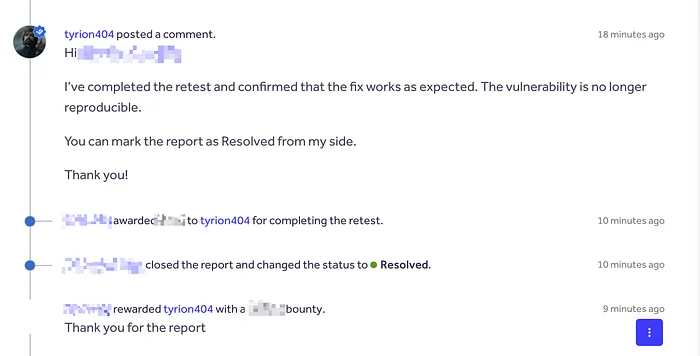
The report records a CVSS v3.1 vector of AV:N/AC:L/PR:L/UI:N/S:C/C:H/I:N/A:N, rated High, and a masked bounty figure.
Fix
The fix is one line in one policy method: add the same entitlement condition that already exists on every other inbox operation.
def add_participants? authenticated? && has_entitlement?(:inbox_write) && participant_in?(conversation)end
Variants to test
- Audit every mutation in the same authorisation family. List all GraphQL mutations that touch conversation membership, message state or metadata, and compare each policy method against the read and write policies. A positive result is a mutation whose policy checks authentication and participation but not entitlement, and which returns
success: truefor an unverified participant. - Test membership changes from a denied account. With an account that is denied read and write by policy, call add, remove and role-change mutations on a conversation it participates in. A positive result is any membership change that succeeds while the same token still gets
pundit_policy.check.failedon read and write. - Test the propagation chain. After a successful injection, use the newly added account's token to add a further account. A positive result is a second
success: truewith no approval step, showing access can be expanded indefinitely. - Test array inputs for bulk expansion. Where a mutation accepts an array of user IDs, submit several at once and repeat the call. A positive result is multiple accounts gaining participant status from a single denied caller.
- Check historical exposure. After injection, read the conversation with the injected account and compare against the ground truth from a legitimate participant. A positive result is the full message history, including messages sent before the account was added.
- Look for the same pattern outside the Inbox. Any feature with a separate entitlement layer and a participation or membership layer is a candidate: check whether the operation that grants membership consults the entitlement layer. A positive result is a membership-granting call that succeeds for an account the entitlement layer denies.
What happened, in plain words
A medical networking site, described in the write-up as the medical equivalent of LinkedIn, lets doctors hold private group conversations in an Inbox feature. Those conversations can contain patient names, diagnoses, test results and clinical decisions.
The site had two separate ideas of who you are. First, whether your account is verified: a verified clinician has confirmed their identity and credentials, while an unverified provider account exists but has not been credentialed. Second, whether you are a participant in a particular conversation, which happens when a verified clinician adds you to it.
The site's own design says these are different things. Being in a conversation's member list does not mean you are allowed to read or write in it. Unverified accounts are denied inbox permissions by default, so they cannot read or send messages even if they are listed as participants.
The bug was in a third operation: the one that adds people to a conversation. The code that guarded reading and writing checked three things: are you logged in, do you have inbox permission, and are you a participant. The code that guarded adding people checked only two: are you logged in, and are you a participant. The permission check was missing.
So an unverified account that could not read the conversation and could not send a message could still add other people to it. Those people could then read the whole history, including messages sent before they joined, and could themselves add more people, and so on.
The researcher proved this on a staging environment with three test accounts and no real patient data. The fix was one missing condition in one policy method.
The product and the feature
To follow the rest of this, you need a rough picture of how a modern web app is put together.
API. An API is the part of a website that a program talks to, rather than a person clicking buttons. When you use a mobile app or a page that updates without reloading, your browser is usually sending requests to an API behind the scenes and getting structured data back. Think of a restaurant: the menu and the waiter are the API, the kitchen is the server. You do not walk into the kitchen yourself; you ask the waiter, and the waiter brings back a plate or tells you the kitchen refused.
GraphQL. GraphQL is a particular style of API. Instead of many separate addresses for many separate things, there is usually one address (here, a path ending in /graphql), and every request describes exactly what it wants in a query language. A query asks for data; a mutation asks the server to change something. The word mutation is just GraphQL's name for a write operation.
Token. A token is a long string that proves which account is making a request, a bit like a wristband at an event. You show it with every request and the server looks up who you are. In these requests it travels in an Authorization header, in the form Bearer <token>. If someone else gets your token, they can act as you, which is why tokens are treated as secrets.
Header. HTTP requests are made of a first line (method and path), then headers, then an optional body. Headers are labelled lines of extra information: Host says which site, Authorization carries the token, Content-Type says what format the body is in.
UUID. A UUID is a long random-looking identifier, like [REDACTED_UUID] in these requests. It is used to name a specific conversation or user without anyone having to guess a simple number.
Policy. A policy is a small piece of server code that answers one yes/no question: may this account do this thing to this object? The backend here is a Rails application (Rails is a popular framework for building web apps in the Ruby language) and it uses a library called Pundit to run these checks. Each operation has a policy method, and if the method returns false, the request is refused.
Entitlement. An entitlement is a permission granted to an account by the platform, independent of any particular conversation. Here, inbox entitlements are what let an account read and write in the Inbox at all. An unverified account is denied them by default.
Participant status. Participant status is membership in one specific conversation. It is recorded in that conversation's participant list. It says you have a seat in that room; it does not say you are allowed to use the room.
Staging environment. A staging environment is a copy of the real system used for testing, kept separate from the live one. The write-up says all three accounts were on staging and no real patient data was involved.
The vulnerability class. This is a broken access control bug, sometimes called an authorisation bypass. Nothing was cracked or decrypted; the server simply failed to ask one of the questions it should have asked before doing what it was told. The everyday comparison: a hotel gives every guest a key to their own room (authentication, proving who you are) and a separate rule about which doors that key opens (authorisation, what you may do). Here the front desk checked that you were a guest, then handed you the master key anyway.
The two layers of access
The write-up describes access as two layers.
- Account verification status. Accounts go through a verification process. A verified clinician has confirmed their identity and credentials. An unverified provider account exists in the system but has not been credentialed. Unverified accounts have restricted access across the platform and are denied inbox entitlements by default.
- Conversation participation. Separately from verification, a user can hold participant status in a specific conversation. This happens when a verified clinician adds them, an action that gives the account a seat in the conversation, tracked in the conversation's participant list.
The design intent is explicit: participant status and inbox entitlement are not the same thing. A user can be in a conversation's member list while being denied the inbox permissions that allow them to read or write. Being added to a room does not mean you are authorised to use it.
Inbox authorisation is enforced through three separate policy classes in the backend, each responsible for a different operation. The first two were implemented and working. The third was absent.
The three accounts
Three accounts were used, all on the staging environment. No real patient data was involved.
| Account | Role | State |
|---|---|---|
| ATK | Attacker | Unverified provider account, legitimately added to a group conversation as a participant by a verified clinician. Denied inbox entitlements: cannot read the conversation and cannot send messages. Holds participant status. |
| DO | Ground truth | Verified, fully entitled clinician and a legitimate authorised participant in the conversation. Used to establish what a real member with full inbox entitlements could see. |
| MD | Injection target | Verified clinician with no prior connection to the conversation. Removed from the conversation before the test to establish a clean denial baseline. |
A word on why three accounts and not one. A security test is only convincing if you can show the difference between before and after. DO is the reference: what a legitimate member sees. MD is the test subject: first shown to be locked out, then shown to be let in. ATK is the account doing the letting in, and it is first shown to be locked out of everything else. Without those baselines, a successful request proves nothing, because you would not know whether the account was supposed to succeed.
The backend is a Rails application using Pundit for authorisation, exposed through GraphQL. Each GraphQL mutation or query is evaluated against a policy method that returns true (allow) or false (deny).
Finding it
The researcher's observation was structural. The platform had two policy classes protecting two operations, reading and writing, and both required the same three conditions: the caller is authenticated, the caller holds an inbox entitlement, and the caller is a participant. A third operation in the same authorisation family, addParticipantsToGroupConversation, was protected by a presence check only. It asked whether the caller was authenticated and held participant status, but never whether the caller had inbox entitlement.
That means an unverified participant, denied both reading and writing, could still call the mutation that determines who else gets access. Participant status is the prerequisite for the bug, not the authorisation for the action.
Exploitation, step by step
Step 1: Control A, message sending blocked
A control is a test you run to prove the starting state. Here the researcher wanted to show, with evidence, that ATK really is denied inbox permissions, rather than merely assuming it.
ATK attempts to send a message to the conversation. The backend evaluates this against Inbox::MessagePolicy#write, the policy that checks whether the caller holds the communication.messages.write permission.
Line by line:
POST /[REDACTED]/graphql HTTP/1.1is the request line.POSTis the method used to send data to the server, the path is the GraphQL endpoint, andHTTP/1.1is the version of the protocol.Host: [REDACTED]names the site being contacted.Authorization: Bearer <ATK_TOKEN>presents ATK's token, so the server knows the request is made as ATK.Content-Type: application/jsonsays the body is JSON, a common text format for structured data.- The body is a GraphQL mutation called
sendMessage. It takes aninputwith the conversation's UUID and the message bodytest, and asks for a single field back,success.
The server's answer:
{ "errors": [{ "message": "Unauthorized access to type Inbox_SendMessage", "extensions": { "[REDACTED]": { "aggregated": { "pundit_policy.check.failed": [{ "warn": "Requires Permissions: [\"communication.messages.write\"]", "type": "permissions" }, { "kind": "type", "name": "Inbox_SendMessage", "pundit_policy_class": "Inbox::MessagePolicy", "pundit_role": "write" }] }
}
}
}], "data": null}
Line by line:
errorsis where GraphQL puts failures. There is nodata, so nothing was returned."message": "Unauthorized access to type Inbox_SendMessage"is the human-readable refusal: this account may not use the send-message operation.pundit_policy.check.failedis the name of the diagnostic entry, telling you a Pundit policy check returned false."warn": "Requires Permissions: [\"communication.messages.write\"]"names the permission that was required and missing."pundit_policy_class": "Inbox::MessagePolicy"and"pundit_role": "write"say which policy class and which method inside it made the decision.
The error is explicit: pundit_policy_class: Inbox::MessagePolicy, pundit_role: write. The MessagePolicy#write? method evaluated to false for ATK because the account lacks the communication.messages.write permission. ATK cannot send messages.
Step 2: Control B, conversation read blocked
A second control, for the other half of the permission pair. Reading and writing are separate operations, so each needs its own proof.
ATK attempts to read the conversation's metadata. The backend evaluates this against Inbox::ConversationPolicy#show_permission, the policy that controls whether a user can access a conversation's content.
Line by line:
- The request line,
Host,AuthorizationandContent-Typeare the same as before, still using ATK's token. - The body is a GraphQL query (a read, not a change). It asks for the conversation with that UUID and requests two fields:
idandsubject(the conversation's title).
The server's answer:
{ "errors": [{ "message": "Unauthorized access to type Inbox_Conversation", "extensions": { "[REDACTED]": { "aggregated": { "pundit_policy.check.failed": [{ "kind": "type", "name": "Inbox_Conversation", "pundit_policy_class": "Inbox::ConversationPolicy", "pundit_role": "show_permission" }] }
}
}
}], "data": {"conversation": null}}
Line by line:
- The refusal message names
Inbox_Conversation, the conversation type. "pundit_policy_class": "Inbox::ConversationPolicy"and"pundit_role": "show_permission"identify a different policy class and method from the one in step 1."data": {"conversation": null}shows the requested object came back empty.
Again explicit: pundit_policy_class: Inbox::ConversationPolicy, pundit_role: show_permission. The ConversationPolicy#show_permission? method evaluated to false, so ATK cannot see the conversation or any of its messages. This is a different policy class from the one that blocked message sending: read and write are enforced through independent checks, not a single permission gate.
Two policy classes, two independently denied operations. ATK's inbox entitlement was confirmed absent before any exploit step was run.
Step 3: Ground truth with DO
Now the researcher needs to know what is actually inside the conversation, so that later it is possible to say exactly what was exposed. DO, a legitimate authorised participant, reads the conversation.
Line by line:
- Same request shape, but with
Bearer <DO_TOKEN>, so the server treats it as DO. - The query asks for the conversation's
subjectand itsmessages. edgesandnodeare GraphQL's way of describing a list of items and each item in it.... on Inbox_Messagesays: for each item that is a message, give me itsid,bodyandcreatedAt(creation time).
The server's answer:
{ "data": { "conversation": { "subject": "Group case discussion", "messages": { "edges": [ {"node": {"body": "Patient case: Labs indicate elevated troponin. Follow-up with cardiology ordered.", "createdAt": "2026-08-28T18:47:52Z"}}, {"node": {"body": "POST-JOIN MESSAGE: patient needs ICU transfer", "createdAt": "2026-08-15T07:07:46Z"}}, {"node": {"body": "Patient [REDACTED], labs show elevated troponin - please review urgently", "createdAt": "2026-08-15T07:07:04Z"}}, {"node": {"body": "Group message test", "createdAt": "2026-08-14T21:31:53Z"}} ] }
}
}}
Line by line:
data.conversation.subjectis the conversation's title,Group case discussion.- Each entry under
edgesis one message, with its text inbodyand its timestamp increatedAt. - The timestamps are in a standard machine format, ending in
Z, which means UTC time.
The conversation held 12 messages in total, the oldest dated 2026-08-14. Content included patient identifiers and clinical information. This is what an authorised participant could see, and exactly what an unauthorised injection would expose.
Step 4: Baseline for MD
Before the exploit, MD must be shown to be locked out. MD was removed from the conversation using an authorised removal call, so that MD had no participant status before the exploit and no access to the conversation. MD's read attempt before injection:
Line by line:
- This is the same read query as step 3, but with
Bearer <MD_TOKEN>. - It asks for the conversation's
id,subjectand full message list.
The server's answer:
{ "errors": [{ "message": "Unauthorized access to type Inbox_Conversation", "extensions": { "[REDACTED]": { "aggregated": { "pundit_policy.check.failed": [{ "kind": "type", "name": "Inbox_Conversation", "pundit_policy_class": "Inbox::ConversationPolicy", "pundit_role": "show_permission" }] }
}
}
}], "data": {"conversation": null}}
Line by line:
- The same
Inbox::ConversationPolicy/show_permissionrefusal as in step 2, now for MD. "conversation": nullmeans nothing was returned.
MD is not a participant, so the request is denied. Baseline confirmed. This matters because the next step will use the identical request; if it succeeds afterwards, the only thing that changed is MD's participant status.
Step 5: The exploit
ATK, denied read access and denied message sending, calls addParticipantsToGroupConversation with MD's user ID.
Line by line:
- The request is made with
Bearer <ATK_TOKEN>, the account that was just shown to be denied read and write. - It is a
mutation, because it changes something. addParticipantsToGroupConversationtakes aninputwith the conversation's UUID anduserIds, a list of user IDs to add. Here the list contains one entry, MD's ID.- It asks for
successand for anyerrors, each with anattributeandmessagesdescribing what went wrong.
The server's answer:
{"data": {"addParticipantsToGroupConversation": {"success": true, "errors": []}}}
Line by line:
"success": truemeans the server carried out the change."errors": []is an empty list, so nothing was reported as wrong.
The mutation accepted the request with success: true. No entitlement check, no role check, no ownership check. ATK, the account that could not read the conversation and could not send a message, had just granted a third party full participant access.
Step 6: MD reads the full history
MD repeats the identical request that returned Unauthorized in step 4, now after being injected by ATK.
Line by line:
- Byte for byte the same query as step 4, with the same
Bearer <MD_TOKEN>. - Nothing about the request changed; only the server's records of who is a participant changed.
The server's answer:
{ "data": { "conversation": { "subject": "Group case discussion", "messages": { "edges": [ {"node": {"body": "Patient case: ************"}}, {"node": {"body": "Patient follow-up: *************"}}, {"node": {"body": "Confirming patient follow-up for case", }}, {"node": {"body": "POST-JOIN MESSAGE: patient needs **********"}}, {"node": {"body": "Patient [REDACTED], **********"}}, {"node": {"body": "Group message test"**************"}} ] }
}
}}
Line by line:
data.conversationis now populated instead ofnull.- The
subjectis the sameGroup case discussionthat DO saw. - Each
edgesentry is a messagebody; the asterisks stand for content that was masked when the write-up was published.
The identical 12-message history that DO saw in step 3 came back, including every message sent before MD was added. The same request that returned Unauthorized access to type Inbox_Conversation minutes earlier now returned the full conversation, including historical patient clinical communications.
Step 7: The chain propagates
MD, just injected by ATK, immediately calls the same mutation to add a third clinician with no prior relationship to the conversation.
Line by line:
- The same mutation as step 5, but now sent with
Bearer <MD_TOKEN>, the account that was added a moment ago. userIdscontains a different ID,[REDACTED_USER_ID], for the third clinician.
The server's answer:
{"data": {"addParticipantsToGroupConversation": {"success": true, "errors": []}}}
Line by line:
"success": trueagain, with no errors.
success: true again. The chain is ATK (no authorisation) grants MD access, then MD grants a third clinician access. Two calls, with no approval gate at either step. The mutation accepts an array of user IDs and can be called repeatedly, expanding access to any verified clinician on the platform.
Root cause
For the two operations ATK was denied, the policy methods required three conditions: the caller is authenticated, the caller holds an inbox entitlement, and the caller is a participant. All three gates had to pass.
def write? authenticated? && has_entitlement?(:inbox_write) && participant_in?(conversation)end
Line by line:
def write?starts the method that answers the question for writing.authenticated?asks whether the caller is logged in.&&means "and", so every condition must be true.has_entitlement?(:inbox_write)asks whether the account holds the inbox write entitlement.participant_in?(conversation)asks whether the account is a participant in this conversation.
def show_permission? authenticated? && has_entitlement?(:inbox_read) && participant_in?(conversation)end
Line by line:
- The same three-part check for reading, using
:inbox_readinstead of:inbox_write.
For addParticipantsToGroupConversation, the policy looked like this:
def add_participants? authenticated? && participant_in?(conversation) end
Line by line:
participant_in?(conversation)asks whether the caller is a participant.- There is no
has_entitlement?call at all. That is the bug.
The entitlement gate was never checked. Participant status alone was sufficient. The mismatch, as the write-up lays it out:
sendMessage: authenticated? AND has_inbox_entitlement? AND participant_in? ✓read conversation: authenticated? AND has_inbox_entitlement? AND participant_in? ✓addParticipants: authenticated? AND participant_in? ← BUG
Line by line:
- The first two lines show the three conditions for sending and reading, all present, marked with a tick.
- The third line shows the add-participants check with the entitlement condition missing, marked as the bug.
An unverified account denied both reading and writing, because it lacked has_inbox_entitlement?, could still call the mutation that controls who gets participant status, because that mutation never consulted the entitlement check. The authorisation model was sound in design: two separate policy classes protected two separate operations. The gap was a third operation in the same authorisation family that was never wired to either of those policies. It was protected by a presence check, not an entitlement check.
Impact
On a platform where conversations carry patient clinical content, the distinction between being a participant and being authorised is the entire security model. An unverified account that had been added to a conversation could add arbitrary verified clinicians to it, and each of those could repeat the call, so access could expand arbitrarily with no notification to the conversation owners.
The write-up states that on production the damage could have been HIPAA-scope: unauthorised disclosure of patient identifiers, diagnoses and clinical decisions to clinicians with no treating relationship to those patients. HIPAA is the United States law that governs the privacy and security of health information; the point is that the consequences would not have been merely technical.
The report records a CVSS v3.1 vector of AV:N/AC:L/PR:L/UI:N/S:C/C:H/I:N/A:N, rated High, and a masked bounty figure. CVSS is a standard scoring system for the severity of a vulnerability; the vector is the shorthand string that encodes the individual ratings, and the bounty is the payment the programme made for the report.
Fix
The fix is one line in one policy method: add the same entitlement condition that already exists on every other inbox operation.
def add_participants? authenticated? && has_entitlement?(:inbox_write) && participant_in?(conversation)end
Line by line:
- The method now checks all three conditions, exactly like the write policy.
has_entitlement?(:inbox_write)is the added gate: an account without inbox write permission can no longer add anyone.
Variants to test
These are follow-up checks for the same class of mistake elsewhere.
- Audit every mutation in the same authorisation family. List all GraphQL mutations that touch conversation membership, message state or metadata, and compare each policy method against the read and write policies. A positive result is a mutation whose policy checks authentication and participation but not entitlement, and which returns
success: truefor an unverified participant. - Test membership changes from a denied account. With an account that is denied read and write by policy, call add, remove and role-change mutations on a conversation it participates in. A positive result is any membership change that succeeds while the same token still gets
pundit_policy.check.failedon read and write. - Test the propagation chain. After a successful injection, use the newly added account's token to add a further account. A positive result is a second
success: truewith no approval step, showing access can be expanded indefinitely. - Test array inputs for bulk expansion. Where a mutation accepts an array of user IDs, submit several at once and repeat the call. A positive result is multiple accounts gaining participant status from a single denied caller.
- Check historical exposure. After injection, read the conversation with the injected account and compare against the ground truth from a legitimate participant. A positive result is the full message history, including messages sent before the account was added.
- Look for the same pattern outside the Inbox. Any feature with a separate entitlement layer and a participation or membership layer is a candidate: check whether the operation that grants membership consults the entitlement layer. A positive result is a membership-granting call that succeeds for an account the entitlement layer denies.
Glossary
- API: the part of a service that programs talk to, sending requests and receiving structured answers.
- Authentication: proving which account is making a request, usually with a token.
- Authorisation: deciding whether that account is allowed to perform the requested action.
- Broken access control: a vulnerability where the server fails to check whether the caller is allowed to do something.
- Control test: a test run to prove the starting state before attempting an exploit.
- CVSS: a standard scoring system for rating the severity of a vulnerability.
- CVSS vector: the shorthand string encoding the individual CVSS ratings.
- Entitlement: a permission granted to an account by the platform, independent of any one object.
- GraphQL: an API style with a single endpoint where each request describes the data it wants; queries read, mutations change.
- Header: a labelled line of extra information in an HTTP request, such as
AuthorizationorContent-Type. - HIPAA: the United States law governing the privacy and security of health information.
- HTTP: the protocol browsers and programs use to talk to web servers.
- JSON: a common text format for structured data, built from keys and values.
- Mutation: GraphQL's name for an operation that changes data on the server.
- Participant status: membership in one specific conversation, recorded in its participant list.
- Policy: a small piece of server code that answers yes or no to "may this account do this thing?".
- Pundit: a Ruby library used by Rails applications to run authorisation policies.
- Query: GraphQL's name for an operation that reads data.
- Rails: a popular framework for building web applications in the Ruby language.
- Staging environment: a copy of a system used for testing, kept separate from the live one.
- Token: a secret string that identifies an account with each request, sent here as
Bearer <token>. - UUID: a long random-looking identifier used to name an object such as a conversation or user.
- Verification status: whether an account has confirmed its identity and credentials; unverified accounts are denied inbox entitlements by default.


