I Found an OTP Bypass Bug in Mahindra’s Account Creation System
The OTP verification step in Mahindra's international account creation flow could be skipped, so an account could be created without ever entering the correct one-time code. An attacker could therefore mass-create unverified or fake accounts and abuse the registration system for spam or automated attacks.
 Published on medium.com
Cybersecurity
The full write-up lives on its author's site
It belongs to its author, so we link to it rather than copy it. The other two tabs are our own rewrites, checked against it.
Context
Mahindra's international website, at https://auto.mahindra.com/, has an account creation flow that includes an OTP (One-Time Password) verification step. That step is meant to confirm that the person registering genuinely owns the phone number or email address being used. In the author's words, it is a critical security control: if it can be bypassed, the whole authentication process is undermined.
The author, Falgun Sondagar, found that the OTP verification step on this account creation flow could be skipped entirely, so that an account could be created without ever entering the correct OTP. The write-up deliberately omits the exact technical methodology, so the requests, parameters and responses behind the bypass are not published here or in the original.
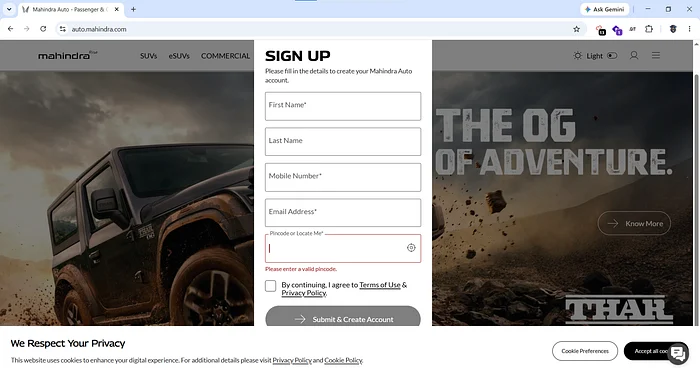
The image shows Mahindra's international website homepage and signup page.
Setup
The report does not describe any particular tooling, versions or test accounts beyond one statement in the disclaimer: all testing was conducted using the author's own accounts, responsibly and ethically, with the sole intention of identifying and reporting the vulnerability. No user data was accessed, misused or disclosed. The only precondition visible in the text is access to the public account creation flow on the international site.
Finding it
The discovery started with curiosity during routine testing of the account creation process. While exploring the flow, the author noticed something in the OTP verification process that seemed off, and after a few methodical tests confirmed that the verification step could be bypassed, allowing an account to be created successfully without entering the correct OTP.
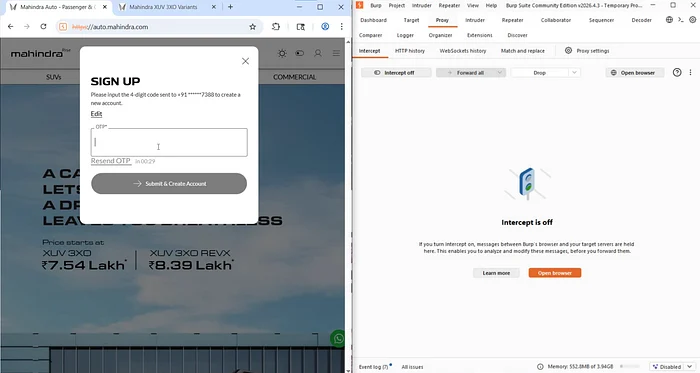
The image shows the OTP entry screen on the signup page.
The author intentionally keeps the exact technical methodology out of the article, on the grounds that this is an international platform with a large user base and a step-by-step exploitation guide could put similar systems at risk if the same flaw exists elsewhere. Researchers who want the methodology are pointed to the author's LinkedIn post for a professional, one-on-one discussion. Because of that decision, the report contains no HTTP requests, payloads, parameters or server responses for the bypass itself.
Exploitation
The report does not publish a reproducible sequence of requests. What it establishes is the outcome: the OTP verification step in the account creation flow could be bypassed, and an account could be created successfully without the correct OTP ever being entered. The steps below reflect only what the author states.
Step 1: Reach the account creation flow
The author tested the signup flow on Mahindra's international website, https://auto.mahindra.com/, which presents an OTP entry screen as part of registration.
Step 2: Bypass the OTP verification step
Through testing that the author does not detail publicly, the OTP check could be satisfied or skipped without the correct code, and registration completed. The report gives no request, parameter or response for this step.
Step 3: Confirm account creation without valid OTP
The result was a successfully created account despite no valid OTP verification, which confirmed the bypass.
Root cause
The report does not describe the underlying implementation, so the specific mistake in code or design is not stated. What can be said from the author's framing is that the OTP verification step, a control meant to prove ownership of the phone number or email being registered, did not actually gate account creation: the flow could complete without it. Why the existing defences did not stop this is not discussed in the report.
Impact
The author describes an OTP bypass on an account creation flow as a serious security gap rather than a minor glitch. Left unaddressed, it could have allowed:
- Mass creation of unverified or fake accounts on an international platform.
- Abuse of the registration system for spam or automated attacks.
- Undermining of user trust in the platform's identity verification process.
- Potential downstream risks if account creation is linked to other services such as loyalty programs, dealer portals or service bookings.
For a company of Mahindra's scale and global presence, the author argues, a flaw like this in a customer-facing, international-facing system carries real business and reputational risk.
Disclosure and fix
After confirming the vulnerability, the author reported it directly to Mahindra. Over more than a month the author sent multiple emails detailing the vulnerability and reached out using several different email addresses, hoping to reach the right team. No response of any kind came back: no acknowledgment, no confirmation, not even an automated receipt. The author notes that responsible disclosure only works when there is a channel for researchers to be heard, and in this case that channel seemed not to exist.
After a month of unanswered emails, the author escalated to CERT-In, India's national nodal agency for responding to cybersecurity incidents, submitting a detailed report including the potential impact through their official reporting channel.
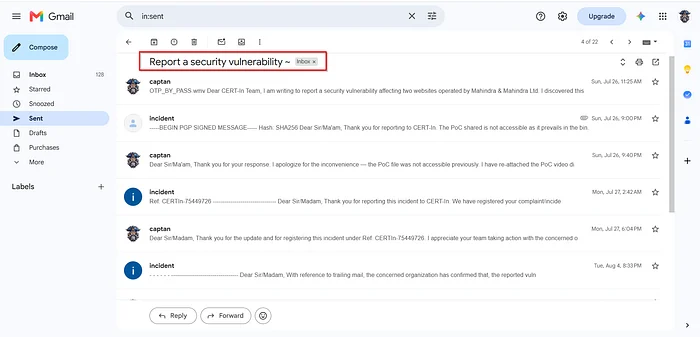
The image is captioned as a CERT-In acknowledgment email and case reference number.
CERT-In registered the case under reference CERTIn-75449726, and shortly after, the vulnerability was fixed on Mahindra's website. The author also notes that formal acknowledgment from the company, such as a Hall of Fame listing, is something responsible researchers deserve, and that this is still being followed up.
Lessons learned
The author draws four conclusions from the experience:
- Direct reporting does not always work. Even large international organisations need a clear, responsive security contact channel, and its absence can delay critical fixes.
- National CERTs matter. CERT-In bridged the gap between an independent researcher and a large corporation so the issue did not fall through the cracks.
- Persistence pays off. A month of silence could have discouraged follow-through, but escalating through the right channel got the job done.
- Recognition should not be an afterthought. The vulnerability was fixed, but formal acknowledgment from the company is still outstanding.
Variants to test
Because the report withholds the methodology, the following are general directions for testing similar registration flows, not reconstructions of this bug. For each, a positive result is an account created, or a registration step completed, without a valid OTP.
- Skip the verification request entirely. Complete the registration call directly after requesting an OTP, without submitting the code. Positive result: the account is created and usable.
- Replay a previously valid OTP. Use a code that was correct for one registration attempt against a new attempt or a different identifier. Positive result: the stale code is accepted.
- Submit an empty or malformed code. Send the verification request with the OTP field omitted, empty, or of the wrong type. Positive result: the server treats it as verified rather than rejecting it.
- Tamper with the verification state. Look for client-side flags, hidden fields or response values that mark the session as verified and try altering them before the final registration step. Positive result: registration succeeds with a forged verified state.
- Reorder the flow. Call the account creation endpoint before, or in parallel with, the OTP verification endpoint. Positive result: the account exists even though verification never completed.
- Reuse the same OTP across identifiers. Request a code for one phone number or email and use it while registering another. Positive result: the code is accepted for the wrong identifier.
Each of these should be tested only on accounts and systems you are authorised to test, as the author did with their own accounts.
What happened, in plain words
A security researcher named Falgun Sondagar was looking at the sign-up page of Mahindra's international website, https://auto.mahindra.com/. When you create an account on a site like this, the site usually sends a short numeric code to your phone or email. You type that code back into the site to prove the phone number or email address really belongs to you. That code is called an OTP, a One-Time Password.
The researcher found that this check could be skipped. An account could be created without ever typing the correct code. That is the whole bug: a step that is supposed to be a locked door turned out to be a door you can walk around.
The researcher reported it to Mahindra by email, several times, over more than a month, and got no reply at all. They then reported it to CERT-In, India's national body for handling cybersecurity incidents. CERT-In registered the case, and shortly afterwards the problem was fixed on Mahindra's website.
This article walks through that story from the beginning, explaining each idea as it comes up. It is written for someone who uses a browser and a computer and nothing more.
Some background first: what the site and the feature do
Mahindra is a large vehicle manufacturer, and https://auto.mahindra.com/ is its international website. Among other things, the site lets a visitor create an account. An account is simply a record on the company's servers that represents you: a username, a password, maybe a phone number or email address, and whatever preferences or services are tied to it.
Creating that account is called registration or sign-up. The set of pages and steps a visitor goes through to register is called the account creation flow. A flow is just an ordered path: fill in this form, then confirm your email, then choose a password, and so on.
One of the steps in this flow is OTP verification. Here is what that means in everyday terms. Imagine a bank that wants to be sure the person opening an account really owns the mobile number they wrote down. The bank sends a text message with a random four or six digit code to that number. Only someone holding the phone can read the code and type it back. If the code matches what the bank generated, the bank accepts that the person controls the number.
That is exactly what an OTP does on a website. The site generates a short code, sends it to the phone number or email address you entered, and asks you to type it into a box. If it matches, the site marks your phone number or email as verified. The code is called one-time because it is meant to be used once and then thrown away.
Why does this matter? Because without it, anyone could type any phone number or email address into a sign-up form. The OTP is the proof of ownership. Security people call a check like this a security control: a deliberate safeguard whose job is to stop something bad from happening. If the control can be bypassed, the protection it was supposed to give disappears.
The discovery
The researcher was doing what they call routine testing of the account creation process. Testing here means using the site the way a normal visitor would, but paying close attention to what happens at each step, and trying small variations to see how the site reacts.
While going through the flow, they noticed something in the OTP verification step that seemed off. The report does not say what exactly looked wrong; it only says something in the OTP verification process seemed off. That is a common starting point in security work: something does not behave the way you expect, and you pull on that thread.
After a few careful, methodical tests, the researcher confirmed that the OTP verification step could be bypassed. In plain words: the site let the registration finish even though the correct code was never entered. An account was created successfully without valid OTP verification.
The image shows the OTP entry screen on the signup page.
Why the exact steps are not published
The researcher deliberately left the exact technical method out of the article. The reason given is that this is an international platform with a large user base, and a step-by-step guide to exploiting the flaw could put other systems at risk if the same mistake exists elsewhere.
This is a normal and sensible choice in security writing. Publishing a precise recipe for breaking into a live system is like publishing the exact code to a safe: it helps defenders a little and attackers a lot. Researchers who want the details are pointed to the author's LinkedIn post, where the method can be discussed professionally, one to one.
Because of that decision, there are no HTTP requests, no payloads, no parameter names and no server responses for the bypass in this article. If you are looking for a copy-and-paste attack, there isn't one here, and there isn't one in the original either.
Exploitation, described only as far as the report goes
The report does not publish a reproducible sequence of requests. What it does establish is the outcome: the OTP verification step in the account creation flow could be bypassed, and an account could be created successfully without the correct OTP ever being entered. The steps below reflect only what the author states.
Step 1: Reach the account creation flow
The researcher tested the signup flow on Mahindra's international website, https://auto.mahindra.com/, which presents an OTP entry screen as part of registration. In browser terms, this is simply opening the site and starting to register, the same thing any new customer would do.
Step 2: Bypass the OTP verification step
Through testing that the author does not detail publicly, the OTP check could be satisfied or skipped without the correct code, and registration completed. The report gives no request, parameter or response for this step.
To understand what "satisfied or skipped" means without the details, it helps to know roughly how these flows are built. A website like this is usually two things working together: the pages you see in your browser, and a program on the company's server that does the real work. That server-side program is often called an API, short for Application Programming Interface. A useful everyday comparison: the web page is the counter of a shop, and the API is the person behind the counter who checks your paperwork and fetches what you asked for. Your browser sends a message to the API ("here is a new registration, here is the code the user typed"), and the API replies ("accepted" or "rejected").
When a researcher says a check can be "skipped", they usually mean the API accepted the final registration message without ever having received, or without properly checking, the code. When they say it can be "satisfied", they mean something in the message convinced the API that verification had happened when it had not. Either way, the result is the same: the account gets created.
Step 3: Confirm account creation without valid OTP
The result was a successfully created account despite no valid OTP verification, which confirmed the bypass. Confirming matters: noticing odd behaviour is a hint, but creating a working account without the code is proof.
Root cause
The report does not describe the underlying implementation, so the specific mistake in code or design is not stated. What can be said from the author's framing is that the OTP verification step, a control meant to prove ownership of the phone number or email being registered, did not actually gate account creation: the flow could complete without it.
"Gate" is a useful word here. A gate is a checkpoint that must be passed before you can continue. The OTP screen looked like a gate, but the thing that actually creates the account did not insist on it. Why the existing defences did not stop this is not discussed in the report.
Impact
The author describes an OTP bypass on an account creation flow as a serious security gap rather than a minor glitch. Left unaddressed, it could have allowed:
- Mass creation of unverified or fake accounts on an international platform.
- Abuse of the registration system for spam or automated attacks.
- Undermining of user trust in the platform's identity verification process.
- Potential downstream risks if account creation is linked to other services such as loyalty programs, dealer portals or service bookings.
For a company of Mahindra's scale and global presence, the author argues, a flaw like this in a customer-facing, international-facing system carries real business and reputational risk.
A little more on each point, for a newcomer:
- Mass creation of fake accounts. If a script can register accounts without a real phone number, one person can create thousands. Each fake account can then be used for whatever the site allows: posting, claiming offers, entering promotions.
- Spam and automated attacks. Automated means done by a program rather than a person, at a speed no human could match. Registration systems are a common target because they are the front door.
- User trust. When a site says a phone number is verified, users assume that means something. If it does not, the promise is hollow.
- Downstream risks. Downstream means services that depend on the account. If an account is linked to a loyalty programme, a dealer portal or a service booking, a fake account may reach into those too.
Disclosure and fix
After confirming the vulnerability, the researcher reported it directly to Mahindra. Over more than a month the researcher sent multiple emails detailing the vulnerability and reached out using several different email addresses, hoping to reach the right team. No response of any kind came back: no acknowledgment, no confirmation, not even an automated receipt. The author notes that responsible disclosure only works when there is a channel for researchers to be heard, and in this case that channel seemed not to exist.
Responsible disclosure is the practice of telling the organisation about a flaw privately, giving it time to fix the problem, rather than publishing it or using it for harm. It depends entirely on the organisation having a working way to receive such reports.
After a month of unanswered emails, the researcher escalated to CERT-In, India's national nodal agency for responding to cybersecurity incidents, submitting a detailed report including the potential impact through their official reporting channel. A national CERT (Computer Emergency Response Team) is a government-backed team that coordinates responses to security incidents in a country. Escalating means taking the matter to a higher level when the normal route fails.
CERT-In registered the case under reference CERTIn-75449726, and shortly after, the vulnerability was fixed on Mahindra's website. The author also notes that formal acknowledgment from the company, such as a Hall of Fame listing, is something responsible researchers deserve, and that this is still being followed up.
A Hall of Fame is a public page where a company thanks researchers who reported bugs. It costs the company nothing and gives the researcher credit, which is why the author considers it important.
Lessons learned
The author draws four conclusions from the experience:
- Direct reporting does not always work. Even large international organisations need a clear, responsive security contact channel, and its absence can delay critical fixes.
- National CERTs matter. CERT-In bridged the gap between an independent researcher and a large corporation so the issue did not fall through the cracks.
- Persistence pays off. A month of silence could have discouraged follow-through, but escalating through the right channel got the job done.
- Recognition should not be an afterthought. The vulnerability was fixed, but formal acknowledgment from the company is still outstanding.
Variants to test
Because the report withholds the methodology, the following are general directions for testing similar registration flows, not reconstructions of this bug. For each, a positive result is an account created, or a registration step completed, without a valid OTP.
- Skip the verification request entirely. Complete the registration call directly after requesting an OTP, without submitting the code. Positive result: the account is created and usable.
- Replay a previously valid OTP. Use a code that was correct for one registration attempt against a new attempt or a different identifier. Positive result: the stale code is accepted.
- Submit an empty or malformed code. Send the verification request with the OTP field omitted, empty, or of the wrong type. Positive result: the server treats it as verified rather than rejecting it.
- Tamper with the verification state. Look for client-side flags, hidden fields or response values that mark the session as verified and try altering them before the final registration step. Positive result: registration succeeds with a forged verified state.
- Reorder the flow. Call the account creation endpoint before, or in parallel with, the OTP verification endpoint. Positive result: the account exists even though verification never completed.
- Reuse the same OTP across identifiers. Request a code for one phone number or email and use it while registering another. Positive result: the code is accepted for the wrong identifier.
Each of these should be tested only on accounts and systems you are authorised to test, as the author did with their own accounts.
A few of the terms in that list deserve a plain explanation:
- Replay means sending something again that was valid once, to see whether the server notices it is being reused. Like handing in a used cinema ticket and seeing if the usher checks the date.
- Malformed means shaped wrongly: missing, empty, or of the wrong type (a word where a number is expected). Servers sometimes fail open on input they did not expect.
- Client-side means it happens in your browser, on your machine, rather than on the company's server. Anything client-side can be changed by the person using the browser, so it should never be trusted on its own.
- Session is the server's memory of your visit. When you log in, the server gives your browser a small piece of data, often called a cookie or a token, which your browser sends back with every request so the server knows it is still you. A useful comparison: a session token is like a wristband at an event, proving you already showed your ticket at the door.
- Endpoint is a specific address on the server that does one job, for example "create account" or "check OTP". Think of it as a particular counter in a large office, each counter handling one kind of request.
- Parameter is a named piece of information sent with a request, such as
phone=...orotp=.... It is the detail on the form you hand over at the counter. - Forged means faked: a value made to look legitimate when it is not.
Glossary
- Account creation flow: the ordered set of pages and steps a visitor goes through to register on a website.
- API (Application Programming Interface): the server-side program a website's pages talk to; it receives requests and returns answers.
- Authentication: the process of proving who you are, for example by logging in or by confirming a code sent to your phone.
- Bypass: getting past a check without satisfying it, so the protection no longer applies.
- CERT-In: India's national Computer Emergency Response Team, the government body that responds to cybersecurity incidents.
- Client-side: happening in the user's browser rather than on the company's server; such values can be changed by the user.
- Cookie: a small piece of data a website stores in your browser and receives back on later requests, often used to remember who you are.
- Downstream: services or systems that depend on the thing being discussed, and are affected by problems in it.
- Endpoint: a specific address on a server that performs one particular job.
- Escalation: taking an issue to a higher authority or level when the normal route does not work.
- Forged: faked or altered to look legitimate.
- Hall of Fame: a public page where a company credits researchers who reported security issues.
- Malformed: wrongly shaped input, such as a missing, empty or wrong-type value.
- National CERT: a government-backed team that coordinates responses to cybersecurity incidents in a country.
- OTP (One-Time Password): a short code sent to a phone number or email address, meant to be used once, to prove the person controls that address.
- Parameter: a named value sent with a request, such as a phone number or a code.
- Payload: the actual data sent in a request, as opposed to the address it is sent to.
- Registration / sign-up: the process of creating an account on a website.
- Replay: sending a value again that was valid once, to see whether the server rejects its reuse.
- Responsible disclosure: reporting a security flaw privately to the organisation and giving it time to fix it before details are made public.
- Root cause: the underlying mistake in code or design that makes a vulnerability possible.
- Security control: a deliberate safeguard whose purpose is to prevent something bad from happening.
- Session: the server's memory of a user's visit, usually maintained with a cookie or token.
- Token: a piece of data, similar to a cookie, that proves to the server that a request comes from an authenticated session.
- Verification: checking that something is true, for example that a phone number really belongs to the person registering.


