I Owned the S3 Buckets Behind 79 Million NASA Satellite Files
Two S3 bucket names listed in NASA's public data catalog had never been created, so anyone could register them. An attacker who did so could serve altered satellite data files to scientists whose tools read the bucket name from that catalog.

NASA
The full write-up lives on its author's site
It belongs to its author, so we link to it rather than copy it. The other two tabs are our own rewrites, checked against it.
Context
NASA's Common Metadata Repository (CMR) is the search backend for Earthdata. Every cloud-hosted collection in CMR carries a block called DirectDistributionInformation, which tells client tools which S3 bucket the data lives in, along with the region and an endpoint for temporary S3 credentials. Tools read that field, request credentials, and download granules from the named bucket.
S3 bucket names are global. If a bucket is deleted, or was never created in the first place, anyone can register that name in their own AWS account. The report is about two bucket names that NASA's own catalogue handed out but that nobody owned.
Setup
The researcher had already spent time on CMR (finding an RCE and a Zip Slip there, written up separately). This time the focus was not the code but what CMR returns.
Finding it
The starting point was the DirectDistributionInformation block on a cloud-hosted collection. A query for one collection returns it like this:
GET https://cmr.earthdata.nasa.gov/search/collections.umm_json?concept_id=C3294057315-ASF"DirectDistributionInformation": { "Region": "us-west-2", "S3BucketAndObjectPrefixNames": [ "asf-cumulus-prod-opera-product/OPERA_L3_DISP-S1/" ], "S3CredentialsAPIEndpoint": "https://cumulus.asf.alaska.edu/s3credentials" }
The S3BucketAndObjectPrefixNames entry names the bucket and the prefix inside it where the data lives. Because bucket names are global, a name that no longer resolves is a name anyone can claim. The researcher pulled every collection from ASF (Alaska Satellite Facility, one of NASA's data centres) and checked each bucket named in that field.
Two of them came back as NoSuchBucket:
asf-cumulus-prod-browseasf-cumulus-prod-opera-product
Exploitation
Step 1: register the buckets
The researcher created both buckets in their own AWS account in us-west-2 and uploaded a poc.txt to each:
$ curl -L https://asf-cumulus-prod-browse.s3.amazonaws.com/poc.txt NASA VDP PoC by obaskly - Bugcrowd$ curl -L https://asf-cumulus-prod-opera-product.s3.amazonaws.com/poc.txt NASA VDP PoC by obaskly - Bugcrowd
Both returned 200 from AmazonS3, serving the text file the researcher had uploaded. The same check against the OPERA bucket is shown at the top of the report:
$ curl -L https://asf-cumulus-prod-opera-product.s3.amazonaws.com/poc.txt NASA VDP PoC by obaskly - Bugcrowd
Step 2: measure the blast radius
A bucket takeover is only as serious as the number of things that reference the bucket. CMR returns the number of matching granules in a CMR-Hits header, so asking for page_size=0 returns the count without returning any records:
r = requests.get( "https://cmr.earthdata.nasa.gov/search/granules.json", params={"collection_concept_id": concept_id, "page_size": 0}, ) hits = int(r.headers.get("CMR-Hits", 0))
Counting collections and granules per bucket gave:
asf-cumulus-prod-browse: 1 collection, about 463,000 granulesasf-cumulus-prod-opera-product: 6 collections, about 79,500,000 granules
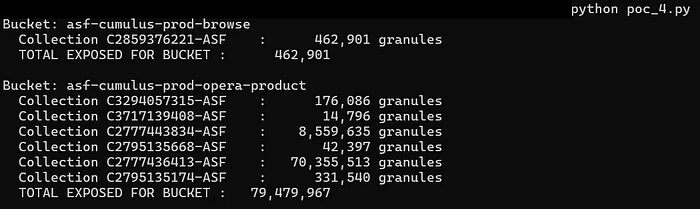
The affected data covered ARIA Sentinel-1 interferograms and the OPERA products: surface displacement, radar backscatter, tropospheric corrections and so on. That data is used for earthquake and landslide monitoring, disaster response and climate research.
Step 3: confirm that a real client reads the field
A bucket name in metadata only matters if something follows it. The researcher checked earthaccess, NASA's official Python library for Earthdata. In earthaccess/results.py:
def s3_bucket(self) -> Dict[str, Any]: return self["umm"].get("DirectDistributionInformation", {})
That is the exact field that had been taken over. The usual cloud workflow is: look up the collection in CMR, read the bucket name, get temporary credentials from the S3CredentialsAPIEndpoint, then download from the bucket. The last step would land in the attacker's bucket, and because the name matches what NASA's metadata says, nothing would look wrong.
Step 4: demonstrate the chain end to end
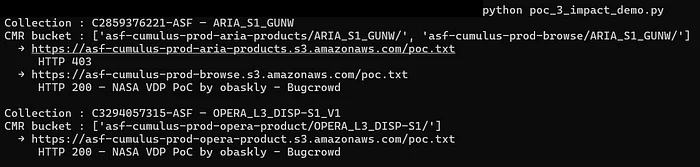
The proof of concept read the bucket names live from CMR and then fetched from them, the way a tool would:
Collection : C3294057315-ASF - OPERA_L3_DISP-S1_V1 CMR bucket : ['asf-cumulus-prod-opera-product/OPERA_L3_DISP-S1/'] → https://asf-cumulus-prod-opera-product.s3.amazonaws.com/poc.txt HTTP 200 - NASA VDP PoC by obaskly - Bugcrowd
Root cause
The catalogue kept publishing bucket names that no longer existed. Because S3 names are global and first-come-first-served, a deleted or never-created bucket is claimable by anyone, and the client side has no way to tell the difference: earthaccess reads the name straight from CMR metadata and downloads from whatever it points at.
Impact
The researcher only ever uploaded a text file. With worse intentions, an attacker holding the buckets could have:
- Placed fake
.nc,.h5or.tiffiles at the paths NASA's granules reference, so scientists download altered satellite data and might never find out. The report gives the example of a fake ground displacement map going into someone's earthquake analysis. - Hidden malware in files people treat as plain data, since nobody runs antivirus on NetCDF files.
- Logged every request to see who is downloading what, from where and when.
Unlike most subdomain or bucket takeovers, which end with defacing a page nobody visits, this one sat in the middle of a scientific data pipeline.
Fix
On NASA's side the report lists three steps:
- Get the bucket names back under NASA's AWS account, which required the researcher to delete their own buckets first.
- Audit every
DirectDistributionInformationentry in CMR for other dead buckets. - Longer term, sign or checksum the data so clients can verify files no matter where they came from.
The issue has been triaged, fixed and resolved.
Variants to test
- Enumerate every bucket name a catalogue publishes. Pull all collections from a metadata API and resolve each bucket named in the distribution fields. A positive result is
NoSuchBucketon a name the catalogue still advertises. - Check the client library, not just the metadata. Find the code path that reads the field (as
earthaccessdoes inresults.py) and confirm it uses the value without validation. A positive result is a direct read of the metadata value into a download or credential step. - Count references before reporting. Use the API's own hit count (here
CMR-Hitswithpage_size=0) to quantify collections and objects per bucket. A large count turns a low-severity takeover into a high-impact one. - Follow the chain end to end. Read the bucket name live from the catalogue and fetch from it, as a real tool would. A positive result is an HTTP
200serving attacker-controlled content from a name the catalogue vouches for. - Look for the same pattern in other distribution fields. Any hostname, URL or bucket name a system hands out is worth resolving to see whether it still exists and who owns it.
What happened, in plain words
NASA publishes an enormous amount of satellite data, and it runs a public catalogue that tells scientists and their software where each dataset lives. For data stored in the cloud, that catalogue includes the name of an Amazon S3 storage bucket, which is like a labelled locker in a giant warehouse run by Amazon. The catalogue said, in effect, "the OPERA satellite files are in the locker called asf-cumulus-prod-opera-product".
The problem was that this locker did not exist. Nobody had it. And because of how Amazon S3 works, anyone in the world with an Amazon Web Services (AWS) account can walk in and claim a locker name that is free. The researcher did exactly that: registered the two missing names in their own account, put a harmless text file inside, and showed that the file could be downloaded from the very address NASA's catalogue was handing out.
That is the whole trick. No NASA password was stolen, no NASA server was broken into. The catalogue simply kept pointing at names that were up for grabs, and the researcher grabbed them. The two names were referenced by roughly 79.5 million satellite data files between them, which is what turned a small mistake into a serious one.
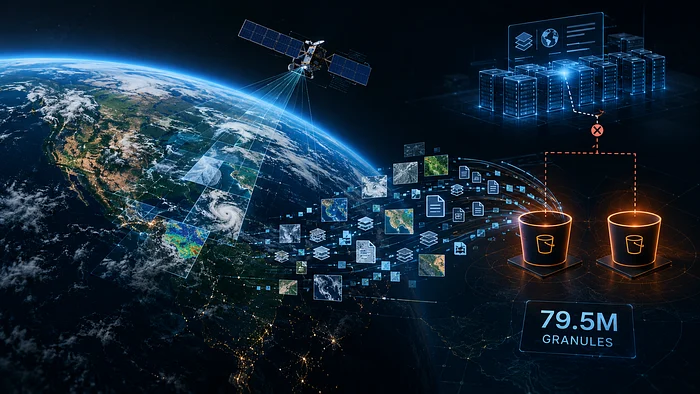
The image above is the article's title card: "79.5 Million Files. Two Buckets. One Overlooked Flaw".
The background you need first
A few ideas come up again and again, so here they are from zero.
What is an API? An API (Application Programming Interface) is a way for one piece of software to ask another for information, in a fixed format. Think of a restaurant: you do not walk into the kitchen, you read the menu, tell the waiter what you want, and food comes back. The menu and the waiter are the API. The kitchen is the server. Here, the "restaurant" is NASA's catalogue, and anyone can order from the menu with a normal web request.
What is a metadata catalogue? Metadata is data about data. A library card does not contain the book; it tells you the title, the shelf and the author. NASA's catalogue does the same for datasets: it says what a dataset is called, where it lives and how to fetch it. The catalogue in this story is called the Common Metadata Repository, or CMR, and it is the search backend for Earthdata, NASA's portal for Earth science data.
What is a collection and a granule? A collection is a whole dataset, for example "all OPERA surface displacement products". A granule is one individual file inside that collection, for example one image covering one place at one time. One collection can contain millions of granules.
What is Amazon S3? S3 (Simple Storage Service) is Amazon's file storage service. You store files in containers called buckets. Every bucket has a name, and those names are global: there is only one asf-cumulus-prod-opera-product in the entire world, across all Amazon customers. Names are handed out first come, first served. If a bucket is deleted, or was never created, the name becomes free again, and the next person to ask for it gets it.
What is a bucket takeover? It is the vulnerability class in this report. A system publishes the name of a storage bucket it expects to control, but the name is free. An attacker registers it, and from then on anything the system sends to that name arrives at the attacker instead. It is like a company printing letters that say "send returns to Unit 4, Industrial Estate" and never renting Unit 4. Whoever rents it first receives the returns.
What is curl? curl is a command-line tool that fetches a web address and prints what comes back. It is the text-only equivalent of typing a URL into your browser and pressing Enter.
What is an HTTP status code? When you request a web page, the server replies with a number. 200 means "here is the content, all good". 404 means "not found". S3 has its own wording for a missing bucket: NoSuchBucket.
Where it started
The researcher had already spent time poking at CMR (they had found two other bugs there, an RCE and a Zip Slip, written up separately). This time they were not reading NASA's code. They were reading what the catalogue sends back to anyone who asks.
Every cloud-hosted collection in CMR carries a block called DirectDistributionInformation. This block is the catalogue's way of telling software which S3 bucket holds the data. In the example shown it contains the Amazon region, the bucket name plus the folder path inside it, and an endpoint where a tool can get temporary S3 credentials.
What are credentials here? Temporary credentials are short-lived keys that let a program read from a bucket. Think of a day pass to a car park: it opens the barrier for a while and then expires. The catalogue hands out the address of the booth where you collect the pass.
A query for one collection returns the block like this:
GET https://cmr.earthdata.nasa.gov/search/collections.umm_json?concept_id=C3294057315-ASF"DirectDistributionInformation": { "Region": "us-west-2", "S3BucketAndObjectPrefixNames": [ "asf-cumulus-prod-opera-product/OPERA_L3_DISP-S1/" ], "S3CredentialsAPIEndpoint": "https://cumulus.asf.alaska.edu/s3credentials" }
Line by line:
GET https://cmr.earthdata.nasa.gov/search/collections.umm_json?concept_id=C3294057315-ASFis the request.GETmeans "give me something". The address is NASA's CMR search service, asking for collection details in a format called UMM-JSON. The?concept_id=...part is a filter: only return the collection with that identifier."DirectDistributionInformation"is the block of interest, the part that says where the data lives."Region": "us-west-2"says the data is stored in Amazon's US West (Oregon) region."S3BucketAndObjectPrefixNames": [ "asf-cumulus-prod-opera-product/OPERA_L3_DISP-S1/" ]is the key line. The bucket isasf-cumulus-prod-opera-product, and inside it the data sits under the folderOPERA_L3_DISP-S1/."S3CredentialsAPIEndpoint": "https://cumulus.asf.alaska.edu/s3credentials"is the address where a tool can collect its temporary pass.
Because bucket names are global, a name that no longer resolves is a name anyone can claim. So the researcher pulled every collection from ASF (Alaska Satellite Facility, one of NASA's data centres) and checked each bucket named in that field. This is a systematic sweep: instead of guessing, take the catalogue's own list of names and test them all.
Two of them came back as NoSuchBucket:
asf-cumulus-prod-browseasf-cumulus-prod-opera-product
In plain terms: NASA's catalogue was advertising two lockers that did not exist.
Taking them
There is not much to the next step. The researcher created both buckets in their own AWS account in us-west-2 and uploaded a poc.txt to each. "PoC" stands for proof of concept: the smallest possible demonstration that the problem is real. A text file is enough, because the point is not to cause harm but to show who controls the content.
$ curl -L https://asf-cumulus-prod-browse.s3.amazonaws.com/poc.txt NASA VDP PoC by obaskly - Bugcrowd$ curl -L https://asf-cumulus-prod-opera-product.s3.amazonaws.com/poc.txt NASA VDP PoC by obaskly - Bugcrowd
Line by line:
curl -Lfetches a URL. The-Lflag means "follow redirects", so if the server points you somewhere else, keep going.https://asf-cumulus-prod-browse.s3.amazonaws.com/poc.txtis the address of the filepoc.txtinside the first bucket. Every S3 bucket can be reached at<bucket-name>.s3.amazonaws.com.https://asf-cumulus-prod-opera-product.s3.amazonaws.com/poc.txtis the same thing for the second bucket.- The text after the URL,
NASA VDP PoC by obaskly - Bugcrowd, is the content of the file that came back. It names the researcher and the bug bounty programme, so nobody can mistake it for real NASA data.
Both returned 200 from AmazonS3, serving the text file the researcher had uploaded. In other words: the addresses NASA's catalogue was publishing now delivered the researcher's file. The same check against the OPERA bucket is shown at the top of the report:
$ curl -L https://asf-cumulus-prod-opera-product.s3.amazonaws.com/poc.txt NASA VDP PoC by obaskly - Bugcrowd
This is the same command as above, repeated on its own to make the result easy to see: the OPERA bucket address returns the researcher's text.
How big was it
A bucket takeover is only as serious as the number of things that reference the bucket. A forgotten bucket behind a page nobody visits is a minor issue. A bucket behind millions of scientific files is a different matter. So the researcher measured the blast radius: how many collections and granules pointed at each name.
CMR returns the number of matching granules in a response header called CMR-Hits. A header is extra information attached to a response, separate from the main content, like the note on the outside of an envelope. The trick here is to ask for page_size=0, which means "give me zero actual records, just the count". That returns the number instantly without downloading millions of entries.
r = requests.get( "https://cmr.earthdata.nasa.gov/search/granules.json", params={"collection_concept_id": concept_id, "page_size": 0}, ) hits = int(r.headers.get("CMR-Hits", 0))
Line by line:
r = requests.get(...)sends a web request usingrequests, a common Python library for talking to web services, and stores the reply in a variable calledr."https://cmr.earthdata.nasa.gov/search/granules.json"is the CMR search endpoint for granules, the individual files.params={"collection_concept_id": concept_id, "page_size": 0}is the filter.collection_concept_idlimits the search to one collection, andpage_size: 0asks for no records at all, only the summary.hits = int(r.headers.get("CMR-Hits", 0))reads theCMR-Hitsheader from the reply, converts it to a whole number, and stores it inhits. If the header is missing, it falls back to0.
Counting collections and granules per bucket gave:
asf-cumulus-prod-browse: 1 collection, about 463,000 granulesasf-cumulus-prod-opera-product: 6 collections, about 79,500,000 granules
The image above shows those results as a table: the browse bucket with 1 collection and roughly 463,000 granules, and the opera-product bucket with 6 collections and roughly 79,500,000 granules.
The affected data covered ARIA Sentinel-1 interferograms and the OPERA products: surface displacement, radar backscatter, tropospheric corrections and so on. You do not need the details to see why it matters. This is data used for earthquake and landslide monitoring, disaster response and climate research. If a scientist downloads a file from the address the catalogue gave them, they have no reason to doubt it.
Who actually reads this field
A bucket name sitting in metadata is only dangerous if something follows it. A signpost to an empty lot is harmless if nobody walks down the road. So the researcher checked whether real software acts on the name.
The software in question was earthaccess, NASA's official Python library for Earthdata. A library is a bundle of ready-made code that other programs use, and earthaccess reads the field. In earthaccess/results.py:
def s3_bucket(self) -> Dict[str, Any]: return self["umm"].get("DirectDistributionInformation", {})
Line by line:
def s3_bucket(self) -> Dict[str, Any]:defines a function calleds3_bucket. A function is a named block of code you can call whenever you need that job done. The-> Dict[str, Any]part says it hands back a dictionary, which is a collection of labelled values.return self["umm"].get("DirectDistributionInformation", {})is the body. It looks inside the collection's metadata (stored under the keyumm) and pulls out theDirectDistributionInformationblock. If the block is missing, it returns an empty dictionary instead of crashing.
That is the exact field that had been taken over. The usual cloud workflow is: look up the collection in CMR, read the bucket name, get temporary credentials from the S3CredentialsAPIEndpoint, then download from the bucket. The last step would land in the attacker's bucket, and because the name matches what NASA's metadata says, nothing would look wrong. The scientist's tool would not warn them, because from its point of view it did exactly what the catalogue told it to.
Showing the chain end to end
So the proof of concept read the bucket names live from CMR and then fetched from them, the way a tool would. This is the difference between "I own a name" and "NASA's own catalogue sends people to my name".
Collection : C3294057315-ASF - OPERA_L3_DISP-S1_V1 CMR bucket : ['asf-cumulus-prod-opera-product/OPERA_L3_DISP-S1/'] → https://asf-cumulus-prod-opera-product.s3.amazonaws.com/poc.txt HTTP 200 - NASA VDP PoC by obaskly - Bugcrowd
Line by line:
Collection : C3294057315-ASF - OPERA_L3_DISP-S1_V1is the collection the proof of concept looked up, identified by its CMR identifier and its human-readable name.CMR bucket : ['asf-cumulus-prod-opera-product/OPERA_L3_DISP-S1/']is the bucket name the catalogue returned for that collection, read live rather than typed in by hand.→ https://asf-cumulus-prod-opera-product.s3.amazonaws.com/poc.txtis the address built from that name.HTTP 200 - NASA VDP PoC by obaskly - Bugcrowdis the result: a successful download of the researcher's file.
The image above shows that end-to-end run: the collection, the bucket name read from CMR, the resulting URL and the 200 response with the researcher's text.
What an attacker could do
The researcher only ever uploaded a text file. That restraint matters: the point was to prove control, not to cause damage. But the same position, held by someone with worse intentions, would allow several things.
- Serve fake data. An attacker could place fake
.nc,.h5or.tiffiles at the paths NASA's granules reference. These are common scientific data formats. Scientists would download altered satellite data and might never find out. The report gives the example of a fake ground displacement map going into someone's earthquake analysis. - Hide malware in files people treat as plain data. Nobody runs antivirus on NetCDF files, a scientific data format, because they are not expected to be programs. A file that looks like data can still carry something harmful.
- Watch who downloads what. Whoever controls a bucket can log every request to it: who asked, from where and when. That shows who is downloading what, from where and when.
Most subdomain or bucket takeovers end with defacing a page nobody visits. This one sat in the middle of a scientific data pipeline, where the files are the work.
The fix
On NASA's side the report lists three steps:
- Get the bucket names back under NASA's AWS account. Because the names were registered to the researcher, this required the researcher to delete their own buckets first, freeing the names for NASA to claim.
- Audit every
DirectDistributionInformationentry in CMR for other dead buckets. If two names were stale, others might be too. - Longer term, sign or checksum the data so clients can verify files no matter where they came from. A checksum is a fingerprint of a file: if the file changes, the fingerprint no longer matches. That way, even a wrong bucket cannot pass off altered data as genuine.
The issue has been triaged, fixed and resolved. Triaged means the programme reviewed it and sorted it for handling.
What to take away
- Metadata is attack surface. Any bucket name, hostname or URL a system hands out is worth checking to see if it still exists and who owns it. The catalogue is part of the system, even though it holds no data itself.
- Count the blast radius. "I took over a bucket" sounds like a minor issue. "I took over a bucket referenced by 79 million files that NASA's SDK reads" does not. Get the numbers and put them in the report.
- Follow the reference all the way through. Showing that
earthaccessreads that field is what made the impact real. A name in a catalogue is a claim; a library acting on it is the proof.
Glossary
- API: a fixed way for one piece of software to ask another for information, like a menu and a waiter in a restaurant.
- AWS: Amazon Web Services, Amazon's cloud platform, where S3 buckets live.
- Bucket: a named container for files in Amazon S3. Bucket names are global and first come, first served.
- Bucket takeover: registering a storage bucket name that a system still publishes but no longer owns, so the system's traffic comes to you.
- Checksum: a fingerprint of a file's contents, used to detect whether the file has changed.
- Cloud-hosted collection: a dataset whose files are stored in cloud storage rather than on NASA's own servers.
- CMR: Common Metadata Repository, NASA's catalogue and search backend for Earthdata.
- CMR-Hits: the response header in which CMR reports how many records match a search.
- Collection: a whole dataset, made up of many individual files.
- Credentials: short-lived keys that let a program read from a storage bucket, like a day pass to a car park.
curl: a command-line tool that fetches a web address and prints the response.DirectDistributionInformation: the block in CMR metadata that names the S3 bucket, region and credentials endpoint for a collection.earthaccess: NASA's official Python library for working with Earthdata.- Earthdata: NASA's portal for Earth science data.
- Granule: one individual data file inside a collection.
- Header: extra information attached to a web response, separate from the main content.
- HTTP status code: the number a server returns with a response;
200means success,404means not found. - Metadata: data about data, like a library card describing a book.
NoSuchBucket: S3's reply when the requested bucket name does not exist.- PoC: proof of concept, the smallest demonstration that a problem is real.
- RCE: remote code execution, a vulnerability that lets an attacker run their own code on a server.
- Region: the geographic location of Amazon's data centres where a bucket is stored, here
us-west-2. - S3: Amazon Simple Storage Service, Amazon's file storage service.
S3BucketAndObjectPrefixNames: the field insideDirectDistributionInformationthat gives the bucket name and the folder path inside it.S3CredentialsAPIEndpoint: the address where a tool collects temporary credentials for a bucket.- Triaged: accepted by a bug bounty programme as a real issue and queued for handling.
- UMM-JSON: the JSON format CMR uses to describe collections.
- Zip Slip: a vulnerability where a crafted archive writes files outside the intended folder.





