LowByte: The eMudhra Single-Byte CA Key Compromise
Eight eMudhra intermediate CA private keys had only 8 bits of entropy, so anyone with the public certificates could recover the keys in milliseconds and mint certificates for any domain or sign code as a verified publisher.

medium.com
Published on medium.com
Emudhra
The full write-up lives on its author's site
It belongs to its author, so we link to it rather than copy it. The other two tabs are our own rewrites, checked against it.
Context
On April 30, 2025, eMudhra, described in the report as India's largest licensed certifying authority, ran a single key generation ceremony that produced 24 intermediate CAs under its emSign brand. The intermediates were split across three series (A, B, C), two algorithms (RSA-4096 and P-384) and four purposes (DV, OV, EV and code signing). The B series was issued to eMudhra BV for European customers and the C series to eMudhra Inc for US customers, to address data-sovereignty requirements.
Eight of those intermediates, all P-384, were created with private keys whose entire value sat in the lowest byte. Every scalar was below 256. One of them was 4. Anyone holding the public certificate could recover the private key in milliseconds and then sign certificates for any domain, or sign code as a verified publisher, on ordinary hardware.
The keys were weak from the moment they were created and effectively public from the moment the certificates existed. The keys were weak from the moment they were created and effectively public from the moment the certificates existed, a window of 17 months before the October 17, 2026 report. the response from root programmes and browsers, and the clients that remain exposed because they trust a CA bundle on disk and never check revocation.
Setup
The attack needs no account, no access to eMudhra infrastructure and no special tooling. The inputs are:
- A public certificate for one of the eight weak intermediates, published in CT logs and attached to the original bug report.
- A machine capable of elliptic-curve scalar multiplication. The author's recovery of the key with value 4 took 0.0080 seconds.
- A library that can derive a private key from a candidate scalar and compare the resulting public key, such as Python's
ecmodule.
The author also published a GitHub repository, eMudhra Private Key Retrieval, containing the recovered private keys for all eight weak keys and the script used to generate them, and links a second tool, eMudhra Certificate Generator.
Finding it
The flaw is visible in the encoding of the private scalar. A P-384 private key is 48 bytes. In all eight eMudhra keys the top 47 bytes were zero and only the lowest byte carried a value. Written as the 48-byte big-endian value an HSM would store, a key looked like this:
d = [redacted] (230)
A healthy P-384 key has 48 bytes of noise. These had 47 zero bytes and one byte of value. Base64-encoded, the private keys show a long run of AAAA…, which several readers on the Mozilla bug pointed out.
Nothing else looked wrong. A point derived from d = 4 is a valid P-384 point. The encoding is standard, the curve is standard, and the signatures verify. Linting, CT logging, audits and root-programme review all check structure and policy, not whether the private scalar is small. The only way to see the flaw is to try small scalars against the public key.
The author named the incident after the low byte, and credits Scott Helme's article Eight Bits of Trust; eMudhra's CA keys cracked in milliseconds as the inspiration for the name.
Exploitation
Step 1: understand why the search space collapsed
The private key is an integer d chosen uniformly from 1 to n − 1, where n is the order of the P-384 base point G. The public key in the certificate is the point Q:
$$Q = d \cdot G, \qquad 1 \le d \le n, 1, \qquad n \approx 2^{384}$$
Computing Q from d is cheap. Going back from Q to d is the elliptic-curve discrete logarithm problem, which is infeasible only because the search space is about 10¹¹⁵ values. Every bit of that security comes from d being large and random. With d below 256, each key had about 8 bits of entropy instead of roughly 384, so recovery takes at most 255 point multiplications, a millisecond or two on a laptop.
Step 2: brute force the scalar from the public key
The attacker reads Q from the certificate and computes 1·G, 2·G, 3·G and so on until one matches. The worst case is 255 steps:
$$\text{work} \le 2^{8} \text{ scalar multiplications} \quad \text{versus} \quad \approx 2^{192} \text{ for Pollard's rho on a random P-384 key}$$
The baby-step giant-step algorithm also finishes near-instantly, but a plain linear scan is enough. The script below reproduces the attack using only the public key:
# Recover a P-384 private scalar known to be below 256 from its public key alone.
def bruteforce_pub_key(public_key): for i in range(1,256): private_key = ec.derive_private_key(i, public_key.curve) if private_key.public_key().public_numbers() == public_key.public_numbers(): print("Success on d = "+str(i)) return private_key
Running it in the author's environment took 0.0080 seconds to derive the private key where it was d=4:
Bruteforrcing for key : Public Keys\CN=EM OV TLS CA - G3C,O=eMudhra Inc,C=US.pemSuccess on d = 4Took 0.0080 seconds
Two independent recoveries confirm how low the bar was. Mozilla recovered the keys on its own 1 hour 42 minutes after receiving the report, without knowing the reporter's method. Mozilla engineer Dennis Jackson and Scott Helme both reported that AI agents recovered the keys from a single short prompt.
Step 3: complete the chain of trust
A forged leaf on its own is not enough. The client also needs the intermediate certificate to build a path to a root it trusts. Nothing secret is required for that step, because intermediate certificates are public by design: they are published in CT logs, searchable on sites like crt.sh, and in this case were attached to the original bug report. The attack looks like this:
- Download one of the compromised intermediate certificates.
- Recover its private key by trying all 256 possible values.
- Use that key to sign a forged leaf certificate for the target domain.
- Serve the forged leaf along with the intermediate. The client walks leaf, intermediate, trusted root, every signature checks out, and the connection looks completely legitimate.
A leaf certificate carries the hostnames and cannot sign other certificates. The CSR step, where the subscriber proves possession of their key and the CA checks domain control, is skipped entirely. The client never checks how a certificate was issued, only that the signatures are valid, and that gap is the whole exploit.
Step 4: use the second trust path
On May 14, 2025, Sectigo cross-signed all eight public keys under its AAA Certificate Services root. That doubled the number of certificates carrying each broken key to 16 and opened a second path to trust. Chrome and Firefox had already dropped AAA Certificate Services for TLS in April 2025, but Apple and Microsoft still trusted it, and so did many Linux bundles. Sectigo revoked its copies on October 19, 2026.
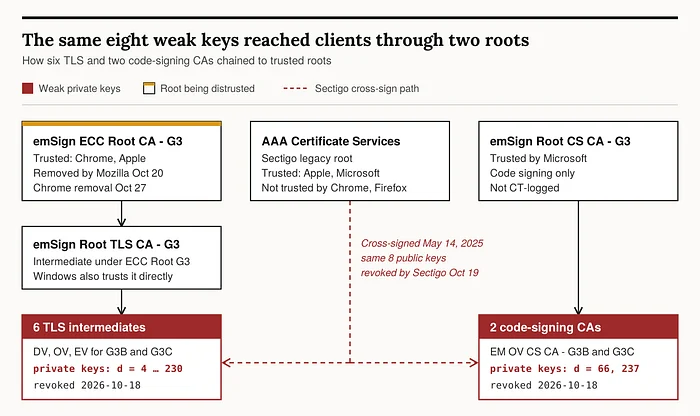
Removing the emSign ECC root cuts only the left-hand path; clients that still trust AAA Certificate Services or emSign Root CS CA, G3 need the intermediates blocked directly.
Root cause
eMudhra's preliminary account is that one ceremony produced two key pairs per CA, and the weak pair was the one certified.
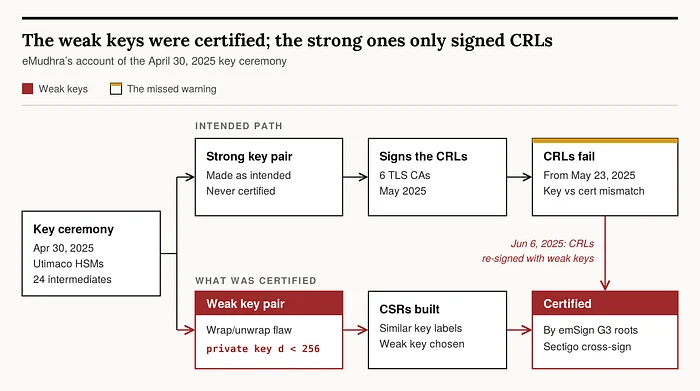
The strong keys were generated as intended, but a flawed wrap/unwrap test, run because the B and C keys were meant for export to US and European data centres, left a second, weak pair on the HSM. With similar labels, the weak pair went into the CSRs that the emSign roots signed and Sectigo cross-signed. The strong keys were later used to sign CRLs, which is why those CRLs failed.
eMudhra says its infrastructure was not breached, its HSMs are FIPS 140-2 Level 3 devices, the RSA keys followed a different code path, and the A and A-1 series were made on Entrust HSMs. It cites human error at several steps and has committed to re-verifying every ceremony it has performed.
The account does not yet explain how a scalar below 256 came to exist. An HSM's approved key-generation mechanism draws d from its internal random source and does not produce such a value by itself. The report raises open questions:
- Imported or supplied material. The weak key came from a value, seed or wrapped blob fed to the module, for example through an unwrap or object-creation call rather than in-module generation. That would conflict with eMudhra's CPS, which says issuing-CA keys are generated in a FIPS 140-2 Level 3 device.
- A module configuration that permits it. The HSM could be made to create such a key internally, which would raise questions for every CA using the same hardware.
Root-programme participants have asked for the ceremony script, the exact PKCS#11 or vendor call that created the second pair (for example C_GenerateKeyPair, C_UnwrapKey or C_CreateObject), the ceremony and witness reports, the HSM firmware and CMVP certificate, and whether the module ran in FIPS-approved mode. Commenters also argue that the Baseline Requirements required a qualified auditor's witness report or video for this ceremony, because Sectigo, an unaffiliated root, cross-certified the keys.
The missed warning: bad CRL signatures in 2025
The key mismatch surfaced 16 months earlier and was closed as a paperwork error. In June 2025, Bug 1970728 recorded invalid CRL signatures from exactly the six affected TLS intermediates.
- What eMudhra said then: a manual CRL process used the wrong CA key configuration on May 29, 2025. Corrected CRLs were published on June 6, 2025, and eMudhra committed to automated post-signing checks.
- What it says now: the original CRLs were signed with the intended, strong keys. Those signatures failed because the certificates held the weak public keys, so the CRLs were re-signed with the weak keys, which made them verify.
In other words, the operator found that its CA certificates did not match its intended keys, picked the key that made the error go away, and kept operating. The report asks why eMudhra did not halt and revoke at that point, why the 2025 report omitted that two key pairs existed per CA, and whether Sectigo or any root programme was told.
Impact
With any of the six TLS keys, anyone on the network path can mint a certificate for any hostname and man-in-the-middle a client that trusts the chain. Helme minted a certificate for api.stripe.com and the author demonstrated the same by minting outloook.com. The two code-signing keys chain to emSign Root CS CA, G3, which Microsoft trusts, so malware signed with them would look like software from a verified publisher on Windows hosts that do not check revocation. Code-signing certificates are not CT-logged, so there is no public record to search.
Chrome found no TLS certificate chaining to the six intermediates in CT logs before its block, and because Chrome, Safari and Firefox require CT, no forged certificate could have been trusted by default in them. CT detects mis-issuance rather than preventing it, and most non-browser clients never check it.
The residual risk is every TLS client that trusts a bundle on disk, skips revocation and ignores CT. The report lists:
- Installer pipes and self-updaters that fetch scripts or binaries over HTTPS with no signature check.
- CI/CD runners and build containers that hold cloud, registry and signing credentials and run on stale base images.
- Server-to-server calls: payment APIs, webhooks, OAuth token exchange and cloud SDKs, which often use certifi or Go's verifier.
- Compiled Go programs, which keep the old behaviour until rebuilt with a patched toolchain.
- IoT, embedded and OT devices with frozen bundles. The intermediates are valid until July 2039.
A stolen key has a thief and a moment of theft; LowByte had neither, so there is no point after which you can say the key was safe. eMudhra says only one of the eight CAs issued anything, and none issued end-entity certificates. Chrome found no forged TLS certificates in CT, and no malicious use had been confirmed as of October 21. eMudhra's Indian digital signature and eSign businesses run on separate infrastructure regulated by the Controller of Certifying Authorities, and India's IT ministry says they are unaffected. None of that rules out silent use against non-CT clients during the 17-month window, and Chrome's October 21 CT count had to set aside precertificates logged after October 17 under EM DV TLS CA, G3B, so certificates have been signed with that now-public key since disclosure.
Fix
Root programmes revoked the intermediates: Mozilla removed the emSign ECC Root CA, G3 from NSS, and Chrome is removing it too. Mozilla's reasoning was that multiple people had independently recovered the keys and some had published them, and many clients cannot consume revocation data or block individual intermediates, so removing the root was the only lever that reached them. The cost is collateral: every legitimate certificate under the G3 ECC root breaks for those clients, which is why Mozilla, Canonical, Red Hat and CERT-In all warned of outages. Chrome also checked every other CA certificate in its store and reported no other instance of this failure mode, and Mozilla said it does not currently believe other CAs are affected.
Two strategies shipped: block the eight keys directly, or drop the roots above them. Key blocking is precise; root removal is blunt and also breaks legitimate G3 certificates. The live list is on Dennis Jackson's tracking site.
For operators, the work left is servers, pipelines and devices that manage their own trust.
- Update every trust store you ship. Apply OS ca-certificates updates, bump certifi, pip, uv, webpki-roots and Electron, then rebuild container images from patched bases rather than patching running containers.
- Rebuild Go and Electron binaries with Go 1.27.3 or 1.26.10 and a patched Electron. Deployed binaries keep their old behaviour.
- Block both trust paths on frozen devices. Distrust the eight intermediates and their eight Sectigo twins (fingerprints in Bug 2083449), enable revocation checking where the stack supports it, and restrict outbound TLS to known endpoints. Removing AAA Certificate Services outright can break legitimate services, so test first.
- Hunt for misuse since April 30, 2025. Search TLS-inspection, proxy and EDR logs for any certificate or signed binary whose issuer is one of the eight intermediates. Weight Windows code-signing telemetry highest, since nothing there is CT-logged.
Find your own G3 certificates. Anything you serve that chains to emSign ECC Root CA, G3 breaks in Chrome once v43 lands. Check what each endpoint presents:
openssl s_client -connect example.com:443 -showcerts </dev/null 2>/dev/null \ | grep -E '^ *(s|i):'
Per Chrome's CT analysis, 30,791 of about 30,800 unexpired G3 precertificates came from InCommon's OVG3C and DVG3C subordinate CAs.
Test your clients against the canary hosts. The disclosure site runs 12 test hosts that serve chains through the compromised intermediates, including Sectigo-path variants. A certificate error means the client is safe; a successful connection means it still trusts the keys.
curl -sS https://dv-g3b-emudhra.we-have-a-problem.com/ curl -sS https://dv-g3b-aaa-emudhra.we-have-a-problem.com/
Run them from CI runners, API gateways, proxies, containers and appliances, not just laptops.
Variants to test
- Scan other CA certificates for small scalars. For every P-384 (or other curve) intermediate and root certificate you can obtain, run the same brute force against the public key. This is the check that linting, CT and audits do not perform.
- Look for the
AAAA…pattern in encoded private material. Where private keys or wrapped blobs are exposed in reports, backups or test fixtures, base64-encode them and look for a long run ofAAAA. - Check CRL and certificate key consistency. For any CA you monitor, verify that CRLs verify against the public key in the CA certificate.
- Test clients against the canary hosts. Run the two
curlcommands above from CI runners, API gateways, proxies, containers and appliances. A successful connection means the client still trusts the compromised keys; a certificate error means it is safe. - Search logs for the eight intermediates and their Sectigo twins. Query TLS-inspection, proxy and EDR telemetry for certificates or signed binaries whose issuer is one of the affected intermediates, weighting Windows code-signing events highest because they are not CT-logged.
What happened, in plain words
Imagine a passport office. It prints passports that every border post in the world accepts. To print a passport, the office uses a special stamp. If someone steals that stamp, they can print passports that look exactly like the real thing, and border posts will wave them through.
In April 2025, a company called eMudhra, described in the report as India's largest licensed certifying authority, ran a ceremony to create the stamps it uses to vouch for websites. A certifying authority (CA) is a company whose job is to confirm that a website is really who it claims to be, and to hand out a digital document, called a certificate, that proves it. Browsers and operating systems keep a list of CAs they trust, and they accept certificates from those CAs without asking further questions.
eMudhra created 24 of these vouching identities in one ceremony. Eight of them were built on a kind of key that should be impossible to guess. But the secret numbers behind those eight keys were tiny: every one was below 256, and one of them was simply 4. Anyone who had the public certificate, which is meant to be public, could work out the secret in milliseconds and then create certificates for any website in the world, or sign software so that Windows would treat it as coming from a verified publisher.
The keys were weak from the moment they were made, and effectively public from the moment the certificates existed. The problem was reported on October 17, 2026, after a window of about 17 months. Browsers were protected within hours. But many other programs, the ones that keep their own list of trusted CAs on disk and never check whether a certificate has been cancelled, are still exposed.
This article walks through the whole story in the same order as the technical write-up: how the keys were found, how they were cracked, why the mistake happened, what damage it could do, and what to do about it. Every technical term is explained where it first appears, and every piece of code is explained line by line.
The setup: what you need to pull this off
The striking thing about this attack is how little it requires. There is no account to create, no access to eMudhra's computers, and no special equipment. The attack needs three things:
- A public certificate for one of the eight weak intermediate CAs. These are published in Certificate Transparency logs and were attached to the original bug report.
- A computer that can do elliptic-curve maths. The author recovered the key with value 4 in 0.0080 seconds.
- A programming library that can take a guessed number, turn it into a public key, and compare the result with the real public key. The author used Python's
ecmodule.
The author also published a GitHub repository, eMudhra Private Key Retrieval, containing the recovered private keys for all eight weak keys plus the script used to generate them, and links a second tool, eMudhra Certificate Generator.
Before going further, a few words on the words themselves.
What is a certificate? When you visit a website over HTTPS, the site sends your browser a certificate. It is a small file that contains the site's name, a public key, and a signature from a CA saying "we checked this site and it is genuine". Your browser checks that signature against the list of CAs it trusts. If the signature is valid, the browser shows the padlock and lets you continue.
What is a public key and a private key? They come in pairs. The public key can be shared with anyone; it is inside the certificate. The private key must be kept secret. They are mathematically linked: something signed with the private key can be checked with the public key, but you cannot work out the private key from the public one. That one-way relationship is the whole basis of trust on the internet.
What is an intermediate CA? CAs do not sign every website certificate with their most important key. Instead, they create a middle layer, called an intermediate CA, and use that to sign website certificates. The intermediate is itself signed by the CA's root key. This keeps the root key offline and safe. If an intermediate is compromised, it can be cancelled without throwing away the root. In this incident, the compromised keys were intermediates, two levels below an ECC root.
What is an HSM? A Hardware Security Module is a specialised computer designed to hold cryptographic keys and never let them out. It is the digital equivalent of a safe that can do maths inside itself. eMudhra says its HSMs are FIPS 140-2 Level 3 devices, which is a formal security standard for such hardware.
Finding it: how the flaw was spotted
The flaw was visible in the way the private key was stored. A P-384 private key is 48 bytes long. A byte is a unit of digital storage, like a single character in a text file. In all eight eMudhra keys, the top 47 bytes were zero and only the lowest byte carried a value. Written as the 48-byte big-endian value an HSM would store, a key looked like this:
d = [redacted] (230)
What this shows: d is the name mathematicians give to the private key number. The 0x at the start means the number is written in hexadecimal, a base-16 way of writing numbers that computers use. The long run of zeros is the giveaway. A healthy P-384 key would look like 48 bytes of random noise. This one has 47 zero bytes and a single byte of value, here E6, which is 230 in ordinary decimal. The (230) at the end is the author's note translating it for the reader.
When such a key is encoded in base64, a common way of turning binary data into text, the private keys show a long run of AAAA…. Several readers on the Mozilla bug report pointed this out.
Nothing else looked wrong. A point derived from d = 4 is a valid P-384 point. The encoding is standard, the curve is standard, and the signatures verify. Linting (automated checks for common mistakes), CT logging, audits and root-programme review all check structure and policy, not whether the private scalar is small. The only way to see the flaw is to try small scalars against the public key.
The author named the incident after the low byte, and credits Scott Helme's article Eight Bits of Trust; eMudhra's CA keys cracked in milliseconds as the inspiration for the name.
Exploitation: how the keys were cracked
Step 1: understand why the search space collapsed
The private key is an integer d chosen uniformly from 1 to n − 1, where n is the order of the P-384 base point G. The public key in the certificate is the point Q:
$$Q = d \cdot G, \qquad 1 \le d \le n, 1, \qquad n \approx 2^{384}$$
This formula is the heart of the whole story, so let us unpack it slowly.
Gis a fixed starting point on an elliptic curve. An elliptic curve is a particular kind of mathematical shape, and the P-384 curve is one specific curve defined by a standard. Think ofGas a fixed landmark on a map.dis the private key, a secret number.Qis the public key, a point on the same curve.- The dot in
d · Gdoes not mean ordinary multiplication. It means "add G to itself d times" using a special rule for adding points on the curve. This is called scalar multiplication. nis the order of G, meaning the number of times you can add G to itself before you get back to where you started. For P-384, n is roughly 2 to the power 384, an enormous number.
Computing Q from d is cheap: a computer can do it in a fraction of a second. Going back from Q to d is the elliptic-curve discrete logarithm problem. It is considered infeasible because the search space is about 10¹¹⁵ values. Every bit of that security comes from d being large and random. With d below 256, each key had about 8 bits of entropy instead of roughly 384. Entropy here means unpredictability: 8 bits means only 256 possibilities, while 384 bits means an astronomically large number of possibilities. Recovery takes at most 255 point multiplications, a millisecond or two on a laptop.
Step 2: brute force the scalar from the public key
The attacker reads Q from the certificate and computes 1·G, 2·G, 3·G and so on until one matches. This is called brute force: trying every possibility in turn. The worst case is 255 steps:
$$\text{work} \le 2^{8} \text{ scalar multiplications} \quad \text{versus} \quad \approx 2^{192} \text{ for Pollard's rho on a random P-384 key}$$
What this says: the work needed is at most 2 to the power 8, which is 256, scalar multiplications. Compare that with about 2 to the power 192 for Pollard's rho, a well-known algorithm for solving the discrete logarithm problem on a properly random key. The difference between 256 and 2 to the power 192 is the difference between counting on your fingers and counting every grain of sand on Earth.
The baby-step giant-step algorithm, another method for solving the discrete logarithm problem, also finishes near-instantly, but a plain linear scan is enough. The script below reproduces the attack using only the public key:
# Recover a P-384 private scalar known to be below 256 from its public key alone.
This first line is a comment. In Python, anything after a # is ignored by the computer and is there for the human reader. It states the goal: recover a private key that is known to be below 256, using only the public key.
def bruteforce_pub_key(public_key): for i in range(1,256): private_key = ec.derive_private_key(i, public_key.curve) if private_key.public_key().public_numbers() == public_key.public_numbers(): print("Success on d = "+str(i)) return private_key
Line by line:
def bruteforce_pub_key(public_key):defines a function, a reusable block of code, namedbruteforce_pub_key. It takes one input,public_key, which is the public key read from the certificate.for i in range(1,256):starts a loop that runs withitaking every value from 1 to 255. This is the brute force: try every possible private key.private_key = ec.derive_private_key(i, public_key.curve)asks theeclibrary to build a private key from the candidate numberi, on the same curve as the target public key. The curve is the mathematical shape mentioned earlier.if private_key.public_key().public_numbers() == public_key.public_numbers():computes the public key that would correspond to this candidate private key, and compares it with the real public key from the certificate. If they match, the guess is correct.print("Success on d = "+str(i))prints a message showing which number worked.return private_keyhands the recovered private key back to whoever called the function, and stops the loop.
Running it in the author's environment took 0.0080 seconds to derive the private key where it was d=4:
Bruteforrcing for key : Public Keys\CN=EM OV TLS CA - G3C,O=eMudhra Inc,C=US.pemSuccess on d = 4Took 0.0080 seconds
This output shows three things. The first line names the certificate being attacked: CN=EM OV TLS CA - G3C,O=eMudhra Inc,C=US.pem. CN stands for Common Name, the name of the certificate's owner. O stands for Organisation, here eMudhra Inc. C stands for Country, here US. The .pem ending is a common file format for certificates. The second line says the correct private key was 4. The third line says the whole search took 0.0080 seconds, less than a hundredth of a second.
Two independent recoveries confirm how low the bar was. Mozilla recovered the keys on its own 1 hour 42 minutes after receiving the report, without knowing the reporter's method. Mozilla engineer Dennis Jackson and Scott Helme both reported that AI agents recovered the keys from a single short prompt. In other words, the attack is so simple that a modern AI assistant can be asked to do it in one sentence.
Step 3: complete the chain of trust
A forged leaf on its own is not enough. A leaf certificate is the one at the bottom of the chain, the one issued to an actual website. The client also needs the intermediate certificate to build a path to a root it trusts. Nothing secret is required for that step, because intermediate certificates are public by design: they are published in CT logs, searchable on sites like crt.sh, and in this case were attached to the original bug report. The attack looks like this:
- Download one of the compromised intermediate certificates.
- Recover its private key by trying all 256 possible values.
- Use that key to sign a forged leaf certificate for the target domain.
- Serve the forged leaf along with the intermediate. The client walks leaf, intermediate, trusted root, every signature checks out, and the connection looks completely legitimate.
A leaf certificate carries the hostnames and cannot sign other certificates. The CSR step, where the subscriber proves possession of their key and the CA checks domain control, is skipped entirely because the attacker signs the leaf directly with the intermediate key. A CSR, or Certificate Signing Request, is the normal paperwork a website owner sends to a CA: here is my public key, here is proof I own the domain, please sign. The attacker does not need it, because they are acting as the CA themselves. The client never checks how a certificate was issued, only that the signatures are valid, and that gap is the whole exploit.
Step 4: use the second trust path
On May 14, 2025, Sectigo cross-signed all eight public keys under its AAA Certificate Services root. Cross-signing means one CA vouches for another CA's certificate, creating a second route to a trusted root. That doubled the number of certificates carrying each broken key to 16 and opened a second path to trust. Chrome and Firefox had already dropped AAA Certificate Services for TLS in April 2025, but Apple and Microsoft still trusted it, and so did many Linux bundles. Sectigo revoked its copies on October 19, 2026.
Removing the emSign ECC root cuts only the left-hand path; clients that still trust AAA Certificate Services or emSign Root CS CA, G3 need the intermediates blocked directly.
Root cause: why the keys were weak
eMudhra's preliminary account is that one ceremony produced two key pairs per CA, and the weak pair was the one certified.
The strong keys were generated as intended, but a flawed wrap/unwrap test, run because the B and C keys were meant for export to US and European data centres, left a second, weak pair on the HSM. Wrapping is the process of encrypting a key so it can be moved safely between systems; unwrapping is decrypting it again. With similar labels, the weak pair went into the CSRs that the emSign roots signed and Sectigo cross-signed. The strong keys were later used to sign CRLs, which is why those CRLs failed. A CRL, or Certificate Revocation List, is a published list of certificates that a CA has cancelled. It is itself signed, so clients can check it is genuine.
eMudhra says its infrastructure was not breached, its HSMs are FIPS 140-2 Level 3 devices, the RSA keys followed a different code path, and the A and A-1 series were made on Entrust HSMs. RSA is a different family of cryptographic algorithm from elliptic curves. It cites human error at several steps and has committed to re-verifying every ceremony it has performed.
The account does not yet explain how a scalar below 256 came to exist. An HSM's approved key-generation mechanism draws d from its internal random source and does not produce such a value by itself. The report raises open questions:
- Imported or supplied material. The weak key came from a value, seed or wrapped blob fed to the module, for example through an unwrap or object-creation call rather than in-module generation. That would conflict with eMudhra's CPS, which says issuing-CA keys are generated in a FIPS 140-2 Level 3 device. A CPS, or Certification Practice Statement, is the public rulebook a CA promises to follow.
- A module configuration that permits it. The HSM could be made to create such a key internally, which would raise questions for every CA using the same hardware.
Root-programme participants have asked for the ceremony script, the exact PKCS#11 or vendor call that created the second pair (for example C_GenerateKeyPair, C_UnwrapKey or C_CreateObject), the ceremony and witness reports, the HSM firmware and CMVP certificate, and whether the module ran in FIPS-approved mode. PKCS#11 is a standard interface for talking to HSMs; the names starting with C_ are specific commands in that interface. CMVP is the programme that certifies cryptographic modules against FIPS standards. Commenters also argue that the Baseline Requirements required a qualified auditor's witness report or video for this ceremony, because Sectigo, an unaffiliated root, cross-certified the keys. The Baseline Requirements are the common rules that publicly trusted CAs must follow.
The missed warning: bad CRL signatures in 2025
The key mismatch surfaced 16 months earlier and was closed as a paperwork error. In June 2025, Bug 1970728 recorded invalid CRL signatures from exactly the six affected TLS intermediates.
- What eMudhra said then: a manual CRL process used the wrong CA key configuration on May 29, 2025. Corrected CRLs were published on June 6, 2025, and eMudhra committed to automated post-signing checks.
- What it says now: the original CRLs were signed with the intended, strong keys. Those signatures failed because the certificates held the weak public keys, so the CRLs were re-signed with the weak keys, which made them verify.
In other words, the operator found that its CA certificates did not match its intended keys, picked the key that made the error go away, and kept operating. The report asks why eMudhra did not halt and revoke at that point, why the 2025 report omitted that two key pairs existed per CA, and whether Sectigo or any root programme was told.
Impact: what an attacker could do
With any of the six TLS keys, anyone on the network path can mint a certificate for any hostname and man-in-the-middle a client that trusts the chain. Man-in-the-middle means sitting between two parties and pretending to be each one to the other, reading or altering what passes. Helme minted a certificate for api.stripe.com and the author demonstrated the same by minting outloook.com. The two code-signing keys chain to emSign Root CS CA, G3, which Microsoft trusts, so malware signed with them would look like software from a verified publisher on Windows hosts that do not check revocation. Code-signing certificates are not CT-logged, so there is no public record to search.
Browsers were protected within hours of the October 17, 2026 report. Chrome found no TLS certificate chaining to the six intermediates in CT logs before its block, and because Chrome, Safari and Firefox require CT, no forged certificate could have been trusted by default in them. CT detects mis-issuance rather than preventing it, and most non-browser clients never check it. Certificate Transparency is a public, append-only log of certificates. Browsers that require it will only accept a certificate if there is proof it was logged, which makes secret mis-issuance visible after the fact.
The residual risk is every TLS client that trusts a bundle on disk, skips revocation and ignores CT. A trust bundle is a file containing the list of CAs a program will accept. The report lists:
- Installer pipes and self-updaters that fetch scripts or binaries over HTTPS with no signature check.
- CI/CD runners and build containers that hold cloud, registry and signing credentials and run on stale base images. CI/CD means automated build and deployment pipelines; a runner is the machine that executes them.
- Server-to-server calls: payment APIs, webhooks, OAuth token exchange and cloud SDKs, which often use certifi or Go's verifier. An API is a way for one program to talk to another; a webhook is an automatic message one service sends to another when something happens; OAuth is a standard for granting one service limited access to another on your behalf; an SDK is a set of tools for building against a service. certifi is a common bundle of trusted CAs used by Python programs.
- Compiled Go programs, which keep the old behaviour until rebuilt with a patched toolchain. Go is a programming language; a compiled program is one that has been turned into a runnable file, and it keeps whatever trust list was baked in when it was built.
- IoT, embedded and OT devices with frozen bundles. IoT means Internet of Things, everyday devices with network connections; OT means operational technology, the computers that run industrial equipment. The intermediates are valid until July 2039.
A stolen key has a thief and a moment of theft; LowByte had neither, so there is no point after which you can say the key was safe. eMudhra says only one of the eight CAs issued anything, and none issued end-entity certificates. Chrome found no forged TLS certificates in CT, and no malicious use had been confirmed as of October 21. eMudhra's Indian digital signature and eSign businesses run on separate infrastructure regulated by the Controller of Certifying Authorities, and India's IT ministry says they are unaffected. None of that rules out silent use against non-CT clients during the 17-month window, and Chrome's October 21 CT count had to set aside precertificates logged after October 17 under EM DV TLS CA, G3B, so certificates have been signed with that now-public key since disclosure. A precertificate is a preliminary entry logged in CT before the final certificate is issued.
Fix: what was done and what you should do
Root programmes revoked the intermediates: Mozilla removed the emSign ECC Root CA, G3 from NSS, and Chrome is removing it too. NSS is the trust store used by Firefox and many Linux systems. Mozilla's reasoning was that multiple people had independently recovered the keys and some had published them, and many clients cannot consume revocation data or block individual intermediates, so removing the root was the only lever that reached them. The cost is collateral: every legitimate certificate under the G3 ECC root breaks for those clients, which is why Mozilla, Canonical, Red Hat and CERT-In all warned of outages. Chrome also checked every other CA certificate in its store and reported no other instance of this failure mode, and Mozilla said it does not currently believe other CAs are affected.
Two strategies shipped: block the eight keys directly, or drop the roots above them. Key blocking is precise; root removal is blunt and also breaks legitimate G3 certificates. The live list is on Dennis Jackson's tracking site.
For operators, the work left is servers, pipelines and devices that manage their own trust. The report gives this order:
- Update every trust store you ship. Apply OS ca-certificates updates, bump certifi, pip, uv, webpki-roots and Electron, then rebuild container images from patched bases rather than patching running containers. These are all common sources of trust lists in software.
- Rebuild Go and Electron binaries with Go 1.27.3 or 1.26.10 and a patched Electron. Deployed binaries keep their old behaviour.
- Block both trust paths on frozen devices. Distrust the eight intermediates and their eight Sectigo twins (fingerprints in Bug 2083449), enable revocation checking where the stack supports it, and restrict outbound TLS to known endpoints. A fingerprint is a short hash that uniquely identifies a certificate. Removing AAA Certificate Services outright can break legitimate services, so test first.
- Hunt for misuse since April 30, 2025. Search TLS-inspection, proxy and EDR logs for any certificate or signed binary whose issuer is one of the eight intermediates. Weight Windows code-signing telemetry highest, since nothing there is CT-logged. EDR means endpoint detection and response, software that watches computers for suspicious activity.
Find your own G3 certificates. Anything you serve that chains to emSign ECC Root CA, G3 breaks in Chrome once v43 lands. Check what each endpoint presents:
openssl s_client -connect example.com:443 -showcerts </dev/null 2>/dev/null \ | grep -E '^ *(s|i):'
Line by line:
openssl s_client -connect example.com:443 -showcertsruns a tool calledopensslin client mode, connecting toexample.comon port 443, the standard HTTPS port.-showcertstells it to print the whole certificate chain the server sends, not just the first certificate.</dev/nullfeeds empty input to the command, so it does not wait for you to type anything.2>/dev/nullthrows away error messages, keeping the output clean.\at the end of the line means the command continues on the next line.| grep -E '^ *(s|i):'pipes the output intogrep, a text search tool.-Eenables extended patterns. The pattern matches lines that start with optional spaces followed bys:ori:, which are the subject and issuer lines of each certificate. This shows you who issued each certificate in the chain.
Per Chrome's CT analysis, 30,791 of about 30,800 unexpired G3 precertificates came from InCommon's OVG3C and DVG3C subordinate CAs. InCommon is a service that provides certificates to universities and research organisations.
Test your clients against the canary hosts. The disclosure site runs 12 test hosts that serve chains through the compromised intermediates, including Sectigo-path variants. A certificate error means the client is safe; a successful connection means it still trusts the keys.
curl -sS https://dv-g3b-emudhra.we-have-a-problem.com/ curl -sS https://dv-g3b-aaa-emudhra.we-have-a-problem.com/
Line by line:
curlis a command-line tool for fetching web pages and other resources.-sSmeans silent but show errors: hide the progress bar, but still print any error message.- The two URLs are the canary hosts. The first serves a chain through the emSign path; the second serves a chain through the Sectigo path.
- If the command prints a certificate error, the client does not trust the compromised keys and is safe. If it prints a web page, the client still trusts them.
Run them from CI runners, API gateways, proxies, containers and appliances, not just laptops. An API gateway is a server that sits in front of APIs and routes traffic; a proxy is a server that forwards requests on behalf of clients; a container is a lightweight, packaged runtime for software; an appliance is a dedicated piece of hardware that does one job.
Variants to test: other ways to look for the same flaw
- Scan other CA certificates for small scalars. For every P-384 (or other curve) intermediate and root certificate you can obtain, run the same brute force against the public key. This is the check that linting, CT and audits do not perform.
- Look for the
AAAA…pattern in encoded private material. Where private keys or wrapped blobs are exposed in reports, backups or test fixtures, base64-encode them and look for a long run ofAAAA. - Check CRL and certificate key consistency. For any CA you monitor, verify that CRLs verify against the public key in the CA certificate.
- Test clients against the canary hosts. Run the two
curlcommands above from CI runners, API gateways, proxies, containers and appliances. A successful connection means the client still trusts the compromised keys; a certificate error means it is safe. - Search logs for the eight intermediates and their Sectigo twins. Query TLS-inspection, proxy and EDR telemetry for certificates or signed binaries whose issuer is one of the affected intermediates, weighting Windows code-signing events highest because they are not CT-logged.
Glossary
- API: a way for one program to talk to another, like a menu of requests one service accepts from another.
- API gateway: a server that sits in front of APIs and routes incoming requests to the right service.
- Appliance: a dedicated piece of hardware built to do one job, such as a firewall or a load balancer.
- Base64: a way of turning binary data into plain text using 64 characters, so it can be stored or sent safely.
- Baseline Requirements: the common rules that publicly trusted CAs must follow.
- Big-endian: a way of storing numbers where the most significant byte comes first.
- Brute force: trying every possible value in turn until one works.
- Byte: a unit of digital storage, eight bits, roughly one character of text.
- CA (Certifying Authority): a company whose job is to confirm that a website or software publisher is genuine and to issue certificates proving it.
- Canary host: a test server set up to reveal whether a client still trusts a particular certificate chain.
- Certificate: a small digital document that binds a name to a public key and carries a CA's signature confirming it.
- Certificate Transparency (CT): a public, append-only log of certificates, so that mis-issuance can be detected after the fact.
- certifi: a common bundle of trusted CA certificates used by Python programs.
- CI/CD: automated build and deployment pipelines; a runner is the machine that executes them.
- CMVP: the programme that certifies cryptographic modules against FIPS standards.
- Code signing: using a certificate to sign software so that the operating system can show it comes from a verified publisher.
- Container: a lightweight, packaged runtime for software, including its own trust list.
- CPS (Certification Practice Statement): the public rulebook a CA promises to follow.
- CRL (Certificate Revocation List): a published, signed list of certificates a CA has cancelled.
- Cross-signing: one CA vouching for another CA's certificate, creating a second route to a trusted root.
- CSR (Certificate Signing Request): the paperwork a website owner sends to a CA asking it to sign their public key, including proof they control the domain.
- curl: a command-line tool for fetching web pages and other resources.
- Curve: a particular mathematical shape used in elliptic-curve cryptography, such as P-384.
- d: the mathematical name for a private key number.
- EDR (Endpoint Detection and Response): software that watches computers for suspicious activity.
- Elliptic curve: a kind of mathematical shape used to build public and private key pairs.
- Elliptic-curve discrete logarithm problem: the hard maths problem of recovering a private key from a public key on an elliptic curve.
- Entropy: a measure of unpredictability; more entropy means more possible values and harder guessing.
- FIPS 140-2 Level 3: a formal security standard for cryptographic hardware such as HSMs.
- Fingerprint: a short hash that uniquely identifies a certificate.
- G: the fixed starting point on an elliptic curve used in key generation.
- Go: a programming language whose compiled programs carry their own trust list.
- grep: a command-line tool for searching text.
- Hacker/attacker: someone trying to break or misuse a system.
- Hexadecimal: a base-16 way of writing numbers, often prefixed with
0x. - HSM (Hardware Security Module): a specialised computer that holds cryptographic keys and never lets them out.
- HTTPS: the secure version of the web protocol, protected by TLS.
- InCommon: a service that provides certificates to universities and research organisations.
- Intermediate CA: a middle-layer CA, signed by a root, used to sign website certificates so the root key can stay offline.
- IoT (Internet of Things): everyday devices with network connections.
- Leaf certificate: the certificate at the bottom of the chain, issued to an actual website.
- Linting: automated checks for common mistakes in certificates or code.
- Man-in-the-middle: sitting between two parties and pretending to be each one to the other, reading or altering what passes.
- NSS: the trust store used by Firefox and many Linux systems.
- OAuth: a standard for granting one service limited access to another on your behalf.
- openssl: a command-line tool for working with certificates and cryptography.
- OT (Operational Technology): the computers that run industrial equipment.
- P-384: a specific elliptic curve defined by a standard, with a 384-bit order.
- PKCS#11: a standard interface for talking to HSMs.
- Pollard's rho: a well-known algorithm for solving the discrete logarithm problem on a properly random key.
- Precertificate: a preliminary entry logged in CT before the final certificate is issued.
- Private key: the secret half of a key pair, used to create signatures.
- Proxy: a server that forwards requests on behalf of clients.
- Public key: the shareable half of a key pair, used to check signatures.
- Q: the mathematical name for a public key point on an elliptic curve.
- Root CA: the top-level CA in a chain, whose certificate is trusted because it is in a root store.
- Root programme: the body that decides which CAs are trusted by a browser or operating system.
- Root store: the list of CAs a browser or operating system trusts.
- RSA: a different family of cryptographic algorithm from elliptic curves.
- Scalar: a single number, here the private key.
- Scalar multiplication: adding a point on an elliptic curve to itself a number of times.
- SDK (Software Development Kit): a set of tools for building against a service.
- Sectigo: a CA whose AAA Certificate Services root cross-signed the eight weak keys.
- TLS: the protocol that secures HTTPS and other network connections.
- Trust bundle: a file containing the list of CAs a program will accept.
- Webhook: an automatic message one service sends to another when something happens.
- Wrapping/unwrapping: encrypting a key so it can be moved safely between systems, and decrypting it again.
- X.509: the standard format for certificates.



