MapMagic.app — Security Vulnerability Disclosure
An unauthenticated Jenkins server exposed the private source-code repository, which contained an unauthenticated API endpoint that generated a valid authentication link for any registered email address. An attacker could use this to log into any account without a password or victim interaction.

medium.com
Published on medium.com
Bug Bounty
The full write-up lives on its author's site
It belongs to its author, so we link to it rather than copy it. The other two tabs are our own rewrites, checked against it.
Context
MapMagic is a GPS route-planning and sharing service, reachable at mapmagic.app. The exposed material came from a multi-component monorepo behind that service, and walking through the repository and the Jenkins jobs that built it gave the following stack:
| Layer | Technology |
|---|---|
| API | ASP.NET Core / C#, targeting .NET 6 |
| Database | PostgreSQL with geospatial extensions, accessed through a Dapper-based data layer |
| Frontend | React web clients, a separate admin panel, and server-side rendering components |
| Infrastructure | Nginx as reverse proxy and cache, Docker Compose for environments, Jenkins for CI/CD |
| Map rendering | Python-based services, with object storage backing uploaded images |
| OAuth and account integrations | Google, Apple, Garmin, Hammerhead |
| Payments | Stripe, CloudPayments, Tinkoff, Apple Pay, Google Play |
The second finding concerns a password-delivery endpoint: normally a user proves ownership of an email address and receives a credential that lets them into their account. The report describes what that flow usually requires (proof of mailbox ownership, a CAPTCHA, rate limiting) and how the exposed endpoint skipped all of it.
Setup
The work started from MapMagic's publicly reachable infrastructure. The only precondition was finding the Jenkins host. Testing of the account-takeover issue was deliberately limited to an account MapMagic controlled and authorised for the purpose; no customer accounts were accessed, no data was modified, and no live credentials or tokens appear in the report.
Finding it
The Jenkins instance was reachable with no authentication at all. Anyone who found the host could open it directly and see:
- Full build history and job configurations
- The entire CI/CD pipeline definitions
- Console output and logs from previous builds
- The source code that the pipeline was building and deploying
That exposed the whole software delivery chain: what got built, how it got built, where it got deployed, and which credentials or environment variables the pipeline used to do it. The linked source-code repository extended the visibility into the application itself: full backend logic, database schemas, internal documentation, and references to every third-party service MapMagic depended on. Some of the configuration values in the repository appeared to be live secrets rather than placeholders.
The repository and the Jenkins jobs laid the stack out in real config files, real pipeline jobs and real environment variables. That level of detail maps exactly where authentication happens, where payments are processed, where the database lives, and which third parties are trusted, which removes most of the reconnaissance work that normally slows an attack down.
While reading the exposed code, the researcher found an unauthenticated API endpoint that looked like a shortcut for testing temporary-password delivery without waiting on real email. It was not confined to a test environment: it was live in production and reachable by anyone.

Exploitation
Step 1: read the build pipeline and the source
No request is shown for this step. The Jenkins instance answered without authentication, and the repository it built from was reachable from there. The value of this step is reconnaissance: internal endpoints, trust boundaries, the location of authentication and payment logic, and any credentials or tokens that were still valid.
Step 2: send a single POST to the password-delivery endpoint
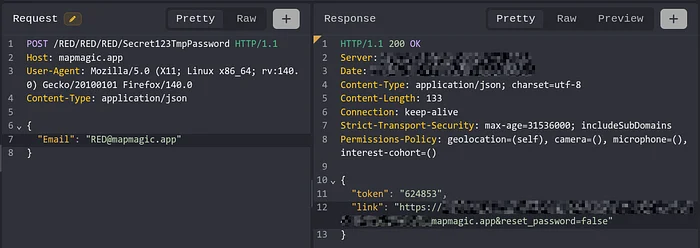
The report shows no raw request or response for this step, only that it was a single POST request carrying a registered email address. The endpoint generated a valid authentication link for that account and returned it directly in the response body. No login attempt, no password guess, and no phishing link for the victim to click: the server handed over a way in.
Step 3: use the returned credential
The response contained a valid authentication link for the account matching the submitted email address. The only input the attacker needs is an email address that exists in the system.
Root cause
The endpoint reads like a leftover developer convenience that was never stripped out before shipping and never locked to a test-only environment. It was undocumented, unauthenticated and live in production, which the report describes as functionally a backdoor whether or not anyone meant it to be one.
Compared with a normal password-reset flow, which usually requires proof that you own the mailbox (a real reset link), a CAPTCHA to stop automation, and rate limiting to slow abuse, this endpoint had none of those checks. It skipped every one of them and returned a session straight to the caller. The report describes the endpoint as undocumented, unauthenticated and live in production.
Impact
With nothing but a known email address, an attacker could:
- Log into the associated account with no password
- View or edit private routes, trip history and profile data
- Change account settings or delete data outright
- Reach any third-party integration connected to that account (Garmin, Google, payment methods, and so on)
Because MapMagic operates under GDPR-related privacy obligations, a path that can act on real user identities conflicts directly with the access-control, purpose-limitation and data-minimisation standards that come with handling personal data.
The Jenkins and repository exposure on its own let an attacker map every internal endpoint and trust boundary without guessing, pinpoint where authentication and payment logic live, reuse any credentials or tokens that were still valid, reach development, staging or production services directly, and find further vulnerabilities much faster because the attack surface was fully documented rather than hidden behind a black box.

Fix
MapMagic fixed the unauthenticated Jenkins exposure and locked down the associated repository. The vulnerable endpoint has been removed or disabled.
The report argues that pulling the endpoint only stops the immediate bleeding. Real remediation means rotating every secret the pipeline ever touched, invalidating old tokens, reviewing access logs for signs of prior abuse, and rethinking how account recovery is designed. Diagnostic shortcuts of this kind belong nowhere near live customer data: they need isolated test accounts, separate environments, synthetic data and hard authorisation checks.
Variants to test
- Unauthenticated CI servers. Request the Jenkins root and its API paths without cookies. A positive result is a build history, job configuration or console log rendered to an anonymous client.
- Repository reachability from CI. Follow links from job configuration to the source repository. A positive result is clone or browse access to application code without separate credentials.
- Secrets in pipeline configuration. Inspect environment variables and config files referenced by jobs. A positive result is values that look live rather than placeholder, which should then be treated as compromised.
- Debug and test endpoints in production. Look for password-delivery, OTP, invitation or impersonation helpers that accept an identifier and return a credential. A positive result is a response containing a usable link or token for an account you control.
- Missing recovery controls. For any account-recovery path, check whether mailbox ownership is proven, whether a CAPTCHA is enforced and whether rate limiting applies. A positive result is a credential issued on the strength of an email address alone.
- Environment leakage. Compare staging and production behaviour for the same endpoint. A positive result is a test-only shortcut answering on the production host.
What happened, in plain words
MapMagic is a website and app for planning GPS routes and sharing them with other people. You plan a GPS route, save it, and share it with other people. To use it you create an account, and the service keeps your routes, your trip history and your profile.
A security researcher was looking at the parts of MapMagic that anyone on the internet can reach. Two problems turned up, one behind the other.
The first was a build server, a machine called Jenkins that software teams use to assemble and publish their code automatically. It was open to the whole internet with no login at all. From it, the researcher could also reach the private repository, the storage place where the company keeps its source code. That repository contained the application code, deployment material, internal documentation and configuration data, including what looked like live secrets for development, staging and production environments.
The second problem was worse. Inside the exposed code was a web address (an API endpoint) that, when sent an email address, produced a working sign-in credential for that account and handed it straight back. No account needed, no password, no click from the victim: just knowing an email address that existed in the system.
Both issues were reported to MapMagic and have since been fixed.
Some words you will need
Before the details, a few everyday comparisons for terms that come up constantly.
- Server: a computer somewhere in a data centre whose job is to answer requests from other computers. Think of a restaurant kitchen: you do not go in, you send an order and food comes back.
- Source code: the instructions a programmer writes to build a program. It is like the recipe rather than the finished cake. If someone gets the recipe, they know exactly what goes into the cake and how it is made.
- Repository: a folder, kept on a server, that holds source code and its whole history of changes. Teams share one repository so everyone works on the same files.
- Jenkins: a program that automates building and publishing software. When a programmer saves a change, Jenkins can compile the code, run tests and copy the result to a live server. It is the kitchen's assembly line.
- CI/CD: short for continuous integration and continuous delivery, the practice of having that assembly line build and ship every change automatically.
- API: short for application programming interface. It is the set of addresses and rules one program uses to talk to another. When your browser loads a page, the page often asks an API behind the scenes for data. Think of a waiter: you do not walk into the kitchen, you tell the waiter what you want and the waiter brings it.
- Endpoint: one specific address on an API, like one particular dish on the menu. Each endpoint does one job, for example "send me my routes" or "reset my password".
- Authentication: proving who you are. Logging in with a password is authentication. A bouncer checking your name against a list is authentication.
- Authorisation: what you are allowed to do once you are in. Authentication gets you through the door; authorisation decides whether you may enter the staff room.
- Unauthenticated: reachable without proving who you are. A shop with no door lock.
- Credential: anything that proves identity, such as a password, a session cookie or a sign-in link. It is the key to the front door.
- Session: the state of being logged in. When you sign in, the server gives your browser a session cookie, a small piece of text it sends back with every request so the server remembers you. It is like a wristband at an event: you show it once at the gate and then it lets you back in without queuing again.
- Token: a similar piece of text, often used in a link or an app, that stands in for a password. A temporary-password link in an email contains a token.
- Production: the real, live system that customers use. Staging and development are copies used for testing before changes go live.
- Environment variables: settings a program reads when it starts, such as database addresses and passwords. They are the settings sheet taped inside the kitchen cupboard.
- Secret: a password, key or token that must stay private. If it leaks, someone else can act as the system.
- Reconnaissance: the information-gathering phase of an attack, finding out what exists and how it is arranged before trying anything. A burglar walking around a house noting windows and locks is doing reconnaissance.
- Attack surface: everything an attacker can reach and try. The more of it that is visible, the more there is to test.
- Vulnerability: a weakness that lets someone do something they should not be able to do.
- Account takeover: getting into someone else's account without their permission.
- Zero-click: an attack that needs no action from the victim, not even opening a link.
- Backdoor: a way into a system that bypasses the normal entrance, whether or not it was left on purpose.
- CAPTCHA: the little puzzle that asks you to tick a box or pick pictures, designed to tell humans from automated programs.
- Rate limiting: a cap on how many requests one person or program may make in a period of time, so automated guessing becomes too slow to be useful.
- GDPR: the European data protection law that sets rules for handling personal data.
- Monorepo: one repository holding the code for several related components of a product, rather than one repository per component.
The technical context: what the code showed
The exposed project was a multi-component monorepo behind MapMagic's GPS route-planning and sharing service. Walking through the repository and the Jenkins jobs building it, the stack broke down like this:
| Layer | Technology |
|---|---|
| API | ASP.NET Core / C#, targeting .NET 6 |
| Database | PostgreSQL with geospatial extensions, accessed through a Dapper-based data layer |
| Frontend | React web clients, a separate admin panel, and server-side rendering components |
| Infrastructure | Nginx as reverse proxy and cache, Docker Compose for environments, Jenkins for CI/CD |
| Map rendering | Python-based services, with object storage backing uploaded images |
| OAuth and account integrations | Google, Apple, Garmin, Hammerhead |
| Payments | Stripe, CloudPayments, Tinkoff, Apple Pay, Google Play |
In plain words, each row is one part of the machine:
- The API is the part that answers requests. ASP.NET Core and C# are the language and framework it is written in, and .NET 6 is the version of the platform it runs on.
- The database is where data is stored. PostgreSQL is a common database program, and the geospatial extensions let it store and search map coordinates. Dapper is a small helper library the code uses to talk to the database.
- The frontend is what you see in the browser. React is a popular tool for building web pages, and there is a separate admin panel for staff plus server-side rendering, which means some pages are assembled on the server before being sent to you.
- The infrastructure is the plumbing. Nginx is a program that sits in front of the application, forwards requests to it and caches answers. Docker Compose describes how to start the pieces of an environment together. Jenkins is the build machine.
- Map rendering means drawing the map tiles and route lines. Those services are written in Python, and uploaded images are kept in object storage, a service for holding files.
- OAuth and account integrations are the buttons that let you sign in with Google or Apple, or connect a Garmin or Hammerhead device. OAuth is a standard way for one service to ask another whether you are who you say you are, without sharing your password.
- Payments are handled by several providers, each a company that processes card or app-store payments.
None of this was abstract: it was laid out in real config files, real pipeline jobs and real environment variables. That level of detail hands an attacker a map of exactly where authentication happens, where payments are processed, where the database lives, and which third parties are trusted. It cuts out most of the reconnaissance work that normally slows an attack down. Normally an outsider has to guess at all of this; here it was written down.
Finding 1: a public Jenkins and exposed source code
What was actually reachable
The Jenkins instance was reachable with no authentication at all. Anyone who found the host could open it directly and see:
- Full build history and job configurations
- The entire CI/CD pipeline definitions
- Console output and logs from previous builds
- The source code that the pipeline was building and deploying
Each of those deserves a moment. Build history is the list of every time the software was assembled, with dates and results. Job configurations are the settings for each build: which repository to fetch, which commands to run, where to send the result. Pipeline definitions are the recipe for the whole process. Console output and logs are the running commentary from past builds, and logs have a habit of containing addresses, usernames and error messages that reveal how things are wired. The source code is the application itself.
In practice, this meant the whole software delivery chain was sitting in the open: what got built, how it got built, where it got deployed, and what credentials or environment variables the pipeline used to do it. From there, the linked source-code repository extended that visibility into the application itself: full backend logic, database schemas, internal documentation, and references to every third-party service MapMagic depended on.
Some of the configuration values in that repository appeared to be live secrets, not placeholders. A placeholder is a dummy value; a live secret is the real password or key that the system actually uses.
Why this matters
Having the build pipeline and source code exposed like this lets an attacker:
- Map every internal endpoint and trust boundary without guessing
- Pinpoint exactly where authentication and payment logic live in the code
- Reuse any credentials or tokens that were still valid
- Reach into development, staging or production services directly
- Find further vulnerabilities much faster, since the attack surface is fully documented instead of hidden behind a black box
A trust boundary is a line where one part of a system is allowed to trust another, for example the line between the public website and the internal database. Knowing where those lines are tells an attacker where to push. A black box means testing something without seeing inside it; here the box was transparent.
Remediation status
MapMagic fixed the unauthenticated Jenkins exposure and locked down the associated repository.
Finding 2: zero-click account takeover
The vulnerable API endpoint
Buried in the exposed code was an unauthenticated API endpoint, almost certainly built as a shortcut for testing temporary-password delivery without having to wait on real email. Instead of just working in a test environment, it was live in production and reachable by anyone.
To unpack that: when you forget your password, a normal service emails you a link that lets you set a new one. Sending real email is slow and awkward during development, so programmers sometimes build a shortcut that skips the email and returns the link directly. That is fine on a developer's laptop. It is not fine on the live service, because anyone who knows the address can ask for the link.
The attack chain
Hit the endpoint with a registered email address, and it generated a valid authentication link for that account and returned it directly in the response. No login attempt, no password guess, no phishing link for the victim to click: the server just handed over a way in.
Compare that to a normal password-reset flow, which usually requires:
- Proof you actually own the mailbox (a real reset link)
- A CAPTCHA to stop automation
- Rate limiting to slow down abuse
This endpoint had none of that. It skipped every one of those checks and just returned a session straight to the attacker.
The report shows no raw request or response text for this step, only that it was a single POST request carrying a registered email address. A POST request is one of the basic ways a browser talks to a server: instead of asking for a page (a GET), it sends data to be processed, like handing a form across a counter. The important part is that the only input needed was an email address that already existed in the system.
Root cause
It reads like a leftover developer convenience that never got stripped out before shipping, and never got locked to a test-only environment. But intent does not matter much here: undocumented, unauthenticated and live in production is functionally a backdoor, whether or not anyone meant it to be one.
Diagnostic shortcuts like this belong nowhere near live customer data. They need isolated test accounts, separate environments, synthetic data and hard authorisation checks, not a straight line into every real user's account.
Security impact
With nothing but a known email address, this let an attacker:
- Log into the associated account with no password
- View or edit private routes, trip history and profile data
- Change account settings or delete data outright
- Reach any third-party integration connected to that account (Garmin, Google, payment methods, etc.)
Given that MapMagic operates under GDPR-related privacy obligations, having a path like this able to act on real user identities was a direct conflict with the access-control, purpose-limitation and data-minimisation standards that come with handling personal data at all. In plain terms: access control means only the right people get in, purpose limitation means data is used only for the reason it was collected, and data minimisation means collecting no more than necessary.
Safe validation
To avoid touching real users, testing was limited strictly to an account MapMagic controlled and authorised for this purpose. No customer accounts were accessed, no data was modified, and no live credentials or tokens appear anywhere in this report. This is the ethical rule of security testing: prove the problem on something you are allowed to touch, and stop there.
Remediation
The endpoint has been removed or disabled by MapMagic.
Disclosure notes
MapMagic is named here because the organisation was notified directly and both issues were fixed before this was published. This report does not include secrets, personal data, customer email addresses, live authentication material or step-by-step exploit instructions. If you run Jenkins, a private source repository, or any leftover debug or authentication endpoints in production, go and check them today.
Conclusion
This was a case of exposed development infrastructure meeting a production authentication flaw that could hand over any account with zero interaction from the victim. Pulling the endpoint stopped the immediate bleeding, but real remediation means rotating every secret that pipeline ever touched, invalidating old tokens, reviewing access logs for signs of prior abuse, and rethinking how account recovery is designed from the ground up.
Rotating a secret means replacing it with a new one and retiring the old, because you must assume the old one was copied. Invalidating tokens means making existing sign-in links and sessions stop working. Reviewing access logs means reading the server's record of who asked for what, to see whether anyone else found the same door before it was closed.
Variants to test
If you are learning, these are the same ideas generalised, so you can recognise them elsewhere. Each one is a thing to look for, not an instruction to attack anyone.
- Unauthenticated CI servers. Request the Jenkins root and its API paths without cookies. A positive result is a build history, job configuration or console log rendered to an anonymous client.
- Repository reachability from CI. Follow links from job configuration to the source repository. A positive result is clone or browse access to application code without separate credentials.
- Secrets in pipeline configuration. Inspect environment variables and config files referenced by jobs. A positive result is values that look live rather than placeholder, which should then be treated as compromised.
- Debug and test endpoints in production. Look for password-delivery, OTP, invitation or impersonation helpers that accept an identifier and return a credential. A positive result is a response containing a usable link or token for an account you control.
- Missing recovery controls. For any account-recovery path, check whether mailbox ownership is proven, whether a CAPTCHA is enforced and whether rate limiting applies. A positive result is a credential issued on the strength of an email address alone.
- Environment leakage. Compare staging and production behaviour for the same endpoint. A positive result is a test-only shortcut answering on the production host.
An OTP is a one-time password, the short code sent by text or email. Impersonation means logging in as another user on purpose, which support staff sometimes need and which must be tightly controlled.
Glossary
- API: the set of addresses and rules one program uses to talk to another; the waiter between your browser and the kitchen.
- Authentication: proving who you are.
- Backdoor: a way into a system that bypasses the normal entrance.
- Black box: testing something without being able to see how it works inside.
- CAPTCHA: a puzzle designed to tell humans from automated programs.
- CI/CD: continuous integration and continuous delivery, the practice of building and shipping every code change automatically.
- Credential: anything that proves identity, such as a password, session cookie or sign-in link.
- Database: the organised store where a service keeps its data.
- Endpoint: one specific address on an API that does one job.
- Environment variables: settings a program reads when it starts, such as addresses and passwords.
- GDPR: the European data protection law governing personal data.
- Impersonation: logging in as another user on purpose, usually for support.
- Monorepo: one repository holding the code for several related components.
- OAuth: a standard way for one service to confirm your identity with another without sharing your password.
- OTP: a one-time password, a short code valid for a single use.
- Placeholder: a dummy configuration value that is not the real secret.
- POST request: a request that sends data to a server to be processed, rather than just asking for a page.
- Production: the real, live system customers use.
- Rate limiting: a cap on how many requests may be made in a period of time.
- Reconnaissance: the information-gathering phase before an attack.
- Repository: a server-side folder holding source code and its change history.
- Rotating a secret: replacing a secret with a new one and retiring the old, assuming the old was copied.
- Server: a computer that answers requests from other computers.
- Session: the state of being logged in, usually remembered by a session cookie.
- Source code: the instructions programmers write to build a program.
- Staging: a copy of the system used for testing before changes go live.
- Token: a piece of text, often in a link or app, that stands in for a password.
- Trust boundary: a line where one part of a system is allowed to trust another.
- Zero-click: an attack that needs no action from the victim.



