PHP2Shell (CVE-2026–109618 / CVE-2026–109619): Kapsamlı Teknik Analiz
Two vulnerabilities in the PHP runtime allow unauthenticated remote code execution by corrupting internal state during request processing, and an attacker may also read worker memory containing secrets. Exploitation attempts have been observed but no confirmed server compromise is reported.
 Published on medium.com
Php2shell
The full write-up lives on its author's site
It belongs to its author, so we link to it rather than copy it. The other two tabs are our own rewrites, checked against it.
Context
PHP2Shell is the name given to two critical vulnerabilities in the PHP runtime itself, CVE-2026-109618 and CVE-2026-109619. The PHP security team scored both at CVSS v4.0 9.2 and describes the risk as unauthenticated remote code execution (RCE). Patches were released on 21 October 2026 in PHP 8.5.12, 8.4.27, 8.3.36 and 8.2.35. There is no upstream patch for PHP 8.1 and older branches. After 21 October, watchTowr and Cloudflare reported observing exploitation attempts; no confirmed server compromise had been reported at the time of writing.
This analysis combines Tenable, Cloudflare, Cyber Security News, Brandefense and The Hacker News. Each claim is attributed to the source that carried it, and inferences not present in those sources are marked as commentary.
The flaw is in the PHP engine itself, not in an application component. PHP's GitHub advisories describe two separate bugs, each mapped to one CVE. The common thread is that PHP's internal state is corrupted while a request is being processed, and that this corruption can be turned into code execution. The changelog shows a single core fix covering both advisories: "Avoid state corruption via bailout".
CVE-2026-109618: RCE via OOM corruption
When an out-of-memory (OOM) condition is handled, PHP can be interrupted while internal data belonging to the request is only partially initialised. The request cleanup phase can then treat this invalid data as if it were valid. The GitHub advisory names multipart parsing problems as one of the triggers.
CVE-2026-109619: RCE via stale global state
Internal state belonging to a request can survive after the memory behind it has been freed. A later request handled by the same worker can use that state before normal initialisation resets it. The advisory confirms two cases:
- the fatal error backtrace path in PHP 8.5;
- session upload progress (
session.upload_progress) after an OOM or another fatal error.
The second point matters operationally: according to the PHP manual, session.upload_progress.enabled is on by default, so the feature is active in most installations without any additional configuration.
Additional effect: worker memory disclosure
According to The Hacker News, an attacker can read the memory of a PHP worker process without first obtaining code execution. That memory can hold passwords, authentication tokens, API keys and certificates belonging to other requests. The researchers demonstrated this read against applications they did not control, so the effect is independent of the application running on top of PHP.
Commentary: even if the code execution path is closed, rotating secrets that may have leaked should be treated as a separate risk decision.
Independent researcher claims (unverified)
A public research repository reported by Cyber Security News offers a different account: the upload progress handler writes the supplied filename into session data without validating it, the session ID in the POST body can bypass the session.use_only_cookies restriction, and a re-entry into the var_destroy destructor produces a use-after-free. The same article stresses that some paths depend on additional conditions (a local file inclusion bug, an application gadget) and that these claims should remain independent research claims until compared with PHP's full advisory. Exploit details are deliberately not reproduced here; defensive decisions should be based on PHP's own advisory.
Age of the code, discoverers and the role of AI
According to The Hacker News, the vulnerabilities were found by Wiz Research, Calif and OpenAI's Codex Security team. The fix was prepared by the PHP security team together with Google's Gemini team. The faulty code has been in PHP for more than ten years, and by the researchers' account the impact reaches back to almost all versions as far as PHP 5.4. That range is not stated in PHP's advisory, so it should be read as a researcher claim.
The researchers say AI models accelerated turning these old flaws into a working exploit. One researcher did in about a week work that would normally take a team months. Calif notes that knowing the target's history (its origin reaching back to a 2004 PHP research effort) still matters, and that current models do not reliably start from such old and obscure primitives on their own. Commentary: this is a signal that the post-patch exploitation window may shorten, not a measured figure.
Setup
The report does not describe a lab environment, accounts, roles or tooling of its own. It is an analysis of the disclosure and of the affected runtime, and the technical material it presents is the version and configuration checks, the temporary FPM pool settings and the detection guidance reproduced below. The preconditions that matter are properties of the target installation:
- PHP is serving web requests. PHP considers every installation that serves a web request at risk, including PHP-FPM, Apache mod_php, php-cgi, FrankenPHP and LiteSpeed.
- For the session upload progress path,
session.upload_progress.enabledis on by default, so no extra configuration is needed for the feature to be active. - For the PHP-FPM path described by Calif, the application must decode data such as a session, and the fatal error produced during that decoding must leave stale state that a later request can use.
Finding it
The report does not describe a discovery process by the author. What it documents is how the two bugs were found and disclosed. Discovery began in August 2026, the information leaked on 20 October, and the patches were published on 21 October. The dates rest on the teams' own accounts (Brandefense, Tenable, The Hacker News).
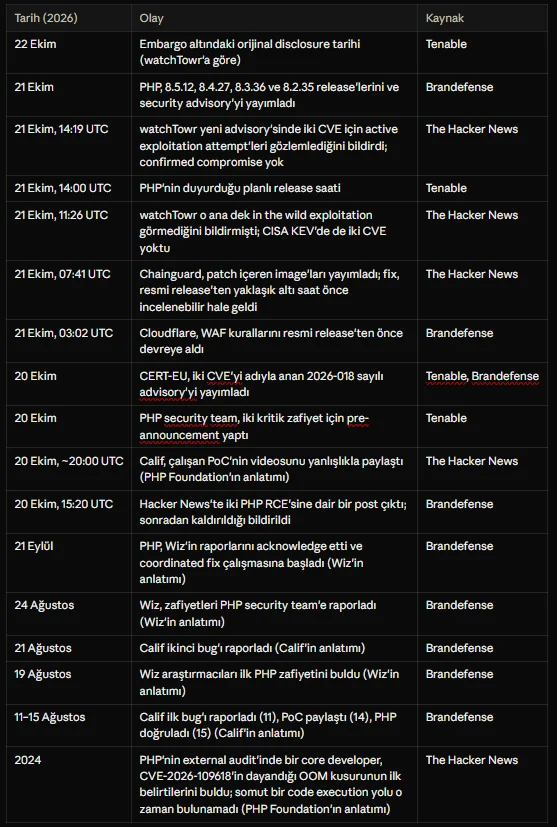
The two teams' timelines are independent accounts. PHP's 21 October announcement does not name the discoverers, so the order of discovery should be read as each team's own statement rather than a definitive conclusion.
On 20 October at around 20:00 UTC, Calif accidentally shared a video of his working PoC. On 21 October at 07:41 UTC, roughly six hours before the fix, Chainguard published images containing the patch. That let anyone inspect the fix while other users were still waiting to update (The Hacker News).
The PHP Foundation adds that the first signs of the OOM flaw behind CVE-2026-109618 were seen by a core developer during an external audit in 2024, but at the time the attack was only theoretical and no code execution path was found. Because each competing fix risked breaking backward compatibility, opening denial-of-service (DoS) paths or forcing changes to third-party extensions, a small team could not agree and work stalled for months. The Foundation called this delay a "structural failure" of its decision process and resources; the fix was prioritised once the 2026 reports from Calif, OpenAI and Wiz (using AI tools) showed the full impact. The Foundation says it has changed its security decision-making process and added staff and tooling to catch similar problems earlier.
Commentary: alongside the leak, the early visibility of images containing the patch may also have given attackers time for patch diffing. The sources do not measure the effect of this on exploitation.
Exploitation
The report does not publish a step-by-step exploit chain, and it deliberately does not reproduce the exploit methods. What it does document is the attack surface, the conditions under which each path works, and the observed exploitation status.
Step 1: choose a target that serves web requests
PHP considers every installation that serves a web request at risk. It sees the highest risk in mod_php. There, a demonstrated exploit triggers the attack with an unauthenticated request before application code runs (Brandefense).
Step 2: account for the SAPI differences
According to Calif, the PHP-FPM path depends on the application: the application must decode data such as a session, and the fatal error produced during that decoding must leave stale state that a later request can use. In Apache mod_php, Calif reports RCE against arbitrary PHP scripts. These statements are the discoverers' own lab results, and Brandefense states it has not verified them.
According to The Hacker News, because the problem is in the engine, even a simple "Hello World" page is exposed on a vulnerable version. PHP-FPM behaves differently from mod_php because it shuts down the worker when request setup fails at the start. For one of the two vulnerabilities, PHP's analysis supports that FPM is susceptible but says no complete FPM exploit has been shown. The second has been shown to reach code execution in both mod_php and PHP-FPM, but the FPM path depends on some processing inside the running application. The news report does not say which vulnerability is which, so this distinction is not tied to a CVE number here.
Step 3: exploit the default-on session upload progress feature
Because a feature such as session upload progress is on by default, an "my application code is safe" approach is not sufficient. According to Sansec, the fix is a PHP update at the server level and cannot be applied from the code of platforms such as Magento, Shopware or WooCommerce.
Step 4: read worker memory without code execution
That memory can contain passwords, authentication tokens, API keys and certificates belonging to other requests, and the researchers demonstrated the read against applications they did not control.
Observed exploitation status
In the sources reviewed, the first-hand statements that attack traffic has been observed come from Cloudflare and watchTowr. Public PoCs are in circulation and NCSC-NL expects widespread exploitation in the short term. Because the sources changed over time, each statement is attributed to its owner and its time.
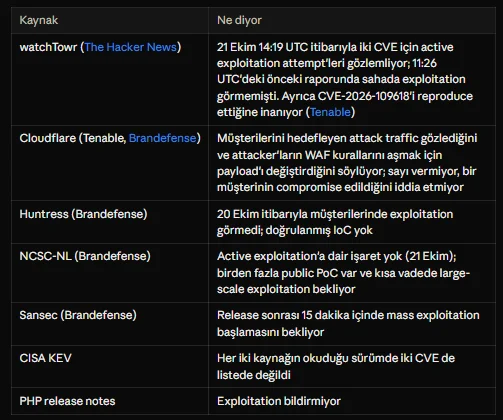
In short: attempts are being observed, and no confirmed compromise has been reported yet. Risk perception has shifted from "expected" to "started", but the estimates are expectations, not measurements. There is also a warning about public exploit code. Tenable states that the circulating exploit code has not been verified to work and that unverified code may be trojanised with malware. Testing should only be done in an isolated lab and with authorisation.
CVSS discrepancy
The PHP security team scored both vulnerabilities at CVSS v4.0 9.2. Some early sources, such as watchTowr and a Hacker News post, said 10.0. Tenable noted the difference and said it would update its article when the PHP advisory was published. The Hacker News also stresses that the 10.0 claim does not belong to PHP. This article uses PHP's official score of 9.2.
Historical context
CISA's KEV catalogue contains three vulnerabilities in PHP core. CVE-2024-4577 (PHP-CGI) and CVE-2019-11043 (PHP-FPM) are known to have been used in ransomware campaigns. CVE-2012-1823 is a PHP-CGI flaw that CVE-2024-4577 later bypassed (Tenable).
Root cause
The mistake is in the PHP engine, not in an application library. PHP's internal state is corrupted while a request is processed, and that corruption can be turned into code execution (Brandefense). The changelog shows a single core fix for both advisories: "Avoid state corruption via bailout".
For CVE-2026-109618, the OOM handling can interrupt PHP while request-owned internal data is only partially initialised, and the request cleanup phase can then treat that invalid data as valid. Multipart parsing problems are named as one trigger.
For CVE-2026-109619, request-owned internal state can survive after the memory behind it has been freed, and a later request handled by the same worker can use it before normal initialisation resets it. The advisory confirms the fatal error backtrace path in PHP 8.5 and session upload progress after an OOM or another fatal error.
Why existing defences did not stop it: the report does not analyse defences in those terms. What it does say is that the problem sits in the engine, so even a simple "Hello World" page is exposed on a vulnerable version, and that because session upload progress is on by default, application-level safety is not enough.
Impact
It sees the highest risk in mod_php, where a demonstrated exploit triggers the attack with an unauthenticated request before application code runs (Brandefense).
According to The Hacker News, the impact is independent of the application on top of PHP, and an attacker can read worker memory without code execution, potentially exposing passwords, authentication tokens, API keys and certificates belonging to other requests. The researchers demonstrated this read against applications they did not control.
PHP's advisories consider all versions before 8.2.35, 8.3.36, 8.4.27 and 8.5.12 affected (Brandefense).
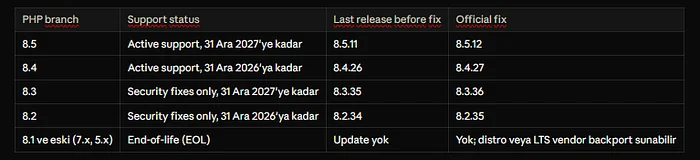
Two points matter. First, how far back the impact reaches in older branches is not stated in PHP's advisories; CERT-EU's "PHP 5 and later" and Sansec's "5.4 and later" ranges are not confirmed by PHP (Tenable). Second, support for PHP 8.2 ends on 31 December 2026, so teams on 8.2 need a short-term upgrade plan even after applying the patch.
PHP has also published minimal source backports for 7.4, 8.0 and 8.1 on GitHub. These are for those who build from source or have no LTS vendor. This is an important distinction: updating an application such as WordPress or Laravel does not update the PHP runtime underneath it. The runtime comes from the server package, the hosting provider or the container image. Because distro packages can carry the fix under an older-looking version string, the CVE number should be looked for in the package changelog (The Hacker News).
Distro packages
Distro packages carry their own version numbers, so the vendor advisory should be consulted rather than the number. The fixes listed by Brandefense:
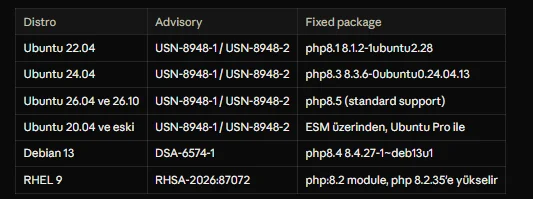
PHP recommends that users of the volunteer-maintained rpms.remirepo.net repository switch to distro packages or build from source. No update was going to be available in that repository on 21 October.
Exposure estimates
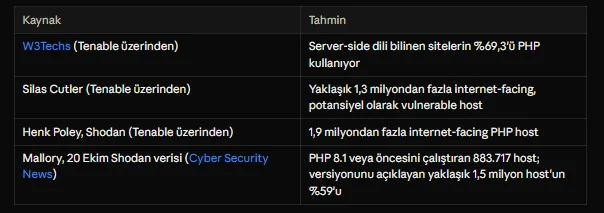
These figures are rough estimates with different methodologies and should not be used interchangeably. The common message is clear: more than half of the hosts that disclose their version are on branches that will not receive an official patch.
Observed operational impact
Some organisations shut down services as a precaution, not because of a compromise. According to The Hacker News, BambooHR took its service offline in the US, Canada and Ireland, announced that payroll processing would be disrupted and gave no restoration time. In the Netherlands, MijnOverheid, DigiD, the lower house of parliament's site, the national cyber security centre and some education systems went offline (as relayed by NOS); the centre said it had not seen the vulnerability being abused but called on everyone to patch.
Fix
The only complete solution is patching. PHP core developer Gina Peter Banyard said the only mitigation is to patch or upgrade, and PHP 8.6 release manager Joe Ferguson said ini settings will not save you (Tenable). PHP's own note says the steps below only narrow specific attack paths and do not make an installation safe (Brandefense). The Hacker News also reports that the release confirmed that the session.upload_progress setting circulated as a workaround before the patch was never a complete fix.
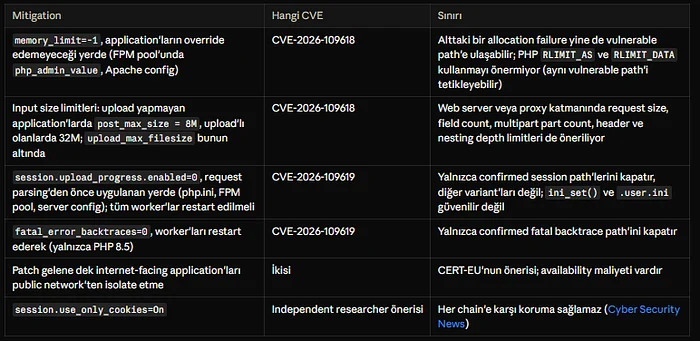
Example FPM pool config (temporary measure only; test in your own environment before applying):
; php-fpm pool dosyası (ör. www.conf)php_admin_value[memory_limit] = -1php_admin_value[post_max_size] = 8Mphp_admin_value[session.upload_progress.enabled] = 0
PHP-FPM or the web server must be restarted after these settings. Commentary: memory_limit=-1 leaves resource consumption unbounded, so it should only be considered as a short-lived stopgap until the patch arrives. On 8.1 and older branches, PHP says to get a backport from the vendor or move to a supported version.
Post-patch configuration review
According to The Hacker News, the fix adds a new hard memory limit; when that limit is reached the process terminates and shutdown handlers do not run. After the update, memory_limit and post_max_size should therefore be reviewed against the application's needs.
Cloudflare emergency WAF release
On 21 October, Cloudflare published an emergency release adding four rules to its Managed Ruleset that catch abnormal request patterns. Two block matching requests and two only log them (Cloudflare changelog).
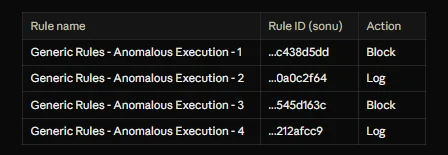
All four are new detections; they do not correspond to an existing rule ID. The changelog entry does not name PHP2Shell by name. The connection comes from the timing and from a statement by Cloudflare CTO Dane Knecht. Knecht said an initial rule set targeting known exploit vectors for PHP sites had been deployed, the rules are present for all customers including the free plan, early attacks had been seen, and the mitigations are updated as new vectors appear (Tenable). Brandefense reports that the rules went live on 21 October at 03:02 UTC, before the official release, and that there is a managed free ruleset for free plans.
Knecht frames the statement explicitly as "stopgap only" and asks for patching as soon as the PHP update is out. There are two limits. The rules only cover traffic passing through Cloudflare, and because two rules only log, attacks matching those rules can pass without being blocked. Teams behind Cloudflare must still patch PHP and must also monitor the records of the rules with the Log action.
Detection and threat hunting
There is no published Indicator of Compromise (IoC) list; Huntress states there is no verified IoC and Sansec lists no signature (Brandefense). The practical signal is therefore behaviour: a web server process doing something a web server would not be expected to do. The researchers also suggest some telemetry signals specific to exploitation.
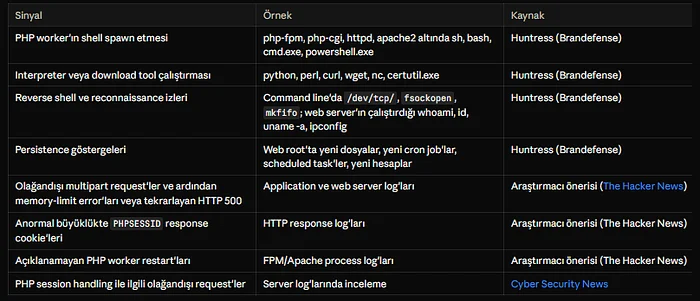
MITRE ATT&CK mapping: exploitation T1190 (Exploit Public-Facing Application), and a dropped web shell T1505.003 (Server Software Component: Web Shell).
Inventory and scanning
Tenable offers the following plugins to find PHP installations and unsupported versions: 48243 (PHP Version Detection), 58987 (PHP Unsupported Version Detection), 200476 (Windows) and 216936 (Unix) for PHP Scripting Language Installed. CVE-specific plugins will be listed on the CVE pages as they are published.
First response if compromise is suspected
Huntress recommends isolating the server and preserving the web server and PHP logs. Then search for web shells, new files in the web root, cron jobs, scheduled tasks and new accounts. Because of the possibility of memory disclosure (see the root cause section), rotating credentials, tokens and API keys processed by workers that may have been affected should also be part of the incident response plan (commentary).
Patch rollout plan
PHP says all users should update immediately to 8.5.12, 8.4.27, 8.3.36 or 8.2.35; the version numbers in the plan should be confirmed against the php.net announcement (Brandefense).
- Build an inventory. Include containers, control panels, CMS hosts and appliances that carry their own PHP; do not forget PHP embedded in vendor software.
- Start with internet-facing systems. Huntress recommends this; Sansec expects attacks minutes after the release.
- Take the distro package. Distro and LTS vendors received the patches in advance; because package numbers follow their own scheme, check the vendor advisory and the CVE reference in the changelog.
- Restart the service. Restart PHP-FPM or the web server and long-running PHP workers so that running workers load the new code. With containers, the image must be rebuilt and redeployed (general practice, not stated in the sources).
- Verify the version again. With the commands below.
- Review memory settings. Check
memory_limitandpost_max_sizebecause of the new hard memory limit. - Run a retrospective hunt. Look in the logs since 20 October for the signals in the detection section.
Brandefense's commands for checking version and settings:
php -vphp -i | grep -i session.upload_progressphp-fpm -vcurl -sI https://www.example.com/ | grep -iE "^(server|x-powered-by):"
Two warnings: the CLI binary may differ from the one the web server uses, so also check php-fpm -v or the Apache module. The value read for session.upload_progress belongs to the CLI's php.ini; inspect the file the web server actually loads (for example with a temporary phpinfo() page, deleted as soon as you are done). A version not appearing in response headers does not mean you are safe; the header only appears if expose_php is on.
Note: do not send exploit traffic in a vulnerability check. As far as Brandefense knows, there is no published safe test; only version and config should be checked.
Conclusion and priority actions
PHP2Shell is a problem in PHP itself, not in an application library, so remediation comes from a server-level update rather than application code. Priority order:
- Update internet-facing PHP servers to 8.5.12, 8.4.27, 8.3.36 or 8.2.35 (or the vendor's backport package) and restart the workers.
- Identify systems on 8.1 and older branches; get a backport from the vendor, move to a supported branch or isolate them.
- If the update will be delayed, apply the temporary settings and WAF protection, knowing they are not a complete fix.
- Since 20 October, hunt for shell and download tool invocations from PHP workers, new files in the web root, unusual multipart requests and scheduled tasks.
- Because of the memory disclosure risk, evaluate rotating secrets on systems that ran a vulnerable version (commentary).
- Brandefense stresses that PHP2Shell is different from WP2Shell, which belongs to WordPress core; WordPress sites may need two separate updates.
At the time of writing some questions remain open: the scope of impact on older branches is unclear, there is no published IoC, and no confirmed server compromise has been reported. However, watchTowr and Cloudflare report observing exploitation attempts. PHP's advisories and the CERT-EU warning should be followed as primary references as new information arrives.
Variants to test
The report does not present a test methodology of its own, and it warns against sending exploit traffic during a vulnerability check. The concrete checks it does give are the following.
- Check the runtime version on the host itself. Run
php -v,php-fpm -vand check the Apache module, because the CLI binary may differ from the one the web server uses. A positive result is a version below 8.2.35, 8.3.36, 8.4.27 or 8.5.12, or a distro package whose changelog should be checked for the CVE reference. - Check the session upload progress setting in the file the web server loads. Run
php -i | grep -i session.upload_progressand confirm against the web server's own configuration, for example with a temporaryphpinfo()page. A positive result issession.upload_progress.enabledon, which is the default. - Check whether the version is exposed in response headers. Run
curl -sI https://www.example.com/ | grep -iE "^(server|x-powered-by):". A positive result is a version string in the headers, which only appears ifexpose_phpis on; absence of the header does not indicate safety. - Check inventory coverage with Tenable plugins. Run plugins 48243, 58987, 200476 and 216936 to find PHP installations and unsupported versions. A positive result is an installation on an unsupported branch or below the fixed versions.
- Check whether Cloudflare's emergency rules are active for the zone. The four new rules are present for all customers including the free plan, two block and two log. The four new rules are present for all customers including the free plan, two block and two log; the two log-only rules do not block, so their records must be monitored.
- Hunt for post-exploitation behaviour. Look for a web server process doing something a web server would not be expected to do, shell and download tool invocations from PHP workers, new files in the web root, unusual multipart requests, cron jobs, scheduled tasks and new accounts. A positive result is any of these appearing after 20 October.
- Review memory settings after patching. Check
memory_limitandpost_max_sizeagainst the application's needs, because the fix adds a hard memory limit that terminates the process without running shutdown handlers. Review memory_limit and post_max_size against the application's needs after patching.
What happened, in plain words
Imagine your website is a restaurant. Visitors send orders (web requests) to the kitchen, and the kitchen (the PHP software running on your server) prepares each dish and sends it back. PHP2Shell is the name given to two serious flaws inside that kitchen itself, not in any recipe (application) the kitchen cooks. The flaws are tracked as CVE-2026-109618 and CVE-2026-109619. A CVE is simply a public catalogue number for a known security bug, so people around the world can talk about the same problem without confusion.
The PHP security team, the people who maintain PHP, rated both bugs at CVSS v4.0 9.2. CVSS is a scoring system from 0 to 10 that tries to express how bad a bug is; 9.2 is very high. They describe the risk as unauthenticated remote code execution (RCE). In plain terms: someone on the internet, with no account and no password, can make your server run code of their choosing. That is about as bad as a web bug gets.
Fixes, called patches, were released on 21 October 2026 in PHP versions 8.5.12, 8.4.27, 8.3.36 and 8.2.35. A patch is a small update that repairs the flaw. There is no official patch for PHP 8.1 and older branches. A branch here means a line of PHP releases that is maintained in parallel, like different editions of the same book. After 21 October, two security companies, watchTowr and Cloudflare, said they had seen attempts to exploit the bugs. Exploiting means trying to actually use a flaw against a real system. No confirmed server compromise had been reported at the time of writing, meaning nobody had publicly confirmed that an attacker had successfully taken over a server.
This analysis combines reporting from Tenable, Cloudflare, Cyber Security News, Brandefense and The Hacker News. Each claim is attributed to the source that carried it, and anything that is my own inference rather than something those sources say is marked as commentary.
The affected feature is not a plugin or a library you install on top of PHP. It is the request lifecycle of the PHP engine: the sequence of steps PHP goes through every time a request arrives, from reading it to cleaning up afterwards. PHP's GitHub advisories, which are official bug notices published on GitHub, describe two separate bugs, each mapped to one CVE. The common thread is that PHP's internal state is corrupted while a request is being processed, and that this corruption can be turned into code execution. Internal state means the working memory PHP keeps while it handles a request: what it has read so far, which parts are finished, which are still pending. The changelog, the list of changes shipped with a release, shows a single core fix covering both advisories: "Avoid state corruption via bailout".
CVE-2026-109618: RCE via OOM corruption
When an out-of-memory (OOM) condition is handled, PHP can be interrupted while internal data belonging to the request is only partially initialised. Out of memory means the program asked for more memory than it was allowed to use. Partially initialised means some of the request's data was set up and some was not, like a form where only half the fields were filled in. The request cleanup phase, the step where PHP tidies up after a request, can then treat this invalid data as if it were valid. The GitHub advisory names multipart parsing problems as one of the triggers. Multipart is the format a browser uses when it uploads a file or sends a form with attachments; parsing means reading that format apart into its pieces.
CVE-2026-109619: RCE via stale global state
Internal state belonging to a request can survive after the memory behind it has been freed. Think of a hotel room that was checked out but not cleaned: the next guest can find the previous guest's belongings. A later request handled by the same worker can use that state before normal initialisation resets it. A worker is a long-running process that handles one request after another, like a single waiter serving many tables in a row. The advisory confirms two cases:
- the fatal error backtrace path in PHP 8.5;
- session upload progress (
session.upload_progress) after an OOM or another fatal error.
A fatal error is an error serious enough that PHP stops what it is doing. A backtrace is the list of function calls that led to the error, useful for debugging. Session upload progress is a PHP feature that reports how far a file upload has got, so a web page can show a progress bar. The second point matters operationally: according to the PHP manual, session.upload_progress.enabled is on by default, so the feature is active in most installations without any additional configuration. That means many sites have the relevant feature switched on without anyone having chosen it.
Additional effect: worker memory disclosure
According to The Hacker News, an attacker can read the memory of a PHP worker process without first obtaining code execution. Memory disclosure means leaking the contents of memory to someone who should not see it. That memory can hold passwords, authentication tokens, API keys and certificates belonging to other requests. An authentication token is a short string that proves you are logged in, a bit like a wristband at an event. An API key is a password-like string that lets one program talk to another. A certificate is a digital identity document used to prove a server is who it claims to be. The researchers demonstrated this read against applications they did not control, so the effect is independent of the application running on top of PHP.
Commentary: even if the code execution path is closed, rotating secrets that may have leaked should be treated as a separate risk decision. Rotating a secret means replacing it with a new one and retiring the old one, the way you change a lock after losing a key.
Independent researcher claims (unverified)
A public research repository reported by Cyber Security News offers a different account: the upload progress handler writes the supplied filename into session data without validating it, the session ID in the POST body can bypass the session.use_only_cookies restriction, and a re-entry into the var_destroy destructor produces a use-after-free. Let me unpack that. A handler is the piece of code that deals with a particular kind of event. A session is the server's memory of who you are across several requests, and a session ID is the label that ties your requests to that memory. A POST body is the part of an HTTP request that carries data you submit, such as a form. session.use_only_cookies is a PHP setting that says the session ID may only come from a cookie, a small piece of data the browser stores and sends back automatically, rather than from the URL or the request body. A destructor is code that runs when an object is being cleaned up. Use-after-free means using memory after it has been handed back, like reading a letter after it has been shredded and the paper reused. The same article stresses that some paths depend on additional conditions (a local file inclusion bug, an application gadget) and that these claims should remain independent research claims until compared with PHP's full advisory. Local file inclusion is a bug that lets an attacker make the server load a file of their choosing. A gadget is an existing piece of application code that an attacker can chain into an attack. Exploit details are deliberately not reproduced here; defensive decisions should be based on PHP's own advisory.
Age of the code, discoverers and the role of AI
According to The Hacker News, the vulnerabilities were found by Wiz Research, Calif and OpenAI's Codex Security team. The fix was prepared by the PHP security team together with Google's Gemini team. The faulty code has been in PHP for more than ten years, and by the researchers' account the impact reaches back to almost all versions as far as PHP 5.4. That range is not stated in PHP's advisory, so it should be read as a researcher claim.
The researchers say AI models accelerated turning these old flaws into a working exploit. One researcher did in about a week work that would normally take a team months. Calif notes that knowing the target's history (its origin reaching back to a 2004 PHP research effort) still matters, and that current models do not reliably start from such old and obscure primitives on their own. A primitive here means a small, basic building block of an attack. Commentary: this is a signal that the post-patch exploitation window may shorten, not a measured figure. The exploitation window is the period between a fix being published and most systems actually being updated, during which attackers can still hit the unpatched ones.
Setup
The report does not describe a lab environment, accounts, roles or tooling of its own. It is an analysis of the disclosure and of the affected runtime, and the technical material it presents is the version and configuration checks, the temporary FPM pool settings and the detection guidance reproduced below. The preconditions that matter are properties of the target installation:
- PHP is serving web requests. PHP considers every installation that serves a web request at risk, including PHP-FPM, Apache mod_php, php-cgi, FrankenPHP and LiteSpeed.
- For the session upload progress path,
session.upload_progress.enabledis on by default, so no extra configuration is needed for the feature to be active. - For the PHP-FPM path described by Calif, the application must decode data such as a session, and the fatal error produced during that decoding must leave stale state that a later request can use.
Those names in the first bullet are different ways of running PHP. PHP-FPM is a separate process manager that runs PHP for web servers such as nginx. Apache mod_php is PHP built directly into the Apache web server. php-cgi is an older way of running PHP as a separate program per request. FrankenPHP and LiteSpeed are other web servers that can run PHP. Decoding means turning stored or transmitted data back into a usable form, for example turning a session string into the variables it represents.
Finding it
The report does not describe a discovery process by the author. What it documents is how the two bugs were found and disclosed. Discovery began in August 2026, the information leaked on 20 October, and the patches were published on 21 October. The dates rest on the teams' own accounts (Brandefense, Tenable, The Hacker News).
The two teams' timelines are independent accounts. PHP's 21 October announcement does not name the discoverers, so the order of discovery should be read as each team's own statement rather than a definitive conclusion.
On 20 October at around 20:00 UTC, Calif accidentally shared a video of his working PoC. PoC stands for proof of concept: a small demonstration that a bug really can be exploited. UTC is the time standard used worldwide, so times can be compared across countries. On 21 October at 07:41 UTC, roughly six hours before the fix, Chainguard published images containing the patch. An image here is a ready-made package of software, such as a container image, that a server can run. That let anyone inspect the fix while other users were still waiting to update (The Hacker News).
The PHP Foundation adds that the first signs of the OOM flaw behind CVE-2026-109618 were seen by a core developer during an external audit in 2024, but at the time the attack was only theoretical and no code execution path was found. An external audit is a review of the code by people brought in from outside. Because each competing fix risked breaking backward compatibility, opening denial-of-service (DoS) paths or forcing changes to third-party extensions, a small team could not agree and work stalled for months. Backward compatibility means old code keeps working after the change. A denial-of-service is an attack that makes a service unavailable rather than taking it over. An extension is add-on code that plugs into PHP. The Foundation called this delay a "structural failure" of its decision process and resources; the fix was prioritised once the 2026 reports from Calif, OpenAI and Wiz (using AI tools) showed the full impact. The Foundation says it has changed its security decision-making process and added staff and tooling to catch similar problems earlier.
Commentary: alongside the leak, the early visibility of images containing the patch may also have given attackers time for patch diffing. Patch diffing means comparing the old and new code to work out exactly what was fixed, and therefore how to attack systems that have not been fixed yet. The sources do not measure the effect of this on exploitation.
Exploitation
The report does not publish a step-by-step exploit chain, and it deliberately does not reproduce the exploit methods. What it does document is the attack surface, the conditions under which each path works, and the observed exploitation status. Attack surface means all the places an attacker could try to get in.
Step 1: choose a target that serves web requests
PHP considers every installation that serves a web request at risk. It sees the highest risk in mod_php. There, a demonstrated exploit triggers the attack with an unauthenticated request before application code runs (Brandefense). Unauthenticated means without logging in. Before application code runs means the attack happens in PHP's own handling of the request, before your website's own code gets a chance to do anything.
Step 2: account for the SAPI differences
According to Calif, the PHP-FPM path depends on the application: the application must decode data such as a session, and the fatal error produced during that decoding must leave stale state that a later request can use. In Apache mod_php, Calif reports RCE against arbitrary PHP scripts. These statements are the discoverers' own lab results, and Brandefense states it has not verified them. SAPI stands for Server Application Programming Interface: the layer that connects a web server to PHP, which is why the same bug can behave differently depending on how PHP is run.
According to The Hacker News, because the problem is in the engine, even a simple "Hello World" page is exposed on a vulnerable version. PHP-FPM behaves differently from mod_php because it shuts down the worker when request setup fails at the start. For one of the two vulnerabilities, PHP's analysis supports that FPM is susceptible but says no complete FPM exploit has been shown. The second has been shown to reach code execution in both mod_php and PHP-FPM, but the FPM path depends on some processing inside the running application. The news report does not say which vulnerability is which, so this distinction is not tied to a CVE number here.
Step 3: exploit the default-on session upload progress feature
Because a feature such as session upload progress is on by default, an "my application code is safe" approach is not sufficient. According to Sansec, the fix is a PHP update at the server level and cannot be applied from the code of platforms such as Magento, Shopware or WooCommerce. Those are e-commerce platforms built on PHP; updating the shop software does not update the PHP underneath it.
Step 4: read worker memory without code execution
That memory can contain passwords, authentication tokens, API keys and certificates belonging to other requests, and the researchers demonstrated the read against applications they did not control.
Observed exploitation status
In the sources reviewed, the first-hand statements that attack traffic has been observed come from Cloudflare and watchTowr. Public PoCs are in circulation and NCSC-NL expects widespread exploitation in the short term. NCSC-NL is the national cyber security centre of the Netherlands. Because the sources changed over time, each statement is attributed to its owner and its time.
In short: attempts are being observed, and no confirmed compromise has been reported yet. Risk perception has shifted from "expected" to "started", but the estimates are expectations, not measurements. There is also a warning about public exploit code. Tenable states that the circulating exploit code has not been verified to work and that unverified code may be trojanised with malware. Trojanised means malicious code hidden inside something that looks legitimate. Testing should only be done in an isolated lab and with authorisation.
CVSS discrepancy
The PHP security team scored both vulnerabilities at CVSS v4.0 9.2. Some early sources, such as watchTowr and a Hacker News post, said 10.0. Tenable noted the difference and said it would update its article when the PHP advisory was published. The Hacker News also stresses that the 10.0 claim does not belong to PHP. This article uses PHP's official score of 9.2.
Historical context
CISA's KEV catalogue contains three vulnerabilities in PHP core. CISA is the US cybersecurity agency, and KEV stands for Known Exploited Vulnerabilities: a list of bugs known to have been used in real attacks. CVE-2024-4577 (PHP-CGI) and CVE-2019-11043 (PHP-FPM) are known to have been used in ransomware campaigns. Ransomware is malicious software that locks up data and demands payment to unlock it. CVE-2012-1823 is a PHP-CGI flaw that CVE-2024-4577 later bypassed (Tenable). Bypassed means got around an existing protection.
Root cause
The mistake is in the PHP engine, not in an application library. PHP's internal state is corrupted while a request is processed, and that corruption can be turned into code execution (Brandefense). The changelog shows a single core fix for both advisories: "Avoid state corruption via bailout".
For CVE-2026-109618, the OOM handling can interrupt PHP while request-owned internal data is only partially initialised, and the request cleanup phase can then treat that invalid data as valid. Multipart parsing problems are named as one trigger.
For CVE-2026-109619, request-owned internal state can survive after the memory behind it has been freed, and a later request handled by the same worker can use it before normal initialisation resets it. The advisory confirms the fatal error backtrace path in PHP 8.5 and session upload progress after an OOM or another fatal error.
Why existing defences did not stop it: the report does not analyse defences in those terms. What it does say is that the problem sits in the engine, so even a simple "Hello World" page is exposed on a vulnerable version, and that because session upload progress is on by default, application-level safety is not enough.
Impact
It sees the highest risk in mod_php, where a demonstrated exploit triggers the attack with an unauthenticated request before application code runs (Brandefense).
According to The Hacker News, the impact is independent of the application on top of PHP, and an attacker can read worker memory without code execution, potentially exposing passwords, authentication tokens, API keys and certificates belonging to other requests. The researchers demonstrated this read against applications they did not control.
PHP's advisories consider all versions before 8.2.35, 8.3.36, 8.4.27 and 8.5.12 affected (Brandefense).
Two points matter. First, how far back the impact reaches in older branches is not stated in PHP's advisories; CERT-EU's "PHP 5 and later" and Sansec's "5.4 and later" ranges are not confirmed by PHP (Tenable). CERT-EU is the European Union's computer emergency response team. Second, support for PHP 8.2 ends on 31 December 2026, so teams on 8.2 need a short-term upgrade plan even after applying the patch. Support ending means the branch stops receiving fixes.
PHP has also published minimal source backports for 7.4, 8.0 and 8.1 on GitHub. A backport is a fix taken from a newer version and adapted to an older one. These are for those who build from source or have no LTS vendor. Building from source means compiling the software yourself from its code rather than installing a ready-made package. LTS stands for long-term support: a vendor that keeps an older version patched for a long time. This is an important distinction: updating an application such as WordPress or Laravel does not update the PHP runtime underneath it. The runtime comes from the server package, the hosting provider or the container image. Because distro packages can carry the fix under an older-looking version string, the CVE number should be looked for in the package changelog (The Hacker News). A distro package is the version of PHP bundled by a Linux distribution such as Debian or Ubuntu.
Distro packages
Distro packages carry their own version numbers, so the vendor advisory should be consulted rather than the number. The fixes listed by Brandefense:
PHP recommends that users of the volunteer-maintained rpms.remirepo.net repository switch to distro packages or build from source. A repository is a place software packages are downloaded from. No update was going to be available in that repository on 21 October.
Exposure estimates
These figures are rough estimates with different methodologies and should not be used interchangeably. The common message is clear: more than half of the hosts that disclose their version are on branches that will not receive an official patch. A host is a machine on the internet.
Observed operational impact
Some organisations shut down services as a precaution, not because of a compromise. According to The Hacker News, BambooHR took its service offline in the US, Canada and Ireland, announced that payroll processing would be disrupted and gave no restoration time. In the Netherlands, MijnOverheid, DigiD, the lower house of parliament's site, the national cyber security centre and some education systems went offline (as relayed by NOS); the centre said it had not seen the vulnerability being abused but called on everyone to patch. MijnOverheid and DigiD are Dutch government login and citizen services.
Fix
The only complete solution is patching. PHP core developer Gina Peter Banyard said the only mitigation is to patch or upgrade, and PHP 8.6 release manager Joe Ferguson said ini settings will not save you (Tenable). A mitigation is something that reduces risk without removing the flaw. Ini settings are PHP's configuration options, stored in files ending in .ini. PHP's own note says the steps below only narrow specific attack paths and do not make an installation safe (Brandefense). The Hacker News also reports that the release confirmed that the session.upload_progress setting circulated as a workaround before the patch was never a complete fix. A workaround is a temporary way to avoid the worst of a problem while waiting for the real fix.
Example FPM pool config (temporary measure only; test in your own environment before applying):
; php-fpm pool dosyası (ör. www.conf)php_admin_value[memory_limit] = -1php_admin_value[post_max_size] = 8Mphp_admin_value[session.upload_progress.enabled] = 0
Line by line, in plain words:
- The first line is a comment (it starts with a semicolon) saying this is a PHP-FPM pool file, for example
www.conf. A pool is a group of PHP-FPM workers with shared settings. php_admin_value[memory_limit] = -1sets the maximum memory a PHP request may use to -1, which means no limit. This removes the memory cap, which the report notes leaves resource consumption unbounded.php_admin_value[post_max_size] = 8Msets the maximum size of submitted form data to 8 megabytes.php_admin_value[session.upload_progress.enabled] = 0switches the session upload progress feature off, narrowing that attack path.
PHP-FPM or the web server must be restarted after these settings. Commentary: memory_limit=-1 leaves resource consumption unbounded, so it should only be considered as a short-lived stopgap until the patch arrives. On 8.1 and older branches, PHP says to get a backport from the vendor or move to a supported version.
Post-patch configuration review
According to The Hacker News, the fix adds a new hard memory limit; when that limit is reached the process terminates and shutdown handlers do not run. Shutdown handlers are cleanup routines that normally run when a process ends. After the update, memory_limit and post_max_size should therefore be reviewed against the application's needs, because a limit that is too tight will kill legitimate requests.
Cloudflare emergency WAF release
On 21 October, Cloudflare published an emergency release adding four rules to its Managed Ruleset that catch abnormal request patterns. Two block matching requests and two only log them (Cloudflare changelog). Cloudflare is a company that sits in front of many websites and filters traffic before it reaches the server. A WAF, web application firewall, is the filter that inspects requests and blocks suspicious ones. A Managed Ruleset is a ready-made set of such rules maintained by the provider. Blocking means refusing the request; logging means letting it through but recording it.
All four are new detections; they do not correspond to an existing rule ID. The changelog entry does not name PHP2Shell by name. The connection comes from the timing and from a statement by Cloudflare CTO Dane Knecht. Knecht said an initial rule set targeting known exploit vectors for PHP sites had been deployed, the rules are present for all customers including the free plan, early attacks had been seen, and the mitigations are updated as new vectors appear (Tenable). An exploit vector is a route an attack takes. Brandefense reports that the rules went live on 21 October at 03:02 UTC, before the official release, and that there is a managed free ruleset for free plans.
Knecht frames the statement explicitly as "stopgap only" and asks for patching as soon as the PHP update is out. There are two limits. The rules only cover traffic passing through Cloudflare, and because two rules only log, attacks matching those rules can pass without being blocked. Teams behind Cloudflare must still patch PHP and must also monitor the records of the rules with the Log action.
Detection and threat hunting
There is no published Indicator of Compromise (IoC) list; Huntress states there is no verified IoC and Sansec lists no signature (Brandefense). An IoC is a clue, such as a file name or network address, that suggests a system has been attacked. A signature is a pattern used to recognise known malicious activity. The practical signal is therefore behaviour: a web server process doing something a web server would not be expected to do. The researchers also suggest some telemetry signals specific to exploitation. Telemetry is the record of what a system is doing, such as logs and process activity.
MITRE ATT&CK mapping: exploitation T1190 (Exploit Public-Facing Application), and a dropped web shell T1505.003 (Server Software Component: Web Shell). MITRE ATT&CK is a public catalogue of attacker techniques, each with an ID. A web shell is a small script an attacker plants on a server to run commands through the browser later.
Inventory and scanning
Tenable offers the following plugins to find PHP installations and unsupported versions: 48243 (PHP Version Detection), 58987 (PHP Unsupported Version Detection), 200476 (Windows) and 216936 (Unix) for PHP Scripting Language Installed. Tenable is a security scanning company, and a plugin is a check its scanner runs. CVE-specific plugins will be listed on the CVE pages as they are published.
First response if compromise is suspected
Huntress recommends isolating the server and preserving the web server and PHP logs. Isolating means cutting the machine off from the network so the attacker cannot keep using it. Then search for web shells, new files in the web root, cron jobs, scheduled tasks and new accounts. The web root is the folder your website's files live in. A cron job is a scheduled task on Linux, and a scheduled task is the Windows equivalent. Because of the possibility of memory disclosure (see the root cause section), rotating credentials, tokens and API keys processed by workers that may have been affected should also be part of the incident response plan (commentary). Incident response is the organised process of handling a security incident.
Patch rollout plan
PHP says all users should update immediately to 8.5.12, 8.4.27, 8.3.36 or 8.2.35; the version numbers in the plan should be confirmed against the php.net announcement (Brandefense).
- Build an inventory. Include containers, control panels, CMS hosts and appliances that carry their own PHP; do not forget PHP embedded in vendor software. An inventory is simply a list of everything you run. A container is a lightweight packaged application. A CMS is a content management system such as WordPress. An appliance is a ready-made device or virtual machine that runs software you did not install yourself.
- Start with internet-facing systems. Huntress recommends this; Sansec expects attacks minutes after the release. Internet-facing means reachable from the public internet.
- Take the distro package. Distro and LTS vendors received the patches in advance; because package numbers follow their own scheme, check the vendor advisory and the CVE reference in the changelog.
- Restart the service. Restart PHP-FPM or the web server and long-running PHP workers so that running workers load the new code. With containers, the image must be rebuilt and redeployed (general practice, not stated in the sources).
- Verify the version again. With the commands below.
- Review memory settings. Check
memory_limitandpost_max_sizebecause of the new hard memory limit. - Run a retrospective hunt. Look in the logs since 20 October for the signals in the detection section. A retrospective hunt means looking back through old records for signs you missed at the time.
Brandefense's commands for checking version and settings:
php -vphp -i | grep -i session.upload_progressphp-fpm -vcurl -sI https://www.example.com/ | grep -iE "^(server|x-powered-by):"
Line by line, in plain words:
php -vasks the PHP command-line program to print its version. The command line is the text interface where you type commands.php -i | grep -i session.upload_progressasks PHP to print all its configuration, then filters that output to lines containing the upload progress setting. The vertical bar passes the output of one command into the next, andgrepsearches text. The-imakes the search ignore upper and lower case.php-fpm -vprints the version of PHP-FPM, which may differ from the plainphpcommand.curl -sI https://www.example.com/ | grep -iE "^(server|x-powered-by):"fetches only the response headers from a web page and filters them for theServerandX-Powered-Bylines. Headers are the small pieces of information a server sends before the page itself.curlis a tool for making web requests from the command line,-skeeps it quiet,-Iasks for headers only, andgrep -iEsearches with a pattern that matches either header name.
Two warnings: the CLI binary may differ from the one the web server uses, so also check php-fpm -v or the Apache module. The value read for session.upload_progress belongs to the CLI's php.ini; inspect the file the web server actually loads (for example with a temporary phpinfo() page, deleted as soon as you are done). phpinfo() is a PHP function that prints every configuration value. A version not appearing in response headers does not mean you are safe; the header only appears if expose_php is on, which is a PHP setting that controls whether the version is advertised.
Note: do not send exploit traffic in a vulnerability check. As far as Brandefense knows, there is no published safe test; only version and config should be checked.
Conclusion and priority actions
PHP2Shell is a problem in PHP itself, not in an application library, so remediation comes from a server-level update rather than application code. Remediation means putting the problem right. Priority order:
- Update internet-facing PHP servers to 8.5.12, 8.4.27, 8.3.36 or 8.2.35 (or the vendor's backport package) and restart the workers.
- Identify systems on 8.1 and older branches; get a backport from the vendor, move to a supported branch or isolate them.
- If the update will be delayed, apply the temporary settings and WAF protection, knowing they are not a complete fix.
- Since 20 October, hunt for shell and download tool invocations from PHP workers, new files in the web root, unusual multipart requests and scheduled tasks. A shell invocation means a process starting a command interpreter, which a web server normally has no reason to do.
- Because of the memory disclosure risk, evaluate rotating secrets on systems that ran a vulnerable version (commentary).
- Brandefense stresses that PHP2Shell is different from WP2Shell, which belongs to WordPress core; WordPress sites may need two separate updates.
At the time of writing some questions remain open: the scope of impact on older branches is unclear, there is no published IoC, and no confirmed server compromise has been reported. However, watchTowr and Cloudflare report observing exploitation attempts. PHP's advisories and the CERT-EU warning should be followed as primary references as new information arrives.
Variants to test
The report does not present a test methodology of its own, and it warns against sending exploit traffic during a vulnerability check. The concrete checks it does give are the following.
- Check the runtime version on the host itself. Run
php -v,php-fpm -vand check the Apache module, because the CLI binary may differ from the one the web server uses. A positive result is a version below 8.2.35, 8.3.36, 8.4.27 or 8.5.12, or a distro package whose changelog does not reference the CVE. - Check the session upload progress setting in the file the web server loads. Run
php -i | grep -i session.upload_progressand confirm against the web server's own configuration, for example with a temporaryphpinfo()page. A positive result issession.upload_progress.enabledon, which is the default. - Check whether the version is exposed in response headers. Run
curl -sI https://www.example.com/ | grep -iE "^(server|x-powered-by):". A positive result is a version string in the headers, which only appears ifexpose_phpis on; absence of the header does not indicate safety. - Check inventory coverage with Tenable plugins. Run plugins 48243, 58987, 200476 and 216936 to find PHP installations and unsupported versions. A positive result is an installation on an unsupported branch or below the fixed versions.
- Check whether Cloudflare's emergency rules are active for the zone. The four new rules are present for all customers including the free plan, two block and two log. A zone is one website's configuration inside Cloudflare. The four new rules are present for all customers including the free plan, two block and two log; the two log-only rules do not block, so their records must be monitored.
- Hunt for post-exploitation behaviour. Look for a web server process doing something a web server would not be expected to do, shell and download tool invocations from PHP workers, new files in the web root, unusual multipart requests, cron jobs, scheduled tasks and new accounts. A positive result is any of these appearing after 20 October.
- Review memory settings after patching. Check
memory_limitandpost_max_sizeagainst the application's needs, because the fix adds a hard memory limit that terminates the process without running shutdown handlers. Review memory_limit and post_max_size against the application's needs after patching.
Glossary
- API key: a password-like string that lets one program talk to another.
- Attack surface: all the places an attacker could try to get in.
- Authentication token: a short string that proves you are logged in.
- Backport: a fix taken from a newer version and adapted to an older one.
- Backtrace: the list of function calls that led to an error.
- Backward compatibility: old code keeps working after a change.
- Blocking: refusing a request outright.
- Branch: a line of software releases maintained in parallel.
- Building from source: compiling software yourself from its code rather than installing a ready-made package.
- Certificate: a digital identity document used to prove a server is who it claims to be.
- Changelog: the list of changes shipped with a release.
- CISA: the US cybersecurity agency.
- CMS: a content management system such as WordPress.
- Container: a lightweight packaged application.
- Cookie: a small piece of data the browser stores and sends back automatically.
- Cron job: a scheduled task on Linux.
- CVSS: a scoring system from 0 to 10 that tries to express how bad a bug is.
- CVE: a public catalogue number for a known security bug.
- Decoding: turning stored or transmitted data back into a usable form.
- Denial-of-service (DoS): an attack that makes a service unavailable rather than taking it over.
- Destructor: code that runs when an object is being cleaned up.
- Distro package: the version of software bundled by a Linux distribution.
- Exploit: to actually use a flaw against a real system.
- Exploit vector: a route an attack takes.
- Extension: add-on code that plugs into PHP.
- External audit: a review of code by people brought in from outside.
- Fatal error: an error serious enough that PHP stops what it is doing.
- Gadget: an existing piece of application code that an attacker can chain into an attack.
- Handler: the piece of code that deals with a particular kind of event.
- Headers: small pieces of information a server sends before the page itself.
- Host: a machine on the internet.
- Image: a ready-made package of software a server can run.
- Incident response: the organised process of handling a security incident.
- Ini settings: PHP's configuration options, stored in files ending in .ini.
- Internal state: the working memory a program keeps while it handles a request.
- Internet-facing: reachable from the public internet.
- Inventory: a list of everything you run.
- IoC (Indicator of Compromise): a clue that suggests a system has been attacked.
- Isolating: cutting a machine off from the network.
- KEV: Known Exploited Vulnerabilities, a CISA list of bugs known to have been used in real attacks.
- Local file inclusion: a bug that lets an attacker make the server load a file of their choosing.
- Logging: letting a request through but recording it.
- LTS: long-term support, a vendor that keeps an older version patched for a long time.
- Managed Ruleset: a ready-made set of firewall rules maintained by a provider.
- Memory disclosure: leaking the contents of memory to someone who should not see it.
- Mitigation: something that reduces risk without removing the flaw.
- MITRE ATT&CK: a public catalogue of attacker techniques, each with an ID.
- Multipart: the format a browser uses to upload files or send forms with attachments.
- Out of memory (OOM): the program asked for more memory than it was allowed to use.
- Parsing: reading a format apart into its pieces.
- Partially initialised: some data was set up and some was not.
- Patch: a small update that repairs a flaw.
- Patch diffing: comparing old and new code to work out what was fixed and how to attack unfixed systems.
- Plugin: a check a security scanner runs.
- PoC (proof of concept): a small demonstration that a bug really can be exploited.
- Pool: a group of PHP-FPM workers with shared settings.
- POST body: the part of an HTTP request that carries data you submit.
- Primitive: a small, basic building block of an attack.
- Ransomware: malicious software that locks up data and demands payment to unlock it.
- RCE (remote code execution): making a server run code of your choosing from a distance.
- Remediation: putting a problem right.
- Repository: a place software packages are downloaded from.
- Request lifecycle: the sequence of steps a program goes through for each request.
- Retrospective hunt: looking back through old records for signs you missed at the time.
- Rotating a secret: replacing it with a new one and retiring the old one.
- SAPI: Server Application Programming Interface, the layer connecting a web server to PHP.
- Scheduled task: the Windows equivalent of a cron job.
- Session: the server's memory of who you are across several requests.
- Session ID: the label that ties your requests to a session.
- Shutdown handlers: cleanup routines that normally run when a process ends.
- Signature: a pattern used to recognise known malicious activity.
- Telemetry: the record of what a system is doing, such as logs and process activity.
- Trojanised: malicious code hidden inside something that looks legitimate.
- Unauthenticated: without logging in.
- Use-after-free: using memory after it has been handed back.
- UTC: the time standard used worldwide.
- WAF (web application firewall): a filter that inspects requests and blocks suspicious ones.
- Web root: the folder your website's files live in.
- Web shell: a small script an attacker plants on a server to run commands through the browser later.
- Worker: a long-running process that handles one request after another.
- Workaround: a temporary way to avoid the worst of a problem while waiting for the real fix.
- Zone: one website's configuration inside Cloudflare.


