Responsible Disclosure: Menemukan Beberapa Kerentanan pada Sistem Pemerintah Kota Makassar
Several public subdomains of Makassar City Government were found to expose a GeoServer endpoint vulnerable to CVE-2024-36401, a Laravel Ignition health-check endpoint in debug mode, and a WordPress REST API that allows user enumeration. An attacker could potentially execute commands on the GeoServer host, exploit Laravel debug features for remote code execution, and enumerate usernames to support brute-force attacks.
 Published on medium.com
Cybersecurity
The full write-up lives on its author's site
It belongs to its author, so we link to it rather than copy it. The other two tabs are our own rewrites, checked against it.
Context
This write-up describes an independent reconnaissance and vulnerability assessment of several subdomains belonging to the Makassar City Government (Pemerintah Kota Makassar). The work was carried out as a responsible disclosure exercise: findings were reported to CSIRT Kota Makassar so that they could be fixed before anyone with malicious intent could use them.
The stated goal was to identify potential vulnerabilities in publicly reachable services without changing the systems, taking sensitive data, or exploiting anything destructively. The focus was on:
- identifying public assets through subdomains;
- verifying which services are actually active;
- detecting vulnerabilities that the scanning surfaced;
- documenting the findings for the mitigation process.
The scanning surfaced three categories of finding:
- CVE-2024-36401 on a GeoServer service;
- exposure of a Laravel Ignition endpoint;
- user enumeration through the WordPress REST API.
Setup
The assessment used three tools, each with a defined role.
Subfinder was used for subdomain enumeration, to establish which public services exist. Its role in the workflow was to collect the subdomain list, widen the asset coverage under test, and act as the first reconnaissance stage.
HTTPX was used to verify which services are genuinely active. It validated live web services, collected basic information about them, supported building the target list for vulnerability scanning, and identified HTTP response status.
Nuclei is a security scanning tool that uses templates to detect potential vulnerabilities, including CVE-related issues, misconfigurations, and disclosure of sensitive information.
The methodology had four simple stages:
- Reconnaissance with Subfinder.
- Service validation with HTTPX.
- Vulnerability scanning with Nuclei.
- Responsible disclosure to CSIRT Kota Makassar.
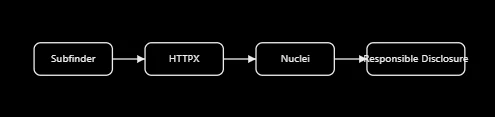
No credentials, accounts or special roles were needed: everything described here concerns services reachable from the public internet.
Finding it
The findings came out of the Nuclei scan over the validated subdomain list. The scan results pointed to three distinct categories, which the researcher then examined individually: a GeoServer instance affected by CVE-2024-36401, several subdomains exposing the Laravel Ignition health-check endpoint, and a WordPress REST API that allowed user enumeration on bapxxx.makassarkota.go.id.
Exploitation
Step 1: CVE-2024-36401 on GeoServer
The vulnerability was found on a GeoServer WFS endpoint that allows command execution through a particular parameter. The test produced an error response containing a ClassCastException, which the researcher reads as an indication that the exploit attempt reached the Java Runtime layer.
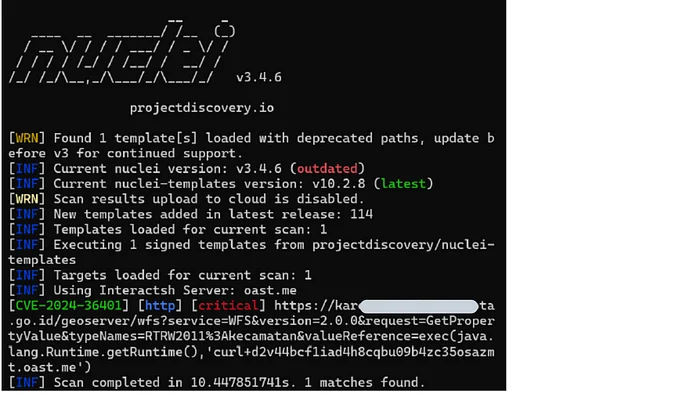
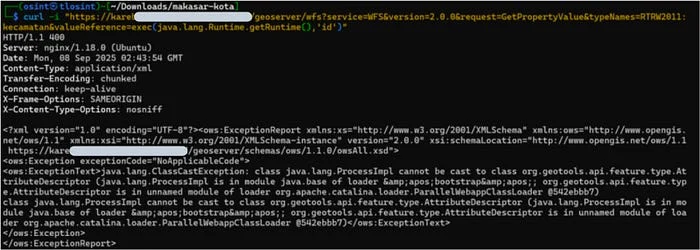
The write-up does not include the request, the parameter name or the payload used for this test.
Step 2: Laravel Ignition exposure
Several subdomains exposed the _ignition/health-check endpoint, which shows that the Laravel configuration is running in debug mode. According to the researcher, this allows an attacker to carry out further exploitation such as Remote Code Execution (RCE).
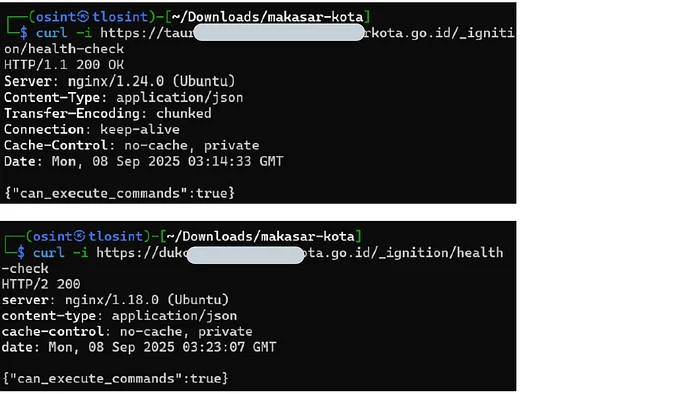
No request or response body is reproduced for this finding.
Step 3: WordPress user enumeration
On the domain bapxxx.makassarkota.go.id, the WordPress REST API endpoint allowed user enumeration. That opens the door to brute force attacks against important accounts such as admin.
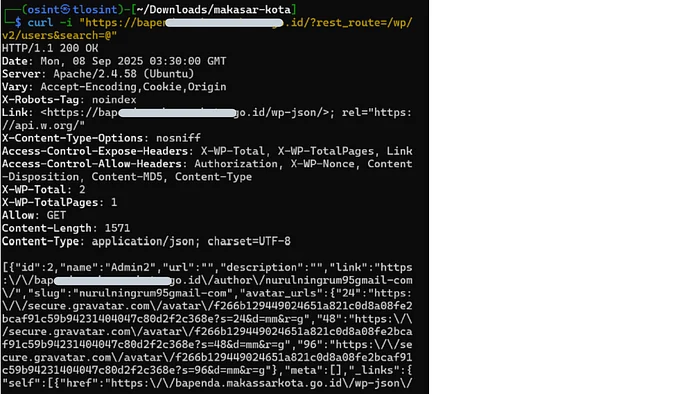
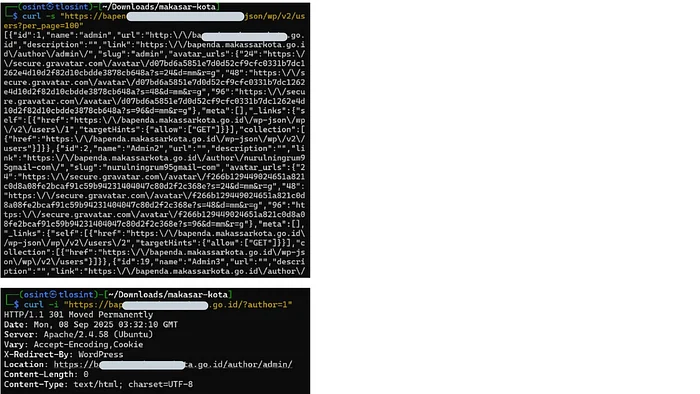
The write-up does not show the exact request used or the fields returned.
Root cause
The three findings have different causes, as described in the report:
- GeoServer: the WFS endpoint accepts a parameter that leads to command execution. The
ClassCastExceptionshows the input reached the Java Runtime layer rather than being rejected earlier. - Laravel: the application runs with debug mode enabled, so the
_ignition/health-checkendpoint is reachable. The report does not explain which Ignition version is involved or whether the further RCE step was actually demonstrated. - WordPress: the REST API allows user enumeration, which makes brute force possible.
Why existing defences did not stop these is not discussed in the report.
Impact
- GeoServer: the endpoint allows command execution through a parameter. The report demonstrates reach into the Java Runtime layer through the error response, but does not show a completed command execution.
- Laravel Ignition: debug mode exposure on several subdomains could let an attacker move on to further exploitation such as RCE. The report frames this as a possibility rather than a demonstrated result.
- WordPress: user enumeration on
bapxxx.makassarkota.go.idopens the opportunity for brute force attacks against important accounts such asadmin.
Fix
The report lists five mitigation recommendations:
- Patch GeoServer and make sure the version in use is the latest.
- Disable endpoints that are not needed on GeoServer, in particular WFS requests that are prone to exploitation.
- Make sure the Laravel configuration does not expose the
_ignition/health-checkendpoint in production. - Restrict access to the WordPress REST API or enable authentication so that user enumeration is not possible.
- Apply strict monitoring and logging across all subdomains to detect suspicious activity.
Variants to test
These are concrete follow-ups for similar government or public-sector estates, each with the signal that makes it worth pursuing.
- GeoServer WFS on other hosts. Run the same CVE-2024-36401 check against every GeoServer instance found during enumeration. A positive result looks like an error response containing a
ClassCastException, as in this report, showing the input reached the Java Runtime layer. - Other Laravel applications. Request
_ignition/health-checkon every Laravel-looking host. A positive result is a successful response from that endpoint, which indicates debug mode is enabled in production. - WordPress REST API across the estate. Query the REST API user endpoint on each WordPress site found. A positive result is a response that lists users without authentication, which is the precondition for the brute force scenario described here.
- Widen the subdomain list. Repeat the Subfinder, HTTPX, Nuclei chain with additional sources and confirm each live host with HTTPX before scanning, so that services missed the first time are covered.
What happened, in plain words
A security researcher, Arya Dwi Aji, went looking for weaknesses in websites run by the Makassar City Government (Pemerintah Kota Makassar). He did this on his own initiative, without breaking anything, and then told the city's computer security team (CSIRT Kota Makassar) about what he found so it could be fixed before someone with bad intentions found it first. That way of reporting is called responsible disclosure: you tell the owner privately and give them a chance to repair the problem.
He found three kinds of problem. One was an old, known bug in a piece of software called GeoServer. Another was a debugging feature left switched on in a web framework called Laravel. The third was a WordPress website that would happily tell anyone the names of the people who have accounts on it.
This article walks through the same work in the same order, explaining each idea from scratch. You only need to know how to use a browser and a computer.
The goal of the test
The researcher set out to find possible weaknesses in services that anyone on the internet can reach. He was careful not to change anything on the systems, not to take any private data, and not to do anything destructive. Think of it like walking around a public building, trying doors and noting which ones are unlocked, without going inside or moving the furniture.
The focus was on four things:
- finding public assets by looking at subdomains;
- checking which services are actually running;
- detecting the weaknesses the scanning turned up;
- writing the findings down so they can be fixed.
What is a subdomain?
A domain is the main name of a website, like makassarkota.go.id. A subdomain is a name placed in front of it, like bapxxx.makassarkota.go.id. Governments and companies often run many subdomains, one for each department, service or internal tool. Each one is a separate door into the organisation, so finding them all is the first job.
What is an asset?
In security, an asset is anything worth protecting: a website, a server, an application. When the report says the researcher widened his asset coverage, it means he found more of these doors to check.
The tools used
Three tools did the heavy lifting. Each has one clear job.
Subfinder
Subfinder is a program that hunts for subdomains. You give it a main domain and it collects the subdomain names that are known to exist, using public sources. Its role here was to:
- gather the list of subdomains;
- widen the range of assets under test;
- act as the first reconnaissance stage.
Reconnaissance means the information-gathering phase before any testing: finding out what is out there. It is like studying a map of a building before you start checking the doors.
HTTPX
HTTPX takes the list of names Subfinder produced and checks which ones actually answer. A subdomain name can exist on paper but point to nothing, or to a service that is switched off. HTTPX confirms which web services are genuinely live, collects basic information about them, helps build the target list for the next stage, and records the HTTP response status.
HTTP response status is the short code a web server sends back when you ask for a page. You have probably seen 404 for a page that does not exist; 200 means the page was served normally. These codes tell the researcher whether a service is up and how it behaves.
Nuclei
Nuclei is a scanning tool. It works from templates: small ready-made recipes, each describing how to check for one particular weakness. It can detect known vulnerabilities tied to CVE numbers, misconfigurations, and places where sensitive information is exposed.
A CVE number is a public identifier for a specific, catalogued security flaw. When a bug is confirmed and written up, it gets a CVE entry so everyone can refer to the same thing. CVE-2024-36401 is one such entry, from 2024.
A misconfiguration is a setting left in a state it should not be in, such as a debugging mode that should only be used during development but is still on in a live system.
The four-stage method
The whole assessment followed four simple stages:
- Reconnaissance with Subfinder.
- Service validation with HTTPX.
- Vulnerability scanning with Nuclei.
- Responsible disclosure to CSIRT Kota Makassar.
Why this order? Each stage depends on the one before. You cannot check services you have not found, you cannot scan services you have not confirmed are live, and you cannot report findings you have not scanned for. Doing it in this order also keeps the work tidy and avoids wasting effort on names that lead nowhere.
No accounts, passwords or special access were needed. Everything described here concerns services that anyone on the public internet can reach.
Finding the problems
The findings came out of the Nuclei scan run over the list of confirmed live subdomains. The scan results pointed to three separate categories, which the researcher then looked at one by one: a GeoServer instance affected by CVE-2024-36401, several subdomains exposing the Laravel Ignition health-check endpoint, and a WordPress REST API that allowed user enumeration on bapxxx.makassarkota.go.id.
Step 1: CVE-2024-36401 on GeoServer
What GeoServer is
GeoServer is software for publishing maps and geographic data on the web. Governments use it to share things like boundary maps and location data. It speaks a set of standards, one of which is called WFS, short for Web Feature Service: a way for one program to ask a map server for geographic features, such as roads or district outlines, in a structured format.
What the flaw is
The vulnerability was found on a GeoServer WFS endpoint that allows command execution through a particular parameter. An endpoint is a specific address inside a web service that accepts a particular kind of request. A parameter is a named value you attach to a request, like the search term in a search box.
Command execution means getting the server to run instructions of your choosing, as if you had typed them on its keyboard. That is about as serious as a web weakness gets, because the server then does whatever the attacker asks.
The test produced an error response containing a ClassCastException. A ClassCastException is a Java programming error that occurs when a program tries to treat one kind of object as a different kind. Java is the programming language GeoServer is written in, and the Java Runtime is the layer that actually runs Java programs. Seeing this particular error means the crafted input got past the outer checks and reached that deep layer, rather than being rejected at the front door. The researcher reads it as an indication that the exploit attempt reached the Java Runtime layer.
The write-up does not include the request, the parameter name or the payload used for this test, so there is no code to show here.
Step 2: Laravel Ignition exposure
What Laravel and Ignition are
Laravel is a popular framework for building web applications in the PHP programming language. A framework is a ready-made set of building blocks that developers assemble an application from, so they do not have to write everything from scratch.
Ignition is Laravel's error-handling helper. When something goes wrong in a Laravel application, Ignition produces a helpful error page. That is useful while building a site, but dangerous on a live one, because those helpful pages can reveal details about how the application works.
What was found
Several subdomains exposed the _ignition/health-check endpoint. A health check is a small address an application offers so that monitoring tools can ask "are you alive?". Here it shows that the Laravel configuration is running in debug mode. Debug mode is a development setting that makes the application talk openly about its internals; it should be switched off once the site is live.
According to the researcher, this allows an attacker to carry out further exploitation such as Remote Code Execution (RCE). Remote Code Execution means running your own commands on someone else's server over the network. The report frames this as a possibility that follows from the exposure, not as something it demonstrated.
No request or response body is reproduced for this finding, so there is no code to show here.
Step 3: WordPress user enumeration
What WordPress and its REST API are
WordPress is the most widely used software for building websites and blogs. A REST API is a way for programs to talk to a website and get answers in a structured form, rather than as a web page meant for a human to read. Think of the difference between asking a librarian a question and being handed a printed list: same information, but the list is far easier for a machine to process.
What user enumeration is
User enumeration means being able to ask a system, one name at a time, whether a particular account exists, and getting a clear answer. On its own it is not a break-in, but it is a useful first step: it tells an attacker which usernames are real, so a later password-guessing attack can be aimed at accounts that actually exist.
On the domain bapxxx.makassarkota.go.id, the WordPress REST API endpoint allowed user enumeration. That opens the door to brute force attacks against important accounts such as admin.
A brute force attack is trying many passwords in turn until one works, like trying every key on a large keyring. It is far more effective when the attacker already knows the exact username to aim at, which is why enumeration matters.
The write-up does not show the exact request used or the fields returned, so there is no code to show here.
Why the problems exist
The three findings have different causes, as described in the report:
- GeoServer: the WFS endpoint accepts a parameter that leads to command execution. Patching means installing the vendor's fix for a known flaw. The
ClassCastExceptionshows the input reached the Java Runtime layer rather than being rejected earlier. - Laravel: the application runs with debug mode enabled, so the
_ignition/health-checkendpoint is reachable. Production means the live system used by real people, as opposed to a test copy. The report does not explain which Ignition version is involved or whether the further RCE step was actually demonstrated. - WordPress: the REST API allows user enumeration, which makes brute force possible. Authentication is the step of proving who you are, usually with a username and password, before being allowed in.
Why existing defences did not stop these is not discussed in the report. Hardening means tightening the settings of a system so that only what is needed is exposed.
What the impact is
- GeoServer: the endpoint allows command execution through a parameter. The report demonstrates reach into the Java Runtime layer through the error response, but does not show a completed command execution.
- Laravel Ignition: debug mode exposure on several subdomains could let an attacker move on to further exploitation such as RCE. The report frames this as a possibility rather than a demonstrated result.
- WordPress: user enumeration on
bapxxx.makassarkota.go.idopens the opportunity for brute force attacks against important accounts such asadmin.
How to fix it
The report lists five mitigation recommendations. Mitigation means reducing the risk, either by removing the weakness or by making it harder to use.
- Patch GeoServer and make sure the version in use is the latest.
- Disable endpoints that are not needed on GeoServer, in particular WFS requests that are prone to exploitation.
- Make sure the Laravel configuration does not expose the
_ignition/health-checkendpoint in production. - Restrict access to the WordPress REST API or enable authentication so that user enumeration is not possible.
- Apply strict monitoring and logging across all subdomains to detect suspicious activity.
Monitoring and logging mean keeping records of what happens on a system and watching those records for signs of trouble, like a security camera and its footage.
Similar things to check elsewhere
These are concrete follow-ups for similar government or public-sector estates, each with the signal that makes it worth pursuing.
- GeoServer WFS on other hosts. Run the same CVE-2024-36401 check against every GeoServer instance found during enumeration. A positive result looks like an error response containing a
ClassCastException, as in this report, showing the input reached the Java Runtime layer. - Other Laravel applications. Request
_ignition/health-checkon every Laravel-looking host. A positive result is a successful response from that endpoint, which indicates debug mode is enabled in production. - WordPress REST API across the estate. Query the REST API user endpoint on each WordPress site found. A positive result is a response that lists users without authentication, which is the precondition for the brute force scenario described here.
- Widen the subdomain list. Repeat the Subfinder, HTTPX, Nuclei chain with additional sources and confirm each live host with HTTPX before scanning, so that services missed the first time are covered.
Glossary
- Asset: anything worth protecting in security terms, such as a website, server or application.
- Authentication: the step of proving who you are, usually with a username and password, before being allowed in.
- Brute force attack: trying many passwords in turn until one works.
- ClassCastException: a Java error that occurs when a program tries to treat one kind of object as a different kind.
- Command execution: getting a server to run instructions of your choosing.
- CVE: a public identifier for a specific, catalogued security flaw.
- Debug mode: a development setting that makes an application talk openly about its internals; it should be off on live sites.
- Domain: the main name of a website, such as
makassarkota.go.id. - Endpoint: a specific address inside a web service that accepts a particular kind of request.
- Framework: a ready-made set of building blocks developers assemble an application from.
- GeoServer: software for publishing maps and geographic data on the web.
- Hardening: tightening the settings of a system so that only what is needed is exposed.
- Health check: a small address an application offers so monitoring tools can ask whether it is alive.
- HTTP response status: the short code a web server sends back when asked for a page, such as
200or404. - HTTPX: a tool that checks which subdomains actually answer and records basic information about them.
- Ignition: Laravel's error-handling helper, which produces helpful error pages.
- Java Runtime: the layer that actually runs Java programs.
- Laravel: a popular framework for building web applications in PHP.
- Misconfiguration: a setting left in a state it should not be in.
- Mitigation: reducing risk, either by removing a weakness or making it harder to use.
- Monitoring and logging: keeping records of what happens on a system and watching them for signs of trouble.
- Nuclei: a scanning tool that uses templates to detect known vulnerabilities, misconfigurations and exposed information.
- Parameter: a named value attached to a request, like a search term.
- Patch: a vendor's fix for a known flaw, installed on the affected software.
- Payload: the crafted input sent in an attempt to trigger a weakness.
- PHP: a programming language commonly used for websites.
- Production: the live system used by real people, as opposed to a test copy.
- Reconnaissance: the information-gathering phase before testing, finding out what is out there.
- Remote Code Execution (RCE): running your own commands on someone else's server over the network.
- Responsible disclosure: reporting a weakness privately to the owner so it can be fixed before it is misused.
- REST API: a way for programs to talk to a website and get answers in a structured form.
- Subdomain: a name placed in front of a main domain, such as
bapxxx.makassarkota.go.id. - Subfinder: a tool that collects subdomain names for a given domain.
- Template: a small ready-made recipe in Nuclei describing how to check for one particular weakness.
- User enumeration: being able to ask a system whether a particular account exists and getting a clear answer.
- WFS (Web Feature Service): a standard way for one program to ask a map server for geographic features.
- WordPress: the most widely used software for building websites and blogs.
- WordPress REST API: the structured interface that lets programs query a WordPress site.


