Subdomain Hijacking Of Any Qwilr’s Customer
The report concerns subdomain hijacking affecting Qwilr customers, but the excerpt gives no technical details.

I was planning to write on my blog regularly for the last few months, but I could not do that due to my lack of time and laziness. So here’s a new year gift for you guys ?
The full write-up lives on its author's site
It belongs to its author, so we link to it rather than copy it. The other two tabs are our own rewrites, checked against it.
Context
Qwilr is a service that lets users publish pages and share them through a link. Besides the default qwilr.com hosting, the product offers two related features: a custom subdomain of the form <your_subdomain>.qwilr.com, and a custom domain, where a customer points their own hostname at Qwilr through a CNAME record. According to Qwilr's documentation, only enterprise plan users can set up a custom domain, and the CNAME record the custom domain setup requires is custom-domains.qwilr.com, itself a subdomain of qwilr.com.
The target in this report was an old private program on HackerOne with a wildcard scope of ***.target.com. The researcher's interest was in DNS records that left that scope: some of the target's subdomains pointed at <subdomain>.target.info, a TLD outside the program scope. Because the program scope was a wildcard, and most wildcard programs accept DNS hijacking issues for any of their assets, the .info names were worth a passive look.
Setup
The work was done in October 2022. The tools were standard subdomain enumeration and DNS inspection utilities, plus Rapid7's Project Sonar FDNS datasets for passive DNS lookups. On the Qwilr side, the researcher registered a trial account and used the settings pages at https://app.qwilr.com/#/settings/, https://app.qwilr.com/#/settings/subdomain and https://app.qwilr.com/#/pages.
Two commands were used to review the enumerated subdomains. The first prints the CNAME and A records for every name in a list:
for sub in $(cat subdomains.txt);do dig $sub +noquestion +noauthority +noadditional +nostats | grep -wE "CNAME|A"
The second prints live titles, status codes, content lengths and detected technologies, following redirects:
cat subdomains.txt |httpx -status-code -content-length -title -tech-detect -follow-redirects
Finding it
Nothing in the initial enumeration stood out, except that a few subdomains pointed to <subdomain>.target.info. Since that TLD was not in scope, the researcher did not touch those hosts actively. Instead, the .info names were enumerated passively from the Project Sonar FDNS datasets, which avoids generating traffic against out-of-scope assets.
That passive pass showed two subdomains pointing to the CNAME record custom-domains.qwilr.com.
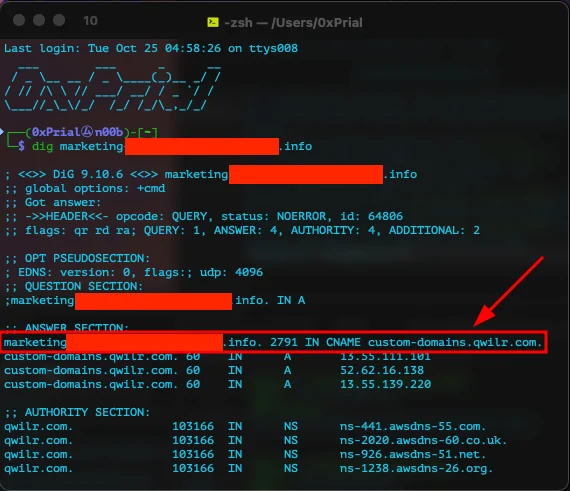
Visiting those domains returned an error page, which is what made the record interesting.
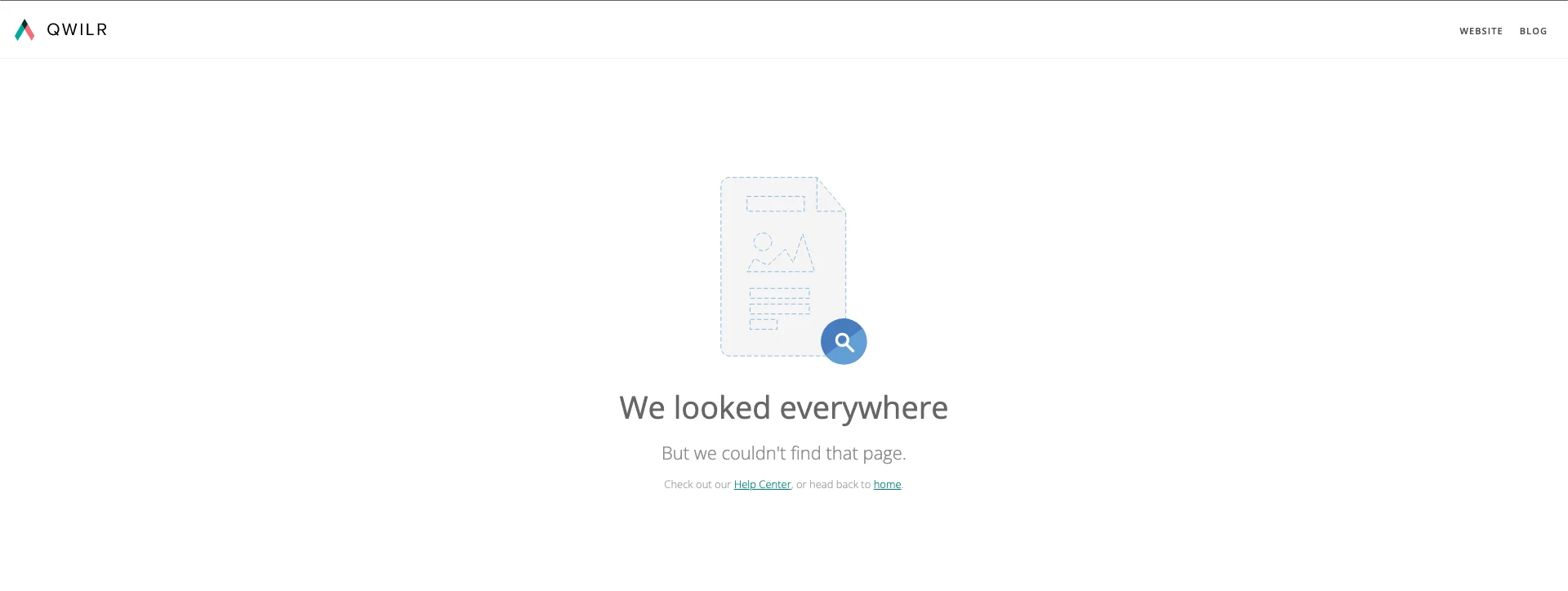
Visiting those domains returned an error page, which the researcher found suspicious. Reading Qwilr's documentation on custom domain setup confirmed that only enterprise plan users can configure a custom domain, so a trial account could not use that feature directly. The settings page at https://app.qwilr.com/#/settings/ gave a popup when the custom-domain feature was attempted.
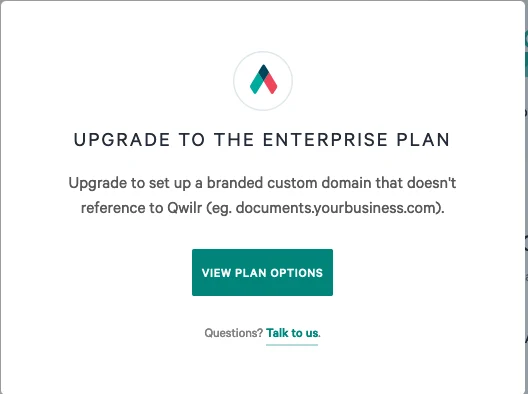
That blocked the obvious way of checking whether the target's subdomains had actually been claimed by a Qwilr customer. The settings area did, however, offer a second option at https://app.qwilr.com/#/settings/subdomain, where a user can pick a subdomain of the form <your_subdomain>.qwilr.com and serve pages from it.
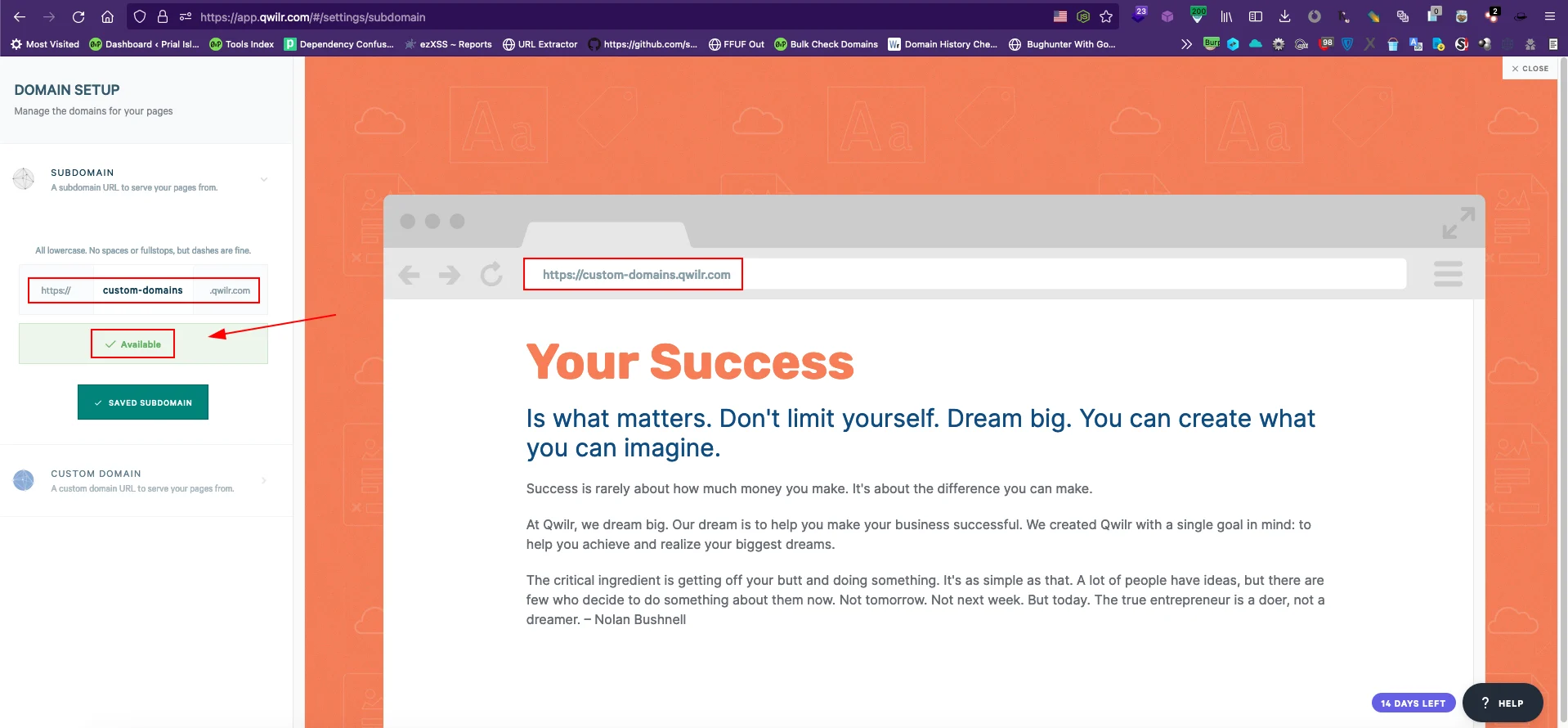
The reasoning that followed is the core of the bug. A user can claim a subdomain of qwilr.com, and the CNAME that custom domains must point at, custom-domains.qwilr.com, is itself a subdomain of qwilr.com. If the custom-domains prefix could be claimed from a trial account, the researcher would control the name that every customer's custom domain resolves to. Vendors that offer subdomains as a service usually blacklist or reserve keywords such as admin, support, app and login for their own use or for security reasons. Qwilr had not done so, and the custom-domains prefix was accepted from the trial account.
Exploitation
Step 1: claim the CNAME target
Using the trial account, the researcher claimed the custom-domains prefix through the subdomain settings page. This made custom-domains.qwilr.com a name under the researcher's control, served by Qwilr's own page hosting.
Step 2: publish a page on the claimed name
A page was created at https://app.qwilr.com/#/pages and its shareable URL was copied. It looked like this:
https://custom-domains.qwilr.com/0xPrial-3tI11SSQiC5z
Step 3: reach the page through a victim hostname
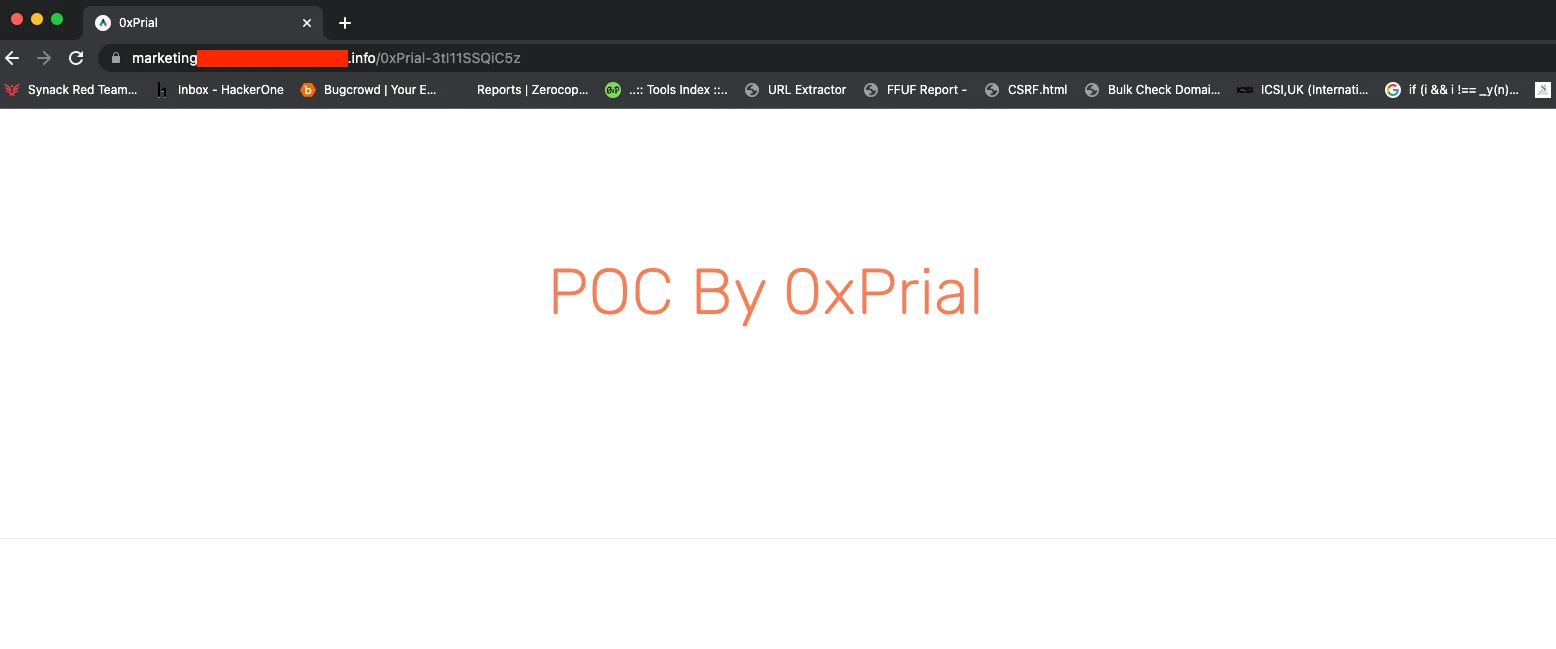
Because a CNAME is only an alias, any hostname whose CNAME points at custom-domains.qwilr.com resolves to the same content, unless the backend applies additional configuration. The researcher replaced the subdomain in the shareable URL with the first target hostname, <subdomain>.target.info, and visited it. The page was served.
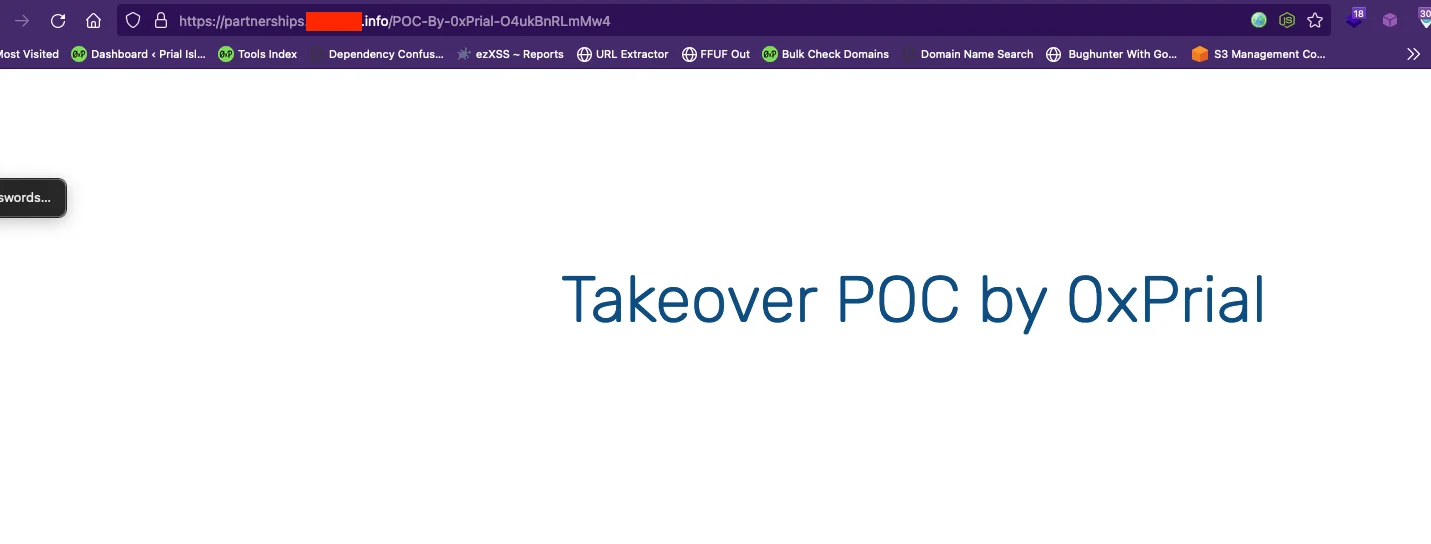
The same was done with a second hostname, partnerships.target.info, which also reflected the page.
Step 4: enumerate every affected hostname
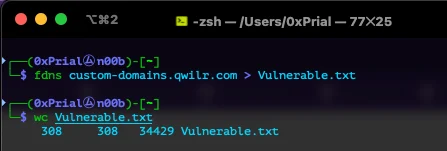
The Project Sonar FDNS datasets were queried again, this time for all DNS records pointing to the CNAME custom-domains.qwilr.com.
More than 300 subdomains used that record. The researcher confirmed that all of them were vulnerable and that the page could be reached from every one of them. A few examples were captured.
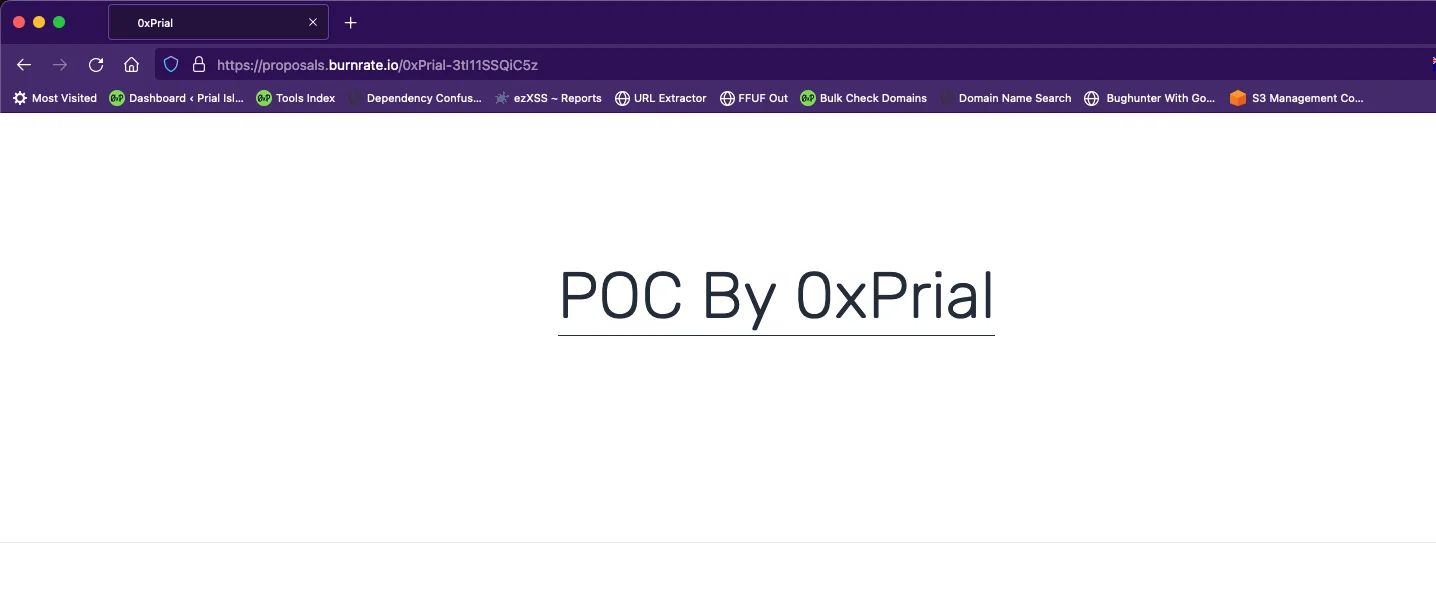
PoC burnrate.io
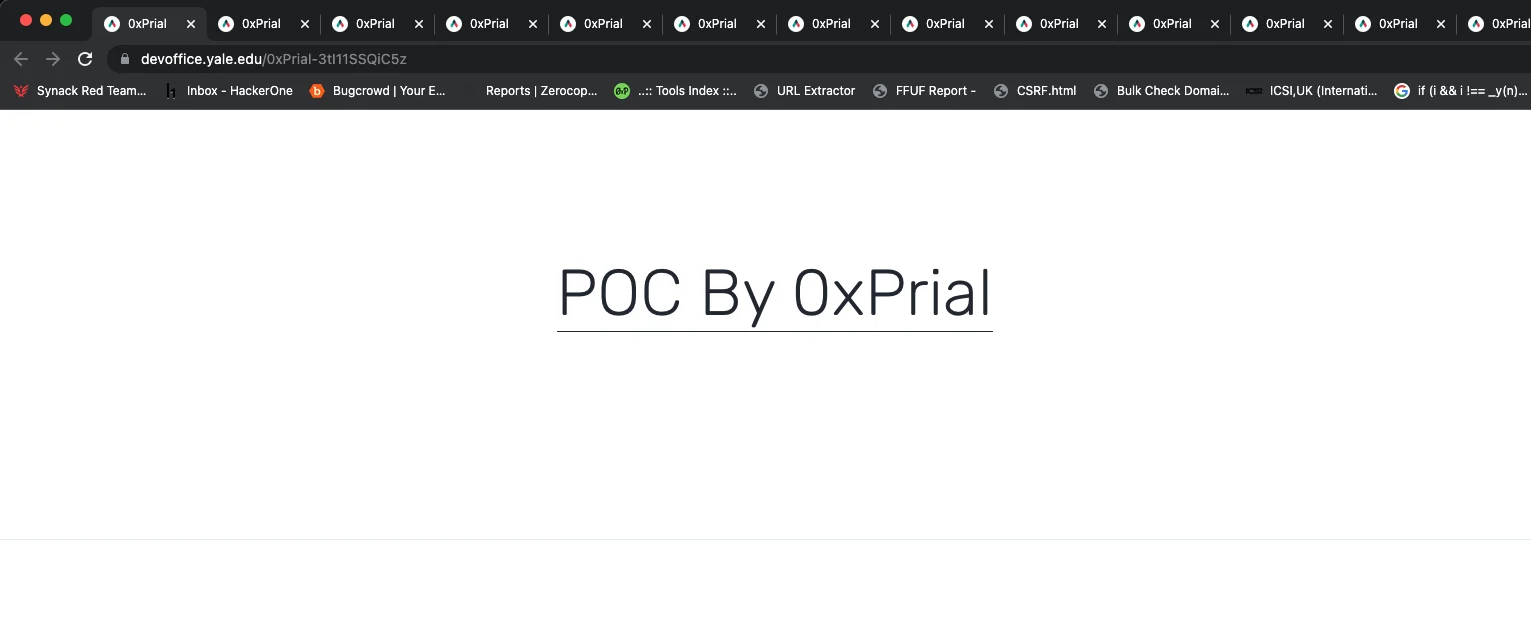
Yale University PoC
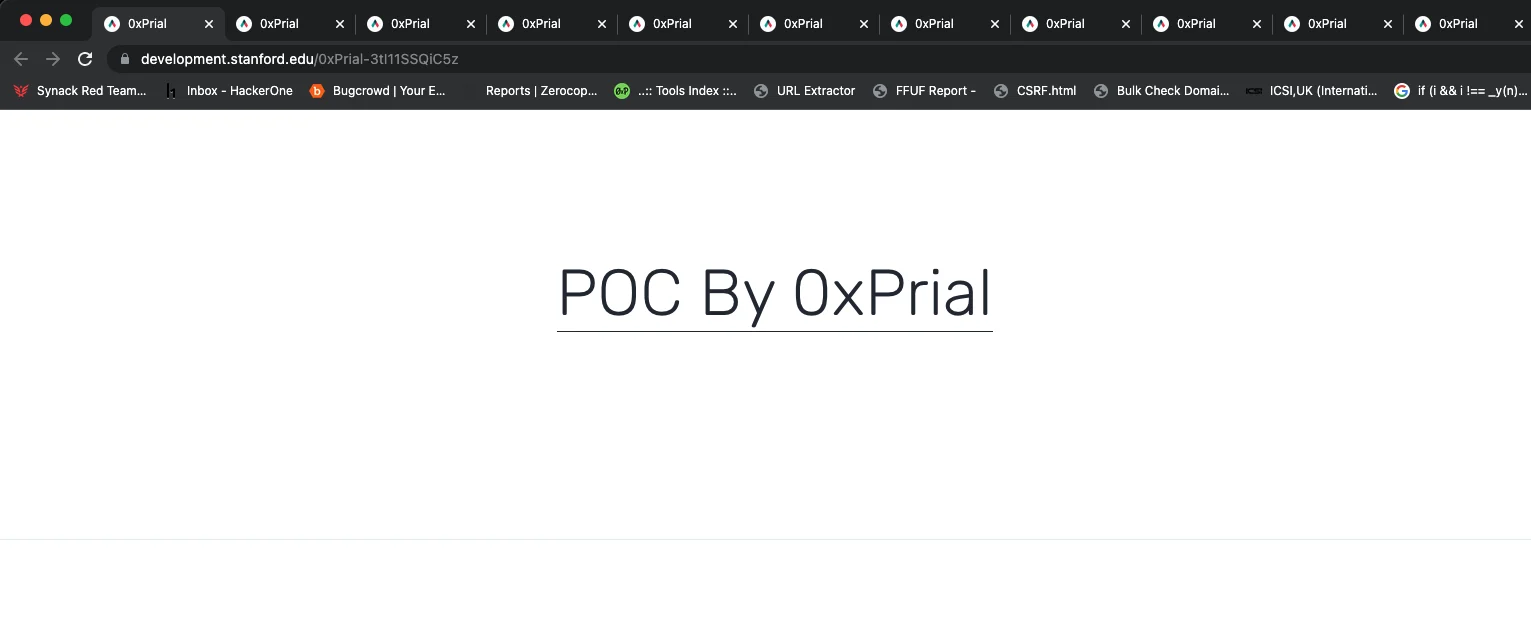
Stanford University PoC
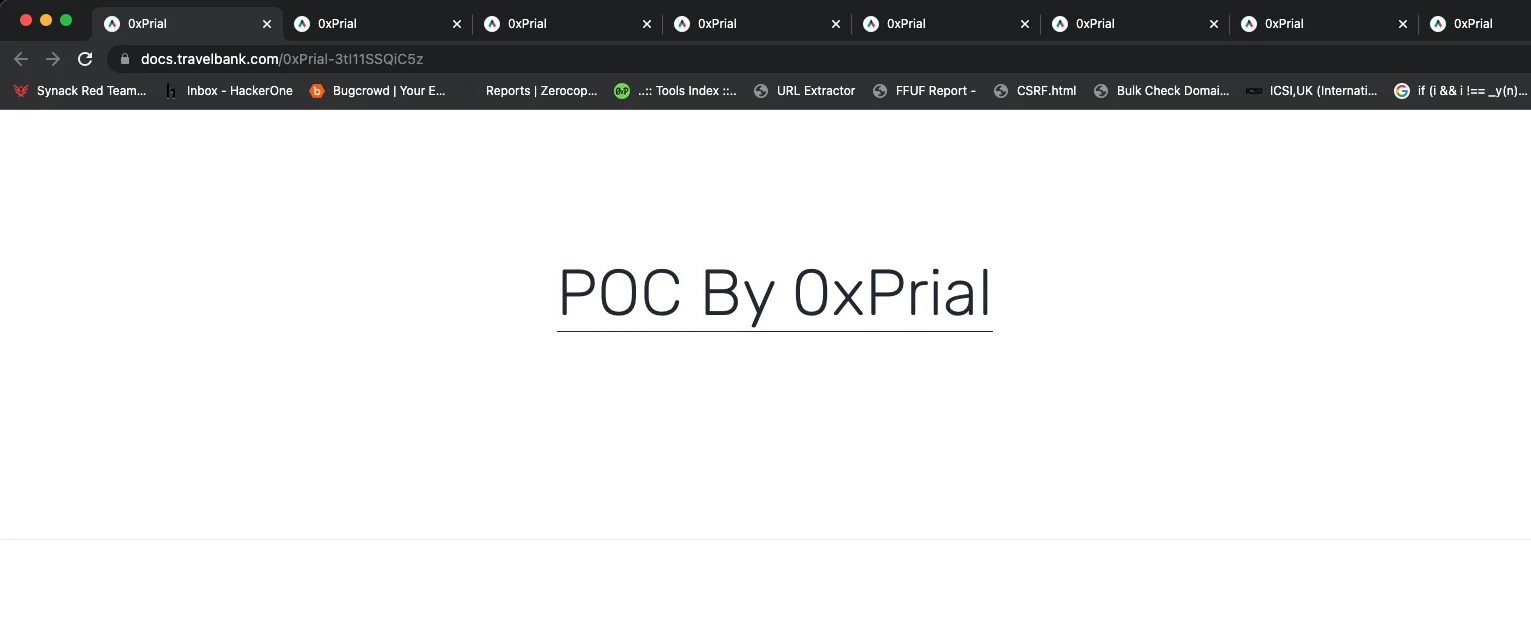
PoC TravelBank
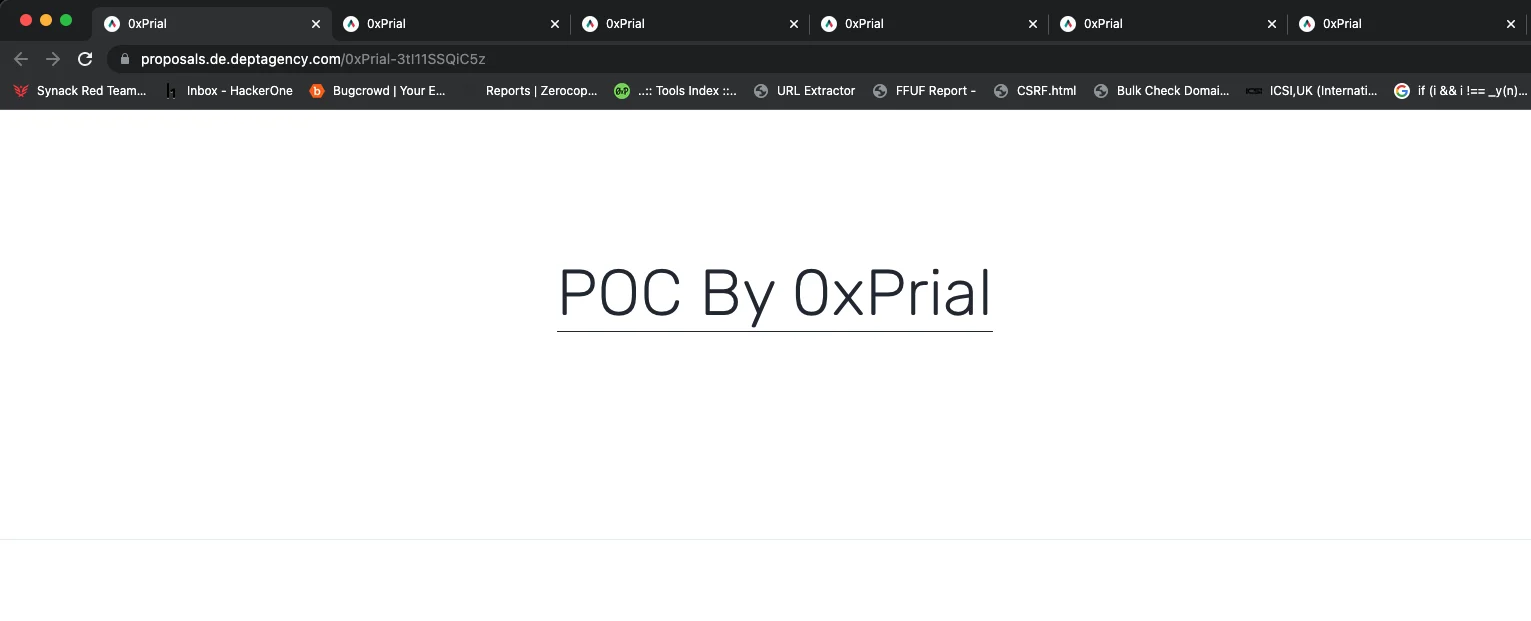
PoC DEPT®
Step 5: report and confirm with the affected parties
Two submissions were filed on HackerOne. Both were triaged and forwarded to the Qwilr support team immediately. The issue was also forwarded to a few other bug bounty programs. One of them confirmed that it had an active, working service on the affected hostname, which shows the hijack worked on both claimed and unclaimed subdomains.
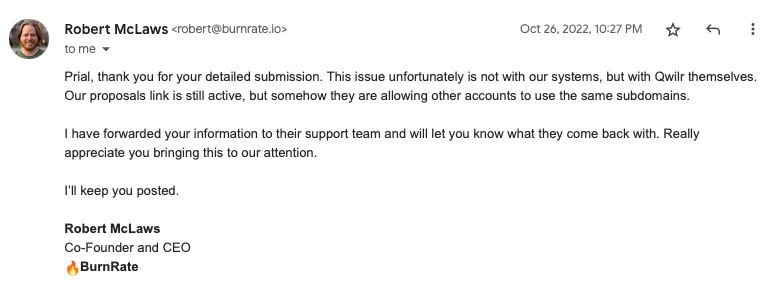
Another program replied with additional information that confirmed the theory.
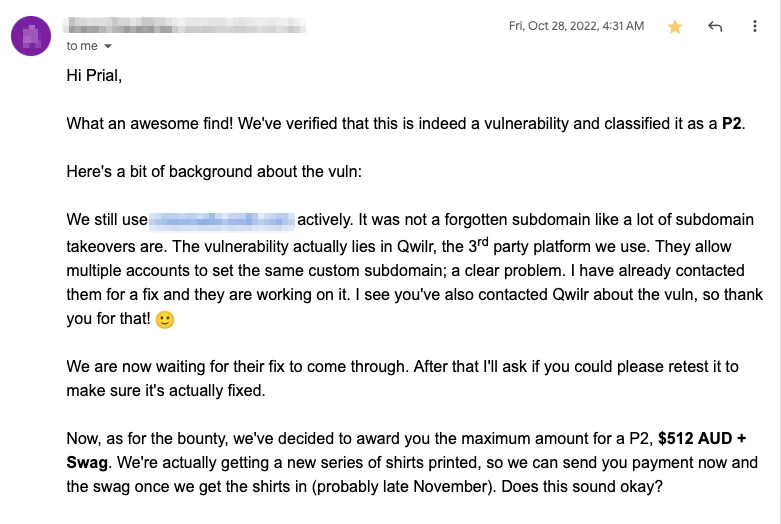
Timeline
| Date | Event |
|---|---|
| 25 October 2022 | Vulnerability discovered |
| 25 October 2022 | HackerOne submissions created |
| 26 October 2022 | Both HackerOne reports triaged |
| 27 October 2022 | Submissions created with other bug bounty programs |
| 1 November 2022 | Vulnerability fixed by the vendor |
| 9 November 2022 | Both HackerOne reports rewarded |
A few rewards and swag also came from the other programs.
Root cause
The design lets users claim arbitrary subdomains of qwilr.com, and the same namespace is used for the CNAME target that customer custom domains must point at. Nothing reserved the custom-domains label, so a trial account could take it. Once that label belonged to a user, every hostname CNAME'd to it resolved to content that user controlled. The alias alone was enough to serve the researcher's page under the victim's name, with no additional backend configuration apparent.
Impact
Any organisation whose hostname pointed at custom-domains.qwilr.com could have its subdomain serve content chosen by the attacker. More than 300 subdomains were found in passive DNS using that record, including names belonging to universities and companies. The researcher confirmed the hijack on both claimed and unclaimed subdomains, and at least one affected program confirmed it had an active, working service on the hostname. The practical consequences depend on how each hostname is used: phishing under a trusted brand, cookie or session implications for the parent domain, and reputational damage are the obvious ones. The report does not describe any specific attack beyond serving the proof-of-concept page.
Fix
The vendor fixed the issue on 1 November 2022. The report does not describe the change.
Variants to test
- Reserved-label bypass on subdomain services. Enumerate the CNAME targets a SaaS product tells customers to use, then try to claim those labels through the product's own subdomain feature. A positive result is a settings page accepting the label and the resulting hostname serving your content.
- Unverified custom domains. Point a hostname you control at the product's CNAME target and see whether the product serves your pages before any ownership verification. A positive result is content appearing on your hostname without a verification step.
- Passive enumeration of shared CNAME targets. Query Project Sonar FDNS or similar passive DNS data for records pointing at the target hostname. A positive result is a list of third-party hostnames, which you can then check for live services before reporting.
- Dangling records after deletion. Claim a subdomain, publish a page, then delete the claim and check whether the DNS record remains. A positive result is the record still resolving to a name that can be re-claimed.
- Scope discipline. For any hostname outside the program's scope, confirm the issue passively and ask the program for permission before active testing, as the researcher did here.
What happened, in plain words
A company called Qwilr lets people build web pages and share them with a link. Think of it like a service that hosts a page for you and gives you a web address to send to others. Qwilr also lets its customers use their own web address (their own domain name) for those pages, so a customer can show Qwilr content under a name that belongs to them.
To make that work, the customer's web address is set up to point at a Qwilr address. The technical name for that kind of pointer is a CNAME record. The pointer used here was custom-domains.qwilr.com.
Qwilr also lets any user pick a free subdomain of the form <your_subdomain>.qwilr.com. The researcher noticed that the pointer address custom-domains.qwilr.com is itself just one of these pickable subdomains. So he signed up for a free trial account and picked the name custom-domains. Qwilr allowed it. From that moment, the address that every customer's own domain pointed at was under his control.
He then published a test page on that address and visited it through other companies' web addresses that pointed at the same place. Their addresses showed his page. He found more than 300 such addresses, including ones belonging to universities and well-known companies. He reported it, Qwilr fixed it, and he was rewarded.
This kind of bug is called a subdomain takeover. The everyday comparison: imagine a building directory that says "Suite 5: go to the reception desk on floor 2". If anyone can rent the reception desk on floor 2 and put their own sign there, then every visitor following the directory ends up at the wrong desk, even though the directory itself was never changed.
The background you need first
Before the steps make sense, here are the ideas the report relies on, explained from zero.
Domain names and subdomains
A domain name is the address you type in a browser, like example.com. A subdomain is a name placed in front of it, like shop.example.com or support.example.com. The part in front (here shop or support) is often called the label or prefix. Companies use subdomains to separate services: app.example.com for the application, login.example.com for signing in, and so on.
DNS and records
DNS (Domain Name System) is the internet's phone book. When you type a name, your computer asks DNS "what does this name point to?" and gets an answer called a record. Two record types matter here:
- An A record gives an IP address, the numeric location of a server.
- A CNAME record says "this name is just another name for that name". It is an alias, like a mail forwarding note that says "for John, write to Jane's address instead".
Because a CNAME is only an alias, whatever content lives at the target name is what visitors to the alias will see. If someone else gains control of the target name, they effectively gain control of every alias pointing at it.
Subdomain takeover
A subdomain takeover happens when a name points at a service that no longer belongs to the owner, and someone else can claim that service. The pointer stays in place, but the destination changes hands. Visitors still trust the original name, yet the content now comes from the new claimant.
Wildcard scope and out-of-scope assets
Bug bounty programs are companies that pay people for finding security problems. Each program publishes a scope: the list of systems you are allowed to test. A wildcard scope like *.example.com means every subdomain of example.com is fair game. Anything not on the list is out of scope, and testing it without permission can cause trouble. The researcher was careful about this, which is a lesson in itself.
Passive DNS data
Passive DNS is a collection of DNS answers that other people have already looked up, stored over time. Instead of asking the DNS system yourself (which creates traffic to a host), you read the stored history. Rapid7's Project Sonar FDNS datasets are one such public collection. Using them lets you discover which names point where without touching the target.
SaaS, trial accounts and reserved names
SaaS means software you use over the internet instead of installing. Most SaaS products offer a free trial account so you can try features. When a product hands out subdomains to users, responsible vendors reserve certain words, such as admin, support, app or login, so that ordinary users cannot take names that look official or that the vendor needs for itself. If a name used internally by the product is not reserved, a user can claim it.
The setup
The work happened in October 2022. The target was an old private program on HackerOne, a well-known bug bounty platform. Its scope was a wildcard: ***.target.com. The researcher used standard tools for finding subdomains and inspecting DNS records, plus the Project Sonar FDNS datasets for passive lookups. On the Qwilr side, he registered a trial account and used three pages inside the Qwilr application:
https://app.qwilr.com/#/settings/for general settingshttps://app.qwilr.com/#/settings/subdomainfor choosing a subdomainhttps://app.qwilr.com/#/pagesfor creating pages
Two commands were used to review the list of subdomains he had collected. The first prints the CNAME and A records for every name in a list:
for sub in $(cat subdomains.txt);do dig $sub +noquestion +noauthority +noadditional +nostats | grep -wE "CNAME|A"
Line by line:
for sub in $(cat subdomains.txt);do ...runs the part betweendoanddoneonce for every line in the filesubdomains.txt, putting the current line into a variable calledsub. In plain terms: take each name from the list, one at a time.dig $subasks DNS for information about that name.digis a common command-line DNS lookup tool.+noquestion +noauthority +noadditional +nostatstelldigto leave out the extra sections of its output, so only the answer remains. This makes the output easier to read and to filter.| grep -wE "CNAME|A"passes the output togrep, which keeps only lines containing the whole wordCNAMEor the whole wordA. The-wmeans match whole words, and-Eallows the|to mean "or".
The second command prints live information about each name: whether it responds, with what status code, how large the page is, its title, and which technologies it appears to use, following any redirects:
cat subdomains.txt |httpx -status-code -content-length -title -tech-detect -follow-redirects
Line by line:
cat subdomains.txtprints the contents of the list of names.|sends that output into the next program instead of the screen.httpxis a tool that makes a web request to each name it receives and reports what came back.-status-codeshows the HTTP status code, the three-digit number a server returns (200 for success, 404 for not found, and so on).-content-lengthshows how big the response body is.-titleshows the page title, the text shown in the browser tab.-tech-detectguesses which software the site runs on.-follow-redirectstells it to keep following when a server sends the browser somewhere else.
Why these steps: before hunting for anything clever, you want a clear picture of what each name is and where it points. The first command shows the pointers; the second shows what is actually alive.
Finding it
The first pass turned up nothing unusual, except that a few subdomains pointed at <subdomain>.target.info. The .info ending is a different top-level domain from .com, and it was not in the program's scope. So the researcher did not send any requests to those hosts. Instead, he looked them up passively in the Project Sonar FDNS datasets, which means reading stored DNS history rather than asking the live system. This avoids creating traffic against systems he was not allowed to test.
That passive pass showed two subdomains pointing at the CNAME record custom-domains.qwilr.com.
The screenshot relates to the two subdomains pointing at the CNAME record custom-domains.qwilr.com. This is the moment the trail leaves the target's own infrastructure and lands on a third party.
Visiting those domains returned an error page. That error is what made the record interesting: a name that is configured to point somewhere but is not being served correctly is exactly the shape of a takeover candidate.
The screenshot shows the error page returned when visiting the affected domains. An error like this suggests the destination exists but is not properly set up for that name.
Reading Qwilr's documentation on custom domain setup confirmed that only enterprise plan users can configure a custom domain. A free trial account therefore could not use that feature directly. When he tried, the settings page at https://app.qwilr.com/#/settings/ always showed a popup.
The screenshot shows the popup that appears when a trial user tries to use the custom domain feature.
That blocked the obvious way of checking whether the target's subdomains had actually been claimed by a real Qwilr customer. But the settings area offered a second option, at https://app.qwilr.com/#/settings/subdomain, where a user can pick a subdomain of the form <your_subdomain>.qwilr.com and serve pages from it.
Here is the reasoning that follows, and it is the heart of the bug. A user can claim a subdomain of qwilr.com. The CNAME that custom domains must point at, custom-domains.qwilr.com, is itself a subdomain of qwilr.com. So if the custom-domains prefix could be claimed from a trial account, the researcher would control the name that every customer's custom domain resolves to. Vendors that offer subdomains as a service usually blacklist or reserve words such as admin, support, app and login for their own use or for security. Qwilr had not done so, and the custom-domains prefix was accepted from the trial account.
The screenshot relates to the researcher being able to use the custom-domains prefix from the trial account.
Exploitation
Step 1: claim the CNAME target
Using the trial account, the researcher claimed the custom-domains prefix through the subdomain settings page. This made custom-domains.qwilr.com a name under his control, served by Qwilr's own page hosting. In everyday terms: he rented the reception desk on floor 2, and the building directory still pointed everyone there.
Step 2: publish a page on the claimed name
A page was created at https://app.qwilr.com/#/pages and its shareable URL was copied. It looked like this:
https://custom-domains.qwilr.com/0xPrial-3tI11SSQiC5z
This is the address of the page he created. The long string at the end is an identifier for that particular page. Anyone opening this address sees his content, because he owns the name it sits on.
Step 3: reach the page through a victim hostname
Because a CNAME is only an alias, any hostname whose CNAME points at custom-domains.qwilr.com resolves to the same content, unless the backend applies extra configuration. The researcher replaced the subdomain in the shareable URL with the first target hostname, <subdomain>.target.info, and visited it. The page was served.
The screenshot shows the researcher's page appearing when visited through the target's hostname.
The same was done with a second hostname, partnerships.target.info, which also reflected the page.
The screenshot shows the same page appearing through the second hostname.
Step 4: enumerate every affected hostname
The Project Sonar FDNS datasets were queried again, this time for all DNS records pointing at the CNAME custom-domains.qwilr.com.
The screenshot relates to the passive DNS search for records pointing at custom-domains.qwilr.com.
More than 300 subdomains used that record. The researcher confirmed that all of them were vulnerable and that the page could be reached from every one of them. A few examples were captured.
PoC burnrate.io
Yale University PoC
Stanford University PoC
PoC TravelBank
PoC DEPT®
These are a few of the proof-of-concept captures from affected hostnames.
Step 5: report and confirm with the affected parties
Two submissions were filed on HackerOne. Both were triaged and forwarded to the Qwilr support team immediately. Triaged means the program's staff reviewed the report, accepted that it was a real issue, and passed it on to the people who could fix it. The issue was also forwarded to a few other bug bounty programs. One of them confirmed that it had an active, working service on the affected hostname, which shows the hijack worked on both claimed and unclaimed subdomains.
The screenshot relates to a program's reply confirming it had an active working service.
Another program replied with additional information that confirmed the theory.
The screenshot relates to another program's reply with additional information confirming the theory.
Timeline
| Date | Event |
|---|---|
| 25 October 2022 | Vulnerability discovered |
| 25 October 2022 | HackerOne submissions created |
| 26 October 2022 | Both HackerOne reports triaged |
| 27 October 2022 | Submissions created with other bug bounty programs |
| 1 November 2022 | Vulnerability fixed by the vendor |
| 9 November 2022 | Both HackerOne reports rewarded |
A few rewards and swag also came from the other programs.
Root cause
The design lets users claim arbitrary subdomains of qwilr.com, and the same namespace is used for the CNAME target that customer custom domains must point at. Nothing reserved the custom-domains label, so a trial account could take it. Once that label belonged to a user, every hostname CNAME'd to it resolved to content that user controlled. The alias alone was enough to serve the researcher's page under the victim's name, with no additional backend configuration apparent.
In plain terms: the product used one shared front door for all customers, and that front door was rentable by anyone. The lock was missing, not picked.
Impact
Any organisation whose hostname pointed at custom-domains.qwilr.com could have its subdomain serve content chosen by the attacker. More than 300 subdomains were found in passive DNS using that record, including names belonging to universities and companies. The researcher confirmed the hijack on both claimed and unclaimed subdomains, and at least one affected program confirmed it had an active, working service on the hostname. The practical consequences depend on how each hostname is used: phishing under a trusted brand, cookie or session implications for the parent domain, and reputational damage are the obvious ones. The report does not describe any specific attack beyond serving the proof-of-concept page.
For a beginner, the key point is that the danger is not the test page itself. The danger is that a trusted name can be made to show someone else's content, and visitors have no way to tell from the address bar.
Fix
The vendor fixed the issue on 1 November 2022. The report does not describe the change.
Variants to test
These are the same ideas generalised, so you can look for similar bugs elsewhere. Each one describes what to try and what a positive result looks like.
- Reserved-label bypass on subdomain services. Enumerate the CNAME targets a SaaS product tells customers to use, then try to claim those labels through the product's own subdomain feature. A positive result is a settings page accepting the label and the resulting hostname serving your content.
- Unverified custom domains. Point a hostname you control at the product's CNAME target and see whether the product serves your pages before any ownership verification. A positive result is content appearing on your hostname without a verification step.
- Passive enumeration of shared CNAME targets. Query Project Sonar FDNS or similar passive DNS data for records pointing at the target hostname. A positive result is a list of third-party hostnames, which you can then check for live services before reporting.
- Dangling records after deletion. Claim a subdomain, publish a page, then delete the claim and check whether the DNS record remains. A positive result is the record still resolving to a name that can be re-claimed.
- Scope discipline. For any hostname outside the program's scope, confirm the issue passively and ask the program for permission before active testing, as the researcher did here.
Glossary
- A record: a DNS record that maps a name to an IP address, the numeric location of a server.
- Alias: a name that stands in for another name; with DNS, a CNAME does this.
- Bug bounty program: a scheme where an organisation pays people for reporting security problems in its systems.
- CNAME record: a DNS record that says one name is another name for a different name, so visitors to the first end up at the second.
- Cookie: a small piece of data a website stores in your browser so it can recognise you on later requests; if another site can set or read cookies for a shared parent domain, sessions can be affected.
- Custom domain: a customer's own web address, pointed at a service so the service's content appears under that address.
- DNS (Domain Name System): the internet's phone book, translating names into addresses and other records.
- Domain name: the address of a site, such as
example.com. - Enterprise plan: a paid tier of a service aimed at large organisations, often with extra features.
- FDNS: a public dataset of DNS answers collected over time, used for passive lookups.
- HackerOne: a platform where bug bounty programs are published and reports are submitted.
- HTTP status code: the three-digit number a web server returns with a response, such as 200 for success or 404 for not found.
- httpx: a command-line tool that sends web requests to many names and reports status, size, title and detected technologies.
- IP address: the numeric address of a machine on a network.
- Label (prefix): the part of a name in front of the domain, such as
shopinshop.example.com. - Out of scope: not on the list of systems a program allows you to test.
- Passive DNS: stored records of DNS lookups made by others, read without querying the live system.
- Phishing: tricking people into trusting a page or message so they give away information or click something harmful.
- PoC (proof of concept): a small demonstration that a vulnerability is real, usually the least harmful action that proves the point.
- Project Sonar: Rapid7's public collection of internet measurement data, including FDNS datasets.
- Reserved name: a name a vendor keeps for itself or blocks for security, so ordinary users cannot claim it.
- SaaS: software delivered over the internet rather than installed on your machine.
- Scope: the list of systems a bug bounty program permits you to test.
- Session: the period during which a website remembers who you are, usually via a cookie or token.
- Subdomain: a name placed in front of a domain, such as
shop.example.com. - Subdomain takeover: a bug where a name points at a service someone else can claim, letting them serve their own content under the original name.
- TLD (top-level domain): the ending of a domain name, such as
.com,.infoor.org. - Triage: the step where a program's staff review a report, confirm it is valid, and route it to the right team.
- Trial account: a free, time-limited account used to try a service.
- Wildcard scope: a scope that covers every subdomain of a domain, written like
*.example.com.