Unauthenticated Massive PII Leak
An unauthenticated endpoint returned personal data (name, date of birth, ID) for any user when given a valid 13-digit ID and matching birthday. The reporter enumerated valid IDs and brute-forced birthdays, bypassing rate limiting with a header, to harvest personal information at scale.
 Published on cristivlad.medium.com
This is probably the report that I’m most proud of. On top of that, it was the lengthiest I’ve ever written.
The full write-up lives on its author's site
It belongs to its author, so we link to it rather than copy it. The other two tabs are our own rewrites, checked against it.
Context
This is the story of an unauthenticated endpoint that returned personal data about individual users, and of the two brute-force steps needed to make it talk. The company behind it is not named, and the author states plainly that the real endpoints, parameters and communication have been changed to protect its identity. Everything below therefore uses the shapes shown in the write-up, not the production values.
The feature itself is a lookup: given an identifier and a date of birth, the service returns the record belonging to that person. It is meant to be used by someone who already knows both values. The problem is that it does not require authentication, and it answers differently depending on which of the two values is wrong.
Setup
The work was done with Burp Suite's Intruder, using the Battering Ram attack type, and with a wordlist generated in Python. The Python script was not written by hand: the author asked GPT4 to produce it, and downloaded the resulting list as a text file from ChatGPT4's Code Interpreter (now called Advanced Data Analysis). No account, role or credential was needed against the target, because the endpoint is unauthenticated. The only precondition is knowledge of the request format, which the author had.
Finding it
The starting point was an endpoint that retrieves user data without authentication. It accepts a GET request of this form:
The response contains the id, first name, last name, date of birth, and a few other pieces of personal information. Two pieces of input are needed for a valid response: the 13-digit ID and the birthday.
What made the endpoint interesting was its error behaviour. The author probed it with an invalid ID and an invalid birthday and compared the answers:
- An invalid ID produced a response along the lines of "We don't know this ID".
- A valid ID combined with an invalid birthday produced a different response, along the lines of "The birthday we have for this ID does not match the one you provided".
That difference is an oracle. It separates "this ID does not exist" from "this ID exists but you gave the wrong birthday", which means the ID space can be searched without knowing any birthday at all, and the birthday can then be searched for each ID that survives.
Exploitation
Step 1: brute-force a valid ID
The first search targeted the ID. The author used Intruder, added a payload for the last 5 digits of the 13-digit ID, and started the attack.
Rate limiting stopped it almost immediately: after not even 5 attempts the requests were blocked, and it took roughly 30 to 60 minutes before the API could be hit again.
Step 2: bypass the rate limit
The block was worked around by adding an X-Forwarded-Host header to the request and switching the attack to the Battering Ram type. With that header in place the attack got through, and after a few minutes the author had a few valid IDs.
Step 3: build a birthday wordlist
The second search needed birthdays in the format dd-mm-yyyy. The author's reasoning, as given in the write-up:
- The company has a particular type and profile of user.
- The most probable age range would be 20 to 40 years. The author notes that in reality this was not the case, but the detail is changed to protect the company's identity.
- A list of all birthdays starting from 1 January 1983 would be needed to get a few hits, and such a list probably does not exist in this exact format.
- So the list was generated with Python, and rather than writing the code by hand the author had GPT4 produce it. The first few lines of the script the AI came up with:

A few seconds later the list was ready and was downloaded as a text file from ChatGPT4's Code Interpreter.
Step 4: brute-force the birthday
Intruder was used again, with another Battering Ram attack, this time with payloads for the birthday and with the X-Forwarded-Host header included as well. One of the valid IDs from step 2 was used as the fixed part of the request.
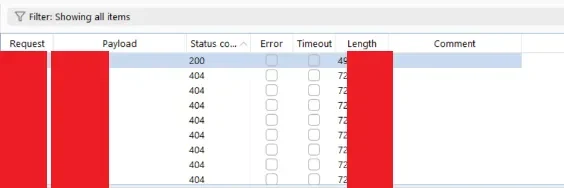
To recap the author's own summary: the first use of Intruder produced valid IDs, and the second use, against one of those IDs, brute-forced the birthday. The write-up describes the second run as finding the correct birthday after a couple of minutes of Intruder working through the list.
Root cause
The design flaw is the combination of three properties in one unauthenticated endpoint:
-
It returns personal data to anyone who supplies the right pair of values, with no session or credential required.
-
It distinguishes between an unknown ID and a known ID with a wrong birthday, which turns the endpoint into an enumeration oracle for IDs.
-
Its only defence against repeated guessing was rate limiting, and that rate limiting could be bypassed by adding an
X-Forwarded-Hostheader.The write-up does not describe the server-side implementation, so the exact mechanism is not stated.
Impact
With a valid ID and the matching birthday, the endpoint returns the person's ID, first name, last name, date of birth and a few other pieces of personal information. Because neither value has to be obtained from the user, an attacker can walk the ID space, keep the IDs that the oracle confirms, and then search birthdays for each one. The author describes the exposed data as the kind that usually appears in data breaches: full names, birthdays and IDs, and, with a bit of a stretch, emails could also be extracted.
The author's own estimate in the reply to the company is that the personal data of hundreds of thousands of users, or more, is exposed through this issue. That figure is the author's characterisation, not a measured count.
Fix
The write-up does not say what the company changed, if anything. What it does record is the company's response: the report was closed as out of scope, on the grounds of bruteforcing and rate limit bypass. The author replied that despite rate limiting being out of scope, the bypass was easy and allowed personal information to be collected, and asked that the issue at least be fixed out of respect for the personal data of the affected users. The author then moved on, noting that the company had already rewarded other serious severity vulnerabilities and that the author decided not to engage with them actively in the future.
Variants to test
- Differential error messages on lookup endpoints. Send an unknown identifier and a known identifier with a wrong secondary value, and compare the responses. A positive result is any difference in wording, status code, timing or body length that tells you the identifier exists.
- Client-supplied headers against rate limits. Repeat a throttled request with headers such as
X-Forwarded-Host,X-Forwarded-Forand similar, one at a time. A positive result is the throttling disappearing, or resetting, when the header is present. - Battering Ram on fixed-length identifiers. Where an identifier has a predictable prefix and a short unknown suffix, place the payload over the suffix only. A positive result is a set of identifiers that the oracle confirms as valid.
- Small, targeted secondary wordlists. Once an identifier is confirmed, generate the secondary values (dates, codes, short numbers) in the exact format the endpoint expects and run them against that single identifier. A positive result is a full record returned for a value you guessed.
- Unauthenticated access to record endpoints in general. Try the lookup without any session at all. A positive result is a full record returned to an anonymous client.
What happened, in plain words
A company ran a web service that could look up a person's details if you gave it two things: a long number that identifies the person, and that person's birthday. You were supposed to already know both values before asking. The service did not check who you were, and it answered slightly differently depending on which of the two values was wrong. That small difference let the author work out which numbers were real, and then guess birthdays until the service handed over personal records.
The author is Cristi Vlad (@CristiVlad25), and this is the report he says he is most proud of, and the longest he has ever written. The company is not named. The author states plainly that the real endpoints, parameters and communication have been changed to protect the company's identity, so everything below uses the shapes shown in the write-up, not the production values.
Two ideas run through the whole story, so here they are before we start.
An API (Application Programming Interface) is the part of a website that answers requests from software rather than drawing pages for a human. Think of a restaurant: the dining room is the website you see, and the kitchen door where orders go in and plates come out is the API. You can talk to it directly with a tool, without using the website's buttons.
Authentication means proving who you are, usually by logging in. An unauthenticated endpoint is one that answers anyone, with no login at all. It is like a building where the front desk gives out resident information to anyone who walks in and says a name, without asking for ID.
The setup
The work was done with a tool called Burp Suite, and specifically its Intruder feature. Burp Suite sits between your browser and the website and lets you see and edit every request. Intruder takes one request and sends it many times, each time swapping a chosen part for the next value from a list. That repeated sending is called brute force: trying many guesses quickly instead of one careful guess.
The attack type used was Battering Ram. In Intruder you mark the parts of the request you want to change with a payload position. Battering Ram puts the same value into every marked position on each attempt. The other common types put different values in different positions. Battering Ram is the right choice when the same value has to appear in more than one place at once.
The list of guesses was generated with Python, a programming language. The author did not write the script by hand: he asked GPT4 (an AI chatbot) to produce it, and downloaded the resulting list as a text file from ChatGPT4's Code Interpreter, which is now called Advanced Data Analysis. That feature lets the chatbot run code and hand you files back.
No account, role or credential was needed against the target, because the endpoint is unauthenticated. The only precondition is knowing the request format, which the author had.
Finding it
The starting point was an endpoint that retrieves user data without authentication. It accepts a GET request of this form:
Line by line:
GETis the type of request a browser makes when you simply ask for a page or a piece of data. It does not change anything on the server; it only asks for something back./id/XXXX123456789is the path. The part after/id/is the identifier of a person.XXXXstands in for a fixed prefix, and123456789stands in for the digits that follow. The write-up describes the identifier as 13 digits long.?starts the query string, the part of a URL that carries extra values.birthday=dd-mm-yyyyis one such value: the parameter is namedbirthday, anddd-mm-yyyyshows the format expected, day, month, year, each two digits except the year.
The response contains the id, first name, last name, date of birth, and a few other pieces of personal information. Two pieces of input are needed for a valid response: the 13-digit ID and the birthday.
What made the endpoint interesting was its error behaviour. The author probed it with an invalid ID and an invalid birthday and compared the answers:
- An invalid ID produced a response along the lines of "We don't know this ID".
- A valid ID combined with an invalid birthday produced a different response, along the lines of "The birthday we have for this ID does not match the one you provided".
That difference is an oracle. In security, an oracle is any behaviour that leaks a yes or no answer you were not supposed to get. Think of a locked door that clicks differently depending on whether the key was the wrong shape or the right shape with the wrong cut: either way the door stays shut, but the sound tells you something. Here the two messages separate "this ID does not exist" from "this ID exists but you gave the wrong birthday". That means the ID space can be searched without knowing any birthday at all, and the birthday can then be searched for each ID that survives.
Exploitation
Step 1: brute-force a valid ID
The first search targeted the ID. The author used Intruder, added a payload position over the last 5 remaining digits of the 13-digit ID, and started the attack.
Rate limiting stopped it almost immediately. Rate limiting is a cap on how many requests a client may make in a period of time, like a shop that only lets you try three samples and then asks you to come back later. After not even 5 attempts the requests were blocked, and it took roughly 30 to 60 minutes before the API could be hit again.
Step 2: bypass the rate limit
The block was worked around by adding an X-Forwarded-Host header to the request and switching the attack to the Battering Ram type. A header is a small labelled line of extra information sent alongside a request, like the notes on the outside of an envelope. X-Forwarded-Host is a header that proxies and load balancers use to tell the server which host name the original request was for. With that header in place the attack got through, and after a few minutes the author had a few valid IDs.
Why would that work? If the server counts requests per host name, and it takes the host name from a header the client can set, then the client can simply claim a different host name on every request and the counter never fills up. The write-up does not describe the server-side implementation, so the exact mechanism is not stated.
Step 3: build a birthday wordlist
The second search needed birthdays in the format dd-mm-yyyy. The author's reasoning, as given in the write-up:
- The company has a particular type and profile of user.
- The most probable age range would be 20 to 40 years. The author notes that in reality this was not the case, but the detail is changed to protect the company's identity.
- A list of all birthdays starting from 1 January 1983 would be needed to get a few hits, and such a list probably does not exist in this exact format.
- So the list was generated with Python, and rather than writing the code by hand the author had GPT4 produce it. The first few lines of the script the AI came up with:
The image shows the opening lines of the Python script that GPT4 produced, as quoted in the write-up.
A few seconds later the list was ready and was downloaded as a text file from ChatGPT4's Code Interpreter. A wordlist here is simply a text file with one guess per line, which Intruder reads and tries in turn.
Step 4: brute-force the birthday
Intruder was used again, with another Battering Ram attack, this time with payloads for the birthday and with the X-Forwarded-Host header included as well. One of the valid IDs from step 2 was used as the fixed part of the request.
To recap the author's own summary: the first use of Intruder produced valid IDs, and the second use, against one of those IDs, brute-forced the birthday. The write-up describes the second run as finding the correct birthday after a couple of minutes of Intruder working through the list.
The image shows the Intruder run against the birthday list, with the correct birthday found after a couple of minutes.
Root cause
The design flaw is the combination of three properties in one unauthenticated endpoint:
- It returns personal data to anyone who supplies the right pair of values, with no session or credential required.
- It distinguishes between an unknown ID and a known ID with a wrong birthday, which turns the endpoint into an enumeration oracle for IDs.
- Its only defence against repeated guessing was rate limiting, and that rate limiting could be bypassed by adding an
X-Forwarded-Hostheader.
Impact
With a valid ID and the matching birthday, the endpoint returns the person's ID, first name, last name, date of birth and a few other pieces of personal information. Because neither value has to be obtained from the user, an attacker can walk the ID space, keep the IDs that the oracle confirms, and then search birthdays for each one. The author describes the exposed data as the kind that usually appears in data breaches: full names, birthdays and IDs, and, with a bit of a stretch, emails could also be extracted.
The author's own estimate in the reply to the company is that the personal data of hundreds of thousands of users, or more, is exposed through this issue. That figure is the author's characterisation, not a measured count.
Fix
The write-up does not say what the company changed, if anything. What it does record is the company's response: the report was closed as out of scope, on the grounds of bruteforcing and rate limit bypass. Out of scope means the company had declared that class of issue off limits for its bug bounty programme, so it declined to treat the report as a valid finding. The author replied that despite rate limiting being out of scope, the bypass was easy and allowed personal information to be collected, and asked that the issue at least be fixed out of respect for the personal data of the affected users. The author then moved on, noting that the company had already rewarded other serious severity vulnerabilities and that the author decided not to engage with them actively in the future.
Variants to test
- Differential error messages on lookup endpoints. Send an unknown identifier and a known identifier with a wrong secondary value, and compare the responses. A positive result is any difference in wording, status code, timing or body length that tells you the identifier exists.
- Client-supplied headers against rate limits. Repeat a throttled request with headers such as
X-Forwarded-Host,X-Forwarded-Forand similar, one at a time. A positive result is the throttling disappearing, or resetting, when the header is present. - Battering Ram on fixed-length identifiers. Where an identifier has a predictable prefix and a short unknown suffix, place the payload over the suffix only. A positive result is a set of identifiers that the oracle confirms as valid.
- Small, targeted secondary wordlists. Once an identifier is confirmed, generate the secondary values (dates, codes, short numbers) in the exact format the endpoint expects and run them against that single identifier. A positive result is a full record returned for a value you guessed.
- Unauthenticated access to record endpoints in general. Try the lookup without any session at all. A positive result is a full record returned to an anonymous client.
Glossary
- API: the part of a service that answers requests from software, as opposed to the pages a person clicks through in a browser.
- Authentication: proving who you are, usually by logging in. An unauthenticated endpoint answers anyone.
- Battering Ram: an Intruder attack type that puts the same value into every marked payload position on each attempt.
- Brute force: trying many guesses quickly instead of one careful guess.
- Burp Suite: a tool that sits between your browser and a website so you can see and edit requests.
- GET: the request type a browser uses to ask for a page or piece of data without changing anything on the server.
- Header: a small labelled line of extra information sent with a request, such as
X-Forwarded-Host. - Intruder: the Burp Suite feature that resends one request many times, swapping in values from a list.
- Oracle: any behaviour that leaks a yes or no answer you were not supposed to get, such as two different error messages.
- Out of scope: a class of issue a bug bounty programme has declared off limits, so reports of it are not treated as valid findings.
- Payload position: the part of a request that Intruder marks to be replaced with each guess.
- Python: a programming language, used here to generate a list of birthdays.
- Query string: the part of a URL after
?that carries extra values, such asbirthday=dd-mm-yyyy. - Rate limiting: a cap on how many requests a client may make in a period of time.
- Wordlist: a text file with one guess per line, which Intruder reads and tries in turn.
- X-Forwarded-Host: a header that proxies and load balancers use to tell the server which host name the original request was for.




