Unexpected IDOR Vulnerability in [REDACTED] - [redacted].net (Write Up)
The report describes an IDOR vulnerability on a domain name profile page, where changing an identifier exposed another user's pre-registration WHOIS data. The attacker could view this data, which the program later claimed was public anyway.
 Published on blog.evanricafort.com
The original lives on blog.evanricafort.com
We do not hold its text, so we link to it rather than copy it. The other two tabs are our own rewrites, checked against it.
What the report shows
The write-up is titled "Unexpected IDOR Vulnerability in [REDACTED] - [redacted].net" and concerns a host on the [redacted].net domain. The report does not name the affected feature, endpoint, parameter or object identifier, and it does not describe the request that triggered the finding. What it does contain is the programme's response to the submission.
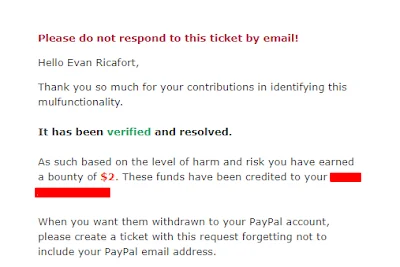
The image sits at the top of the write-up, above the quoted correspondence, and is the only visual material in the report.
The researcher received the following message after submitting:
"Thank you so much for your contributions in identifying this mulfunctionality. It has been verified and resolved. As such based on the level of harm and risk you have earned a bounty of $2. These funds have been credited to your [REDACTED] Live Credits. When you want them withdrawn to your PayPal account, please create a ticket with this request forgetting not to include your PayPal email address. We are hoping to continuously hear from you while you are in the hunt of bugs."
So the outcome recorded in the report is: the issue was verified, it was resolved, and a bounty of 2.00 USD was credited to the researcher's platform balance. No severity rating, CVSS score or weakness classification is given.
A second quoted message explains the programme's view of the data involved:
"Domain name profiles are really domain name pre-registration whois preset data and don't necessarily represent the client's data. Who's data is kinda public anyway! None the less, I can't give any further details as to why it earned the respective bounty!"
That reply tells us the objects at issue were domain name profiles, and that the programme considered them to be pre-registration WHOIS preset data rather than client data. The programme also declined to explain the bounty decision further. The report does not describe how the researcher reached another user's profile, whether the identifier was sequential, or what fields were exposed.
Root cause
The report labels the issue an IDOR but does not show the code path. The report labels the issue an IDOR but does not show the code path or explain how the profile was fetched. The programme's argument that the data is "kinda public anyway" suggests the profile content was not treated as sensitive.
Impact
The report gives no detail on what an attacker could read or change. The programme's own framing is that the exposed material was preset WHOIS data associated with domain pre-registration, which it regarded as not necessarily representing client data. The programme's framing is that the material was preset WHOIS data it regarded as not necessarily representing client data. The report does not establish whether profiles could be modified.
How this kind of bug works
Insecure direct object reference is an access control failure rather than an injection flaw. The application takes an identifier from the request, such as a numeric ID, a UUID or a slug, and uses it to look up a record. If the lookup is not scoped to the authenticated principal, any valid identifier returns the corresponding record regardless of who owns it. The bug appears wherever object identifiers are exposed to clients: REST paths, query strings, JSON bodies, GraphQL arguments, form fields and hidden inputs.
Two conditions make it common. First, developers often implement authentication (who are you) correctly while leaving authorisation (may you see this) to the UI, hiding links rather than enforcing checks server-side. Second, identifiers that are guessable, sequential or reused across tenants make enumeration trivial once a single valid value is known.
Defences are straightforward in principle: every object access must be resolved through a query constrained by the current subject, for example by joining on the owner column or by checking a permission table before returning the record. Indirect reference maps, where the server translates an opaque per-session token to a real identifier, add defence in depth but do not replace the check. Deny-by-default middleware on object routes catches new endpoints that forget the rule.
How to test for it
- Create two accounts of the same role and populate each with a few objects: profiles, documents, orders, whatever the feature stores.
- Capture every request that reads, updates or deletes an object, in a proxy, and note where identifiers appear.
- With account A's session, replay the requests using account B's identifiers. Try the identifier in the path, in query parameters, in JSON bodies and in headers.
- Repeat with no session at all, and with a session of a different role, to separate authentication failures from authorisation failures.
- Where identifiers are numeric, test neighbouring values and negative or zero values. Where they are UUIDs, check whether they leak elsewhere, such as in emails, exports or public pages.
- For write operations, change only the identifier and keep the rest of the body valid, then confirm the change by reading the object back as its owner.
A positive result is a response containing another account's data, or a successful state change on it, with a 200 status rather than a 403 or 404. Common false positives include objects that are genuinely public by design, shared within a tenant or team, cached responses served from the tester's own session, and endpoints that return the same generic payload for every identifier. Confirm the data belongs to the other account before reporting.
How it is fixed
Scope every object query to the authenticated subject, either by filtering on an owner or tenant column or by an explicit permission check before the record is returned or mutated. Return 404 rather than 403 where revealing existence is itself a leak. Apply the same rule to bulk endpoints, exports and any secondary API that serves the same records. Add regression tests that request another user's object and assert denial.
Hunting notes
IDOR tends to hide in features added later: reporting dashboards, invoice downloads, attachment handlers, notification settings, API versions kept for old mobile clients, and anything that accepts an ID in a JSON body rather than the path. Recon signals worth following are sequential identifiers in URLs, numeric parameters in mobile API traffic, endpoints that return objects without any visible ownership field, and GraphQL schemas exposing node lookups by ID. To make a report land, demonstrate cross-account access with two controlled accounts, show the exact request and response, state which fields belong to the victim, and describe the realistic harm rather than the theoretical maximum. Where the programme argues the data is public, as here, the report is stronger if you can show a field that is not.
What happened, in plain words
This write-up is about a bug found on a host in the [redacted].net domain. The title calls it an "Unexpected IDOR Vulnerability". IDOR stands for Insecure Direct Object Reference, and it is explained properly further down. The report does not say which feature, page, address or identifier was involved, and it does not show the request that triggered the finding. What it does show is how the bug bounty programme responded.
The image sits at the top of the write-up, above the quoted messages, and is the only visual material in the report.
After the researcher submitted the finding, the programme replied:
"Thank you so much for your contributions in identifying this mulfunctionality. It has been verified and resolved. As such based on the level of harm and risk you have earned a bounty of $2. These funds have been credited to your [REDACTED] Live Credits. When you want them withdrawn to your PayPal account, please create a ticket with this request forgetting not to include your PayPal email address. We are hoping to continuously hear from you while you are in the hunt of bugs."
In plain terms: the programme checked the report, agreed the problem was real, fixed it, and paid a bounty of 2.00 USD into the researcher's balance on the platform. A bounty is a reward a company pays someone who reports a security problem to it. No severity rating, CVSS score or weakness classification is given.
A second quoted message gives the programme's view of the data involved:
"Domain name profiles are really domain name pre-registration whois preset data and don't necessarily represent the client's data. Who's data is kinda public anyway! None the less, I can't give any further details as to why it earned the respective bounty!"
So the objects at issue were domain name profiles. WHOIS is the public directory that records who registered an internet domain, and the programme describes these profiles as preset data filled in before registration, not necessarily the client's own data. It also declined to explain the bounty decision further.
The report does not describe how the researcher reached another user's profile, whether the identifier was a simple number, or which fields were exposed.
Why this kind of bug happens
The report labels the issue an IDOR but does not show the code path. The report labels the issue an IDOR but does not show the code path or explain how the profile was fetched. The programme's argument that the data is "kinda public anyway" suggests the profile content was not treated as sensitive.
What the impact was
The report gives no detail on what an attacker could read or change. The programme's own framing is that the exposed material was preset WHOIS data linked to domain pre-registration, which it regarded as not necessarily representing client data. The programme's framing is that the material was preset WHOIS data it regarded as not necessarily representing client data. The report does not establish whether profiles could be modified.
In general, how this kind of bug works
Insecure direct object reference is a failure of access control, not of input filtering. The application takes an identifier from the request, such as a number, a UUID (a long random-looking string used as an ID) or a slug (a readable name in the address), and uses it to look up a record. If the lookup is not limited to the logged-in user, any valid identifier returns the matching record no matter who owns it. The bug appears wherever object identifiers are visible to the browser: in web addresses, in query strings, in JSON bodies, in GraphQL arguments, in form fields and in hidden inputs.
A request is simply the message your browser sends to a server asking for a page or an action, and the response is what comes back. A cookie is a small piece of data the server asks the browser to store and send back with each request, and it is often how the server recognises your session, meaning the period during which you are logged in. A token is a similar credential, usually a string, that proves who you are.
Two conditions make IDOR common. First, developers often implement authentication (who are you) correctly while leaving authorisation (may you see this) to the interface, hiding links rather than enforcing checks on the server. Hiding a door is not the same as locking it. Second, identifiers that are guessable, sequential or reused across customers make enumeration trivial once a single valid value is known. Enumeration means trying one value after another.
Defences are straightforward in principle: every object access must be resolved through a query constrained by the current user, for example by filtering on the owner column or by checking a permission table before returning the record. Indirect reference maps, where the server translates an opaque per-session token to a real identifier, add defence in depth but do not replace the check. Deny-by-default middleware on object routes catches new endpoints that forget the rule.
In general, how to test for it
- Create two accounts of the same role and populate each with a few objects: profiles, documents, orders, whatever the feature stores.
- Capture every request that reads, updates or deletes an object, in a proxy, and note where identifiers appear. A proxy is a tool that sits between your browser and the server and records the traffic.
- With account A's session, replay the requests using account B's identifiers. Try the identifier in the path, in query parameters, in JSON bodies and in headers.
- Repeat with no session at all, and with a session of a different role, to separate authentication failures from authorisation failures.
- Where identifiers are numeric, test neighbouring values and negative or zero values. Where they are UUIDs, check whether they leak elsewhere, such as in emails, exports or public pages.
- For write operations, change only the identifier and keep the rest of the body valid, then confirm the change by reading the object back as its owner.
A positive result is a response containing another account's data, or a successful change to it, with a 200 status rather than a 403 or 404. Status codes are the short numbers a server returns to say how the request went: 200 means success, 403 means forbidden, 404 means not found. Common false positives include objects that are genuinely public by design, shared within a team, cached responses served from the tester's own session, and endpoints that return the same generic payload for every identifier. Confirm the data belongs to the other account before reporting.
In general, how it is fixed
Scope every object query to the logged-in user, either by filtering on an owner or tenant column or by an explicit permission check before the record is returned or changed. Return 404 rather than 403 where revealing existence is itself a leak. Apply the same rule to bulk endpoints, exports and any secondary API that serves the same records. Add regression tests that request another user's object and assert denial.
In general, where to look
IDOR tends to hide in features added later: reporting dashboards, invoice downloads, attachment handlers, notification settings, API versions kept for old mobile clients, and anything that accepts an ID in a JSON body rather than the path. Recon signals worth following are sequential identifiers in URLs, numeric parameters in mobile API traffic, endpoints that return objects without any visible ownership field, and GraphQL schemas exposing node lookups by ID. To make a report land, demonstrate cross-account access with two controlled accounts, show the exact request and response, state which fields belong to the victim, and describe the realistic harm rather than the theoretical maximum. Where the programme argues the data is public, as here, the report is stronger if you can show a field that is not.
Glossary
- Bounty: a reward a company pays someone who reports a security problem to it.
- Bug bounty programme: an organised scheme through which a company receives and pays for security reports.
- IDOR (Insecure Direct Object Reference): an access control bug where an identifier from the request returns a record the requester should not be able to reach.
- Authentication: checking who a user is.
- Authorisation: checking whether a user is allowed to do or see something.
- Request: the message a browser sends to a server asking for a page or an action.
- Response: the message a server sends back.
- Cookie: a small piece of data stored by the browser and sent back with requests, often used to recognise a session.
- Session: the period during which a user is logged in, identified by a cookie or token.
- Token: a credential, usually a string, that proves who you are.
- Identifier: a value such as a number, UUID or slug that names a specific record.
- UUID: a long random-looking string used as an identifier.
- Slug: a readable name used in a web address to identify a page or record.
- Enumeration: trying one value after another to find valid ones.
- WHOIS: the public directory recording who registered an internet domain.
- Domain name profile: a record holding details about a domain, described here as preset data filled in before registration.
- Severity rating: a label for how serious a bug is.
- CVSS: a standard scoring system for the severity of a vulnerability.
- Status code: the short number a server returns to say how a request went, such as 200, 403 or 404.
- Proxy: a tool that sits between browser and server and records the traffic.
- GraphQL: a way for applications to ask a server for specific data by name.
- Middleware: code that runs on every request before the main handler, often used for shared checks.
- Deny-by-default: a setting where access is refused unless explicitly allowed.
- Defence in depth: adding more than one layer of protection so a single mistake does not open everything.
- False positive: a finding that looks like a bug but is not one.
- Regression test: an automated test that checks a fixed bug stays fixed.