When Three “Small” Bugs Become a Critical Account Takeover
An unauthenticated product review API returned full customer objects including password hashes, the application allowed very weak passwords, and login lacked effective rate limiting. Together these could let an attacker enumerate valid accounts, guess credentials and potentially take over accounts.
 Published on medium.com
Account Takeover
The full write-up lives on its author's site
It belongs to its author, so we link to it rather than copy it. The other two tabs are our own rewrites, checked against it.
Context
The target described here is a web application with a product review feature, a password management feature and an authentication flow that includes both password login and OTP verification. The review functionality is the ordinary part of the product: a visitor reads reviews on a product page and the frontend renders basic review information such as the reviewer's name, rating and review text.
The write-up does not name the program, the vendor or the application, and it gives no endpoint paths, parameter names, headers or version numbers. What it does give is the shape of three weaknesses and the way they connect: an API returning more customer data than the frontend needs, a password policy that accepts trivially weak values, and authentication endpoints that do not effectively limit repeated attempts. The chained finding was rated Critical, CVSS 9.8. A separate OTP brute-force issue was rated Critical, CVSS 9.1.
Setup
The report does not describe the tooling beyond Burp Intruder, which appears in the OTP section, and it does not list versions. The OTP testing was carried out against a self-owned test account, which the author explicitly notes as authorised testing. No other accounts, roles or preconditions are described.
Finding it
The starting point was the product review functionality. The frontend only needed basic review information, but the server response contained a much larger serialised customer object. Among the exposed fields were customer contact and business information, internal identifiers and a password hash.
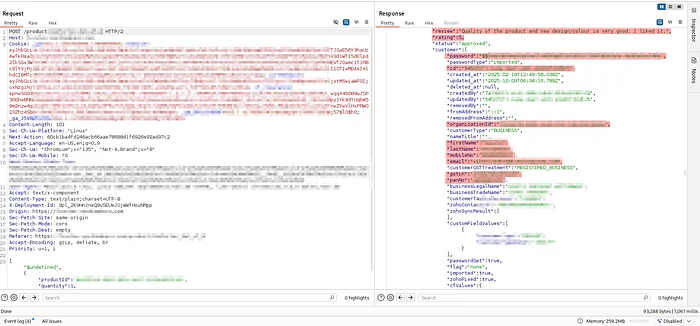
The screenshot shows the product response carrying customer information that the frontend did not require. The decisive detail is that this data was accessible without authentication. That changes the scale of the problem: an attacker is not limited to seeing one user's data, because the same response shape can be collected across multiple products and reviews, producing a scalable source of customer information.
The author makes a point that is easy to skip past: an exposed email address is often dismissed as low value. It becomes valuable when the authentication system elsewhere is weak, because it turns into a list of valid account identifiers.
Exploitation
Step 1: collect valid account identifiers
Unauthenticated requests to the review functionality return the oversized customer object. The exposed contact information, including email addresses, can be gathered across products and reviews. The report shows a screenshot of the response rather than the raw request; it states that contact and business information, internal identifiers and a password hash were present.
Step 2: exploit the weak password policy
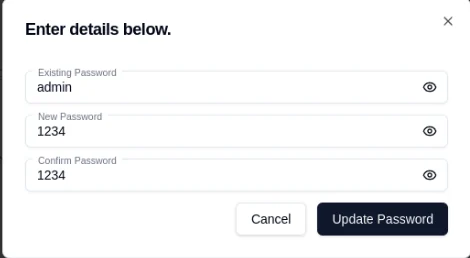
The password management functionality accepted extremely weak passwords. The report gives one example value:
1234admin
There was no meaningful server-side enforcement preventing short, predictable or commonly used passwords. This does not mean every account was automatically compromised, but it produces a much weaker credential environment: the space an attacker has to guess through is far smaller than it should be.
Step 3: guess credentials without a barrier
The login functionality lacked effective protection against repeated authentication attempts. There was no sufficient combination of throttling, lockout or CAPTCHA to stop automated password guessing. The identifiers from step 1 could therefore be used as targets for repeated authentication attempts.
The three issues connect into a single path, which the report draws as follows:
Exposed customer information ↓Discover valid email addresses ↓Weak password policy ↓Predictable credential space ↓No effective login rate limiting ↓Repeated authentication attempts ↓Potential Account Takeover
Each step removes a different obstacle: the disclosure supplies the account list, the weak policy shrinks the credential space, and the missing rate limiting removes the cost of trying. The report stresses that there was no single magical vulnerability behind the compromise; multiple controls failed at different layers.
Step 4: brute-force the OTP
While investigating authentication, the author found a separate issue in the OTP verification flow. The OTP validation endpoint did not enforce an effective limit on failed attempts. Using a self-owned test account, the correct OTP was identified within a relatively small request range, resulting in successful authentication.
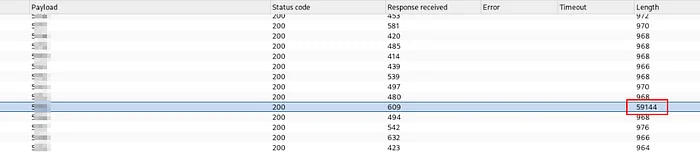
The Burp Intruder results show a significant response-length difference for the successful attempt. Incorrect OTP submissions returned a small response, while a successful OTP produced a substantially larger response. That size difference is an observable success indicator: an automated test does not need to parse the response body, and does not need to rely on the HTTP status code, to tell which attempt succeeded. The response effectively becomes a success/failure oracle.
Root cause
The review endpoint serialised a full customer object, including a password hash, instead of the handful of fields the frontend renders, and it did so without authentication. The password policy had no meaningful server-side enforcement, so short and predictable values were accepted. The login flow had no sufficient combination of throttling, lockout or CAPTCHA. The OTP validation endpoint likewise had no effective limit on failed attempts, and its responses differed in size between failure and success, which made the correct value distinguishable.
The report frames this as multiple controls failing at different layers rather than one control being bypassed. The report frames this as controls failing at different layers rather than one control being bypassed.
Impact
Under the conditions described, an attacker could read customer contact and business information, internal identifiers and password hashes without authentication, and the data could potentially be collected across products and reviews. Combined with the weak password policy and the absence of effective login rate limiting, the exposed identifiers could be used as targets for repeated authentication attempts, forming a practical account takeover path. The report consistently hedges this as a potential path rather than a demonstrated mass compromise, and it notes that weak password controls alone do not mean every account was compromised.
Separately, the OTP flow allowed the correct code to be found by repeated attempts within a small request range, resulting in successful authentication against the test account. The report says the correct OTP was identified within a relatively small request range, but does not state how long the OTP was.
Fix
The controls it identifies as missing are the ones that would need to be in place: return only the fields the frontend needs from the review endpoint and require authentication for customer data, enforce a real password policy server-side, add throttling, lockout or CAPTCHA to login, and limit failed OTP attempts while making success and failure indistinguishable in the response.
Variants to test
- Compare the JSON returned by public listing endpoints (reviews, comments, order summaries) with the fields the frontend actually renders. A positive result is a serialised object containing fields the UI never uses, especially identifiers or hashes, returned without a session.
- Register or reset an account and submit a short, common password such as the example above. A positive result is acceptance with no server-side complaint.
- Send a batch of failed logins for one account and watch for throttling, lockout or a CAPTCHA challenge. A positive result is that none appears after a volume no human would produce.
- Submit wrong OTPs in sequence and compare response lengths and status codes. A positive result is a distinct length or body for the correct value, giving an oracle that does not depend on the status code.
- Ask the authentication questions the report lists for any OTP flow: whether the code can be guessed, how many attempts are allowed, whether it expires, whether it is single-use, and whether account or IP throttling exists.
What happened, in plain words
A security researcher was looking at a web application with a product review feature, password management and a login flow that uses an OTP. While poking around, they noticed that the website was quietly handing out far more information about customers than it needed to. Then they found two more weaknesses: the site let people choose ridiculously easy passwords, and it did not stop anyone from trying to log in over and over again. None of these three things looks dramatic on its own. Put together, they form a potential path to taking over someone else's account. The researcher rated that combined chain Critical, with a CVSS score of 9.8. They also found a separate problem in the one-time code (OTP) used during login: the validation endpoint did not limit failed attempts, and the correct code was found within a relatively small request range. That was rated Critical, CVSS 9.1.
The report does not name the company, the website or the specific pages involved. It describes the shape of the weaknesses and how they connect, which is what this article walks through.
Before going further, a few words that will come up constantly:
- A web application (or just "app") is a website that does things for you, not just shows text: it lets you log in, leave a review, change your password. Your browser talks to a computer somewhere else, called a server, which does the real work.
- An API is the part of the server that answers requests from the app's own pages. Think of a restaurant: the menu and the dining room are the frontend (what you see), and the kitchen is the API (where the actual work happens). Normally you only get what you ordered. The bug here is that the kitchen was sending out extra dishes nobody asked for.
- Authentication means proving who you are, usually with an email address and a password. Account takeover means someone else manages to log in as you.
- PII stands for personally identifiable information: data that points at a specific person, such as an email address or phone number.
- CVSS is a standard scoring system for how serious a security flaw is. Scores run from 0 to 10; 9.0 and above is "Critical".
The setup
The target is a web application with three relevant features: product reviews, password management, and a login flow that uses both a password and an OTP (a one-time code).
The review feature is the ordinary part. A visitor opens a product page, and the page shows reviews: the reviewer's name, a star rating, the review text and similar basics. That is all the page needs.
The report does not describe any special tools beyond Burp Intruder, which appears later in the OTP section. Burp is a program that sits between your browser and the website and lets you see and change the requests going back and forth; Intruder is one of its features for sending the same request many times with one part changed each time, which is how you try a long list of guesses automatically. The report gives no version numbers.
The OTP testing was done against a test account the researcher owned, and the report explicitly notes this as authorised testing. No other accounts, roles or preconditions are described.
The first clue: an API returning too much data
The researcher started with the product review functionality. The page only needed basic review information, but the server's response contained a much larger serialised customer object. Serialised just means the data was packaged up in a structured format (like a form filled in with many fields) and sent as one block. Among the fields in that block were customer contact and business information, internal identifiers, and even a password hash.
A password hash is what a well-built site stores instead of your actual password. It is the result of running your password through a one-way mathematical function: you can turn a password into a hash, but you are not supposed to be able to turn the hash back into the password. It is like putting a document through a shredder. Even so, a hash should never be handed out to strangers, because attackers can try common passwords against it offline until one matches.
The screenshot shows the product response carrying customer information that the frontend did not require. The decisive detail is that this data was accessible without authentication: no login, no account, nothing. The data was accessible without authentication: no login or account was needed.
That changes the scale of the problem. An attacker is not limited to seeing one user's data, because the same response shape appears across multiple products and reviews. The data could potentially be collected across multiple products and reviews, creating a scalable source of customer information.
The researcher makes a point that is easy to skip past: people often see an exposed email address and think "it's only an email address". But an email address becomes valuable when the login system elsewhere is weak, because it turns into a confirmed list of accounts that exist.
Why this matters
A common mistake during security testing is to look at an exposed email address and stop there. The report puts it bluntly: an email address can become extremely valuable when combined with weaknesses elsewhere in the authentication system. So the researcher kept testing instead of writing up the disclosure and moving on.
The second piece: weak password controls
The next issue was in the password management functionality. The application allowed users to set extremely weak passwords, including values such as:
1234admin
This is a single password value, copied exactly as the report gives it. It is short, it is a predictable pattern (four digits followed by the word "admin"), and it is exactly the kind of thing an attacker tries first.
There was no meaningful server-side enforcement preventing short, predictable or commonly used passwords. Server-side enforcement means the server itself checks the rule, rather than the web page merely showing a hint in the browser. If the check only happens in the browser, anyone can skip it by sending the request directly. Here, there was no meaningful server-side enforcement.
This does not mean every account using the application was automatically compromised. But it creates a much weaker credential environment: the set of passwords an attacker has to try is far smaller than it should be. Imagine a padlock shop where customers are allowed to use "0000" as their combination. The locks still work, but guessing them becomes trivial.
That raised the next question: what happens if an attacker can repeatedly try credentials without being stopped?
The missing security control: rate limiting
The login functionality lacked effective protection against repeated authentication attempts. There was no sufficient combination of throttling, lockout or CAPTCHA to prevent automated password guessing.
- Throttling means slowing down or capping how many attempts are allowed in a period.
- Lockout means temporarily blocking an account after too many failures.
- CAPTCHA is the puzzle that asks you to prove you are human.
Any one of these, done properly, makes automated guessing expensive. There was no sufficient combination of them here, so the identifiers exposed in step one could be used as targets for repeated login attempts.
The three issues now connect into a single path, which the report draws like this:
Exposed customer information ↓Discover valid email addresses ↓Weak password policy ↓Predictable credential space ↓No effective login rate limiting ↓Repeated authentication attempts ↓Potential Account Takeover
Read it top to bottom: the leak gives you a list of real email addresses; the weak password policy means the passwords behind those addresses are easy to guess; the missing rate limiting means nothing stops you from trying guess after guess. Each step removes a different obstacle. The report stresses that there was no single magical vulnerability behind the compromise: several controls failed at different layers.
The critical chain, step by step
The interesting part was that there wasn't one magical vulnerability that caused the entire compromise. Instead, the application had multiple security controls that failed at different layers.
- Find valid accounts. The exposed customer information could help identify valid email addresses associated with accounts. The exposed customer information could help identify valid email addresses associated with accounts.
- Reduce the credential complexity. Weak password requirements reduced the difficulty of guessing or predicting credentials. The pool of likely passwords shrinks dramatically.
- Remove the guessing barrier. Missing effective login rate limiting allowed repeated authentication attempts without meaningful throttling. Nothing slows the attacker down.
The result was a scalable attack path where exposed identifiers could potentially be combined with weak credentials and missing effective authentication rate limiting. The chained finding was rated Critical, CVSS 9.8.
Why this is interesting from a bug bounty perspective
For the researcher, the most interesting part wasn't discovering each individual vulnerability. It was recognising that the vulnerabilities were connected.
A scanner (an automated tool that checks a site for known problems) might report sensitive data exposure, weak password policy and missing rate limiting as three separate findings. But a security researcher needs to ask a different question: can these findings be chained?
That is where manual testing becomes particularly valuable. Instead of stopping after proving the initial information disclosure, the researcher looked at what the exposed information could enable elsewhere in the application. That shifted the finding from "sensitive information is exposed" to "this exposed information can contribute to a practical account compromise attack path".
Another critical issue: OTP verification could be brute-forced
While investigating the authentication functionality, the researcher also found a separate issue in the OTP verification flow. An OTP (one-time password) is a short code used as a second proof of identity after your password. Brute-forcing means trying every possible value in turn until one works.
The OTP validation endpoint didn't enforce an effective limit on failed attempts. During authorised testing using a self-owned test account, the correct OTP was identified within a relatively small request range, resulting in successful authentication. The finding was rated Critical, CVSS 9.1.
The Burp Intruder results show a significant response-length difference for the successful attempt. Incorrect OTP submissions returned a small response, while a successful OTP produced a substantially larger response. That size difference is an observable success indicator: an automated test doesn't need to read the response body, and doesn't need to rely on the HTTP status code, to tell which attempt succeeded. The response effectively becomes a success/failure oracle.
An oracle, in security, is any signal that tells you whether a guess was right. Here the signal is simply how big the reply is. Imagine a locked door where a wrong key makes no sound but the right key makes the lock click: you don't need to see inside to know you found it.
This is a good example of why authentication testing shouldn't stop at "is the OTP random?". You also need to ask:
- Can the OTP be guessed?
- How many attempts are allowed?
- Does the OTP expire?
- Is it single-use?
- Is there account or IP throttling?
- Can success or failure be distinguished through response behaviour?
The biggest lesson
This experience reinforced something the researcher thinks is extremely important in bug bounty hunting: don't just hunt for vulnerabilities, hunt for attack paths.
Finding an information disclosure is good. Finding weak password controls is good. Finding missing rate limiting is good. But understanding how they interact is where the real impact can appear. A vulnerability that looks Medium or High in isolation can become Critical when chained with another weakness. The attacker doesn't care how vulnerabilities are categorised in a report. They care about one thing: can I turn this into access?
Final thoughts
The most valuable part of this research wasn't the CVSS score. It was seeing how seemingly independent weaknesses could connect together:
Information Disclosure +Weak Credential Controls +Missing Rate Limiting ↓ Attack Chain ↓Account Takeover
Read it as a recipe: one part leaked information, one part easy passwords, one part no limits on guessing, and the result is a potential account takeover. Sometimes the most interesting vulnerability isn't the one you find first. It's the one you discover after asking what the first vulnerability can be combined with.
Glossary
- Account takeover: when an attacker gains access to someone else's account and can act as them.
- API: the part of a server that answers requests from the app's own pages, as opposed to the pages you see in the browser.
- Authentication: the process of proving who you are, usually with a username and password.
- Authorised testing: testing done with permission, for example against an account you own.
- Brute-force: trying many possible values in turn until one works.
- Burp Intruder: a feature of the Burp Suite tool that sends the same request many times with one part changed each time, used for automated guessing.
- CAPTCHA: a puzzle designed to prove a human, not a program, is making the request.
- Credential: a piece of information used to log in, such as a password.
- CVSS: a standard 0 to 10 score for the severity of a security flaw; 9.0 and above is Critical.
- Endpoint: a specific address on a server that accepts requests, such as the login handler.
- Frontend: the part of the application you see and interact with in your browser.
- HTTP status code: a number the server sends back with every response, such as 200 for success or 401 for not allowed.
- Information disclosure: a flaw where the server reveals data it should not.
- Lockout: temporarily blocking an account after too many failed login attempts.
- OTP: one-time password, a short code used as a second proof of identity.
- Oracle: any observable signal that tells an attacker whether a guess was correct.
- Password hash: a one-way transformation of a password, stored instead of the password itself; it should never be exposed.
- PII: personally identifiable information, data that points at a specific person.
- Rate limiting: restricting how many requests can be made in a period.
- Serialised: packaged into a structured format for sending, such as a block of fields in a response.
- Server: the computer that stores the data and does the work behind a website.
- Server-side enforcement: a check performed by the server itself, which the user cannot skip.
- Throttling: slowing down or capping repeated requests.
- Vulnerability: a weakness in a system that an attacker can use.


