CRLF and XSS stored on ton.twitter.com
The ton.twitter.com image host reflected a crafted path into response headers, allowing CRLF injection that set cookies on the twitter.com domain, and also served uploaded images with a changed extension as HTML, giving stored XSS. By combining both, an attacker could set their own auth_token cookie on a victim and then load an injected image that runs script, enabling phishing.
 Originally disclosed on HackerOne
- Triaged in 11 hours
- Fixed in 6 months
- Paid in 43 days
- Disclosed after 7 months
Hey,
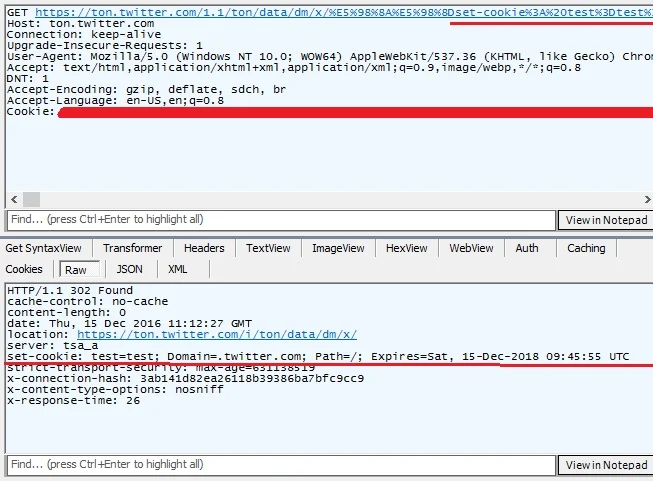
###[1] CRLF: It's similar to #52042 but weaker to reproduce go to: https://ton.twitter.com/1.1/ton/data/dm/x/%E5%98%8A%E5%98%8Dset-cookie%3A%20test%3Dtest%3B%20Domain%3D.twitter.com%3B%20Path%3D%2F%3B%20Expires%3DSat%2C%2015-Dec-2018%2009%3A45%3A55%20UTC
you will find that test cookie with the value test has been added to your cookies
###[2] XSS:
XSS can occur by injecting a .jpg image
and uploading it to twitter
then changing the extension from .jpg to .html
to reproduce open messages and start a conversation
upload this image F143743 and send it in the conversation
open the image source url it will look alike
https://ton.twitter.com/i/ton/data/dm/123456789/987654321/AbCdEf.jpg:large
remove the last part :large
and put %23.html
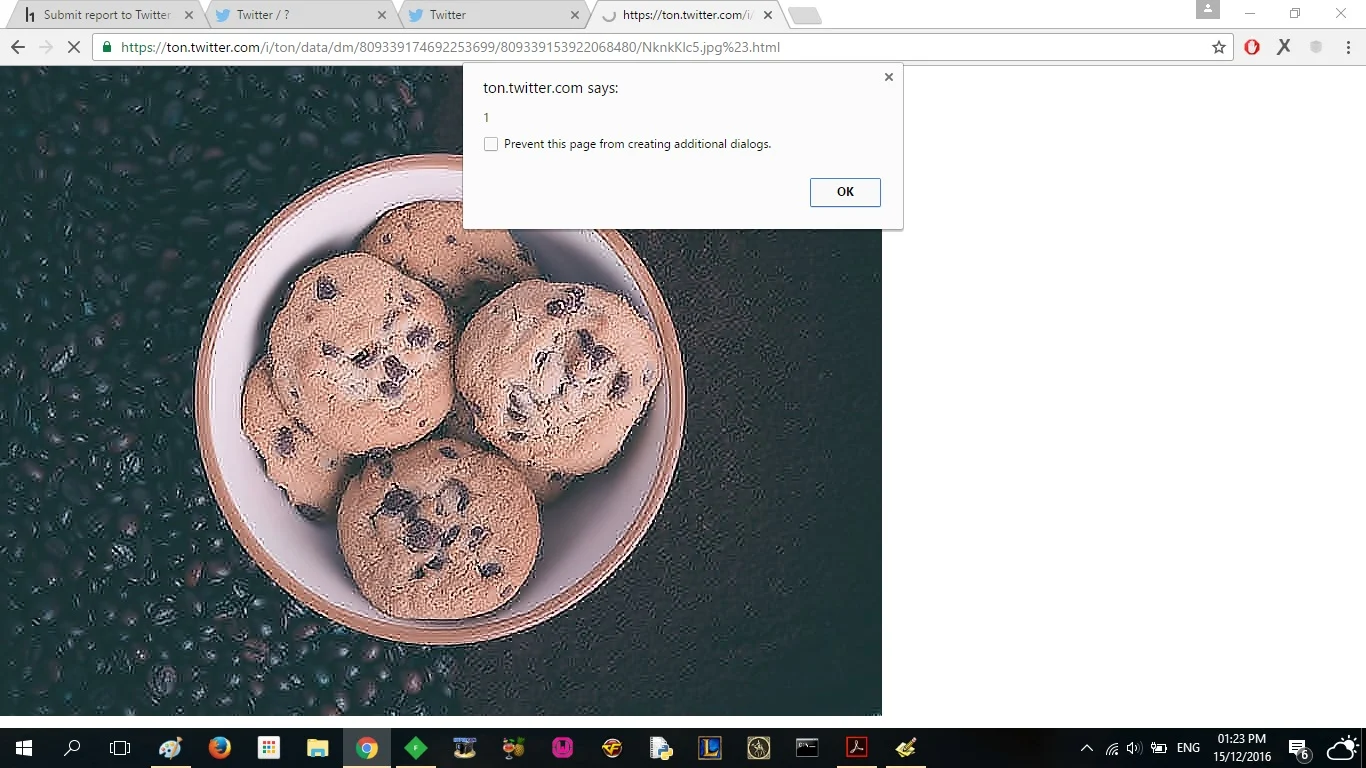
XSS popup box will popup
however this image can only appear to you and to the one who you send it to because it is a private message and to send the message you have to follow the victim and the victim has to follow you in most cases and ton.twitter.com has no valuable cookies at all so the impact will be a phishing page or let the victim downloading a malicious software after sending the injected image on a message
###CRLF + XSS:
both bugs separately are too weak
but by joining them together the impact will be much more powerful
ton.twitter.com showing the image to the one who has a valid auth_token cookie with a value that has the right to see the injected image
as example the attackers' auth_token is valid and has the right to see the injected image
so if the attacker injected his own auth_token to the victim by CRLF
the injected image will appear to the victim even if the victim not following you
causing a XSS to occur
the following URL will:
[1] change auth_token value to my own auth_token value to make the injected image appear in your pc
[2] will redirect you to the injected imaged
[3] Javascript will be executed causing attacker's phishing page to appear
https://ton.twitter.com/1.1/ton/data/dm/809353163740483587/809353151434330112/O5hEYiOt.jpg%2523.html%E5%98%8A%E5%98%8Dset-cookie%3A%20auth_token%3Db2868e3d5fd901a1cf4819afd147ee893f331294%3B%20Domain%3D.twitter.com%3B%20Path%3D%2F%3B%20Expires%3DSat%2C%2015-Dec-2018%2009%3A45%3A55%20UTC%3BSecure%3BHTTPOnly
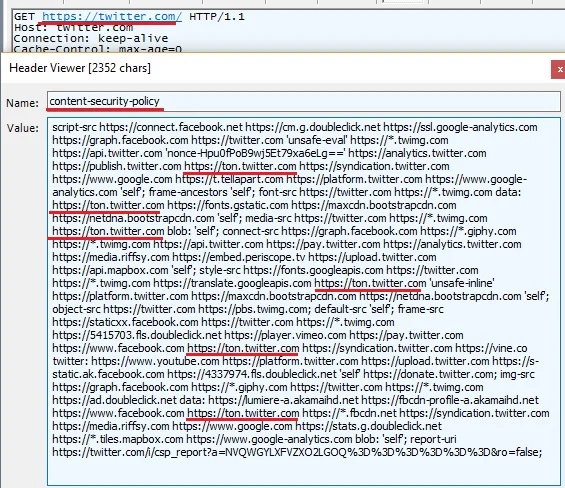
###Impacts [1] phishing [2] crlf injection (cookie injection & DOS may occur & cache poisoning ) [3] under certain circumstances it may lead to bypassing CSP in https://twitter.com
###POCS F143759 F143760 F143761
Thank you!
Attachments

Not written yet. The AI write-up for this report has not been written yet. The Original tab links to the source.
How it worked
Root cause
Likely the image host failed to sanitise newline characters in the request path before writing it into response headers, and it served uploaded files based on a user-controlled extension rather than a fixed image content type.
Impact
The XSS is limited to private messages visible only to sender and recipient, and ton.twitter.com holds no valuable cookies, so the realistic impact is a phishing page or tricking the victim into downloading malware; the combined CRLF plus XSS could show the injected image to a victim who does not follow the attacker.
What the attacker needed
Attacker and victim follow each other (most cases); victim opens a crafted link; attacker has a valid auth_token
How it was found
- Open the crafted ton.twitter.com URL containing encoded newline and set-cookie text.
- Observe that a test cookie has been added to the browser.
- Upload a .jpg image to a direct message conversation.
- Change the extension from .jpg to .html in the image source URL.
- Open the modified URL and see the script execute as a popup.
Explained by bugbounty.wiki with AI from the original and checked against quotes from it; it can still be wrong. Read the original before relying on a detail.
Not written yet. The AI write-up for this report has not been written yet. The Original tab links to the source.
A web server puts some of the URL into its reply headers. If it does not clean up special newline characters, an attacker can sneak in extra headers, such as a cookie-setting one. Separately, the image host let an uploaded picture be opened as a web page, so script inside it ran in the browser.
What is XSS?
Script an attacker supplies runs in another user's browser, on the target's origin, with that user's session.






