POODLE SSLv3 bug on multiple twitter smtp servers (mx3.twitter.com,199.59.148.204,199.16.156.108 and 199.59.148.204)
Multiple Twitter SMTP servers were found to support the SSLv3 protocol, which is vulnerable to the POODLE padding-oracle attack. An attacker in a man-in-the-middle position could potentially decrypt parts of the encrypted traffic.
 Originally disclosed on HackerOne
- Triaged in 7 days
- Fixed in 2 months
- Paid in 8 days
- Disclosed after 3 months
Summary: POODLE SSLv3 bug on multiple twitter smtp servers
Description: CVE-2014-3566: The SSL protocol 3.0, as used in OpenSSL through 1.0.1i and other products, uses nondeterministic CBC padding, which makes it easier for man-in-the-middle attackers to obtain cleartext data via a padding-oracle attack, aka the "POODLE" issue.
Steps To Reproduce:
Hi Twitter Sec team here is the POC
- get a nmap installation and twitter_smtp_ssl_servers.txt file (attached)
- run this command :
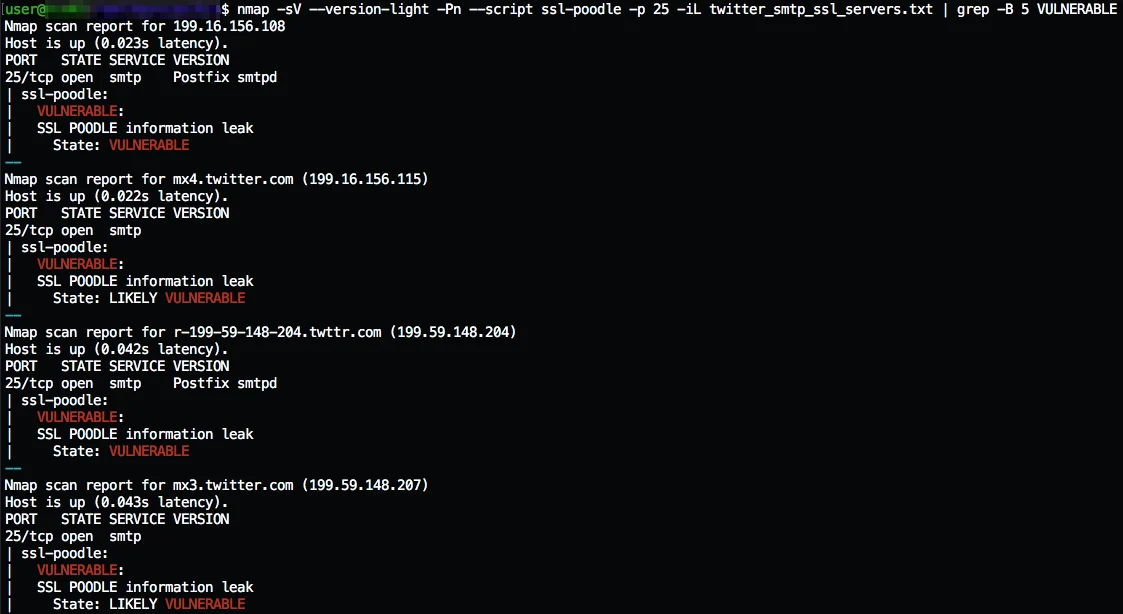
"nmap -sV --version-light -Pn --script ssl-poodle -p 25 -iL twitter_smtp_ssl_servers.txt | grep -B 5 VULNERABLE" 3. See the results
Supporting Material/References:
- An output screentshot and the twitter_smtp_ssl_servers.txt are attached.
Attachments
What the report shows
The target is Twitter's SMTP infrastructure, in scope as *.twitter.com. The researcher reported that several Twitter SMTP servers still accepted SSLv3 and were therefore exposed to the POODLE issue, tracked as CVE-2014-3566. The report names the affected hosts as mx3.twitter.com, [redacted], [redacted] and repeats [redacted] in the title.
The description is a short restatement of the CVE: SSL 3.0, as used in OpenSSL through 1.0.1i and other products, uses nondeterministic CBC padding, which makes it easier for man-in-the-middle attackers to obtain cleartext data via a padding-oracle attack.
The reproduction is a three-step scan:
- Obtain an nmap installation and the
twitter_smtp_ssl_servers.txtfile, which the researcher attached. - Run the following command:
nmap -sV --version-light -Pn --script ssl-poodle -p 25 -iL twitter_smtp_ssl_servers.txt | grep -B 5 VULNERABLE
- Read the results.
The command runs version detection with the light intensity setting, skips host discovery with -Pn, targets port 25 on every host listed in the input file, and applies nmap's ssl-poodle script. The output is filtered with grep -B 5 VULNERABLE so that each host flagged as vulnerable is shown together with the five lines preceding the match, which normally carry the host and port context.
The supporting material is an output screenshot and the server list file. The report attaches an output screenshot:
Root cause
The scan flagged the SMTP service on port 25 as accepting SSLv3, which is what makes the padding-oracle attack possible. SSLv3's CBC padding is not deterministic and its padding check leaks through distinguishable error behaviour, which is what makes the padding-oracle attack possible. The report points at the protocol version being enabled rather than at a specific application bug.
Impact
As the report frames it, a man-in-the-middle attacker could obtain cleartext data from connections to the affected servers via a padding-oracle attack. The report does not demonstrate an interception or recover any data; the finding is the presence of the vulnerable protocol version on the scanned hosts.
How this kind of bug works
POODLE abuses the way SSL 3.0 handles CBC-mode padding. The record MAC covers the plaintext and the padding, but the padding length byte is the last byte of the decrypted block, so an attacker who can inject ciphertext blocks and observe whether the server rejects the record can use the server as an oracle. By manipulating a block and watching for a padding error versus a MAC error, the attacker learns bytes of the plaintext one at a time. Because SSL 3.0 does not specify the padding contents, only the length, an attacker can also shift a target byte into the padding position and recover it with roughly 256 tries per byte.
The attack requires the ability to sit between client and server and to force or observe many connections, which is why it is classed as a man-in-the-middle issue. TLS 1.0 and later include the MAC-then-encrypt structure but add explicit IVs and, in TLS 1.1 and 1.2, other mitigations; the cleanest defence is to stop negotiating SSLv3 at all. Modern stacks also implement the TLS fallback signalling and padding checks that make the oracle harder to use, but disabling the protocol remains the primary control.
How to test for it
Look for services that terminate TLS, including non-HTTP ones such as SMTP, IMAP, POP3 and LDAP, both on dedicated TLS ports and behind STARTTLS. Mail exchangers are a common place to find old protocol support because they are often run by separate teams and upgraded on a slower cycle.
A practical method:
- Enumerate the hosts and ports in scope, including the mail ports and any port that offers STARTTLS.
- For each endpoint, attempt a handshake restricted to SSLv3. A positive result is a completed handshake with the server selecting SSLv3, not merely the server listing it in a cipher suite response.
- Where a scanner script is used, confirm the finding manually with a client that can pin the protocol version, so the result does not depend on the scanner's interpretation.
- Record the host, port and the negotiated protocol version as evidence.
Common false positives: a server that advertises SSLv3 ciphers but refuses the handshake, a load balancer that answers for one backend while another backend differs, and scanner output produced against a host that was not actually reachable. Also check whether the endpoint is a shared service outside the program's scope before reporting.
How it is fixed
Disable SSLv3 in the server configuration and in any TLS-terminating proxy or load balancer in front of it, and prefer TLS 1.2 or later. Where the software allows it, enable the TLS fallback SCSV so clients that try to downgrade are refused, and keep the OpenSSL or equivalent library patched. After the change, re-run the same handshake test to confirm SSLv3 is rejected.
Hunting notes
This class of finding hides in infrastructure that is easy to overlook: mail servers, internal APIs exposed to the internet, appliances and older load balancers. Recon signals include hosts that answer on port 25, 465, 587, 993 or 995, certificate common names that differ from the web tier, and version banners that suggest an old TLS stack. Because the issue is about protocol negotiation rather than an application endpoint, the evidence that convinces a program is a reproducible handshake showing SSLv3 selected, together with the exact host and port. Keep the scope check explicit: confirm the host belongs to the program before spending time on it, and report the protocol version and the command or client used so the triager can repeat the result.
What happened, in plain words
Twitter runs mail servers that speak SMTP. Those servers are part of the company's infrastructure, and the report treats them as in scope because they fall under *.twitter.com. The researcher found that several of these mail servers still accepted an old, broken version of the encryption protocol used to protect connections, called SSL 3.0. Because of that, the servers were exposed to a well-known flaw nicknamed POODLE, tracked as CVE-2014-3566.
The report names the affected hosts as mx3.twitter.com, [redacted] and [redacted], and repeats [redacted] in the title.
A quick comparison helps here. When your browser or mail program connects to a server, the two sides agree on a set of rules for scrambling the traffic so nobody in the middle can read it. That agreement is called a handshake, and the rulebook is the protocol version. SSL 3.0 is a very old edition of that rulebook, published in the 1990s, and it has a design weakness. POODLE is the name given to the attack that exploits it. The description in the report restates the official CVE entry: SSL 3.0, as used in OpenSSL through 1.0.1i and other products, uses nondeterministic CBC padding, which makes it easier for man-in-the-middle attackers to obtain cleartext data via a padding-oracle attack. Each of those terms is unpacked in the glossary at the end.
The point of the report is simple: these mail servers should have refused SSL 3.0, and they did not.
How the researcher checked it
The researcher used a free scanning tool called nmap, which probes machines on a network and reports what services they run and how they are configured. The reproduction has three steps.
- Install nmap and obtain the file
twitter_smtp_ssl_servers.txt, which the researcher attached. That file is the list of servers to test, passed to the scan with-iL. - Run this command:
nmap -sV --version-light -Pn --script ssl-poodle -p 25 -iL twitter_smtp_ssl_servers.txt | grep -B 5 VULNERABLE
- Read the results.
Line by line, the command does the following:
nmapstarts the scanner.-sVasks nmap to detect the version of each service it finds, not just the port number.--version-lighttells it to use a lighter, faster set of probes for that detection.-Pnskips the usual first step of checking whether a host is up, and probes it directly. Mail servers often ignore the ping-style probes nmap sends by default, so without this flag they could be wrongly reported as down.--script ssl-poodleruns a built-in nmap script written specifically to test whether a service accepts SSL 3.0 in a way that exposes it to POODLE.-p 25limits the scan to port 25, the standard port for SMTP, the protocol mail servers use to pass email between each other.-iL twitter_smtp_ssl_servers.txtreads the target list from that file.| grep -B 5 VULNERABLEpipes the output intogrep, a text filter, which keeps only the lines containing the word VULNERABLE and also shows the five lines before each match (-B 5). Those preceding lines normally carry the host and port, so each flagged server appears with its context rather than as a bare word.
Step 2 matters because it turns a vague worry into a repeatable test: anyone with nmap and the same list can run the identical command. Step 3 matters because the output is the evidence. The report attaches an output screenshot:
In general, how this kind of bug works
POODLE abuses the way SSL 3.0 handles padding. When data is encrypted in blocks of a fixed size, the last block usually needs some filler bytes to round it up, and that filler is the padding. In SSL 3.0 the receiving side checks the padding and, if it is wrong, reacts differently than it does to a corrupted message. An attacker who can sit between two parties and tamper with the encrypted traffic can therefore use the server as an oracle: a machine that answers yes or no to carefully crafted questions. By watching whether a padding error or a different error comes back, the attacker learns the plaintext one byte at a time. Because SSL 3.0 does not specify what the padding bytes contain, only how many there are, the attacker can also shift a target byte into the padding position and recover it with roughly 256 tries per byte.
That is why the flaw is classed as a man-in-the-middle issue: it needs someone positioned on the network path, able to force or observe many connections. The cleanest defence is to stop negotiating SSL 3.0 at all. Newer versions of the protocol, TLS 1.0 and later, keep a similar structure but add protections that make the oracle far harder to use, and TLS 1.1 and 1.2 add more. Modern software also implements fallback signalling and stricter padding checks, but switching the old protocol off remains the primary control.
When testing for this, look at every service that encrypts traffic, not only websites. Mail servers, IMAP, POP3 and LDAP all do, both on their dedicated encrypted ports and through a feature called STARTTLS, which upgrades a plain connection to an encrypted one. Mail exchangers are a common place to find old protocol support because they are often run by separate teams and upgraded on a slower cycle. A practical method:
- List the hosts and ports in scope, including mail ports and anything offering STARTTLS.
- For each one, try a handshake restricted to SSL 3.0. A real finding is a completed handshake where the server actually chose SSL 3.0, not merely a server that lists old ciphers in a response.
- If a scanner script is used, confirm the result by hand with a client that can pin the protocol version, so the conclusion does not rest on the scanner's interpretation.
- Record the host, the port and the negotiated protocol version as evidence.
Watch for false positives: a server that advertises SSL 3.0 ciphers but refuses the handshake, a load balancer that answers for one backend while another differs, and scanner output produced against a host that was not actually reachable. Check that the endpoint belongs to the program before spending time on it.
The fix is to disable SSL 3.0 in the server configuration and in any proxy or load balancer in front of it, and to prefer TLS 1.2 or later. Where the software allows it, enable the TLS fallback signalling so clients that try to downgrade are refused, and keep the encryption library patched. Afterwards, re-run the same handshake test to confirm SSL 3.0 is rejected.
This class of finding hides in infrastructure that is easy to overlook: mail servers, internal APIs exposed to the internet, appliances and older load balancers. Useful signals are hosts answering on mail ports such as 25, 465, 587, 993 or 995, certificates whose names differ from the web tier, and version banners suggesting an old encryption stack. Because the issue is about protocol negotiation rather than an application endpoint, the evidence that convinces a program is a reproducible handshake showing SSL 3.0 selected, together with the exact host and port, and the command or client used so the triager can repeat it.
Glossary
- SMTP: the protocol mail servers use to send and relay email; port 25 is its standard port.
- Mail exchanger (MX): a server that receives email on behalf of a domain.
- SSL 3.0: an old version of the encryption protocol used to protect network connections, now considered insecure.
- TLS: the successor to SSL; versions 1.0 and later are the modern standard.
- Handshake: the opening exchange in which client and server agree on protocol version, ciphers and keys.
- CVE: a public identifier for a known security flaw, here CVE-2014-3566.
- POODLE: the nickname of the attack that exploits SSL 3.0's padding handling.
- OpenSSL: a widely used software library that implements SSL and TLS.
- CBC: a mode of encryption that chains fixed-size blocks of data together.
- Padding: filler bytes added to the last block so the data fits the block size.
- Padding oracle: a server whose different error responses reveal whether padding was correct, letting an attacker learn plaintext.
- Man-in-the-middle: an attacker positioned on the network path between two parties, able to read or alter traffic.
- Cleartext: data that is not encrypted and can be read directly.
- STARTTLS: a command that upgrades an already open plain connection to an encrypted one.
- nmap: a free tool that scans hosts and ports and reports which services they run.
- Port: a numbered channel on a machine that a particular service listens on.
- grep: a command-line text filter that prints lines matching a pattern.
- False positive: a result that looks like a problem but is not one on closer inspection.
- CVSS: a standard scoring system for rating the severity of a vulnerability.



