YAHOO IDOR -elimination of any comment
A Yahoo product page accepted a comment identifier in a request without checking that the comment belonged to the requesting user. By changing the identifier to another user's value, an attacker could delete any comment on the site.

Hello everyone, my name is Bernardo and I’m from Chile, this time I bring you a bug (IDOR) that I found in Yahoo that allows you to remove any comments on the website.
The full write-up lives on its author's site
It belongs to its author, so we link to it rather than copy it. The other two tabs are our own rewrites, checked against it.
What the report shows
The researcher, writing as Bernardo from Chile, describes an IDOR (Insecure Direct Object Reference) found on a page under *.yahoo.com. The feature involved was a product page where users could leave comments and evaluations. The researcher looked at the comments and evaluations left by users on the site.
The proof of concept is built around that identifier. First the researcher captured the request for a comment they had written themselves, where the identifier belonged to them:
Id = my own
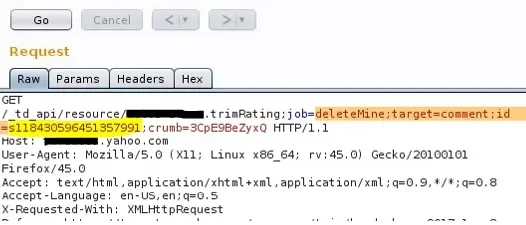
The next step was to substitute the identifier of another user's comment into the same request:
id = user

With the other user's identifier in place, the comment belonging to that user was deleted. The researcher's reaction to the result is captured in the final image:

The report does not give the exact endpoint, the HTTP method, the full request or the response, and it does not state a severity rating, a CVSS score, a bounty amount or a fix.
Root cause
The likely cause is that the delete operation trusted the comment identifier supplied by the client and did not check that the comment belonged to the authenticated user.
Impact
The report demonstrates that an attacker could delete comments belonging to other users on the affected site. The report does not describe any other effect, such as reading private data or modifying content, so the demonstrated impact is limited to deletion of other users' comments.
How this kind of bug works
An IDOR appears when an application exposes an internal object reference (a numeric ID, a UUID, a filename, an order number) and uses it to act on a record without verifying that the caller is allowed to act on that particular record. Authentication proves who you are; authorisation decides what you may touch. When the second check is missing, any authenticated user can operate on any object whose reference they can supply.
The bug is common in delete, edit and view endpoints because developers often assume that a user will only ever send their own identifiers. Predictable identifiers make the problem worse, since an attacker can walk the range. Even unguessable identifiers do not fix the issue if they leak elsewhere, for example in listing pages, emails or shared links.
Defences are ownership checks on the server for every object-level action, ideally enforced centrally so that no endpoint forgets them, and the use of indirect references where the server maps a session-scoped token to the real object.
How to test for it
- Identify features that act on a single object: delete, edit, view, download, share. Note the request that performs the action.
- Create two accounts, A and B, and create an object under each (a comment, a draft, an upload).
- Capture the request from account A acting on A's object. Record every identifier in the path, query string and body.
- Replay the same request while authenticated as account B, substituting A's identifier. Do not change anything else.
- A positive result is a successful response that actually changes or reveals A's object, confirmed by checking A's view of the data, not just the status code.
- Also try removing the identifier, sending an empty value, or sending an array of identifiers, since some frameworks bind these loosely.
Common false positives: the server returns a generic success message but nothing changes; the object is public by design; the endpoint checks ownership but the UI simply hides the button; or a cached response makes it look as though the action succeeded. Always verify the effect on the victim object.
How it is fixed
- Enforce an ownership or permission check on the server for every object-level operation, based on the authenticated identity, not on client-supplied data.
- Prefer indirect references, mapping a per-session token to the real object on the server.
- Apply the check in a shared authorisation layer so new endpoints inherit it.
- Return a consistent error for unauthorised access so that the response does not reveal whether the object exists.
- Log and rate-limit repeated failed object accesses to catch enumeration.
Hunting notes
IDORs cluster around features that were added quickly: comment and review systems, draft and draft-preview endpoints, file and invoice downloads, notification and message APIs, and any mobile or internal API that mirrors the web app. Recon signals include numeric or sequential identifiers in URLs and JSON bodies, endpoints that accept an ID alongside a session, and separate API hosts that may lag behind the web application in authorisation checks.
To make a report accepted, show the request from the victim's perspective and the request from the attacker's, prove the effect on the victim object with before and after evidence, and state clearly what an attacker gains. Where the identifier is enumerable, demonstrate a small range rather than a single value, and stop as soon as impact is proven.
What happened, in plain words
A security researcher found a bug on a Yahoo website where users could leave comments and evaluations on products. The bug let one person delete another person's comment, even though that comment did not belong to them.
The type of bug is called an IDOR, which stands for Insecure Direct Object Reference. To understand it, imagine a cloakroom where you hand in your coat and get a ticket with a number on it. If the attendant hands back any coat whose ticket number you say out loud, without checking that the ticket is really yours, you could ask for someone else's coat just by guessing their number. A website has the same problem when it lets you act on a record (a comment, a photo, an order) purely by naming its number, without checking that the record belongs to you.
On the product page, each comment had an identifier, a short value that the website used to refer to that specific comment. The researcher looked at the comments and evaluations left by users on the site. A request is simply the message your browser sends to a website's server, for example "please delete comment number 123".
The researcher first wrote a comment of their own and captured the request that deleted it. The identifier in that request belonged to them:
Id = my own
This step matters because it gives a known, working example: a request that is definitely allowed, because the comment is the researcher's own.
The next step was to take the same request and swap in the identifier of a different user's comment:
id = user
The identifier of another user's comment was used in place of the researcher's own.
The other user's comment was deleted. The final image captures the researcher's reaction to seeing it work. That is the whole bug: a comment belonging to another user could be deleted.
The report does not give the exact web address, the full request, the response, a severity rating, a bounty amount or details of a fix.
In general, how this kind of bug works
Every website that has user accounts does two separate jobs. Authentication proves who you are, like showing your passport at a border. Authorisation decides what you are allowed to touch once you are inside, like a hotel key card that opens only your room. An IDOR happens when authentication is in place but authorisation is missing for a particular record.
The record is named by an object reference: a number, a random-looking string, a file name, an order number. When that reference is direct, meaning the website uses it as-is to find the record, anyone who can supply a different reference can act on a different record. Delete, edit and view features are the usual places, because developers often assume a user will only ever send their own identifiers.
Predictable identifiers make it worse. If comment numbers run 1, 2, 3 and so on, a person can simply try the next number. Even hard-to-guess identifiers do not fully protect a site if they leak somewhere else, such as in a listing page, an email or a shared link.
The fix is a check on the server, for every action on a single record, that the logged-in person owns or is permitted to touch that record. The check must use who the server knows you to be, never a value the browser supplies. A good design also avoids exposing the real record number at all, giving each session a temporary reference that the server translates internally.
In general, how to test for it
- Find features that act on one record at a time: delete, edit, view, download, share. Note the request each one sends.
- Create two accounts, A and B, and create one record under each, for example a comment or a draft.
- While logged in as A, capture the request that acts on A's record. Write down every identifier in the address, the query string and the body.
- Send that same request again while logged in as B, replacing A's identifier with B's. Change nothing else.
- The bug is confirmed only if the action really succeeds on A's record. Check A's view of the data, not just the success message.
- Also try leaving the identifier out, sending it empty, or sending several identifiers at once, because some frameworks handle these loosely.
Watch for false alarms. A website may show a generic success message while changing nothing, a record may be public by design, the button may simply be hidden in the interface while the server still checks ownership, or a cached page may make an action look successful. Always confirm the effect on the other account's record.
In general, how it is fixed
- Check ownership or permission on the server for every action on a single record, based on the logged-in identity rather than anything the browser sends.
- Prefer indirect references, where the server maps a temporary per-session value to the real record.
- Put the check in one shared layer so that new features inherit it automatically.
- Return the same error whether or not the record exists, so the response does not reveal which records are real.
- Log and rate-limit repeated failed attempts, to catch someone trying many identifiers in a row.
Glossary
- IDOR (Insecure Direct Object Reference): a bug where a website lets you act on a record just by naming its identifier, without checking that the record belongs to you.
- Request: the message a browser sends to a website's server, such as a request to delete a comment.
- Server: the computer that runs a website and answers requests from browsers.
- Identifier (ID): a value, often a number, that a website uses to refer to one specific record.
- Object reference: the identifier a website uses to look up a record such as a comment, file or order.
- Authentication: proving who you are, usually by logging in.
- Authorisation: deciding what a logged-in person is allowed to do or touch.
- Session: the period during which a website remembers that you are logged in.
- Endpoint: a specific address on a website that performs a particular action.
- HTTP method: the word in a request, such as GET or POST, that says what kind of action is wanted.
- Query string: the part of a web address after the question mark, often carrying values such as identifiers.
- Body: the part of a request that carries data, used by methods such as POST.
- Enumeration: trying identifiers one after another, for example 1, 2, 3, to find records that are not yours.
- False positive: a result that looks like a bug but is not one, for example a success message with no real effect.
- Rate-limit: a cap on how many requests a website accepts in a period of time.
- Proof of concept (POC): a small demonstration that proves a bug is real.