Verification of email addresses possible through https://www.yelp.com/signup/facebook
The Yelp signup endpoint for Facebook-linked accounts returns different responses depending on whether an email address is already registered, allowing an attacker to check if a given email is in use. The endpoint lacks rate limiting and CSRF token validation, so an attacker can test many email addresses quickly.

- Paid in 5 months
- Disclosed after 9 months
Hi,
There is an issue with the https://www.yelp.com/signup/facebook endpoint which allows an attacker to validate whether a specific email address is registered on Yelp. There seems to be no rate limit nor a validation for already used CSRF tokens.
Steps to reproduce:
- Go to https://www.yelp.com/login?return_url=%2F and sign up with a facebook account which is not linked to any yelp account yet.
- After confirming the access on FB, yelp will request to enter an email address and a password, as well as the ZIP code to finish the account creation. Enter any email address/password/zip code.
- Capture the request to https://www.yelp.com/signup/facebook with a HTTP sniffer.
The request body like this (unvalidated/unimportant parameters are ommited):
first_name=<FIRSTNAME>&last_name=<LASTNAME>&fb_access_token=<FB_TOKEN>&email=<EMAIL>&post_csrf=<CSRF>&csrftok=<CSRFTOK>&password=<PASSWORD>&zip=<ZIP>
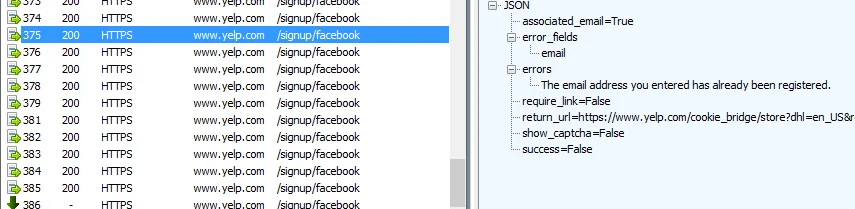
The response if the email address is already used by another user:
{
   "errors":[
      "The email address you entered has already been registered."
   ],
   "require_link":false,
   "success":false,
   "error_fields":[
      "email"
   ],
   "show_captcha":false,
   "return_url":"https://www.yelp.com/cookie_bridge/store?dhl=en_US\u0026redir=https%3A%2F%2Fwww.yelp.com%2Ffind_friends%2Ffacebook",
   "associated_email":true
}
Should the email address not be used by any user, we get the following response:
{
   "errors":[

   ],
   "photo_id":"<PHOTO_ID>",
   "success":true,
   "error_fields":[

   ],
   "show_captcha":false,
   "return_url":"https://www.yelp.com/cookie_bridge/store?dhl=en_US\u0026redir=https%3A%2F%2Fwww.yelp.com%2Ffind_friends%2Ffacebook"
}
Knowing how the responses look like and having a valid cookie collection, as well as the values for post_csrf and csrftok parameters and the FB access token from the captured request, an attacker can test a large list of email addresses against the https://www.yelp.com/signup/facebook endpoint. I could submit hundreds of requests to the given endpoint within a short time with the [email protected] email address whch definitely indicates that there is no rate limit.
Attachments
Not written yet. The AI write-up for this report has not been written yet. The Original tab links to the source.
How it worked
Root cause
Likely the signup endpoint returns a distinct error message for already-registered emails and does not enforce rate limiting or CSRF token uniqueness, enabling enumeration.
Impact
An attacker could determine whether a given email address is registered on Yelp, and the lack of rate limiting allows testing many addresses quickly.
What the attacker needed
A Facebook account not linked to Yelp; ability to capture HTTP requests; valid CSRF tokens and FB access token
How it was found
- Sign up with a Facebook account not linked to Yelp.
- After confirming Facebook access, enter any email, password, and ZIP code to finish account creation.
- Capture the request to the signup endpoint with an HTTP sniffer.
- Observe that the response differs when the email is already registered versus not registered.
- Use the captured CSRF tokens and Facebook access token to test a large list of email addresses.
Explained by bugbounty.wiki with AI from the original and checked against quotes from it; it can still be wrong. Read the original before relying on a detail.
Not written yet. The AI write-up for this report has not been written yet. The Original tab links to the source.
When you sign up, the website checks if your email is already used. This report shows that the website tells you clearly if an email is taken, and it does not stop you from asking many times. So someone can try lots of email addresses to find out which ones have accounts.
What is Info disclosure?
Data the application should keep private (personal data, internal details, other users' records) reaches someone it should not.



