Found multiple SAP NetWeaver vulnerable services
Two SAP NetWeaver services lacked an authentication check, allowing an unauthenticated attacker to execute configuration tasks and create an administrative user. The reporter demonstrated this by creating a random user on one of the hosts.

- Disclosed after 46 hours
Summary by the program
The report is not applicable since redapi.acronis.com and redapi2.acronis.com are internally developed systems not related to SAP NetWeaver.
The report
Summary:
Hello Team, I found two (redapi.acronis.com and redapi2.acronis.com) sap Netweaver vulnerable services. They do not perform an authentication check which allows an attacker without prior authentication to execute configuration tasks to perform critical actions against the SAP Java system, including the ability to create an administrative user, and therefore compromising Confidentiality, Integrity, and Availability of the system, leading to Missing Authentication Check.
Steps To Reproduce:
- Run the script (Attachment on the original report: acronis_sap.py)
- You will see random user created
POC:
Just for the POC, I have created a random user with creds sapRpoc9049:Secure!PwD6751 (at redapi.acronis.com)
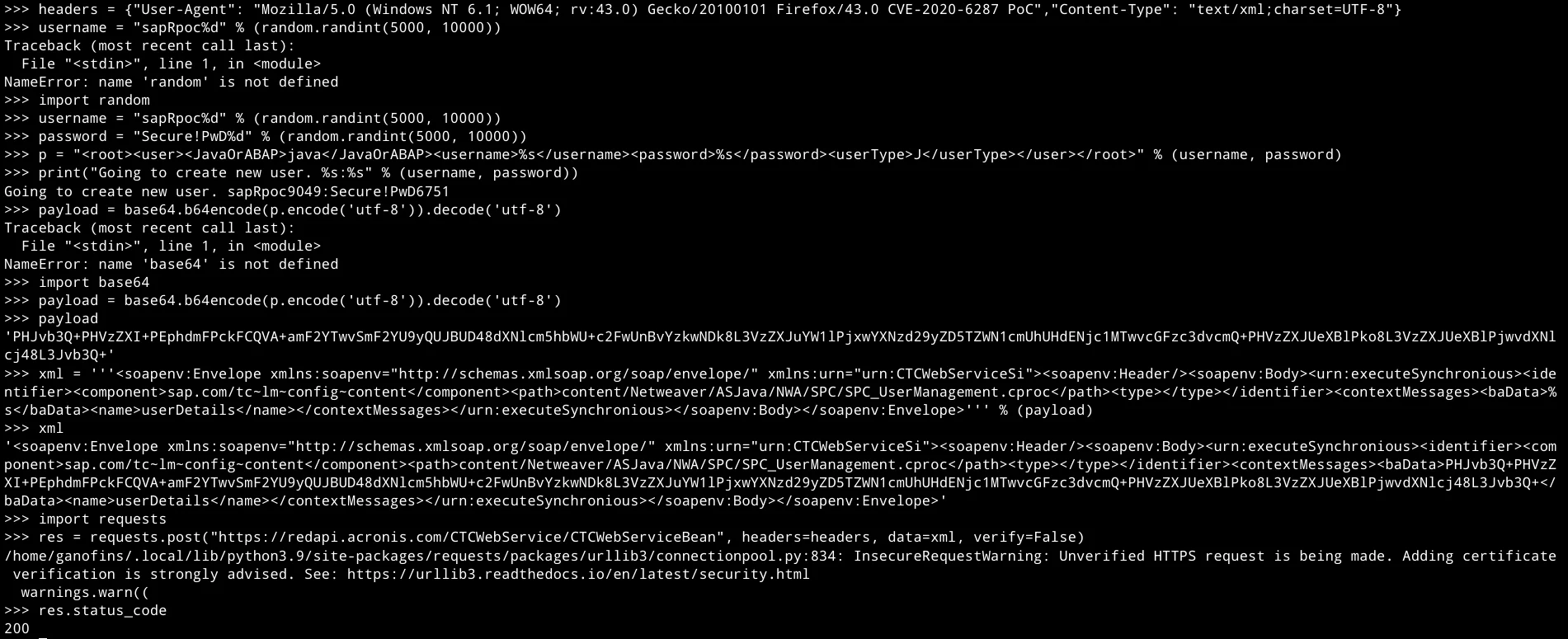
References:
https://github.com/chipik/SAP_RECON https://nvd.nist.gov/vuln/detail/CVE-2020-6286 https://nvd.nist.gov/vuln/detail/CVE-2020-6287 https://launchpad.support.sap.com/#/notes/2934135 https://launchpad.support.sap.com/#/notes/2939665
Please lemme know if you need any additional information reagarding this
Impact
Impact:
This version of SAP netweaver does not perform an authentication check which allows an attacker without prior authentication to execute configuration tasks to perform critical actions against the SAP Java system, including the ability to create an administrative user, and therefore compromising Confidentiality, Integrity, and Availability of the system, leading to Missing Authentication Check.
Not written yet. The AI write-up for this report has not been written yet. The Original tab links to the source.
How it worked
Root cause
Likely the SAP NetWeaver service was missing an authentication check on its configuration interface, as described in the referenced CVE.
Impact
An unauthenticated attacker could create an administrative user, compromising confidentiality, integrity, and availability of the SAP Java system.
What the attacker needed
Network access to the SAP service
How it was found
- Run the provided script against the target hosts.
- Observe that a random user is created.
Explained by bugbounty.wiki with AI from the original and checked against quotes from it; it can still be wrong. Read the original before relying on a detail.
Not written yet. The AI write-up for this report has not been written yet. The Original tab links to the source.
Some SAP systems have a component that lets administrators run setup commands. If that component does not check who is calling it, anyone on the network can run those commands too. Here the reporter showed that they could create a new user account without logging in first.
What is Access control?
A user can do something their role should not allow: reach an admin function, act on a feature they have not paid for, or skip a permission check. IDOR is the special case where the object belongs to someone else.

