Local Privilege Escalation via EXE hijacking with Acronis True Image 2021 - Acronis Scheduler2 Service
The Acronis Scheduler2 Service searches for an executable at a fixed path (C:\Program.exe) that a low-privileged local user could write to, so placing a malicious file there causes it to run with SYSTEM rights when the service starts. This allows a local attacker to escalate privileges to SYSTEM.

- Triaged in 3 days
- Fixed in 5 months
- Disclosed after 4.0 years
Using the latest version of Acronis True Image 2021 (25.4.30480) is possible to perform EXE Hijacking. This could potentially allow an authorized but privileged local user to execute arbitrary code with elevated privileges on the system.
A successful attempt would require the local attacker must insert an executable file in the path of the EXE that is called. Upon the Acronis Scheduler2 Service start/restart , the malicious code will be run with SYSTEM rights.
-Impact: If a local attacker has modifying rights, or is chaining the attack with an arbitrary move/write vulnerability, and be able to store the file in the path from where the EXE is called, allowing to execute code with SYSTEM rights.
-How to Reproduce: 1.Download the latest version of Acronis True Image 2021 installer
URL: https://download.acronis.com/AcronisTrueImage2021.exe
2.Start a procmon utility, from Sysinternal, and monitor "schedul2.exe".
3.Finish the installation 4.During the Acronis Scheduler2 Service start/restart the executable is looking for C:\program.exe Below is an output:
NT AUTHORITY\SYSTEM schedul2.exe 2976 CreateFile C:\Program.exe NAME NOT FOUND
The test was perform on my Windows 10 Pro Version 1909 (OS Build 18363.1016).
I have attached a sample exe file, that when executed will display a pop-up with the message "EXE Loaded". This need to be stored in the C:\ just to demonstrate this behavior, before the installation process begins.
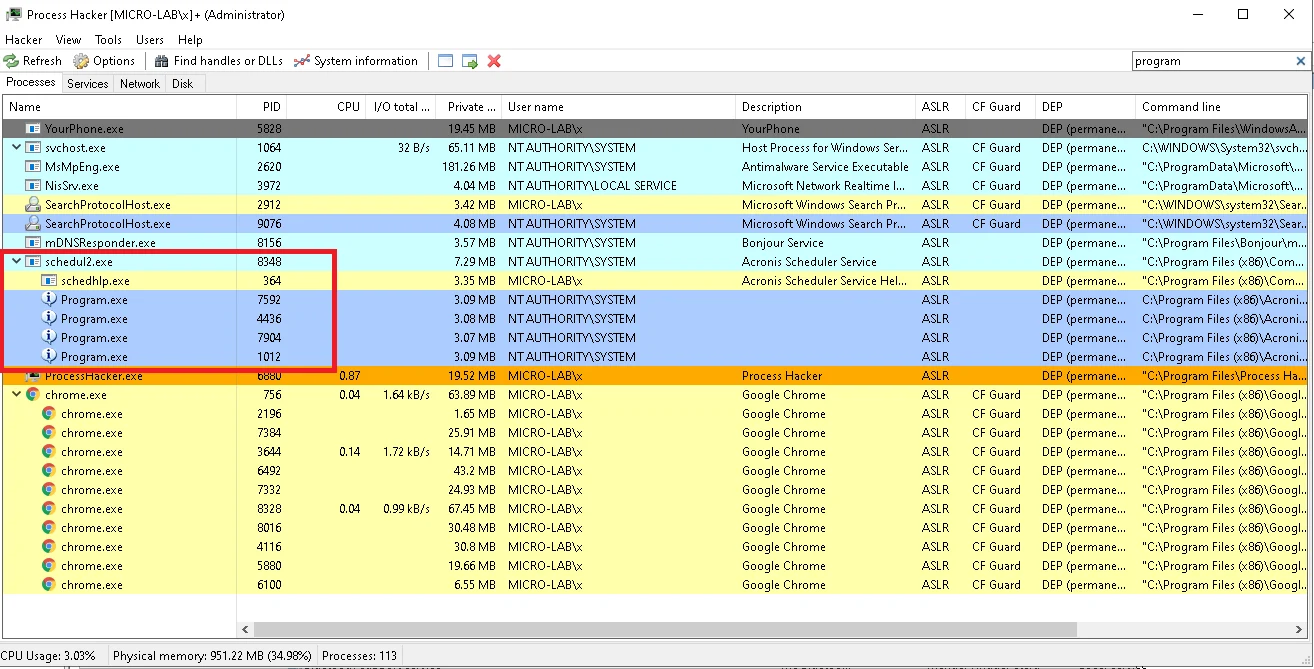
I have attached a print-screen that shows the schedul2.exe is running the sample executable.
Impact
This could potentially allow an authorized low privileged local account to execute arbitrary code in order to perform horizontal and/or vertical privilege escalation.
Attachments
Not written yet. The AI write-up for this report has not been written yet. The Original tab links to the source.
How it worked
Root cause
Likely the service uses an unqualified executable path (C:\Program.exe) instead of a fully qualified path in a protected directory, allowing a low-privileged user to plant a file that the service executes.
Impact
A local low-privileged user could execute arbitrary code with SYSTEM rights, leading to privilege escalation, provided they can write to the path the service searches.
What the attacker needed
Local low-privileged account; write access to C:\; service restart
How it was found
- Download the Acronis True Image 2021 installer.
- Start Process Monitor and monitor the schedul2.exe process.
- Complete the installation.
- When the Acronis Scheduler2 Service starts or restarts, observe that it tries to open C:\Program.exe.
Explained by bugbounty.wiki with AI from the original and checked against quotes from it; it can still be wrong. Read the original before relying on a detail.
Not written yet. The AI write-up for this report has not been written yet. The Original tab links to the source.
A background service runs with SYSTEM rights. When it starts, it tries to run a program from a path an attacker with write access could plant a file in, and that file runs with high permissions.
What is Access control?
A user can do something their role should not allow: reach an admin function, act on a feature they have not paid for, or skip a permission check. IDOR is the special case where the object belongs to someone else.


