Reflected cross-site scripting on multiple Starbucks assets.
404 error pages on multiple Starbucks websites reflected unsanitised double quotes from the URL path into hidden input attributes, allowing an attacker to inject an event handler. An attacker could execute JavaScript in a victim's browser if the victim visited a crafted link and pressed a specific key combination.

- Disclosed after 4 months
Summary by the program
@stealthy discovered that invalid page requests resulting in a 404 error page response were vulnerable to Reflected Cross-site Scripting (XSS) when double encoding a link and persuading the user to press an unusual key combination.
Thank you @stealthy for bringing this to our attention and helping to resolve the issue.
Summary by the researcher
Reflected cross-site scripting on multiple Starbucks in scope assets. The reflection took place in hidden inputs and exploitation required user interaction. This vulnerability affected 404 not found pages.
POC:"accesskey='x' onclick='confirm`1`' // in URL path with double URL encoding to bypass WAF.
The report
NOTE! Thanks for submitting a report! Please replace all the [square] sections below with the pertinent details. Please indicate NA, if not applicable. Remember, the more detail you provide, the easier it is for us to verify and then potentially issue a bounty, so be sure to take your time filling out the report!
Summary: [Many Starbucks websites are vulnerable to cross-site scripting on 404 pages because double quotes lack sanitizing in hidden input tags, which leads to JavaScript execution.]
Description: [Starbucks employs a WAF which redirects any URL with a double quote to an error page. However, using double encoding, this can be bypassed. I used double encoding for most of the payload, which includes white spaces. My payload is below.
htp8bi2zcg%2522%2520accesskey=%2527x%2527%2520onclick=%2527confirm`1`%2527%2520//2injectiontrme47nbfq/blonde/bright-sky-blend/ground=1
The payload is just the on click event with the access key set as x, and the rest of a Starbucks URL added as an arbitrary parameter to make sure the onclick event works.
htp8bi2zcg" accesskey='x' onclick='confirm`1`' //2injectiontrme47nbfq/blonde/bright-sky-blend/ground=1
This vulnerability affects multiple Starbucks websites. Two are listed below.
https://www.starbucks.co.uk/htp8bi2zcg%2522%2520accesskey=%2527x%2527%2520onclick=%2527confirm%601%60%2527%2520//2injectiontrme47nbfq/blonde/bright-sky-blend/ground=1

https://www.starbucks.fr/htp8bi2zcg%2522%2520accesskey=%2527x%2527%2520onclick=%2527confirm%601%60%2527%2520//2injectiontrme47nbfq/blonde/bright-sky-blend/ground=1
The vulnerable HTML is below.
<link rel="canonical" href="https://www.starbucks.co.uk/htp8bi2zcg" accesskey="x" onclick="confirm`1`" 2injectiontrme47nbfq="" blonde="" bright-sky-blend="" ground="1"">
As you can see, the injection is successful.]
Platform(s) Affected: [Tested in Firefox Quantum 67.0.]
Steps To Reproduce:
(Add details for how we can reproduce the issue)
1: Visit the link below.
https://www.starbucks.fr/htp8bi2zcg%2522%2520accesskey=%2527x%2527%2520onclick=%2527confirm%601%60%2527%2520//2injectiontrme47nbfq/blonde/bright-sky-blend/ground=1
2: The key bind on MAC is CONTROL+ALT+X and on Windows is ALT+SHIFT+X.
Supporting Material/References:
- List any additional material (e.g. screenshots, logs, etc.)
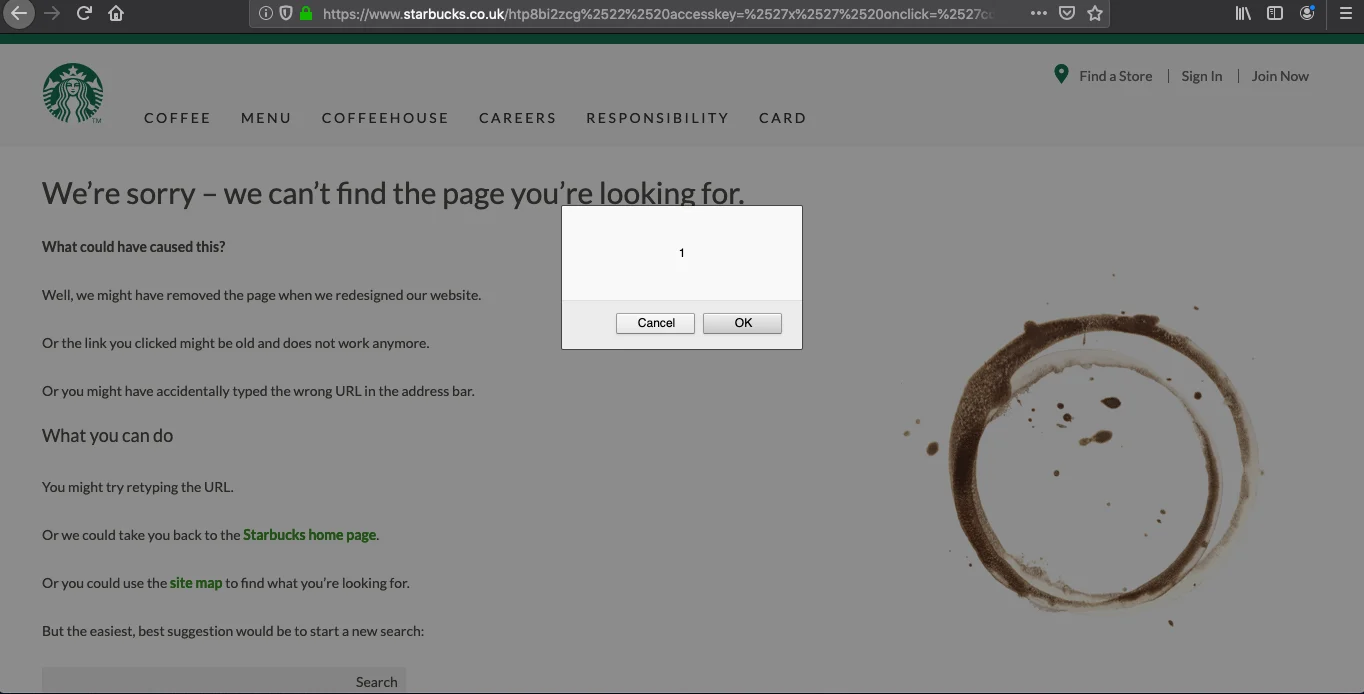
██████
How can the system be exploited with this bug?
Execute arbitrary JavaScript in a victim's browser to steal information or perform unwanted actions on the victim's behalf.
How did you come across this bug ?
I was trying to bypass the double quote filter for SQL injection and came across this XSS when I looked at the HTML.
Recommendations for fix
- Escape double quotes.
Impact
JavaScript is against Starbucks users on multiple critical domains. JavaScript execution results in information theft and an attacker can perform unwanted actions on a victim's behalf.
Not written yet. The AI write-up for this report has not been written yet. The Original tab links to the source.
How it worked
Root cause
Likely the application failed to escape double quotes when reflecting the URL path into HTML attribute values on 404 pages.
Impact
An attacker could execute JavaScript in a victim's browser to steal information or perform actions on the victim's behalf, but exploitation required the victim to press a specific key combination; testing was done in Firefox.
What the attacker needed
Victim visits a crafted link; victim presses a specific key combination
The fix
The recommended fix was to escape double quotes.
How it was found
- Visit the crafted URL containing the double-encoded payload.
- Press CONTROL+ALT+X on a Mac or ALT+SHIFT+X on Windows to trigger the injected event handler.
Explained by bugbounty.wiki with AI from the original and checked against quotes from it; it can still be wrong. Read the original before relying on a detail.
Not written yet. The AI write-up for this report has not been written yet. The Original tab links to the source.
When a page shows an error, it sometimes repeats part of the web address you typed. Here, the site put that text inside a hidden form field without cleaning it. By adding special characters, an attacker could make the page run their own code when the victim pressed a key combination.
What is XSS?
Script an attacker supplies runs in another user's browser, on the target's origin, with that user's session.







