Apple Security Bounty: A personal experience
An iOS app could access a user's location permanently and without consent on iOS 13 and older, bypassing the system's location permission prompt. An attacker could collect location data over time to build motion profiles.
 Published on medium.com
This is my personal story with the Apple Security Bounty program and why I believe it is a lie after reporting an issue, testing fixes and being left in the dark after 14 months.
The full write-up lives on its author's site
It belongs to its author, so we link to it rather than copy it. The other two tabs are our own rewrites, checked against it.
Context
Apple runs a Security Bounty program that invites researchers and developers to report possible critical issues in exchange for a payment. The author notes that experience reports from contributors are hard to find, and this article is his account of one report: a way to access a user's location permanently and without consent on any iOS 13 (or older) device, found in March 2020.
iOS protects user data and the current location of a user by default. Apps cannot access it without user consent, and they normally request it by showing a prompt. Users can grant access once, while the app is in the foreground, or permanently, including when the app is in the background. In practice, users typically grant access only while the app is in the foreground.
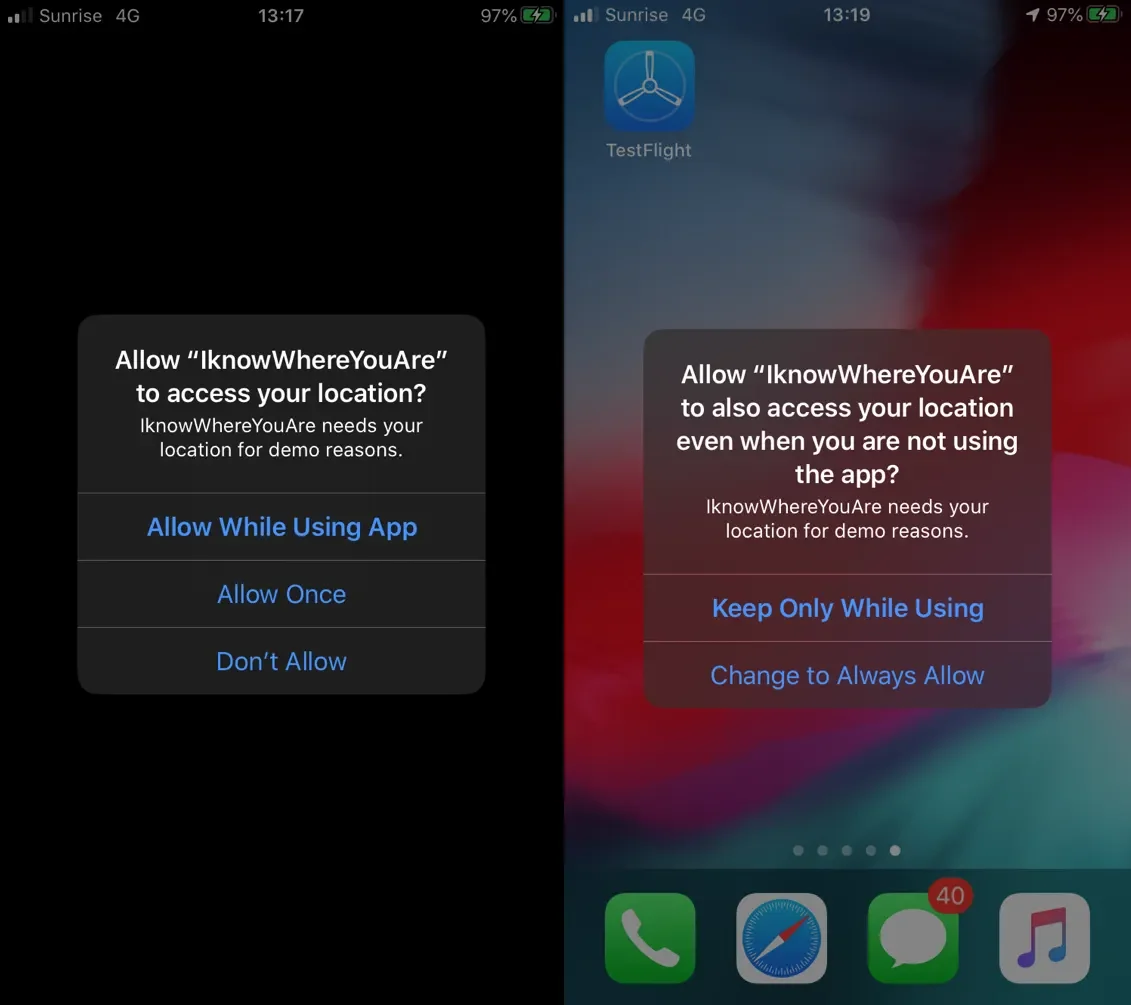
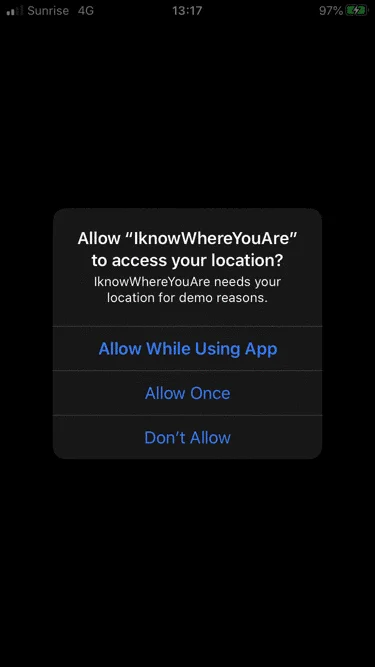
TCC prompt of an app to request access to location data (iOS 13).
The report was accepted, the issue was fixed in iOS 14, and the author was credited in the iOS 14 security content release notes. As of the time of writing, however, Apple had refused any bounty payment, although in the author's view the report clearly qualifies under Apple's own payout guidelines, and Apple declined to elaborate on why it would not qualify.
Setup
The work involved a project that used location and monitored for beacons at the same time. The author does not describe any accounts, roles or tooling beyond this, and deliberately withholds the source code and the instructions for reproducing the unauthorised access, because in his view it remains an open security issue for all iOS users who cannot update their devices to iOS 14. The author assessed the fix and confirmed the iOS 14 beta resolved the issue.
Finding it
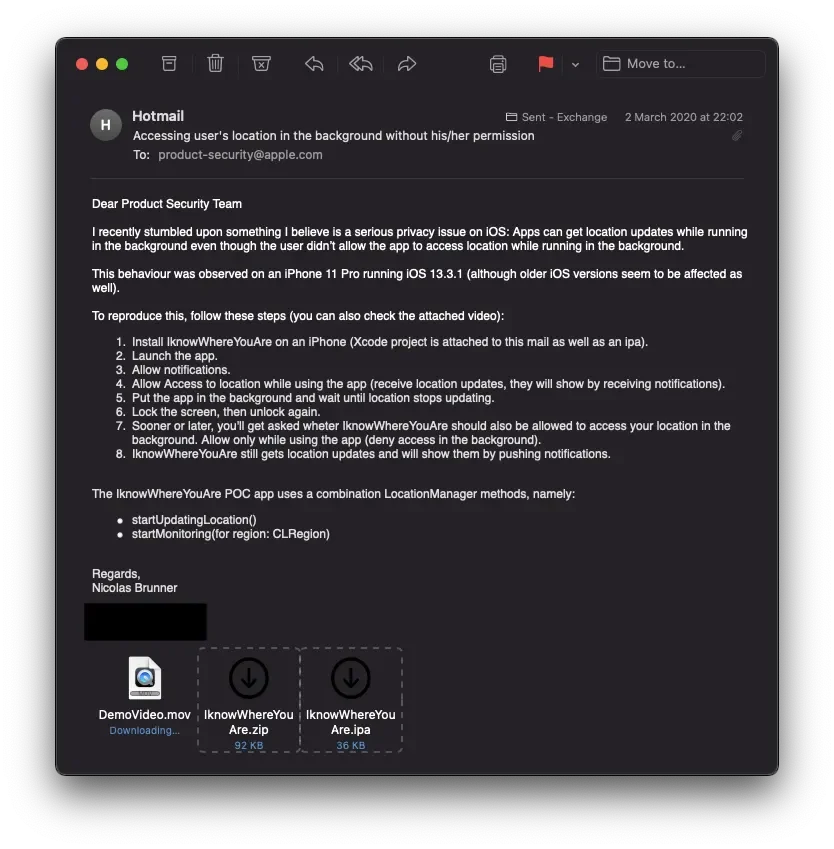
While working on that project, the author found he was suddenly able to permanently access the device's location, even though he had never granted that permission. He decided to write a small demo app and submit a report to the security bounty program.
Demo App showing unauthorized background access to location data on iOS 13.
He judged this a critical issue, particularly given Apple's focus on privacy in recent years. The report does not describe the underlying mechanism, so the precise trigger cannot be reconstructed from the text.
Exploitation
The report does not give reproduction steps, requests or code. The only artefact shown is the demo app, which demonstrates background access to location data on iOS 13 without the user ever granting the permission. The author's stated reason for omitting the details is that the flaw remains open for users who cannot move to iOS 14.
Root cause
The report does not identify the code or design mistake behind the permission bypass. What it does establish is the observable behaviour: an app obtains permanent location access without the TCC prompt being granted. Why the existing consent mechanism did not stop this is not explained in the text.
Impact
On any iOS 13 (or older) device, an app could access a user's location permanently and without consent. The author points out what any app could do with this: collect a user's location over years and store it in its databases to create motion profiles. The author notes the issue remains open for users who cannot update their devices to iOS 14.
Fix
Deven informed the author the issue was fixed in an upcoming security update, and the author confirmed the iOS 14 beta resolved it.
Disclosure and bounty handling
The timeline is the substance of the article:
- March 2020: the issue is found and reported.
- Within a week, a response arrives from "Brittany".
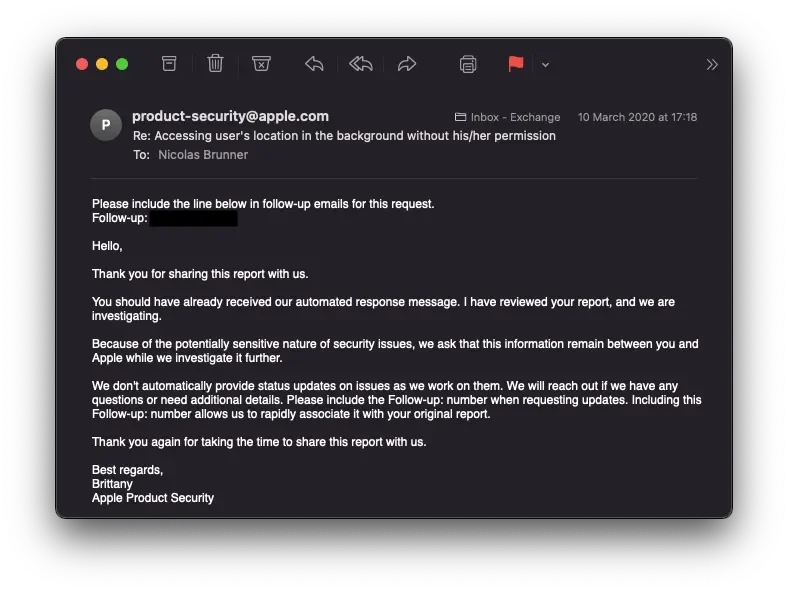
- Six months later, "Deven" says the issue has been fixed in an upcoming security update and asks for the author's assessment. The author tests and confirms the iOS 14 beta resolves it.
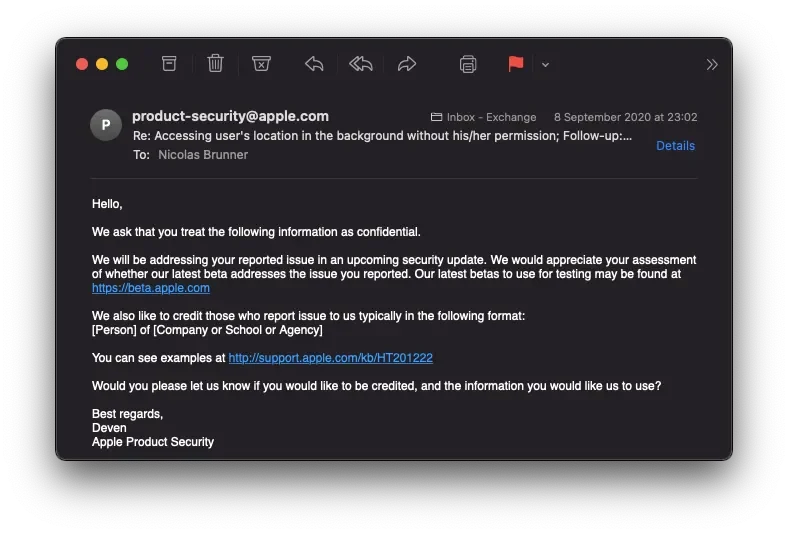
- Deven then says Apple would like to credit the author on the iOS 14 security advisories.
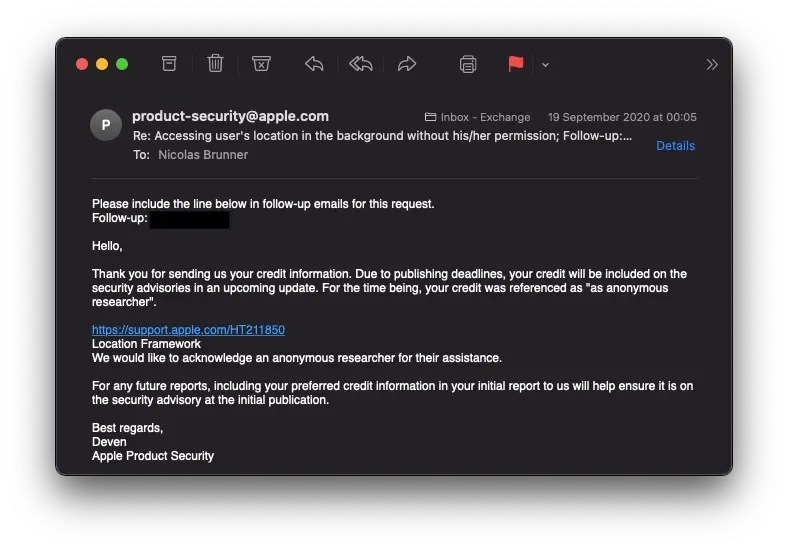
- Over the next 8 months the author asks for the bounty reward on multiple occasions.
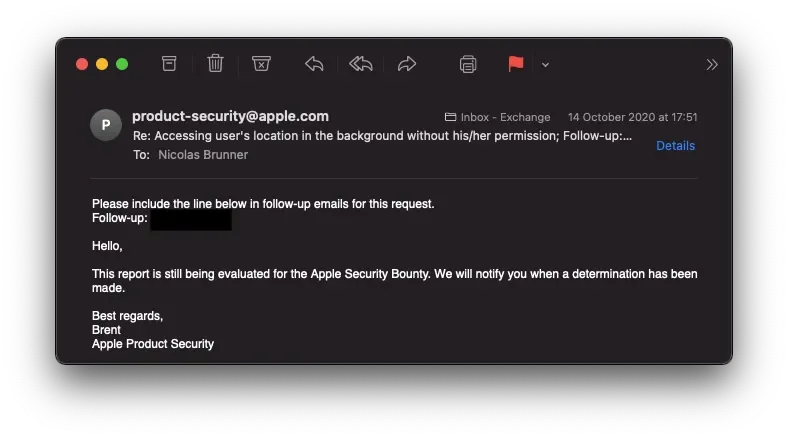
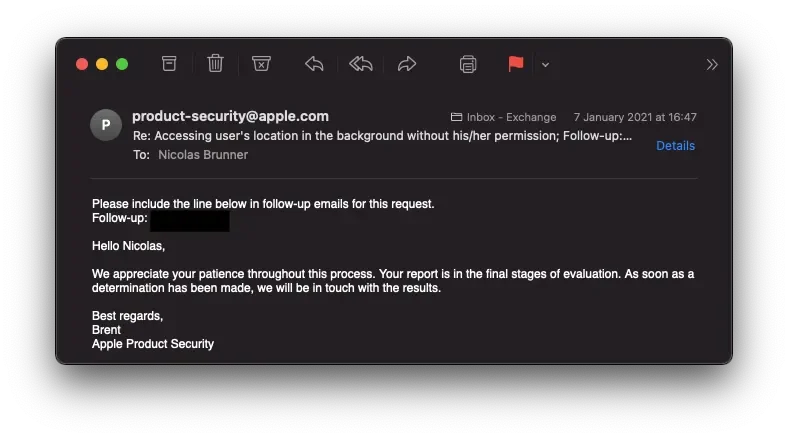
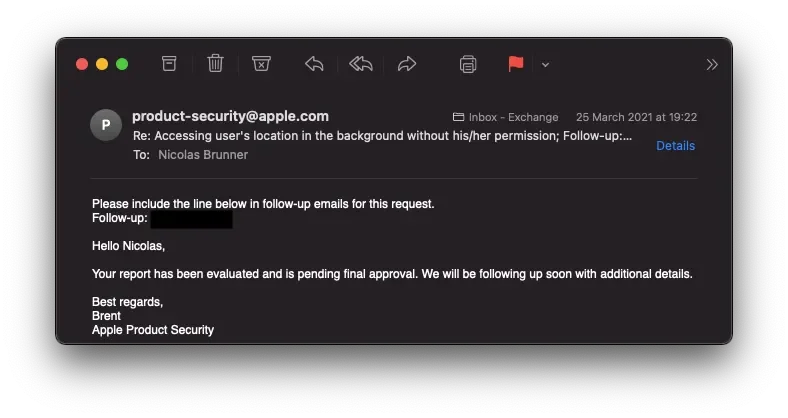
- More than a year after the initial report, an e-mail arrives that the author describes as leaving him completely dazzled.
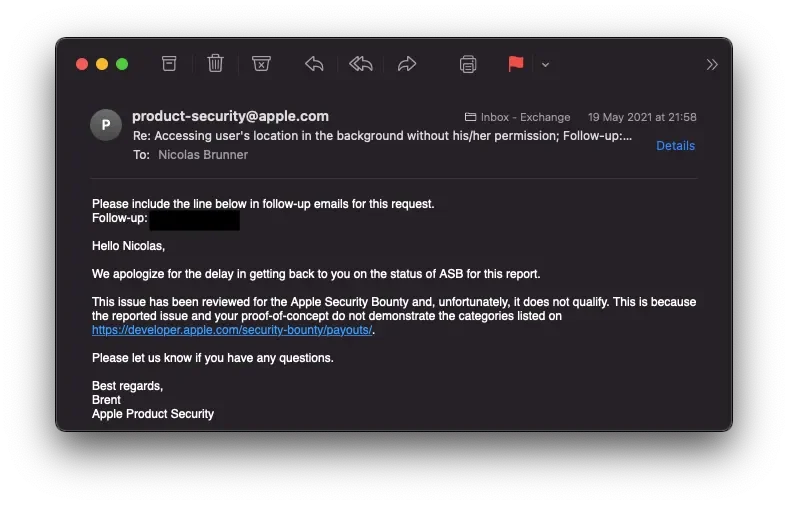
He then contacted Apple through "Brent" to ask in what ways the report would not demonstrate the categories listed on the payouts page. In his view it fell clearly into this category:
"App access to sensitive data normally protected by a TCC prompt"
Apple's page further elaborates on "Sensitive data":
"Real-time or historical precise location data that would normally be prevented by the system"
After that last e-mail, the author says he never received any further answers, despite trying many times. The whole process took 14 months. He concludes that Apple never fulfilled its part of the deal until now, that he feels robbed, and that in his current understanding he sees no reason why developers like himself should continue to contribute to the program.
Variants to test
These are general directions suggested by the shape of the issue, not steps from the report:
- Combine a location-using feature with another subsystem that runs concurrently, such as beacon monitoring, and check whether location becomes readable in the background without a granted permission. A positive result is location data arriving while the TCC state shows no authorisation.
- Check the permission state after the app is backgrounded and relaunched. A positive result is access persisting across launches without a new prompt.
- Test on the oldest supported iOS versions, where users cannot update. A positive result is the same unauthorised access reproducing there after it is fixed on current versions.
- Compare the behaviour against the payout categories for sensitive data protected by a TCC prompt, so the report maps directly onto a qualifying category.
What happened, in plain words
Apple runs a Security Bounty program. It invites people who find security problems in Apple's products to report them, and it promises a payment (a bounty) for qualifying reports. The author of this article is a long-time iOS developer. He found a way for an app to access a user's location permanently and without the user's consent on any iOS 13 (or older) device. He reported it, Apple fixed it in iOS 14, and he was credited in the release notes. But Apple refused any bounty payment and declined to elaborate on why the report would not qualify. The whole process took 14 months.
This article is his personal account. He notes that experience reports from bounty contributors are hard to find, and he wants to change that.
The reported security issue
iOS is Apple's operating system for iPhones and iPads. By default it protects user data and the current location of a user. Apps cannot read location without the user's consent. Normally an app asks by showing a prompt: a small dialog box that appears on screen and asks the user to allow or deny something.
TCC prompt of an app to request access to location data (iOS 13).
The prompt is produced by a part of iOS called TCC, which guards private data and asks the user for permission. Think of it as a security guard standing between an app and your private data: the app must ask the guard, the guard asks you, and only if you say yes does the app get through. The prompt in the screenshot is that guard asking on behalf of an app.
When the prompt appears, the user can choose to grant access once, while the app is in the foreground (visible on screen), or permanently, including when the app is in the background (not visible on screen). In practice, users typically grant access only while the app is in the foreground.
The author was working on a project that used location and monitored for beacons at the same time. A beacon is a small wireless device that broadcasts a short-range signal; apps can listen for those signals to know when a user is near a particular place. While working on that project, he found he was suddenly able to permanently access the device's location, even though he had never granted that permission.
He decided to write a small demo app and submit a report to the security bounty program.
Demo App showing unauthorized background access to location data on iOS 13.
He judged this a critical issue, particularly given Apple's focus on privacy in recent years. The report does not describe the underlying mechanism, so the precise trigger cannot be reconstructed from the text.
Setup
The work involved a project that used location and monitored for beacons at the same time. The author does not describe any accounts, roles or tooling beyond this. He deliberately withholds the source code and the instructions for reproducing the unauthorised access, because in his view it remains an open security issue for all iOS users who cannot update their devices to iOS 14. The author assessed the fix and confirmed the iOS 14 beta resolved the issue.
Finding it
While working on that project, the author found he was suddenly able to permanently access the device's location, even though he had never granted that permission.
Exploitation
The report does not give reproduction steps, requests or code. The only artefact shown is the demo app, which demonstrates background access to location data on iOS 13 without the user ever granting the permission. The author's stated reason for omitting the details is that the flaw remains open for users who cannot move to iOS 14.
Root cause
The report does not identify the code or design mistake behind the permission bypass. What it does establish is the observable behaviour: an app obtains permanent location access without the TCC prompt being granted. Why the existing consent mechanism did not stop this is not explained in the text.
Impact
On any iOS 13 (or older) device, an app could access a user's location permanently and without consent. The author points out what any app could do with this: collect a user's location over years and store it in its databases to create motion profiles. A motion profile is a record of where someone has been over time. The author notes the issue remains open for users who cannot update their devices to iOS 14.
Fix
Deven informed the author the issue was fixed in an upcoming security update, and the author confirmed the iOS 14 beta resolved it.
Disclosure and bounty handling
Disclosure is the process of telling the vendor about a security problem and agreeing when and how it becomes public. The timeline is the substance of the article:
- March 2020: the issue is found and reported.
- Within a week, a response arrives from "Brittany".
- Six months later, "Deven" says the issue has been fixed in an upcoming security update and asks for the author's assessment. The author tests and confirms the iOS 14 beta resolves it.
- Deven then says Apple would like to credit the author on the iOS 14 security advisories.
- Over the next 8 months the author asks for the bounty reward on multiple occasions.
- More than a year after the initial report, an e-mail arrives that the author describes as leaving him completely dazzled.
He then contacted Apple through "Brent" to ask in what ways the report would not demonstrate the categories listed on the payouts page. In his view it fell clearly into this category:
"App access to sensitive data normally protected by a TCC prompt"
Apple's page further elaborates on "Sensitive data":
"Real-time or historical precise location data that would normally be prevented by the system"
After that last e-mail, the author says he never received any further answers, despite trying many times. The whole process took 14 months. He concludes that Apple never fulfilled its part of the deal until now, that he feels robbed, and that in his current understanding he sees no reason why developers like himself should continue to contribute to the program.
Variants to test
These are general directions suggested by the shape of the issue, not steps from the report:
- Combine a location-using feature with another subsystem that runs concurrently, such as beacon monitoring, and check whether location becomes readable in the background without a granted permission. A positive result is location data arriving while the TCC state shows no authorisation.
- Check the permission state after the app is backgrounded and relaunched. A positive result is access persisting across launches without a new prompt.
- Test on the oldest supported iOS versions, where users cannot update. A positive result is the same unauthorised access reproducing there after it is fixed on current versions.
- Compare the behaviour against the payout categories for sensitive data protected by a TCC prompt, so the report maps directly onto a qualifying category.
Glossary
- API: a set of rules that lets one piece of software ask another for data or actions, like a menu of things you can order.
- App: a program on a phone or tablet, such as a maps or messaging app.
- Background: the state of an app that is not visible on screen but may still be running.
- Beacon: a small device that broadcasts a short-range radio signal so apps can detect when a user is nearby.
- Bounty: a payment offered by a company for a qualifying security report.
- Consent: permission given by the user, usually through a prompt.
- Demo app: a small program written to demonstrate a problem, not for everyday use.
- Disclosure: the process of reporting a security problem to the vendor and agreeing when it becomes public.
- Foreground: the state of an app that is visible on screen and in use.
- iOS: Apple's operating system for iPhone and iPad.
- Motion profile: a record of where someone has been over time.
- Permission bypass: getting access to something without the permission that is supposed to be required.
- Prompt: a small dialog box that asks the user to allow or deny something.
- Root cause: the underlying code or design mistake that produces a problem.
- Security advisory: a public notice from a vendor describing a fixed security issue.
- TCC: the part of iOS that guards private data and asks the user for permission.
- Vendor: the company that makes the product, here Apple.