Vulnerability Details & Attack Breakdown
A path traversal vulnerability in Argo CD's Helm chart processing allowed an attacker to bypass the anti-path-traversal mechanism by supplying a valueFiles entry that looks like a URI, enabling reading of arbitrary files on the reposerver. This could lead to disclosure of secrets, tokens, and other sensitive information from other applications, and potentially privilege escalation and lateral movement.
Apiiro’s Security Research Follow
 Published on apiiro.com
Apiiro’s Security Research team has uncovered a major software supply chain 0-day vulnerability (CVE-2022-24348) in Argo CD, the popular open source Continuous Delivery platform, which enables attackers to access sensitive information such as secrets, passwords, and API keys.
The full write-up lives on its author's site
It belongs to its author, so we link to it rather than copy it. The other two tabs are our own rewrites, checked against it.
Argo CD is a widely used open source Continuous Delivery platform that manages and orchestrates the execution and monitoring of application deployment after integration. Apiiro's Security Research team found a software supply chain 0-day in it, tracked as CVE-2022-24348, that lets an attacker who can supply a Helm Chart reach sensitive data belonging to other applications on the same Argo CD installation.
Context
To build a deployment pipeline, a user defines either a Git repository or a Kubernetes Helm Chart file. A Helm Chart is a YAML file that embeds fields forming a declaration of the resources and configuration needed to deploy an application. Among those fields, one type can hold file names and relative paths to self-contained application parts stored in other files.
Argo CD keeps repositories on a dedicated server or pod named argocd-reposerver. There is no strong segmentation between repositories apart from the file hierarchy, so the anti-path-traversal mechanism is a critical linchpin of file security. The Argo CD contributors were aware of this class of exploitation as early as 2019 and built a dedicated mechanism to thwart it.
The impact of the attack described here includes privilege escalation, sensitive information disclosure and lateral movement.
Setup
The report does not describe a lab environment, accounts or tool versions. The relevant preconditions are structural: the attacker needs to be able to define an application whose source is a Helm Chart, and the target data lives on the shared argocd-reposerver, whose file structure is monolithic and deterministic, so the paths of other applications are predictable.
Finding it
The anti-path-traversal logic lives mainly in a single source file, util/security/path_traversal.go, which defines the procedural cleanup of the source path input:
// Ensure that `requestedPath` is on the same directory or any subdirectory of `currentRoot`. Both `currentRoot` and
// `requestedPath` must be absolute paths. They may contain any number of `./` or `/../` dir changes.
func EnforceToCurrentRoot(currentRoot, requestedPath string) (string, error) {
 currentRoot = filepath.Clean(currentRoot)
 requestedDir, requestedFile := parsePath(requestedPath)
 if !isRequestedDirUnderCurrentRoot(currentRoot, requestedDir) {
  return "", fmt.Errorf("requested path %s should be on or under current directory %s", requestedPath, currentRoot)
 }
 return requestedDir + string(filepath.Separator) + requestedFile, nil
}

func isRequestedDirUnderCurrentRoot(currentRoot, requestedPath string) bool {
 if currentRoot == string(filepath.Separator) {
  return true
 } else if currentRoot == requestedPath {
  return true
 }
 if requestedPath[len(requestedPath)-1] != '/' {
  requestedPath = requestedPath + "/"
 }
 if currentRoot[len(currentRoot)-1] != '/' {
  currentRoot = currentRoot + "/"
 }
 return strings.HasPrefix(requestedPath, currentRoot)
}

func parsePath(path string) (string, string) {
 directory := filepath.Dir(path)
 if directory == path {
  return directory, ""
 }
 return directory, filepath.Base(path)
}
These functions perform cleanup, consisting mainly of Go's filepath package and its Clean() function, and then check that the cleaned-up version of the path sits in a subdirectory of the current operating directory.
The function is used in Helm Chart processing under reposerver/repository/repository.go:
func helmTemplate(appPath string, repoRoot string, env *v1alpha1.Env, q *apiclient.ManifestRequest, isLocal bool) ([]*unstructured.Unstructured, error) {
    concurrencyAllowed := isConcurrencyAllowed(appPath)
    if !concurrencyAllowed {
        manifestGenerateLock.Lock(appPath)
        defer manifestGenerateLock.Unlock(appPath)
    }

    templateOpts := &helm.TemplateOpts{
        Name:        q.AppName,
        Namespace:   q.Namespace,
        KubeVersion: text.SemVer(q.KubeVersion),
        APIVersions: q.ApiVersions,
        Set:         map[string]string{},
        SetString:   map[string]string{},
        SetFile:     map[string]string{},
    }

    appHelm := q.ApplicationSource.Helm
    var version string
    var passCredentials bool
    if appHelm != nil {
        if appHelm.Version != "" {
            version = appHelm.Version
        }
        if appHelm.ReleaseName != "" {
            templateOpts.Name = appHelm.ReleaseName
        }

        for _, val := range appHelm.ValueFiles {
            // If val is not a URL, run it against the directory enforcer. If it is a URL, use it without checking
            // If val does not exist, warn. If IgnoreMissingValueFiles, do not append, else let Helm handle it.
            if _, err := url.ParseRequestURI(val); err != nil {

                // Ensure that the repo root provided is absolute
                absRepoPath, err := filepath.Abs(repoRoot)
                if err != nil {
                    return nil, err
                }

                // If the path to the file is relative, join it with the current working directory (appPath)
                path := val
                if !filepath.IsAbs(path) {
                    absWorkDir, err := filepath.Abs(appPath)
                    if err != nil {
                        return nil, err
                    }
                    path = filepath.Join(absWorkDir, path)
                }

                _, err = security.EnforceToCurrentRoot(absRepoPath, path)
                if err != nil {
                    return nil, err
                }

                _, err = os.Stat(path)
                if os.IsNotExist(err) {
                    if appHelm.IgnoreMissingValueFiles {
                        log.Debugf(" %s values file does not exist", path)
                        continue
                    }
                }
            }
            templateOpts.Values = append(templateOpts.Values, val)
        }
This function inspects and relies on the values returned by the path traversal cleanup and current-directory matching for the elements listed under the Chart's valueFiles field. That field is supposed to contain a reference to files within the local accompanying value files, which are then read and parsed into ingested values.
A sample Argo CD manifest with the valueFiles field present looks like this:
apiVersion: argoproj.io/v1alpha1
kind: Application
metadata:
 name: testApplication
 namespace: argocd
spec:
 destination:
   namespace: default
   server: https://kubernetes.default.svc
 project: default
 source:
  helm:
   valueFiles:
      - values.yaml
  path: src
  repoURL:  https://github.com/[path_to_repo].git
While investigating the control flow and potential angles of attack, the Apiiro team paid special attention to the way valueFiles values are evaluated and parsed. A crucial point of interaction is the preliminary check on the input value's content: the code searches for a patterned string that fits the mould of a URI by calling a function named ParseRequestURI.
The official documentation describes the function's behaviour as follows:
ParseRequestURI parses a raw url into a URL structure. It assumes that url was received in an HTTP request, so the url is interpreted only as an absolute URI or an absolute path. The string url is assumed not to have a #fragment suffix. (Web browsers strip #fragment before sending the URL to a web server.)
That raised the question the researchers pursued: can the parser be made to accept a local file path and confuse it for a URI, and can that confusion be used to skip the whole cleanup and anti-path-traversal check? The answer is yes, with a simple trick.
Exploitation
Step 1: make the value look like a URI
Deconstructing the sentence "It assumes that url was received in an HTTP request, so the url is interpreted only as an absolute URI or an absolute path" reveals the weak point. If the listed valueFiles entry looks like a URI, it is treated as one, skipping all other checks and being treated as a legitimate URL. Because the function takes for granted that it receives an HTTP request, an absolute path of a URL such as /directory/values.yaml passes the sanity test, while it is in fact an absolute file path. Note the prefixed backslash on the path.
Step 2: target a predictable path
Because the reposerver uses a monolithic and deterministic file structure, every other out-of-bound application has a definite and predictable format and path. The attacker assembles a concatenated, direct call to a specified values.yaml file, which many applications use as a vessel for secret and sensitive values.
Step 3: read the data
With the check bypassed, the attacker can assemble a direct call to a specified values.yaml file used by other applications.
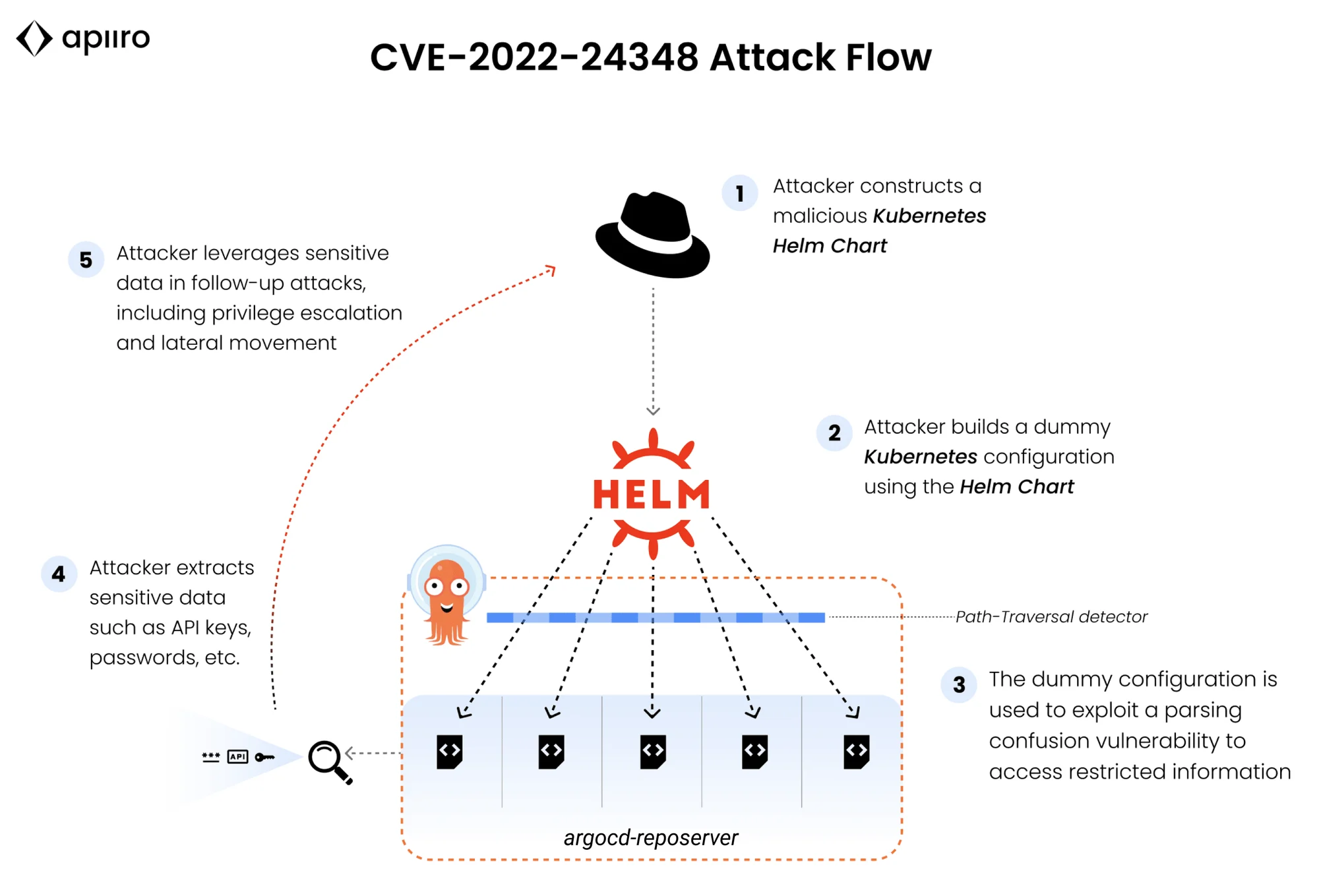
The image illustrates the malicious Helm chart path from the attacker's application ecosystem into other applications' data outside the user's scope.
Root cause
The mistake is the ordering of the checks in helmTemplate. The valueFiles entry is first passed to url.ParseRequestURI, and the directory enforcer (security.EnforceToCurrentRoot) only runs when that call returns an error. Any string that ParseRequestURI accepts as an absolute URI or absolute path therefore bypasses the anti-path-traversal mechanism entirely. The mechanism was built after the 2019 issue, but a bug in the control allows the vulnerability to be exploited.
Impact
The impact is two-fold. First, there are the direct implications of contents read from other files present on the reposerver, which can contain sensitive information; this by itself can impact an organisation. Second, because application files usually contain an assortment of transitive values of secrets, tokens and environment-sensitive settings, the attacker can use the read data to expand the campaign by moving laterally through different services and escalating privileges to gain more ground on the system and the target organisation's resources.
Technical designations given in the report:
| Item | Value |
|---|---|
| CVSS | 3.0/AV:N/AC:L/PR:L/UI:N/S:C/C:H/I:N/A:N, score 7.7 (High) |
| CVE | CVE-2022-24348 |
Fix
The report records that the vendor worked on a patch and fix with a release schedule, and that advisories, patch and blog were released synchronously on 03-Feb-2022. It does not describe the code change itself.
Timeline
| Date | Event |
|---|---|
| 30-Jan-2022 | Vulnerability reported to vendor |
| 30-Jan-2022 | Vendor verified and acknowledged the bug |
| 31-Jan-2022 | Mutual continued triage to understand and discuss the vulnerability's extent and impact |
| 01-Feb-2022 | Vendor reported progressive work on patch and fix and the release schedule |
| 03-Feb-2022 | Synchronous release of advisories, patch and blog |
Variants to test
- Other fields that accept file references and are validated with a URI parser before a path check. A positive result is a value that
ParseRequestURIaccepts while resolving to a file outside the intended root. - Absolute paths with a leading separator in any Helm-related input that is later joined or cleaned. A positive result is a read of a file belonging to another application on the same reposerver.
- Any component that stores multiple tenants' repositories on one filesystem with only hierarchy as separation. A positive result is a predictable path to another tenant's
values.yamlor equivalent secrets file. - Order-of-validation bugs where a permissive parser runs before a restrictive check. A positive result is a payload that never reaches the restrictive check because the permissive one succeeded.
What happened, in plain words
Argo CD is a free, open source tool that many companies use to ship software. You tell it where your application lives (usually a Git repository, which is a shared folder that keeps a history of every change), and Argo CD takes care of putting that application onto a cluster of servers and watching it run. Think of it as a delivery driver that picks up a parcel from a warehouse and drops it at the right door, again and again, every time the parcel changes.
A security research team at Apiiro found a serious flaw in Argo CD. They call it a "0-day", a term for a vulnerability disclosed before a fix is publicly available. The flaw was given an official tracking number, CVE-2022-24348. CVE stands for Common Vulnerabilities and Exposures: it is a public catalogue where every known security bug gets a unique ID so people can talk about it unambiguously, a bit like a licence plate for a bug.
The bug is a "software supply chain" problem. The supply chain is everything that goes into building and delivering your software: the code, the configuration files, the tools that assemble them. If an attacker can slip something malicious into that chain, they get in without ever touching your servers directly. Here, the malicious ingredient is a Helm Chart, which is a configuration file that describes how an application should be deployed. By loading a crafted Helm Chart YAML file, an attacker can make Argo CD read files that belong to other applications on the same Argo CD installation. Those files often contain secrets: passwords, access tokens, API keys.
An API key is a long random string that acts like a password for a program talking to another program (an API, or Application Programming Interface, is simply a way for two pieces of software to talk to each other). A token is similar: a small piece of text that proves who you are, so you do not have to send your password every time. If an attacker steals these, they can pretend to be your application and do things on your behalf.
The consequences listed in the report are privilege escalation (gaining more rights than you should have), sensitive information disclosure (secrets leaking out), and lateral movement (using one foothold to hop to other systems, like a burglar moving from room to room once inside a house).
The background you need
To understand the bug, you need three ideas.
First, Kubernetes. Kubernetes is a system for running many applications across many servers and keeping them healthy. It is configured with YAML files, which are plain text files written in an indented, human-readable format. A YAML file is just a structured list of settings, like a very tidy shopping list.
Second, Helm Charts. A Helm Chart is a YAML file that bundles together the description of an application: what resources it needs, what settings it uses, and so on. One of the fields inside a chart can point to other files that hold values, for example a file called values.yaml that contains configuration values. Those referenced files are called "value files".
Third, path traversal. On any computer, files live in folders, and folders live inside other folders. A "path" is the address of a file, like /home/app/config/values.yaml. Path traversal is an attack where someone supplies a path that climbs out of the folder they are supposed to be confined to, using ../ (which means "go up one folder"). If a program is supposed to only read files inside /home/app/, but you can trick it into reading /home/app/../../etc/passwd, you have escaped your cage. It is like being told you may only take books from shelf A, but you write a label that says "shelf A, then walk to shelf Z" and the librarian follows it.
Argo CD's developers knew about this risk. Back in 2019 they built a defence: a piece of code that checks every file path a chart asks for and refuses anything that tries to climb out of the allowed folder. The report links to the original discussion where this was raised. The defence is the lock on the door. The bug is that the lock can be bypassed.
Where the files live
Argo CD stores all the repositories it manages on a dedicated server or pod (a pod is a small unit of computing inside Kubernetes) called argocd-reposerver. All applications' files sit on this one machine. There is no strong separation between them apart from the folder structure itself. In other words, application A's files and application B's files are in different folders on the same disk, and nothing else stops one from reading the other. That makes the path-traversal defence absolutely critical: it is the only thing standing between one customer's files and another's.
The defence, in code
The defence lives mainly in one source file, util/security/path_traversal.go. Here is the code as the report shows it:
// Ensure that `requestedPath` is on the same directory or any subdirectory of `currentRoot`. Both `currentRoot` and
// `requestedPath` must be absolute paths. They may contain any number of `./` or `/../` dir changes.
func EnforceToCurrentRoot(currentRoot, requestedPath string) (string, error) {
 currentRoot = filepath.Clean(currentRoot)
 requestedDir, requestedFile := parsePath(requestedPath)
 if !isRequestedDirUnderCurrentRoot(currentRoot, requestedDir) {
  return "", fmt.Errorf("requested path %s should be on or under current directory %s", requestedPath, currentRoot)
 }
 return requestedDir + string(filepath.Separator) + requestedFile, nil
}

func isRequestedDirUnderCurrentRoot(currentRoot, requestedPath string) bool {
 if currentRoot == string(filepath.Separator) {
  return true
 } else if currentRoot == requestedPath {
  return true
 }
 if requestedPath[len(requestedPath)-1] != '/' {
  requestedPath = requestedPath + "/"
 }
 if currentRoot[len(currentRoot)-1] != '/' {
  currentRoot = currentRoot + "/"
 }
 return strings.HasPrefix(requestedPath, currentRoot)
}

func parsePath(path string) (string, string) {
 directory := filepath.Dir(path)
 if directory == path {
  return directory, ""
 }
 return directory, filepath.Base(path)
}
Line by line, in plain words:
- The comment at the top states the goal: make sure the requested path is inside the allowed root folder or one of its subfolders. Both paths must be absolute (starting from the very top of the disk, like
/home/app), and they may contain./("this folder") or/../("go up one folder") segments. func EnforceToCurrentRoot(...)is the main guard. It takes the allowed root and the requested path.currentRoot = filepath.Clean(currentRoot)tidies up the root path, removing redundant slashes and..segments.filepath.Cleanis a standard Go function that normalises a path.requestedDir, requestedFile := parsePath(requestedPath)splits the requested path into its folder part and its file-name part.- The
if !isRequestedDirUnderCurrentRoot(...)block asks: is the requested folder inside the allowed root? If not, it returns an error and refuses the request. The error message says the path should be on or under the current directory. - If the check passes, it rebuilds the path from the folder and file name and returns it.
isRequestedDirUnderCurrentRootis the actual comparison. If the root is the very top of the disk (/), everything is allowed, so it returns true. If the root equals the requested path exactly, that is allowed too.- It then makes sure both paths end with a
/so the comparison is fair (otherwise/home/appwould wrongly match/home/application). - Finally
strings.HasPrefix(requestedPath, currentRoot)checks that the requested path starts with the root path. If it does, it is inside; if not, it is outside. parsePathsplits a path into folder and file.filepath.Dirgives the folder,filepath.Basegives the file name. If the path is just a folder with no file, it returns the folder and an empty file name.
In short: clean the path, split it, check the folder is under the allowed root, and refuse otherwise. That is a sensible defence. The problem is not this code. The problem is when it gets called.
Where the defence is used
The guard is called during Helm Chart processing, in reposerver/repository/repository.go. Here is the relevant function:
func helmTemplate(appPath string, repoRoot string, env *v1alpha1.Env, q *apiclient.ManifestRequest, isLocal bool) ([]*unstructured.Unstructured, error) {
    concurrencyAllowed := isConcurrencyAllowed(appPath)
    if !concurrencyAllowed {
        manifestGenerateLock.Lock(appPath)
        defer manifestGenerateLock.Unlock(appPath)
    }

    templateOpts := &helm.TemplateOpts{
        Name:        q.AppName,
        Namespace:   q.Namespace,
        KubeVersion: text.SemVer(q.KubeVersion),
        APIVersions: q.ApiVersions,
        Set:         map[string]string{},
        SetString:   map[string]string{},
        SetFile:     map[string]string{},
    }

    appHelm := q.ApplicationSource.Helm
    var version string
    var passCredentials bool
    if appHelm != nil {
        if appHelm.Version != "" {
            version = appHelm.Version
        }
        if appHelm.ReleaseName != "" {
            templateOpts.Name = appHelm.ReleaseName
        }

        for _, val := range appHelm.ValueFiles {
            // If val is not a URL, run it against the directory enforcer. If it is a URL, use it without checking
            // If val does not exist, warn. If IgnoreMissingValueFiles, do not append, else let Helm handle it.
            if _, err := url.ParseRequestURI(val); err != nil {

                // Ensure that the repo root provided is absolute
                absRepoPath, err := filepath.Abs(repoRoot)
                if err != nil {
                    return nil, err
                }

                // If the path to the file is relative, join it with the current working directory (appPath)
                path := val
                if !filepath.IsAbs(path) {
                    absWorkDir, err := filepath.Abs(appPath)
                    if err != nil {
                        return nil, err
                    }
                    path = filepath.Join(absWorkDir, path)
                }

                _, err = security.EnforceToCurrentRoot(absRepoPath, path)
                if err != nil {
                    return nil, err
                }

                _, err = os.Stat(path)
                if os.IsNotExist(err) {
                    if appHelm.IgnoreMissingValueFiles {
                        log.Debugf(" %s values file does not exist", path)
                        continue
                    }
                }
            }
            templateOpts.Values = append(templateOpts.Values, val)
        }
Line by line:
func helmTemplate(...)is the function that turns a Helm Chart into a deployable configuration. It receives the application path, the repository root, and a request objectqthat describes what the user asked for.- The first block deals with locking, so two deployments of the same app do not run at the same time. This is housekeeping, not security.
templateOpts := &helm.TemplateOpts{...}builds an options object for Helm, filling in the application name, namespace, Kubernetes version, and empty maps for settings.appHelm := q.ApplicationSource.Helmgrabs the Helm-specific part of the user's request.- The
if appHelm != nilblock runs only if the user actually supplied Helm settings. It reads the chart version and release name if present. for _, val := range appHelm.ValueFilesloops over every value file the user listed. This is the crucial loop.- The comment explains the intent: if the value is not a URL, run it through the directory enforcer; if it is a URL, use it without checking. That comment is the heart of the bug.
if _, err := url.ParseRequestURI(val); err != nil {tries to parse the value as a URI (a web address). If parsing fails, the code enters the block and does the safety checks. If parsing succeeds, the whole block is skipped.- Inside the block,
filepath.Abs(repoRoot)turns the repository root into an absolute path. - Then, if the value is a relative path, it is joined with the application's working directory to make it absolute.
security.EnforceToCurrentRoot(absRepoPath, path)is the guard from the previous file. If it returns an error, the function stops.os.Stat(path)checks whether the file exists. If it does not and the user setIgnoreMissingValueFiles, it logs a debug message and skips this entry.- Finally,
templateOpts.Values = append(templateOpts.Values, val)adds the value to the list Helm will use.
Notice the shape of the logic: the safety check only runs when ParseRequestURI fails. If ParseRequestURI succeeds, the value goes straight to the end of the loop and is used. That is the flaw.
What a normal chart looks like
Here is a sample Argo CD manifest with the valueFiles field present, as shown in the report:
apiVersion: argoproj.io/v1alpha1
kind: Application
metadata:
 name: testApplication
 namespace: argocd
spec:
 destination:
   namespace: default
   server: https://kubernetes.default.svc
 project: default
 source:
  helm:
   valueFiles:
      - values.yaml
  path: src
  repoURL:  https://github.com/[path_to_repo].git
Line by line:
apiVersion: argoproj.io/v1alpha1says which version of the Argo CD format this file uses.kind: Applicationsays this file describes an application.metadata:holds identifying information.name: testApplicationis the application's name.namespace: argocdis the Kubernetes namespace (a kind of folder for resources) it lives in.spec:is the actual specification of what to deploy.destination:says where to deploy it.namespace: defaultis the target namespace.server: https://kubernetes.default.svcis the address of the Kubernetes cluster.project: defaultgroups this application under a project called default.source:says where the application's files come from.helm:holds Helm-specific settings.valueFiles:lists the value files to use. Here it is justvalues.yaml, a plain file name with no folders.path: srcsays the chart is in thesrcfolder of the repository.repoURL: https://github.com/[path_to_repo].gitis the address of the Git repository.
In a normal case, values.yaml is a simple relative path. ParseRequestURI will fail on it (it is not a URI), so the safety check runs, the path is confirmed to be inside the repository, and everything is fine.
The trick
While investigating how valueFiles values are evaluated, the Apiiro team focused on that preliminary check: the code searches for a string that fits the mould of a URI by calling ParseRequestURI. The official documentation for that function says:
ParseRequestURI parses a raw url into a URL structure. It assumes that url was received in an HTTP request, so the url is interpreted only as an absolute URI or an absolute path. The string url is assumed not to have a #fragment suffix. (Web browsers strip #fragment before sending the URL to a web server.)
In plain words: this function was written for web servers receiving web addresses. It assumes whatever it is given came in over HTTP. So it accepts two shapes: a full web address (an absolute URI, like https://example.com/x), or an absolute path (like /directory/values.yaml). It does not check whether the path is safe. It just checks whether the string looks like a web address or an absolute path.
That raised the question the researchers pursued: can the parser be made to accept a local file path and confuse it for a URI, and can that confusion be used to skip the whole cleanup and anti-path-traversal check? The answer is yes, with a simple trick.
Step 1: make the value look like a URI
Deconstructing the sentence "It assumes that url was received in an HTTP request, so the url is interpreted only as an absolute URI or an absolute path" reveals the weak point. If the listed valueFiles entry looks like a URI, it is treated as one, skipping all other checks and being treated as a legitimate URL. Because the function takes for granted that it receives an HTTP request, an absolute path of a URL such as /directory/values.yaml passes the sanity test, while it is in fact an absolute file path. Note the prefixed backslash on the path.
Why does this matter? Because the code's logic is: if it parses as a URI, skip the safety check. So the attacker's job is simply to make the value parse as a URI. An absolute path does exactly that. The safety check never runs. The path is then used as-is.
Step 2: target a predictable path
Because the reposerver uses a monolithic and deterministic file structure, every other out-of-bound application has a definite and predictable format and path. The attacker assembles a concatenated, direct call to a specified values.yaml file, which many applications use as a vessel for secret and sensitive values.
In plain words: all applications' files sit on the same machine in a fixed, predictable layout. If you know how Argo CD names and arranges folders, you can guess exactly where another application's values.yaml lives. You do not need to browse around; you just write the address. It is like knowing that every flat in a building has its keys under the same mat.
Step 3: read the data
With the check bypassed, the referenced file is read and parsed as ingested values for the attacker's own chart, so the contents of another application's values file end up in the attacker's deployment context.
In plain words: Argo CD reads the file the attacker pointed at, treats its contents as settings for the attacker's own application, and uses them. The attacker can read and exfiltrate secrets, tokens and other sensitive information residing on other applications. The stolen values can include passwords, tokens, and API keys.
The image illustrates the malicious Helm chart path from the attacker's application ecosystem into other applications' data outside the user's scope.
Why it works: the root cause
The mistake is the ordering of the checks in helmTemplate. The valueFiles entry is first passed to url.ParseRequestURI, and the directory enforcer (security.EnforceToCurrentRoot) only runs when that call returns an error. Any string that ParseRequestURI accepts as an absolute URI or absolute path therefore bypasses the anti-path-traversal mechanism entirely. The mechanism itself, written after the 2019 issue, is sound in intent, but the control around it has a bug that allows the vulnerability to be exploited.
In everyday terms: the guard is competent, but the guard is only called when the front-desk clerk says "this does not look like a valid visitor pass". If you show a pass that the clerk recognises (even a forged one), the guard is never called.
Impact
The impact is two-fold. First, there are the direct implications of contents read from other files present on the reposerver, which can contain sensitive information; this by itself can impact an organisation. Second, because application files usually contain an assortment of transitive values of secrets, tokens and environment-sensitive settings, the attacker can use the read data to expand the campaign by moving laterally through different services and escalating privileges to gain more ground on the system and the target organisation's resources.
In plain words: even one leaked password is bad. But configuration files often contain chains of credentials: a token that gets you into service A, which holds a key for service B, which holds a password for database C. Each leak unlocks the next door. That is lateral movement, and it is why a single file read can turn into a full compromise.
Technical designations given in the report:
| Item | Value |
|---|---|
| CVSS | 3.0/AV:N/AC:L/PR:L/UI:N/S:C/C:H/I:N/A:N, score 7.7 (High) |
| CVE | CVE-2022-24348 |
A quick word on CVSS: it is a standard scoring system for vulnerabilities. The string is a set of measurements. AV:N means the attack can be carried out over the network. AC:L means the attack is easy (low complexity). PR:L means the attacker needs low privileges, i.e. a normal account. UI:N means no user interaction is required. S:C means the impact can cross a security boundary (here, from one application to another). C:H means confidentiality impact is high (secrets can be read). I:N means integrity impact is none (data is not modified). A:N means availability impact is none (nothing is taken down). The total is 7.7, rated High.
The fix
The report records that the vendor worked on a patch and fix with a release schedule, and that advisories, patch and blog were released synchronously on 03-Feb-2022. It does not describe the code change itself.
In plain words: advisories, patch and blog were released synchronously on 03-Feb-2022. The report does not show what the corrected code looks like.
Timeline
| Date | Event |
|---|---|
| 30-Jan-2022 | Vulnerability reported to vendor |
| 30-Jan-2022 | Vendor verified and acknowledged the bug |
| 31-Jan-2022 | Mutual continued triage to understand and discuss the vulnerability's extent and impact |
| 01-Feb-2022 | Vendor reported progressive work on patch and fix and the release schedule |
| 03-Feb-2022 | Synchronous release of advisories, patch and blog |
Triage, in case the word is new, is the process of sorting and assessing a reported problem: confirming it is real, understanding how bad it is, and deciding what to do about it. The timeline runs from 30-Jan-2022 to 03-Feb-2022.
Variants to test
These are patterns a defender or researcher might look for elsewhere, because the same mistake can appear in other software:
- Other fields that accept file references and are validated with a URI parser before a path check. A positive result is a value that
ParseRequestURIaccepts while resolving to a file outside the intended root. - Absolute paths with a leading separator in any Helm-related input that is later joined or cleaned. A positive result is a read of a file belonging to another application on the same reposerver.
- Any component that stores multiple tenants' repositories on one filesystem with only hierarchy as separation. A positive result is a predictable path to another tenant's
values.yamlor equivalent secrets file. - Order-of-validation bugs where a permissive parser runs before a restrictive check. A positive result is a payload that never reaches the restrictive check because the permissive one succeeded.
In plain words: whenever you see code that says "if this looks like a web address, skip the safety check", ask whether an attacker can make a dangerous value look like a web address. The answer is often yes.
Glossary
- 0-day: a vulnerability that the software's makers do not yet know about, so no fix exists at the time of discovery.
- API (Application Programming Interface): a way for two pieces of software to talk to each other, usually over the network.
- API key: a long random string that acts like a password for a program talking to an API.
- Argo CD: an open source tool for continuously delivering applications to Kubernetes clusters.
- argocd-reposerver: the dedicated server or pod inside Argo CD where all managed repositories are stored.
- CVE (Common Vulnerabilities and Exposures): a public catalogue that gives every known security bug a unique ID.
- CVSS: a standard scoring system that rates the severity of a vulnerability using a set of measurements.
- Continuous Delivery (CD): the practice of automatically shipping software changes to production after they pass checks.
- Git repository: a folder of files that keeps a full history of every change, used to store and share code.
- Helm Chart: a YAML file that describes the resources and configuration needed to deploy an application.
- Kubernetes: a system for running and managing many applications across many servers.
- Lateral movement: an attacker using one foothold to reach other systems inside the same organisation.
- Manifest: a file that declares what should be deployed and how.
- Namespace: a way of grouping resources inside Kubernetes, like a folder.
- Path traversal: an attack that uses
../or similar to climb out of an allowed folder and read files elsewhere. - Pod: a small unit of computing inside Kubernetes that runs one or more containers.
- Privilege escalation: gaining more rights or access than you are supposed to have.
- Sensitive information disclosure: leaking secrets such as passwords, tokens, or keys.
- Software supply chain: everything that goes into building and delivering software, including code, configuration, and tools.
- Token: a small piece of text that proves who you are, so you do not have to send your password every time.
- Triage: the process of assessing a reported problem to understand how serious it is and what to do.
- URI / URL: a web address, like
https://example.com/page. - Value file: a file referenced by a Helm Chart that holds configuration values, often including secrets.
- YAML: a plain-text, indented format for writing structured configuration.



