No Rate Limit when accessing "Password protection" enabled surveys leads to bypassing passwords via "pd-pass_surveyid" cookie
Password-protected surveys stored the password as an MD5 hash inside a cookie, and the survey page accepted that cookie without any rate limiting. An attacker who knew a survey ID could brute-force the cookie value offline-style through repeated requests and view the protected survey.

- Fixed in 16 days
- Paid in 16 days
- Disclosed after 5 months
Summary:
Hi team, If you write the right password on any password protected survey, you will see this request :
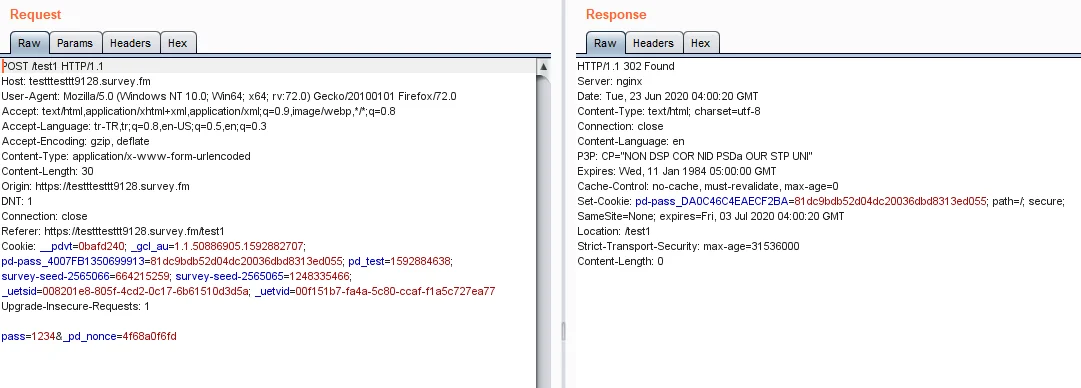
This request is protected with rate limit, that's great. But if you look to response, you will see a cookie. The password protection feature is cookie-based system.
In my survey, if you write the right password, system will set this cookie : pd-pass_DA0C46C4EAECF2BA=81dc9bdb52d04dc20036dbd8313ed055
And basically this is pd-pass_SURVEYID=md5(password), it encrypts the right password with MD5 and if you visit the survey page with this cookie, you can see the survey.
So, I tried to brute force this cookie with Burp Suite's Payload Processing feature. (it encrypts your value with any hash type). And it worked, there is no rate limit when directly accessing to the survey page with password cookie.
Actually, I didn't any way to find the survey IDs. But when you go to a survey without password protection, the survey ID will be inside the source code. And if you enable the password protection after that, the survey ID won't be changed. So, attacker can save the survey ID before the survey creator enable the password protection feature.
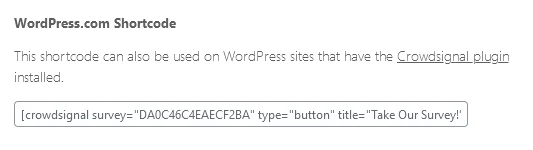
Also, the WordPress.com Shortcode on Sharing page leaks the survey ID too. (but I don't know how it works, maybe this code turns to iframe etc. whne you paste it to any wordpress.com website)
Steps To Reproduce:
-
Go to your survey's
Sharingpage and copy the survey ID fromWordPress.com Shortcode -
Turn on intercept on Burp Suite and go to your password protected survey.
-
And send the GET request to Intruder
-
Add
pd-pass_YOURSURVEYIDHERE=testto cookie and set payload position totestvalue. -
Now go to
Payloadstab on Intruder and set thePayload Processingfeature like that :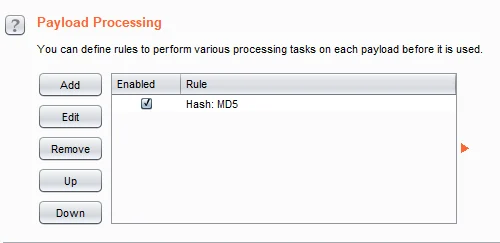
payloadprocessing.PNG From the original on HackerOne -
Set the payload type to
Brute forcerand you can change the other options like threads etc. -
Start the attack.
You can watch the video :
Probably, this issue works on quizzes too, I didn't test it.
Impact
Bypassing the password protected surveys with brute force
Not written yet. The AI write-up for this report has not been written yet. The Original tab links to the source.
How it worked
Root cause
Likely the password check relied on a client-side cookie containing an unsalted MD5 hash of the password, and the survey page enforced no rate limit on requests carrying that cookie.
Impact
An attacker who knows a survey ID could brute-force the cookie and bypass the password protection to view the survey.
What the attacker needed
Knowledge of the survey ID; password-protected survey enabled
How it was found
- Obtain the survey ID, for example from the Sharing page's WordPress.com shortcode.
- With interception on, open the password-protected survey and send the request to Intruder.
- Add a password cookie for that survey ID and mark the value as the payload position.
- Configure payload processing to hash each candidate value.
- Use a brute-forcer payload set and start the attack.
Explained by bugbounty.wiki with AI from the original and checked against quotes from it; it can still be wrong. Read the original before relying on a detail.
Not written yet. The AI write-up for this report has not been written yet. The Original tab links to the source.
Some websites protect a page with a password and remember you by setting a cookie, a small piece of data your browser sends back on each visit. Here the cookie held a scrambled (hashed) form of the password, and the page never limited how many guesses someone could make, so a tool could try many passwords quickly until one worked.
What is Business logic?
The application works as coded but not as intended: a negative price, a skipped payment step, a limit that can be crossed.