How I Made The BBC Hall Of Fame 3 Times
 Published on medium.com
Happy Monday to anyone reading this write up. Today I am going to describe how I was able to make the BBC Hall Of Fame 3 times.
The full write-up lives on its author's site
It belongs to its author, so we link to it rather than copy it. The other two tabs are our own rewrites, checked against it.
Context
The target was the BBC's public web estate, and the feature at the centre of the write-up is the login page that most BBC subdomains redirect to. That page offers three things: a login function, a forgot-password function and a help desk instruction function. There is no registration, so any testing of the authenticated or account-related functions requires an existing email address.
The author reports three findings: two information disclosures through an insecure API and one account function abuse. The author notes that the BBC team was particularly interested in the 2FA status exposed by the first one. The third finding is a lockout behaviour that resets the password, which terminates the user's sessions.
Setup
The only tool named in the report is Burp Suite, used to observe the responses of the login function. No versions are given.
The key precondition is an existing email address, because the login page allows no registrations. The author found one in a JavaScript file and used it for testing. The author also harvested further addresses through an endpoint that had no rate limit, which later became relevant to the third finding.
Finding it
The author began with subdomain enumeration rather than the main application, on the reasoning that the main application would already have been heavily tested. Many of the enumerated subdomains redirected to what appeared to be a shared login page for the majority of BBC subdomains. The page itself was sparse: login, forgot password and help desk instructions.
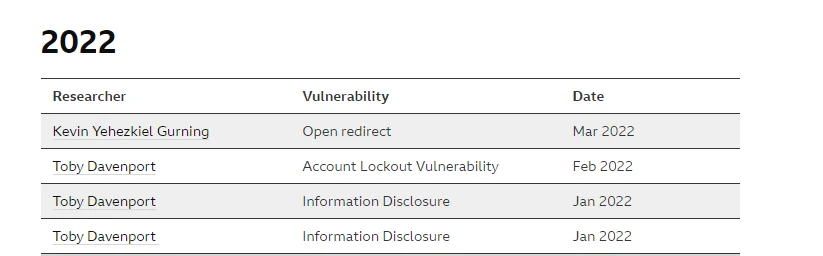
The author assumed the page had been tested before, and attributes the findings to reconnaissance. Looking at previous Hall of Fame listings, the author had noticed a lot of information disclosure and XSS reports, and chose those two categories as a starting point.
When the login function was submitted with an incorrect password, the Burp Suite response showed that the page was clearly querying an API. That raised the question of what other endpoints existed in the application's JavaScript file. The author spent many hours reading the JavaScript to find endpoints that would accept only an emailAddress and require no further authorisation.
Exploitation
Step 1: an unauthenticated endpoint that returns account data
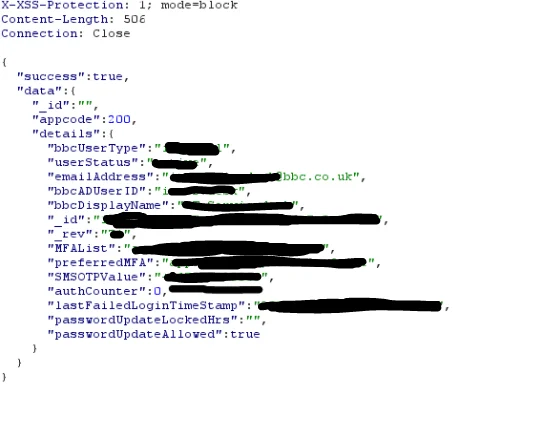
The first endpoint found took an email address and returned account information for it: UID, 2FA status, full name and account activity status, among other fields. Because there was no further rate limit, the author could fuzz email addresses against the endpoint to gather more addresses and see whether other information could be revealed.
This was the first information disclosure. The author was not satisfied with it, because no phone number appeared in the response and the impact was therefore limited. The reasoning was that there must be a separate 2FA endpoint that revealed the number.
Step 2: a 2FA endpoint that trusts a cookie set during the 2FA flow
The author went back to the JavaScript files, looking specifically for endpoints that matched the emailAddress parameter. This produced the second finding.
Browsing straight from the homepage to the endpoint returned a 500 Internal error. However, if the 2FA flow was started first, the non-authenticated account was assigned cookies. With those cookies present, the 500 error was bypassed and the application assumed the requester was authenticated against the email address being queried. The endpoint then returned the phone number associated with the account, which the author describes as an evident PII leak.
Step 3: abusing the lockout to reset passwords and terminate sessions
Returning to the login function, the author observed that after six failed login attempts the account was locked out. This was not a traditional lockout: the account was locked, the password was reset, and the user then had to visit their email to reset the password.
Using the addresses harvested earlier through the endpoint with no rate limit, an attacker could terminate a large number of BBC user sessions, because the password reset terminates those sessions. The author characterises this as low impact in itself, but raises the scenario of fuzzing a critical IT email address responsible for monitoring the system: terminating that session remotely would cause significant inconvenience.
All three issues were reported and received three mentions.
Root cause
The first disclosure is an API endpoint that returns account attributes for any supplied email address without authentication or authorisation, and without a rate limit that would make enumeration impractical.
The second is an authentication decision made on the basis of cookies issued at the start of the 2FA flow. Starting the flow for a non-authenticated account was enough to obtain cookies, and the endpoint then treated the request as authenticated against the email address in the query. The 500 error seen when browsing directly suggests the endpoint depends on state that only exists once the flow has begun. The report does not describe the code, so the precise mechanism is not stated.
The third is a lockout design that resets the password rather than only blocking further attempts, which the author says can terminate sessions for anyone who knows the address.
Impact
Through the first endpoint, an unauthenticated party can retrieve UID, 2FA status, full name and account activity status for a supplied email address, and can enumerate addresses because there is no rate limit. The BBC team was interested in the 2FA status in particular.
Through the second endpoint, an unauthenticated party who first starts the 2FA flow can retrieve the phone number associated with an account, which is PII.
Through the lockout behaviour, an attacker who knows an address can force a password reset and terminate that user's sessions. The author rates this as low impact but points out the disruption of targeting a critical IT address used for system monitoring.
Fix
The report does not describe any remediation. Based on the findings, the endpoints that accept an email address should require authentication and authorisation that binds the caller to that address, and should be rate limited. The 2FA endpoint should not treat cookies issued at the start of the flow as proof of authentication for an arbitrary address. The lockout should block further attempts without resetting the password and terminating sessions, or should require a separate verification step before doing so.
Variants to test
- Grep JavaScript bundles for parameter names such as
emailAddressand try each endpoint without cookies, then with cookies obtained from a partial flow. A positive result is account data or PII returned for an address you do not control. - Start a multi-step flow (2FA, password reset, onboarding) and replay the cookies it issues against other endpoints. A positive result is a 500 turning into a 200 with data.
- Fuzz the email parameter on any endpoint that accepts one, watching for missing rate limits. A positive result is a stable stream of distinct valid responses.
- Trigger the lockout threshold on an account you control and observe whether the password is reset and sessions terminated. A positive result is a session ending without the owner's action.
- Check whether the same shared login page is used across many subdomains, and test the API behind it once rather than per host.
What happened, in plain words
The author of this write-up found three separate problems in the BBC's public websites and reported all three. The author reported all three and received three mentions in the BBC Hall of Fame, a public list of people who have reported security bugs. The three problems were:
- A web address (an endpoint) that, when given an email address, returned private details about that account without asking for any password.
- A second endpoint that returned the phone number linked to an account, again without a real login, as long as the visitor had first started the two-factor authentication (2FA) process.
- A login page that, after six wrong password attempts, locked the account by resetting the password, which also ended the user's sessions. Anyone who knew an email address could trigger this.
Before going further, a few words need explaining, because the whole story depends on them.
- Subdomain: a smaller address under a main domain. If the main site is
bbc.co.uk, thenlogin.bbc.co.ukorhelp.bbc.co.ukwould be subdomains. Think of the main domain as a building and subdomains as different rooms inside it. - API: short for Application Programming Interface. It is the behind-the-scenes part of a website that the page talks to in order to fetch or save data. When you type into a login box and press Enter, the page usually sends your details to an API, and the API replies with an answer. A useful comparison is a restaurant: the web page is the menu and the waiter, and the API is the kitchen. You never see the kitchen, but it does the work.
- Endpoint: one specific address inside an API, like one particular dish on the menu. Each endpoint does one job, for example "look up an account by email".
- Information disclosure: a vulnerability where the system gives out information it should keep private. It is like a receptionist who reads out a customer's home address to anyone who asks, without checking who they are.
- PII: Personally Identifiable Information. Any data that can identify a real person, such as a phone number, full name or email address.
- 2FA: two-factor authentication. A second proof of identity on top of a password, usually a code sent by text message or generated by an app. The phone number stored for 2FA is sensitive, because it is both private and useful to an attacker.
- Cookie: a small piece of data a website stores in your browser so it can remember you between page loads. It is like a cloakroom ticket: you hand in your coat, get a ticket, and later the ticket proves the coat is yours. If a site hands out tickets too easily, someone else can use one.
- Session: the period during which a website remembers that you are logged in. Ending a session means logging the user out.
- Rate limit: a cap on how many requests you can make in a period of time. Without one, a computer can ask the same question thousands of times per minute.
- Fuzz / fuzzing: sending lots of different inputs automatically to see what comes back. Here it means trying many email addresses against an endpoint.
- Burp Suite: a tool that sits between your browser and a website and lets you see and change the requests and responses. It is like a transparent pipe you can look into.
- 500 Internal error: a standard web error meaning the server ran into an unexpected problem while handling the request.
The image at the top is the title card of the write-up, "How I Made The BBC Hall Of Fame 3 Times".
How the author got started
The author did not begin on the BBC's main website. The reasoning was simple: the main site is the most obvious target, so it will already have been tested heavily by many people. Instead, the author looked for subdomains, the smaller addresses under the BBC's domain. This is called subdomain enumeration: finding as many of those addresses as possible.
While doing this, the author noticed that many subdomains redirected visitors to the same login page. That page appeared to be the shared login for most of the BBC's subdomains. The page itself was sparse. It offered three things:
- A login function.
- A forgot-password function.
- A help desk instruction function.
The author assumed this page had been tested before, and later put the success down to reconnaissance (recon): the patient work of mapping a target before attacking it. As a starting point, the author looked at the BBC's previous Hall of Fame listings and noticed a lot of information disclosure and XSS reports. XSS, or cross-site scripting, is a vulnerability where an attacker gets their own code to run inside someone else's web page. The author chose those two categories as promising places to look.
One practical obstacle stood out immediately: the login page allowed no registrations. You could not create an account. So to test anything that involved logging in or looking up an account, the author needed an existing email address that belonged to a real account. The author found one inside a JavaScript file and used it for testing.
JavaScript is the programming language that runs in web pages. The files that contain it are downloaded by your browser and can be read by anyone. Developers often leave useful details in them, including the names and addresses of the API endpoints the page talks to. That is why the author spent so long reading them.
Finding the API behind the login page
The author tried the login function with an incorrect password. Watching the traffic in Burp Suite, the response showed clearly that the page was querying an API. In other words, the login form was not checking the password itself; it was sending the details to a separate service and showing whatever came back.
That observation led to the key question: what other endpoints exist in the application's JavaScript file? If the login page talks to an API, the same JavaScript probably mentions other endpoints too. The author spent many hours reading the JavaScript, looking specifically for endpoints that would accept only an emailAddress and require no further authorisation. In plain terms: endpoints that would answer a question about an account just because you supplied an email address, with no password and no proof of who you are.
Step 1: an endpoint that returns account data for any email address
The first endpoint the author found did exactly that. Given an email address, it returned account information for that address: the UID (the account's unique identifier), the 2FA status, the full name, the account activity status, and other fields.
Because the endpoint had no rate limit, the author could also fuzz email addresses against it. That means sending many different addresses automatically to collect more valid ones and to see whether other information could be revealed. Without a rate limit, nothing slowed this down.
This was the first information disclosure. The author was not satisfied with it, for a specific reason: no phone number appeared in the response, so the impact was limited. The reasoning was that if 2FA status was exposed here, there must be a separate 2FA endpoint somewhere that revealed the phone number itself.
Step 2: a 2FA endpoint that trusts a cookie from the 2FA flow
The author went back to the JavaScript files, this time looking harder for endpoints that matched the emailAddress parameter. That search produced the second finding.
The behaviour was unusual. If you browsed straight from the homepage to the endpoint, you got a 500 Internal error. But if you first started the 2FA flow, the non-authenticated account was assigned cookies. With those cookies present, the 500 error was bypassed, and the application assumed the requester was authenticated against the email address being queried. The endpoint then returned the phone number associated with the account. The author describes this as an evident PII leak.
Why does this matter so much? Because the cookies were handed out at the start of the 2FA flow, and the site treated "you have started the process" as if it meant "you have proved who you are". The 500 error when browsing directly suggests the endpoint depends on some state that only exists once the flow has begun. The report does not describe the code, so the precise mechanism is not stated.
Step 3: abusing the lockout to reset passwords and end sessions
The author then returned to the login function. After six failed login attempts, the account was locked out. But this was not a traditional lockout. Normally a lockout simply stops further attempts for a while. Here, the account was locked, the password was reset, and the user then had to visit their email to reset the password.
That design turns a protection against password guessing into something else: a way to force a password reset, and a password reset ends that user's sessions. Using the addresses harvested earlier through the endpoint with no rate limit, an attacker could terminate a large number of BBC user sessions.
The author rates this as low impact in itself, but raises a scenario: what happens when the address being fuzzed belongs to a critical IT account responsible for monitoring the system? Terminating that session remotely would cause significant inconvenience.
All three issues were reported, and the author received three mentions.
Why the vulnerabilities existed
Looking at the three findings together:
- The first disclosure is an API endpoint that returns account attributes for any supplied email address, with no authentication (no proof of who you are), no authorisation (no check that you are allowed to see that account), and no rate limit that would make mass enumeration impractical.
- The second is an authentication decision made on the basis of cookies issued at the start of the 2FA flow. Starting the flow for a non-authenticated account was enough to obtain cookies, and the endpoint then treated the request as authenticated against the email address in the query.
- The third is a lockout design that resets the password rather than only blocking further attempts. That converts brute-force protection into a way to end someone else's session.
What an attacker could do with these
- Through the first endpoint: retrieve the UID, 2FA status, full name and account activity status for a supplied email address, and enumerate addresses because there is no rate limit. The BBC team was interested in the 2FA status in particular.
- Through the second endpoint: retrieve the phone number associated with an account, which is PII, after first starting the 2FA flow.
- Through the lockout behaviour: force a password reset and terminate that user's sessions, for anyone whose address is known.
How it should be fixed
The report does not describe any remediation. Based on the findings, the endpoints that accept an email address should require authentication and authorisation that binds the caller to that address, and should be rate limited. The 2FA endpoint should not treat cookies issued at the start of the flow as proof of authentication for an arbitrary address. The lockout should block further attempts without resetting the password and terminating sessions, or should require a separate verification step before doing so.
Variants to test
If you want to look for similar issues yourself, these are the patterns worth trying:
- Grep JavaScript bundles for parameter names such as
emailAddressand try each endpoint without cookies, then with cookies obtained from a partial flow. A positive result is account data or PII returned for an address you do not control. - Start a multi-step flow (2FA, password reset, onboarding) and replay the cookies it issues against other endpoints. A positive result is a 500 turning into a 200 with data.
- Fuzz the email parameter on any endpoint that accepts one, watching for missing rate limits. A positive result is a stable stream of distinct valid responses.
- Trigger the lockout threshold on an account you control and observe whether the password is reset and sessions terminated. A positive result is a session ending without the owner's action.
- Check whether the same shared login page is used across many subdomains, and test the API behind it once rather than per host.
Glossary
- 2FA (two-factor authentication): a second proof of identity on top of a password, usually a code sent by text message or generated by an app.
- API (Application Programming Interface): the behind-the-scenes service a web page talks to in order to fetch or save data.
- Authentication: proving who you are, for example with a password or a code.
- Authorisation: the check that you are allowed to do or see something, once you are known.
- Brute force: trying many passwords or inputs automatically until one works.
- Burp Suite: a tool that sits between your browser and a website so you can see and change requests and responses.
- Cookie: a small piece of data a website stores in your browser to remember you between page loads.
- Endpoint: one specific address inside an API that performs one job.
- Fuzzing: sending lots of different inputs automatically to see what comes back.
- Hall of Fame: a public list of people who have reported security bugs to an organisation.
- JavaScript: the programming language that runs in web pages; its files can be read by anyone.
- Lockout: a protection that blocks further login attempts after too many failures.
- PII (Personally Identifiable Information): data that can identify a real person, such as a phone number or full name.
- Rate limit: a cap on how many requests can be made in a period of time.
- Reconnaissance (recon): the patient work of mapping a target before attacking it.
- Subdomain: a smaller address under a main domain, such as
login.bbc.co.ukunderbbc.co.uk. - Subdomain enumeration: finding as many subdomains of a target as possible.
- UID: a unique identifier assigned to an account.
- XSS (cross-site scripting): a vulnerability where an attacker gets their own code to run inside someone else's web page.




