No Valid SPF Records.
The domain's SPF record uses a soft-fail qualifier, so receiving mail servers are told to accept mail from unauthorised senders but merely mark it. An attacker could send forged email claiming to come from the domain, which may reach recipients and be used for phishing.
 Originally disclosed on HackerOne
- Triaged in 8 days
- Fixed in 22 days
- Paid in 8 days
- Disclosed after 23 days
Hiii,
There is any issue No valid SPF Records
Desciprition :
There is a email spoofing vulnerability.Email spoofing is the forgery of an email header so that the message appears to have originated from someone or somewhere other than the actual source. Email spoofing is a tactic used in phishing and spam campaigns because people are more likely to open an email when they think it has been sent by a legitimate source. The goal of email spoofing is to get recipients to open, and possibly even respond to, a solicitation.
I found :
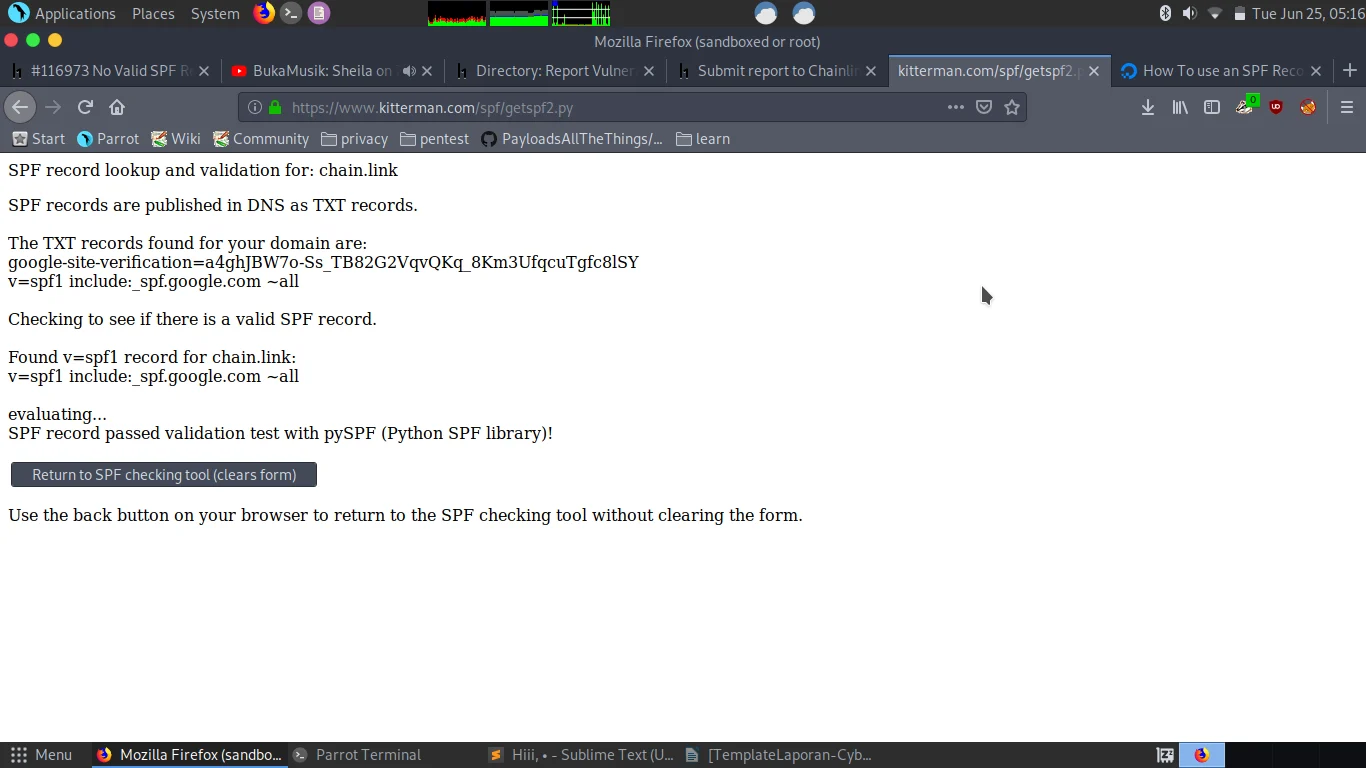
SPF record lookup and validation for: chain.link SPF records are published in DNS as TXT records.
The TXT records found for your domain are: google-site-verification=a4ghJBW7o-Ss_TB82G2VqvQKq_8Km3UfqcuTgfc8lSY v=spf1 include:_spf.google.com ~all
Checking to see if there is a valid SPF record.
Found v=spf1 record for chain.link: v=spf1 include:_spf.google.com ~all
evaluating... SPF record passed validation test with pySPF (Python SPF library)!
Use the back button on your browser to return to the SPF checking tool without clearing the form.
Remediation :
Replace ~all with -all to prevent fake email.
Refferences :
Impact
An attacker would send a Fake email. The results can be more dangerous.
Attachments
Not written yet. The AI write-up for this report has not been written yet. The Original tab links to the source.
How it worked
Root cause
Likely the SPF record uses the soft-fail qualifier instead of a hard-fail qualifier, so unauthorised senders are not rejected outright.
Impact
An attacker could send forged email appearing to come from the domain, which may be used in phishing or spam campaigns.
What the attacker needed
Ability to send email with a forged sender
Explained by bugbounty.wiki with AI from the original and checked against quotes from it; it can still be wrong. Read the original before relying on a detail.
Not written yet. The AI write-up for this report has not been written yet. The Original tab links to the source.
SPF is a DNS record that lists which mail servers are allowed to send email for a domain. The record here ends in a soft-fail setting, which tells receiving servers to accept suspicious mail but flag it rather than reject it. That makes it easier for someone to send email that looks like it came from the real domain.
What is Misconfiguration?
Settings left unsafe: exposed panels, open storage buckets, debug modes, default credentials.



