[chatws25.stream.highwebmedia.com] - Reflected XSS in c parameter
The report claims a reflected cross-site scripting flaw in the c parameter of a chat websocket host, and that the payload also bypasses a Cloudflare filter. An attacker could use it to steal a victim's session cookies and hijack their account.

- Triaged in 4 hours
- Fixed in 25 hours
- Paid in 4 hours
- Disclosed after 44 hours
Hi Team,
Found that chatws25.stream.highwebmedia.com is vulnerable to reflected XSS in c parameter, we can verify it with following URL, it is also a Cloudflare filter bypass:
https://chatws25.stream.highwebmedia.com/ws/007/tgpraolp/htmlfile?c=███
https://chatws25.stream.highwebmedia.com/ws/007/tgpraolp/htmlfile?c=███████
Impact
One of the most common XSS attack vectors is to hijack legitimate user accounts by stealing their session cookies.
What the report shows
The target is chatws25.stream.highwebmedia.com, a host under the *.highwebmedia.com asset scope of the Chaturbate program on HackerOne. The researcher, kazan71p, reports a reflected cross-site scripting (XSS) issue in the c query parameter of an endpoint under /ws/007/tgpraolp/htmlfile.
The report states that the host is vulnerable to reflected XSS in the c parameter and that the same request also bypasses a Cloudflare filter. The researcher gives the following URL as verification:
https://chatws25.stream.highwebmedia.com/ws/007/tgpraolp/htmlfile?c=███
and repeats it in a fenced block:
https://chatws25.stream.highwebmedia.com/ws/007/tgpraolp/htmlfile?c=███████
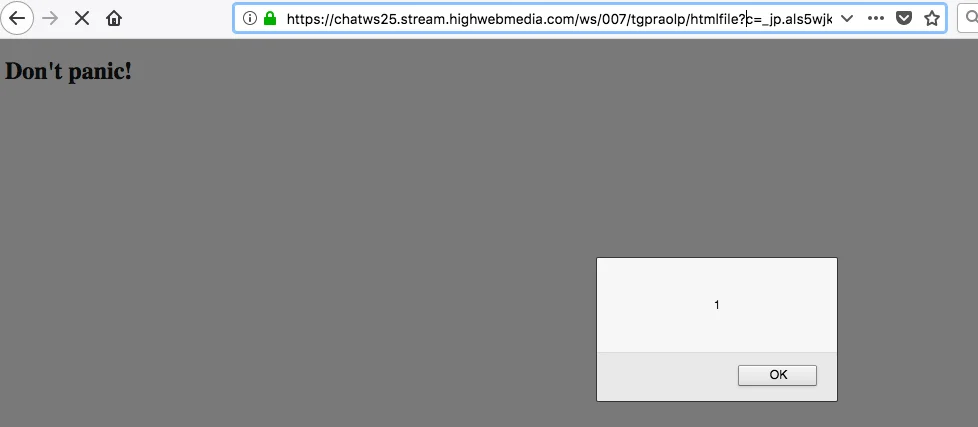
The screenshot is the only evidence attached to the report, placed directly after the verification URL.
The report was rated medium severity and disclosed on 26 September 2018. The platform records a bounty of 350.00 USD. The report text itself does not describe a fix or a remediation step; it stops after the impact section.
Root cause
The report states that the c parameter is vulnerable to reflected XSS, so markup supplied by the requester is interpreted by the browser rather than displayed as text. The report does not show the server-side code or the exact reflection context, so the precise mistake (for example, reflection inside an attribute, a script block or raw HTML) is not stated. The report describes the request as a Cloudflare filter bypass but does not explain which rule or how it was bypassed.
Impact
The report frames the impact in the standard terms for reflected XSS: hijacking legitimate user accounts by stealing their session cookies. That is the stated attack vector. Because the payload is delivered through a URL, exploitation depends on a victim following a crafted link to the affected host, after which script running in the origin's context can act with the victim's privileges. The report does not enumerate further consequences beyond cookie theft.
How this kind of bug works
Reflected XSS occurs when an application takes input from the request (query string, path segment, header or body) and writes it into an HTML response without context-appropriate encoding. The browser receives the response as coming from the trusted origin and executes any script it contains. Because the payload is not stored, the attacker must deliver it to the victim, typically as a link or a redirect.
The vulnerability class exists because servers frequently build responses by string concatenation, and because the same value can land in several different contexts: HTML text, an attribute value, a URL inside an attribute, a JavaScript string, a CSS block or a JSON document. Each context needs its own escaping rules. HTML-encoding alone is insufficient inside a script block, and attribute encoding differs from text encoding. A web application firewall can reduce noise but is not a fix: filters that match known payload shapes can often be bypassed with alternative encodings, unusual event handlers or parser quirks, which is the kind of situation a filter bypass can represent.
The defences that actually stop the class are output encoding applied at the point of rendering, contextual auto-escaping in modern templating engines, a restrictive Content-Security-Policy that blocks inline and third-party script, and correct handling of the Content-Type header so that responses are not sniffed as HTML. HttpOnly cookies limit the damage of cookie theft but do not prevent script execution.
How to test for it
A practical method for this bug class:
- Map reflected parameters. Crawl or proxy the application and note every parameter whose value appears in the response body, including hidden fields, path segments and headers that are echoed (for example in error pages or debug output).
- Identify the reflection context. Look at the surrounding bytes: is the value inside a tag body, between quotes in an attribute, inside a
scriptelement, in a URL, or in a JSON response served as HTML? - Send a benign marker first, such as a unique alphanumeric string, and confirm it is reflected unencoded. This distinguishes reflection from storage and from server-side processing.
- Escalate gradually with context-appropriate probes: angle brackets for HTML context, quote-breaking characters for attributes, and string terminators for script context. Watch whether the characters survive or are encoded.
- Confirm execution in a real browser rather than relying on string matching. A positive result is script running in the origin's context, for example a dialog or a network request to a listener you control.
- Test filter behaviour separately. If a WAF blocks obvious payloads, try alternative encodings, different event handlers, or different HTML elements, and record which variants pass.
Common false positives: the marker appears but is HTML-encoded (safe); the reflection lands in a context where it cannot break out (for example inside a quoted attribute with proper encoding); the response has a Content-Type that prevents HTML interpretation; the payload only executes in a browser mode or with a header the victim would not send; or the reflection is in a part of the page that is never rendered. Always verify in a browser and note the exact request that produced execution.
How it is fixed
Standard remediation for reflected XSS:
- Apply context-aware output encoding to every value written into a response, using the templating engine's escaping by default and explicit encoding only where raw HTML is genuinely required.
- Validate input against an allowlist where the parameter has a known format, rejecting values that do not match.
- Set a Content-Security-Policy that disallows inline script and restricts script sources, as defence in depth.
- Ensure responses carry the correct
Content-TypeandX-Content-Type-Options: nosniffso browsers do not reinterpret them as HTML. - Mark session cookies HttpOnly and Secure so that script cannot read them even if execution occurs.
- Treat WAF rules as a mitigation layer, not a substitute for encoding, and review them when bypasses are reported.
Hunting notes
Reflected XSS tends to hide in parameters that feed error pages, search results, redirects, language and theme selectors, and any endpoint that echoes input into a template. Streaming and websocket-adjacent hosts, legacy endpoints and subdomains that sit outside the main application's templating pipeline are common places to look, because they are often maintained separately and may not share the same escaping helpers.
Recon signals worth following: hosts under a wildcard scope that respond with HTML but are not part of the primary app, endpoints with query parameters that appear in the response, and responses that look hand-built. Comparing encoded and unencoded reflections across similar endpoints often reveals one that missed the shared escaping routine.
To make a report accepted, show the exact request, the exact response fragment where the payload lands, and a browser screenshot or recording of execution. State the context and why the encoding is missing. If a filter is involved, document the bypass precisely. Keep the impact realistic: describe what script in that origin can reach, such as session cookies or authenticated actions, rather than claiming outcomes the evidence does not support.
What happened, in plain words
Chaturbate is a live streaming site. Behind the site there are many servers, and one of them is called chatws25.stream.highwebmedia.com. The researcher, kazan71p, found that this server has a flaw in how it handles one piece of information sent to it: a value named c that travels in the web address (the URL).
When a browser asks a website for a page, it sends a request. A request is simply a message: "please give me this page". The address can carry extra details after a question mark, and each of those details is called a parameter. In this case the parameter is c. Instead, the value is reflected back into the page, and the browser then treats part of it as instructions (code) rather than as text. That is what security people call reflected cross-site scripting, or XSS for short: the harmful content is "reflected" back from the server to whoever asked, like an echo.
The researcher gives this URL as proof:
https://chatws25.stream.highwebmedia.com/ws/007/tgpraolp/htmlfile?c=███
and repeats it in a code block:
https://chatws25.stream.highwebmedia.com/ws/007/tgpraolp/htmlfile?c=███████
Reading it piece by piece:
https://is the secure way a browser talks to a website.chatws25.stream.highwebmedia.comis the server being tested./ws/007/tgpraolp/htmlfileis the path, which points to a specific feature on that server.?c=starts the parameters, and everything after it is the value placed inc.
The value itself is hidden in the published report, so the exact payload is not shown here. What matters is that the value is crafted so that, once the server echoes it into the page, the browser runs it as code.
The report also says the same request gets past a Cloudflare filter. Cloudflare is a service many sites put in front of their servers to block suspicious traffic, a bit like a security guard at a door checking everyone who comes in. A filter bypass means the guard let the request through even though it should have been stopped. The report does not say which filter rule was involved or how it was evaded.
The screenshot is the only evidence attached to the report, placed right after the verification URL.
The report was rated medium severity and disclosed on 26 September 2018. The platform records a bounty of 350.00 USD. The report does not describe a fix.
Why this matters
The report explains the impact in the usual terms for this kind of bug: an attacker can hijack a real user's account by stealing their session cookie. A cookie is a small piece of data a website asks your browser to keep and send back with every request, so the site can remember that you are logged in. If someone else gets hold of that cookie, they can often pretend to be you without knowing your password.
For the attack to work, the victim has to open the crafted link. The code then runs as if it came from the trusted site itself, so it can do things the site would allow the victim to do. The report does not list any consequences beyond cookie theft.
In general, how this kind of bug works
Reflected XSS happens when a site takes something from the request and writes it into the page it returns without properly neutralising it. Neutralising means turning characters that have special meaning in a web page into harmless text, so the browser shows them instead of acting on them. When that step is missing, the browser cannot tell the difference between the site's own code and the attacker's, because both arrive from the same trusted address.
A useful comparison is a notice board. If the person in charge copies whatever visitors hand in and pins it up unchanged, a visitor can hand in a note that looks like an official announcement. Encoding is the equivalent of stamping every visitor note clearly as "visitor text" so nobody mistakes it for an official one.
The same value can land in different places on a page: as visible text, inside an attribute (an extra setting on an HTML element), inside a script block, or inside a link. Each place needs its own kind of neutralising, which is why a single blanket fix often fails. A filter in front of the server, like Cloudflare, helps reduce noise but is not a real fix, because filters that look for known bad patterns can often be slipped past with unusual spellings or alternative forms.
The defences that actually work are: encoding values at the moment the page is built, using a templating engine that escapes by default, adding a Content-Security-Policy (a header that tells the browser which scripts it may run), and marking cookies HttpOnly so that code on the page cannot read them.
In general, how to test for it
- Find parameters that come back. Browse or intercept the site's traffic and note every parameter whose value appears in the returned page.
- Work out where the value lands: in plain text, between quotes in an attribute, inside a script block, or in a link.
- Send a harmless unique marker first, such as a random word, and check whether it comes back unchanged. This proves the value is echoed and not just stored.
- Try characters that matter in that spot, such as angle brackets for text, or quotes for attributes, and watch whether they survive or get converted.
- Confirm in a real browser, not just by reading the response. A real result is code actually running on the site's own address.
- Test the filter separately. If obvious attempts are blocked, try other forms and record which ones get through.
Watch for false alarms: a marker that comes back already converted is safe, and a value that lands somewhere it cannot break out of is not exploitable. Always note the exact request that produced execution.
In general, how it is fixed
- Encode every value written into a page, using the templating engine's escaping by default.
- Reject input that does not match the expected format where the parameter has a known shape.
- Add a Content-Security-Policy that blocks inline script and limits where scripts can come from.
- Send the correct
Content-Typeheader, plusX-Content-Type-Options: nosniff, so browsers do not reinterpret responses as web pages. - Mark session cookies HttpOnly and Secure so code cannot read them even if it runs.
- Treat filter rules as an extra layer, never as a replacement for encoding.
In general, where to look
This bug tends to hide in parameters that feed error pages, search results, redirects, language and theme choices, and any endpoint that echoes input into a page template. Servers that sit outside the main application, such as streaming or websocket-related hosts and older subdomains, are common places to find it, because they are often maintained separately and may not use the same escaping helpers.
To get a report accepted, show the exact request, the exact part of the response where the value lands, and a screenshot or recording of it running in a browser. Explain the context and why the encoding is missing. If a filter is involved, document the bypass precisely. Keep the impact realistic: describe what code on that site can reach, such as session cookies, rather than outcomes the evidence does not support.
Glossary
- XSS (cross-site scripting): a flaw where a site lets attacker-supplied content run as code in a visitor's browser.
- Reflected XSS: XSS where the harmful content is echoed back from the server in the same response, usually via a crafted link.
- Request: the message a browser sends to a server asking for a page or data.
- Response: the message the server sends back.
- URL: the address of a page or resource on the web.
- Parameter: an extra value attached to a URL after a question mark, such as
chere. - Endpoint: a specific address on a server that performs a particular function.
- Payload: the crafted value an attacker sends to trigger the flaw.
- Cookie: a small piece of data a site stores in your browser so it can recognise you, often keeping you logged in.
- Session cookie: the cookie that proves you are logged in.
- HttpOnly: a cookie setting that stops page code from reading the cookie.
- Secure: a cookie setting that sends the cookie only over encrypted connections.
- Cloudflare: a service placed in front of websites to filter and block suspicious traffic.
- Filter bypass: getting a request past a security filter that should have stopped it.
- Encoding (output encoding): converting special characters into harmless text so a browser displays them instead of acting on them.
- Attribute: an extra setting written inside an HTML tag.
- Templating engine: software that builds web pages from templates and can escape values automatically.
- Content-Security-Policy: a header that tells the browser which scripts a page may run.
- Content-Type: a header that states what kind of content a response contains.
X-Content-Type-Options: nosniff: a header that stops browsers from guessing a different content type.- WAF (web application firewall): a filter that inspects traffic and blocks patterns that look malicious.
- Severity: a rating of how serious a flaw is.
- Bounty: a reward paid for reporting a valid flaw.
- Disclosed: made public, usually after a fix or an agreed period.








