View Failed Approval and Pending videos other users
Public photosets could be viewed before they were approved or denied, and videos could be accessed while awaiting confirmation or after rejection. An attacker could view pending or unaccepted content by guessing content IDs.

- Triaged in 13 hours
- Fixed in 21 hours
- Paid in 13 hours
- Disclosed after 31 days
Summary by the program
The hacker found that public photosets can be accessed before they are approved or denied. This was quickly resolved. There was no access to private photosets.
The report
See videos uploaded by a user. The video is available when it waits for confirmation or is not accepted.
Steps To Reproduce:
1 - Go victim page : https://chaturbate.com/p/akaxanxa/?tab=bio 2 - Open video : https://chaturbate.com/photo_videos/photo/big/[user_name]/[content_id]/
3 - Get random requests - https://chaturbate.com/photo_videos/photo/big/[user_name]/[ last content id + 1 ]/
4 - Done - If the id holds the content opens up as a result.
Impact
By collecting user information, they can access their pending content. I can share content on my site or blog as original content from my own name by playing the contents.
Attachments
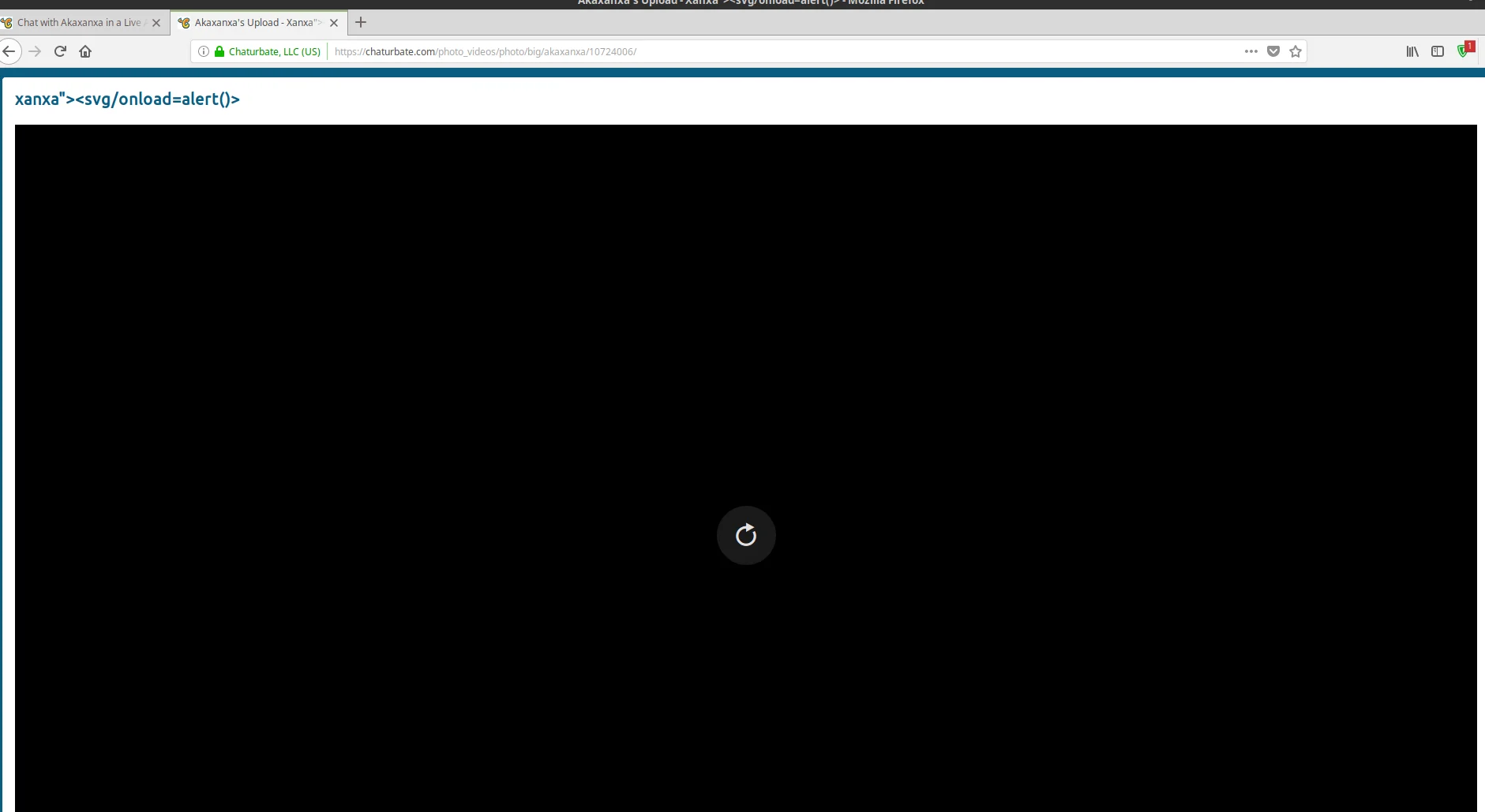
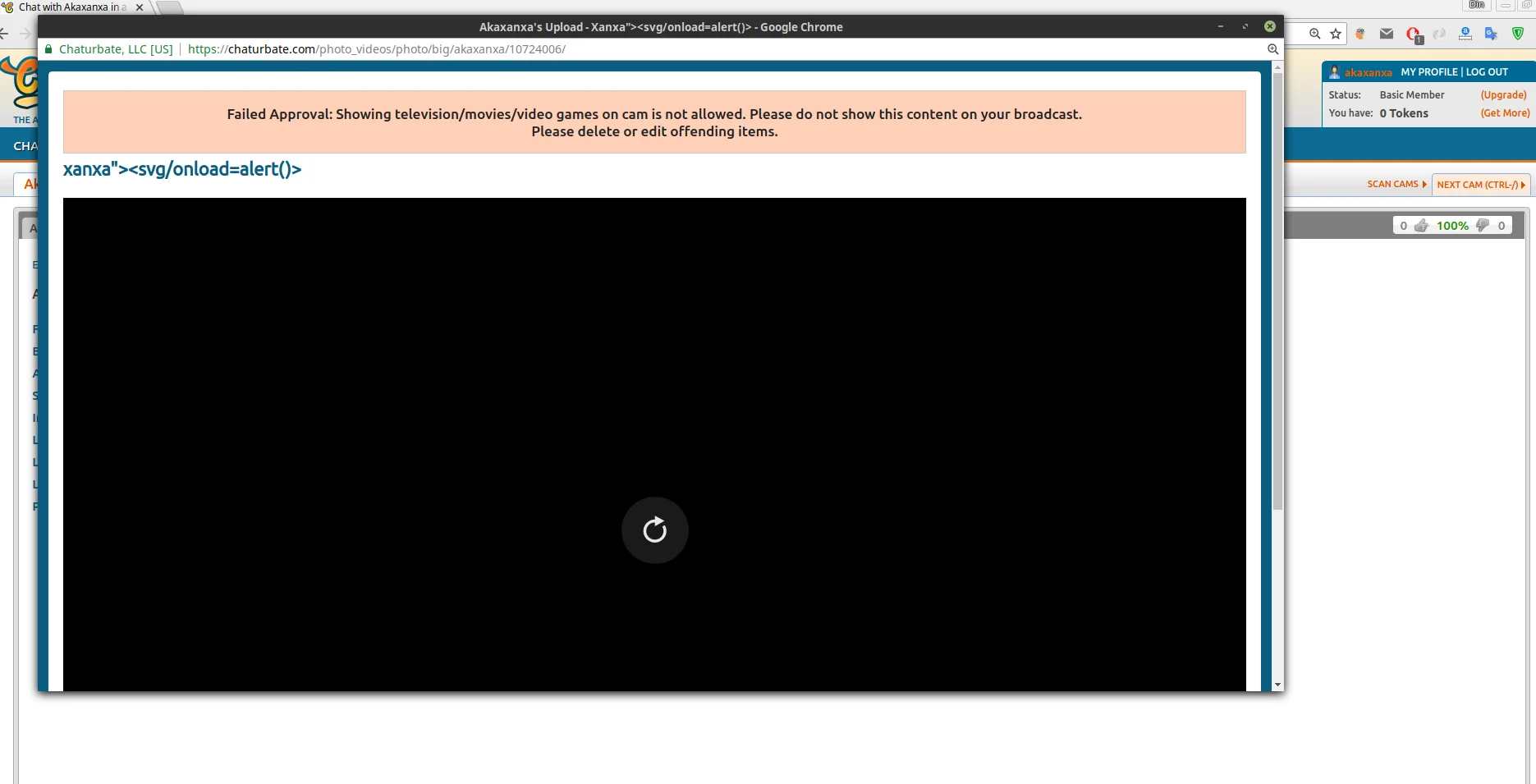
What the report shows
The target is Chaturbate, and the feature in question is the photo and video content that users upload to their profile pages. The program's own summary states the finding plainly: public photosets could be accessed before they had been approved or denied. The summary also records that the issue was resolved quickly and that private photosets were not exposed.
The researcher's description is short. A video uploaded by a user is reachable while it is still waiting for confirmation, or after it has not been accepted. The reproduction steps are given as follows.
- Open the victim's page:
https://chaturbate.com/p/akaxanxa/?tab=bio
- Open a video through the content path:
https://chaturbate.com/photo_videos/photo/big/[user_name]/[content_id]/
- Request neighbouring identifiers by incrementing the content id:
https://chaturbate.com/photo_videos/photo/big/[user_name]/[ last content id + 1 ]/
- If the identifier holds content, the content opens.
The report was rated low severity and paid a bounty of 200.00 USD. It was disclosed on 2018-10-21. No CVSS score or weakness classification is given.
The report includes two attachments.
Root cause
The report does not describe the server-side implementation, so the cause can only be inferred. The researcher reached unapproved content by requesting the next content id.
Impact
In the researcher's words, collecting user information gives access to pending content. The researcher also notes that the content could be republished on another site or blog under the researcher's own name, presented as original work. The program's summary limits the scope: only public photosets were affected, and private photosets were not accessible. The practical consequence is that material a user submitted but which the platform had not yet approved, or had declined, remained readable by anyone who could guess or enumerate its identifier.
How this kind of bug works
Moderation states such as pending, approved and rejected are metadata attached to a content record. The bug class appears when the delivery path for an object does not check its moderation state. Listing pages, profile pages and search filter on state, so the item is invisible in the interface, but the direct object endpoint resolves the record by identifier alone. The object is then served to anyone who knows or guesses the identifier.
Sequential or otherwise predictable identifiers make this worse, because an attacker does not need a link. Objects may also leak through caches, previews, thumbnails, transcoding jobs or API responses that return the full record. The defence is authorisation at the point of delivery: every request for the object must re-evaluate the caller's relationship to it and the object's state, and must fail closed for any state that is not publicly visible.
How to test for it
- Identify a feature with a moderation or review workflow: uploads, comments, listings, profile changes, marketplace items.
- Create two accounts, one that submits content and one unrelated account that should not see it.
- Submit content and keep it in the pending state. Record every identifier the application returns for it, including identifiers in JSON responses, upload confirmations and redirect locations.
- As the unrelated account, request the direct object endpoint for that identifier, and also request the endpoints for neighbouring identifiers, both lower and higher.
- Repeat after the content is rejected, and again after it is approved, to see which states change the response.
- Compare responses carefully: a 200 with the full body, a partial body, a different content type or a redirect to a signed URL all count. A generic error page does not.
Common false positives are placeholder responses that return 200 with an empty body or a default image, cached public copies that were legitimately published before moderation, and endpoints that return metadata only, without the media itself. Confirm that the bytes you receive are the unapproved object and not a stand-in.
How it is fixed
Enforce the state check in the handler that serves the object, not only in the listing queries. Return a not-found or forbidden response for any object whose state is not public, and apply the same rule to thumbnails, previews, transcoding outputs and API representations. Where identifiers are sequential, consider non-guessable identifiers as an additional layer, but treat that as defence in depth rather than the fix. Add regression tests that request pending and rejected objects directly as an unrelated user.
Hunting notes
This bug class tends to hide wherever content passes through a review step before publication: media uploads, classified ads, profile bios, comments held for moderation, and anything with a draft or scheduled state. Recon signals include numeric identifiers in URLs, upload responses that reveal an id before approval, and separate hostnames or paths for media delivery that differ from the application itself. State the boundary of the exposure, as this program did when it noted that private photosets were unaffected.
What happened, in plain words
Chaturbate is a site where users have profile pages. Those pages can hold photos and videos that the user uploads. Content can sit in a pending state, waiting for confirmation, or be not accepted. Think of it like a shop window with a back room: the back room holds items waiting for the manager's approval, and only approved items go into the window.
The researcher found that pending content could be opened directly. A video that was still waiting for confirmation, or that had not been accepted, could still be opened directly by anyone who knew its address. The program's own summary says it plainly: public photosets could be accessed before they were approved or denied. The summary also records that the issue was fixed quickly and that private photosets were not exposed.
The report was rated low severity and paid a bounty of 200.00 USD. It was disclosed on 2018-10-21. No CVSS score or weakness classification is given.
The report
The researcher's description is short: a video uploaded by a user is reachable while it waits for confirmation, or after it has not been accepted. The reproduction steps are given as follows.
- Open the victim's page:
https://chaturbate.com/p/akaxanxa/?tab=bio
- Open a video through the content path:
https://chaturbate.com/photo_videos/photo/big/[user_name]/[content_id]/
This is the address used to open a video. [user_name] is the account name and [content_id] is a number that identifies one particular upload. The square brackets are placeholders: in a real request you replace them with the name and the number. This step matters because it shows that the file has its own direct address, separate from the profile page that lists it.
- Request neighbouring identifiers by incrementing the content id:
https://chaturbate.com/photo_videos/photo/big/[user_name]/[ last content id + 1 ]/
Here the researcher takes the last content id they know about and adds one, then asks for that address. The researcher takes the last content id they know about and adds one, then asks for that address. This is the heart of the finding: you do not need a link from the site, you just count upwards.
- If the identifier holds content, the content opens.
That is the whole test: if the identifier holds content, the content opens.
The report includes two attachments.
Why it matters
In the researcher's words, collecting user information gives access to pending content. The researcher also notes that the content could be republished on another site or blog under the researcher's own name, presented as original work. The program's summary limits the scope: only public photosets were affected, and private photosets were not accessible. The practical consequence is that material a user submitted but which the platform had not yet approved, or had declined, remained readable by anyone who could guess or count its identifier.
In general, how this kind of bug works
Moderation states such as pending, approved and rejected are labels attached to a content record. The bug appears when the page that serves the file does not check those labels. Listing pages, profile pages and search filter on state, so the item is invisible in the interface. The direct file address, however, looks the record up by number alone and serves it to anyone who knows or guesses that number.
Sequential or otherwise predictable identifiers make this worse, because an attacker does not need a link. Objects may also leak through caches, previews, thumbnails, transcoding jobs or API responses that return the full record. The defence is a permission check at the point of delivery: every request for the file must re-check who is asking and what state the object is in, and must refuse anything that is not publicly visible.
In general, how to test for it
- Find a feature with a review step: uploads, comments, listings, profile changes, marketplace items.
- Create two accounts, one that submits content and one unrelated account that should not see it.
- Submit content and keep it pending. Note every identifier the site returns for it, including numbers in responses, upload confirmations and redirect addresses.
- As the unrelated account, request the direct file address for that identifier, and also for neighbouring numbers, both lower and higher.
- Repeat after the content is rejected, and again after it is approved, to see which states change the response.
- Compare responses carefully: a normal page with the full file, a partial file, a different content type or a redirect to a temporary link all count. A generic error page does not.
Common false positives are placeholder responses that return an empty body or a default image, cached public copies that were legitimately published before moderation, and addresses that return only metadata without the media itself. Confirm that what you receive is the unapproved object and not a stand-in.
In general, how it is fixed
Enforce the state check in the handler that serves the file, not only in the listing queries. Return a not-found or forbidden response for any object whose state is not public, and apply the same rule to thumbnails, previews, transcoding outputs and API representations. Where identifiers are sequential, consider non-guessable identifiers as an additional layer, but treat that as defence in depth rather than the fix. Add regression tests that request pending and rejected objects directly as an unrelated user.
In general, where to look
This bug class tends to hide wherever content passes through a review step before publication: media uploads, classified ads, profile bios, comments held for moderation, and anything with a draft or scheduled state. Signals worth watching for include numeric identifiers in URLs, upload responses that reveal an id before approval, and separate hostnames or paths for media delivery that differ from the application itself. State the boundary of the exposure, as this program did when it noted that private photosets were unaffected.
Glossary
- Request: the message your browser sends to a website asking for a page or file.
- Response: what the website sends back, such as a page, a file or an error.
- Endpoint: a specific address on a site that performs one job, such as serving a media file.
- Identifier (id): a number or string that names one particular record, such as one uploaded video.
- Sequential identifier: an id that increases by one for each new record, so the next one can be guessed.
- Enumeration: trying a series of identifiers one after another to find records that were not meant to be found.
- Moderation state: the label on content saying whether it is pending, approved or rejected.
- Pending: submitted but not yet reviewed.
- Photoset: a set of content uploaded to a profile.
- Private photoset: a set the user has restricted to certain viewers; the program states these were not exposed.
- Authorisation: checking whether the person asking is allowed to see a particular thing.
- Access control: the overall system of rules that decides who may see or do what.
- Defence in depth: adding a second, independent safeguard on top of the main fix.
- False positive: a result that looks like a bug but is not, such as a placeholder image.
- Metadata: descriptive information about a file, such as its title or state, rather than the file itself.
- CVSS: a standard scoring system for rating the severity of a vulnerability.
- Bounty: a payment a program makes to a researcher who reports a valid issue.

