Hey Developer, Give me your API keys.!!
A secret API key and project identifier were exposed in a public GitHub repository, allowing the author to access and take over a Crowdin test project. The attacker could view project details and add, delete, or upload files.
 Published on medium.com
This is just another friendly article, without any secret “Ninja” techniques..!!
The full write-up lives on its author's site
It belongs to its author, so we link to it rather than copy it. The other two tabs are our own rewrites, checked against it.
Context
Crowdin is a localisation management platform that automates localisation within agile software development. The author quotes the platform as having more than 1,000,000 user accounts and being used by development companies in 140 countries. Crowdin exposes an HTTP API for managing projects, and the write-up is about a test project called rubytestapi that was reachable through that API.
The article is deliberately framed as a simple story rather than advanced research: the theme is that developers leave secret API keys, AWS secret keys, MySQL credentials and Slack channel credentials in public repositories. The author also notes that Base64 encoding an API key is not a fix, because Base64 encoded keys can easily be decoded.



Setup
The researcher decided to test Crowdin because the company offers a goodies pack for valid vulnerabilities. The only tooling mentioned is Burp, used to send the API request. No accounts, roles or versions are described. The key was found in a public GitHub repository of Crowdin.
Finding it
The researcher started by looking for code level bugs in Crowdin's GitHub repositories and ended up on a page that disclosed a secret API key:
https://github.com/crowdin/crowdin-api/blob/master/bin/console
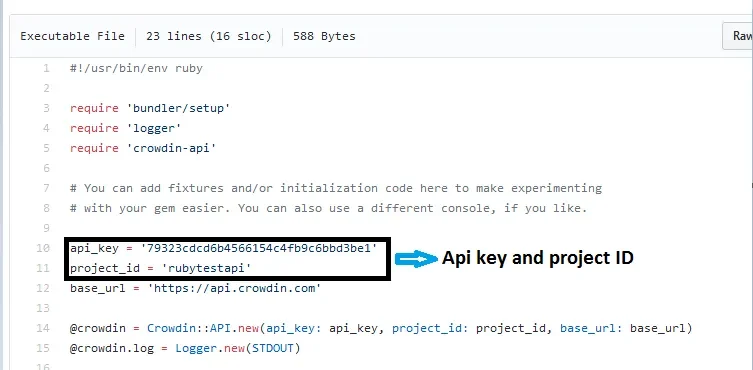
The file contained three values:
api_key = '[redacted]'
 project_id = 'rubytestapi'
 base_url = 'https://api.crowdin.com'
At that point the researcher did not know how the key could be used to access the project, so the next step was reading Crowdin's API documentation at https://support.crowdin.com/api/api-integration-setup/. From the documentation it became clear that the API key was enough to take over the rubytestapi project. The author notes that the key is now expired.
Exploitation
Step 1: enumerate the project details
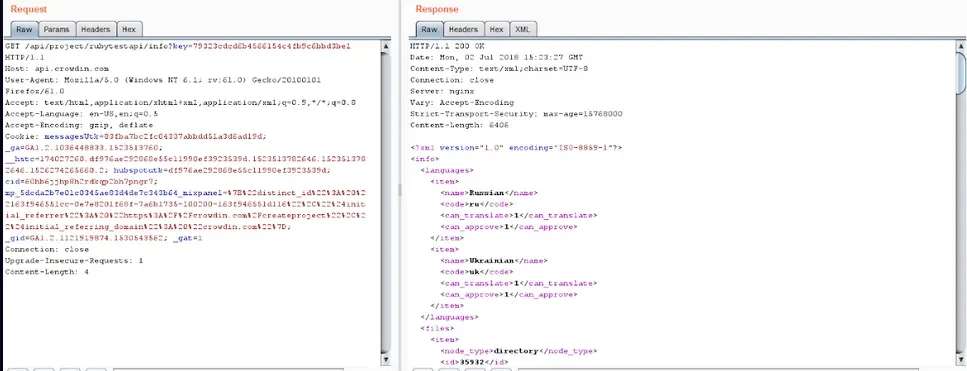
With the project identifier and the project key in hand, the request to enumerate project details is:
GET https://api.crowdin.com/api/project/{project-identifier}/info?key={project-key}
Here {project-identifier} is rubytestapi and {project-key} is [redacted]. The key is passed as a query string parameter, so it travels in the URL rather than in a header.
When the request was sent through Burp, the response was 200 OK and contained the complete details of the rubytestapi project.
Step 2: assess what the key allows
According to the API documentation, the key allowed the researcher to add files, delete files, upload translations, check translation status and do many other things. In short, the researcher had complete access to the project.

Step 3: confirm ownership
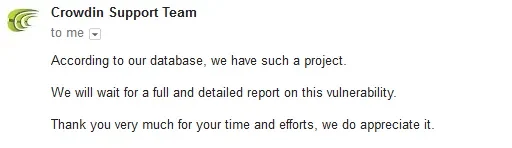
Before reporting, the researcher emailed Crowdin to confirm whether the rubytestapi project was owned by them. Within a few minutes Crowdin replied, confirming that the project belonged to them.
Step 4: report and resolution
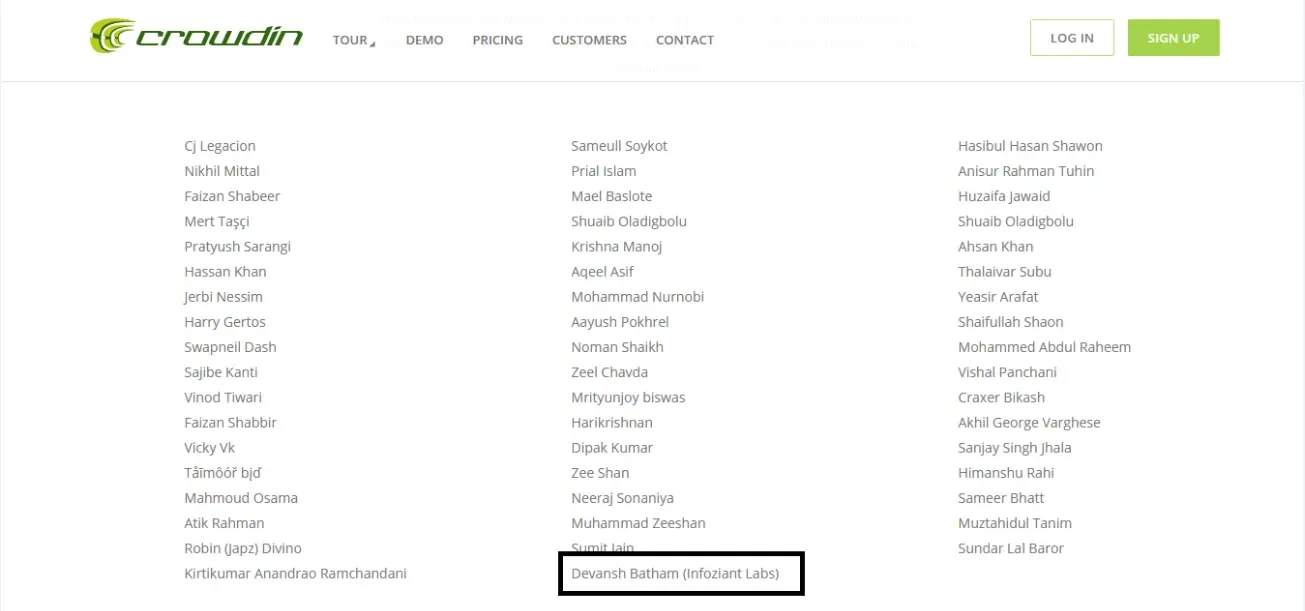
The issue was reported with a proof of concept. Crowdin triaged and fixed the report within one hour. The researcher received a goodies pack and was listed in Crowdin's hall of fame at https://crowdin.com/page/hall-of-fame.
Root cause
A secret API key and the matching project identifier were committed to a public GitHub repository, in the bin/console file of the crowdin-api repository. Because the API accepted the leaked key and project identifier, anyone who could read the repository could act on the project. The report does not describe any additional defence, such as IP restrictions, scoping or rotation, that would have limited the key's use.
Impact
An attacker who found the key could read the full details of the rubytestapi project and, per the API documentation, add and delete files, upload translations and check translation status. In practice this meant complete control over that project. The project was a test project, and the report does not claim access to any other Crowdin project or to user data.
Fix
Crowdin fixed the issue within one hour of the report. The report does not describe the specific change. The key shown in the write-up is expired. The general lesson the author gives is to be careful when handling API keys, and not to rely on Base64 encoding to protect them.
Variants to test
- Search public repositories for API keys and project identifiers in configuration and console scripts, for example files under
bin/. A positive result is a key that still authenticates against the vendor's API. - Check whether keys are passed in query strings, as here with
?key=. A positive result is a200 OKresponse containing project details when the key is supplied by URL. - Test whether a leaked key is scoped to a single project or grants broader access. A positive result is a response for a project other than the one named in the repository.
- Look for Base64 encoded credentials in repositories and decode them. A positive result is a decoded key that authenticates successfully.
- Check mobile applications for hardcoded credentials, as the author mentions from past cases. A positive result is a credential that grants access to an admin dashboard.
What happened, in plain words
A security researcher found a secret password-like string, called an API key, sitting in a public code repository belonging to Crowdin. Crowdin is a company that makes software for translating and localising products into many languages. Because that key was public, anyone who read the repository could use it to control one of Crowdin's test projects, called rubytestapi. The researcher used the key to read the project's details, confirmed with Crowdin that the project was theirs, reported the problem, and Crowdin fixed it within an hour.
The author's point is simple: the mistake was not a clever hack. It was a developer leaving a secret in a place where the whole world could read it.
Before going further, a few words on the ideas involved.
What an API is. Think of a restaurant. The kitchen is the software that does the real work. The menu and the waiter are the API: a fixed, limited way for you to ask the kitchen for things without walking into it yourself. In computing, an API (Application Programming Interface) is a set of addresses and rules that let one program ask another program to do something, such as "list my project details" or "upload this file". You send a request to a specific address, and the other program sends back a response.
What an API key is. If the API is the waiter, the API key is the membership card you show to prove you are allowed to order. It is a long random-looking string that the service checks on every request. Anyone who has the card can act as you. That is why a leaked key is serious: it is not a password you can guess, it is a password that was handed out.
What a repository is. A repository (often shortened to repo) is a shared folder for source code, with a history of every change. GitHub is a website that hosts millions of these folders publicly. Public means exactly that: anyone with a browser can read every file, without logging in.
What the vulnerability class means. This is called information disclosure: secret information was exposed to people who should not have it. The secret itself is not a bug in the code; the bug is where the secret was stored.
The author also makes a related point: some developers encode keys using Base64 and assume attackers cannot find them. Base64 is a way of rewriting data using only letters, digits and a couple of symbols. It is not encryption and it has no key. It is like writing a message backwards: it looks scrambled, but anyone can unscramble it in seconds. A Base64 encoded API key can easily be decoded.
Setup
The researcher chose to test Crowdin because the company offers a goodies pack (stickers, T-shirts and similar) for valid vulnerability reports. That is a common incentive: companies run bug bounty or reward programmes to encourage people to report problems instead of misusing them.
The only tool mentioned for sending requests is Burp, short for Burp Suite. Burp is a program that sits between your browser and a website, letting you capture a request, edit it, and send it again. Think of it as an interceptor for letters: you can open the envelope, change the wording, and post it again.
The key was found in a public GitHub repository of Crowdin.
Finding it
The researcher started by looking for code level bugs in Crowdin's GitHub repositories. Instead of a bug in the code, the search ended on a page that was disclosing a secret API key:
https://github.com/crowdin/crowdin-api/blob/master/bin/console
This is a normal GitHub address. crowdin is the organisation, crowdin-api is the repository, blob/master means "show me the file as it exists on the main branch", and bin/console is the file itself. A bin folder usually holds small helper scripts that developers run by hand, which is exactly the kind of place where people paste credentials for convenience.
The file contained three values:
api_key = '[redacted]'
 project_id = 'rubytestapi'
 base_url = 'https://api.crowdin.com'
Line by line:
api_key = '[redacted]'is the secret membership card. The long string of letters and digits is the key itself.project_id = 'rubytestapi'is the name of the project the key belongs to. The API needs to know which project you mean, and this is its identifier.base_url = 'https://api.crowdin.com'is the address of Crowdin's API, the front door where requests are sent.
At that point the researcher did not know how the key could be used to access the project. A key on its own is just a string; you need to know which address accepts it and in what format. So the next step was reading Crowdin's API documentation at https://support.crowdin.com/api/api-integration-setup/. Documentation is the manual for an API: it lists the addresses, what each one does, and what it expects you to send. From the documentation it became clear that the API key was enough to take over the rubytestapi project. The author notes that the key is now expired, meaning it no longer works.
Exploitation
Step 1: enumerate the project details
With the project identifier and the project key in hand, the request to enumerate project details is:
GET https://api.crowdin.com/api/project/{project-identifier}/info?key={project-key}
Line by line:
GETis the type of request. It means "give me information", as opposed to sending or changing something. It is the same kind of request your browser makes when you open a page.https://api.crowdin.comis the base address from the file./api/project/is the path that says "I want to work with a project".{project-identifier}is a placeholder. In this case it is replaced withrubytestapi./infoasks for the project's details.?key={project-key}is the part after the question mark, called the query string. It carries extra information, here the key, and it is replaced with[redacted].
So the key is passed in the URL itself, not in a separate header. That matters because URLs end up in browser history, server logs and shared links far more often than headers do.
When the request was sent through Burp, the response was 200 OK. HTTP status codes are short numbers that say how a request went: 200 means success, 404 means not found, 403 means forbidden. A 200 OK here meant the key was accepted, and the response contained the complete details of the rubytestapi project.
Step 2: assess what the key allows
According to the API documentation, the key allowed the researcher to add files, delete files, upload translations, check translation status and do many other things. In short, the researcher had complete access to the project. The leaked key could change things, not just look at them.
Step 3: confirm ownership
Before reporting, the researcher emailed Crowdin to confirm whether the rubytestapi project was owned by them. This step matters: a project with a test-like name could belong to a customer, and you do not want to report, or touch, someone else's data. Within a few minutes Crowdin replied, confirming that the project belonged to them.
Step 4: report and resolution
The issue was reported with a proof of concept. A proof of concept is the smallest, clearest demonstration that the problem is real, usually the exact request and the response showing it worked. Crowdin triaged and fixed the report within one hour. Triaged means the team reviewed the report, confirmed it was valid, and assigned it for fixing. The researcher received a goodies pack and was listed in Crowdin's hall of fame at https://crowdin.com/page/hall-of-fame, a public page that thanks people who reported security issues.
Root cause
A secret API key and the matching project identifier were committed to a public GitHub repository, in the bin/console file of the crowdin-api repository. Committed means saved into the repository's history, so even deleting the file later does not remove it from the past versions. Because the API accepted the leaked key and project identifier, anyone who could read the repository could act on the project. The report does not describe any additional defence, such as IP restrictions, scoping or rotation, that would have limited the key's use.
Impact
An attacker who found the key could read the full details of the rubytestapi project and, per the API documentation, add and delete files, upload translations and check translation status. In practice this meant complete control over that project. The project was a test project, and the report does not claim access to any other Crowdin project or to user data.
Fix
Crowdin fixed the issue within one hour of the report. The report does not describe the specific change. The key shown in the write-up is expired. The general lesson the author gives is to be careful when handling API keys, and not to rely on Base64 encoding to protect them.
Variants to test
- Search public repositories for API keys and project identifiers in configuration and console scripts, for example files under
bin/. A positive result is a key that still authenticates against the vendor's API. - Check whether keys are passed in query strings, as here with
?key=. A positive result is a200 OKresponse containing project details when the key is supplied by URL. - Test whether a leaked key is scoped to a single project or grants broader access. A positive result is a response for a project other than the one named in the repository.
- Look for Base64 encoded credentials in repositories and decode them. A positive result is a decoded key that authenticates successfully.
- Check mobile applications for hardcoded credentials, as the author mentions from past cases. A positive result is a credential that grants access to an admin dashboard.
Glossary
- API (Application Programming Interface): a fixed set of addresses and rules that let one program ask another program to do something, like a menu and waiter in a restaurant.
- API key: a long random string that proves to a service that a request is allowed, like a membership card.
- AWS secret key: a secret string that grants access to Amazon Web Services, a large cloud computing provider.
- Base64: a way of rewriting data using only letters, digits and a few symbols. It is not encryption and can be decoded by anyone.
- Bug bounty / reward programme: a scheme where a company pays or rewards people for reporting security problems responsibly.
- Burp (Burp Suite): a tool that captures, edits and resends web requests, like an interceptor for letters.
- Commit: saving a change into a repository's history. Old versions remain readable even after the file is deleted.
- Credentials: any secret used to prove identity, such as a password, key or token.
- Crowdin: a localisation management platform, software for managing translations of products into many languages.
- Enumeration: systematically listing information, here the details of a project, by asking the API.
- GET request: an HTTP request that asks for information rather than changing something.
- GitHub: a website that hosts source code repositories, many of them public and readable by anyone.
- Hall of fame: a public page listing people who reported security issues to a company.
- HTTP status code: a short number in a response saying how the request went, such as
200 OKfor success or403for forbidden. - Information disclosure: a vulnerability where secret information is exposed to people who should not have it.
- Localisation: adapting a product for different languages and regions.
- MySQL: a popular database system. Its credentials are the username and password used to connect to it.
- Proof of concept (PoC): the smallest clear demonstration that a problem is real, usually the exact request and response.
- Query string: the part of a URL after the question mark, carrying extra values such as a key.
- Repository (repo): a shared folder for source code with a full history of changes.
- Slack: a workplace chat tool. Its channel credentials are the secrets used to connect to it.
- Token: a string used in place of a password to prove identity on each request.
- Triaged: reviewed and confirmed as valid by the receiving security team.
- Vulnerability: a weakness that lets someone do something they should not be able to do.



