Email Spoofing Possible on djangoproject.com Email Domain
The djangoproject.com domain lacked SPF and DMARC records, allowing attackers to send spoofed emails that appear to come from the domain. This could be used for phishing attacks against employees or customers.

- Disclosed after 39 hours
Summary: Due to lacking a SPF and DMARC record it is possible to spoof emails from djangoproject.com. This could potentially be used to trick employees, customers or clients via phishing emails.
Description: Mail servers rely on both SPF and DMARC to properly deal with email spoofing. SPF shows what servers are allowed to send emails for the current domain. However when a mail does not originate from one of the listed IP's or domains it does not automatically get rejected. What happens to the spoofed email relies of the DMARC policy of the domain. If there is no DMARC policy or the DMARC policy contains 'p=none;' then no action is taken and the email is accepted, even though SPF has failed. In this case there is neither a SPF or a DMARC record.
Steps To Reproduce:
- You can verify the missing SPF and DMARC policy with the following commands on Linux or OSX:
git clone https://github.com/BishopFox/spoofcheck cd spoofcheck; python spoofcheck.py djangoproject.com Verify the lines: [+] djangoproject.com has no SPF record! [*] No DMARC record found. Looking for organizational record [+] No organizational DMARC record 2. You can test if spoofing is legitimate by sending a spoofed email using Send Grid. I have attached a small bash script which can do this for you, but you will need to provide a SendGrid username (SGUSER) and password (SGPASS) to use it. Also make sure to update the recipient email address (SGTO).
Supporting Material/References:
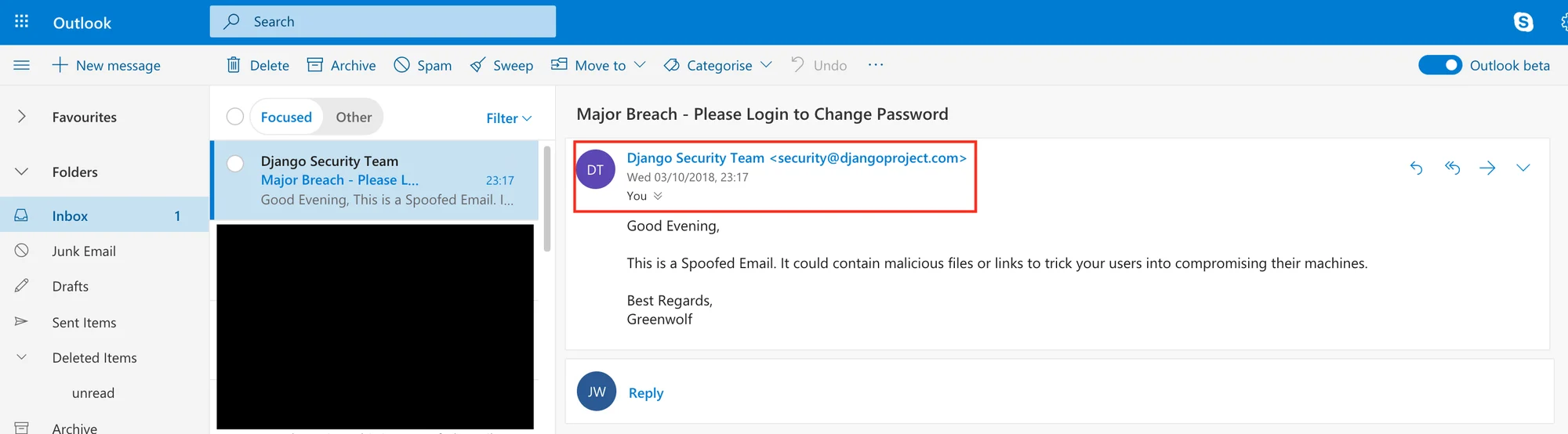
- I have attached an image of a spoofed email from vimeo.com to my outlook account called 'Vimeo-Spoofed-Email.png'.
- I have attached the output of spoofcheck showing the misconfigured DMARC record called 'misconfigured-dns.txt'.
- I have attached a small sendgrid script for you to test the spoofing called 'spooftest.sh'.
Impact
By exploiting this issue, attackers can spoof emails from your domain, which could be used to target your customers or employees with phishing emails.
As 90% of security breaches and compromises start with Phishing emails, allowing your domain to be spoofed removes an additional layer of protection for your customers, as they will see a legitimate from address at the top of a non legitimate email. This means an attacker doesn't have to rely on techniques such as character replacement which users have been trained to spot. E.g goggle.com or microsift.com
To fix the issue, a DMARC record containing 'p=reject;' should be added, which will cause spoofed emails to be rejected by the recipients mailbox.
Attachments
Not written yet. The AI write-up for this report has not been written yet. The Original tab links to the source.
How it worked
Root cause
The domain djangoproject.com had no SPF record and no DMARC record, so receiving mail servers had no instructions to reject spoofed emails.
Impact
Attackers could spoof emails from djangoproject.com, which could be used to phish customers or employees, as the emails would appear to come from a legitimate address.
What the attacker needed
None
The fix
A DMARC record with 'p=reject;' should be added to reject spoofed emails.
How it was found
- Clone the spoofcheck tool from GitHub.
- Run the spoofcheck script against djangoproject.com.
- Observe that the output shows no SPF record and no DMARC record.
- Optionally, send a test spoofed email using SendGrid with provided credentials.
Explained by bugbounty.wiki with AI from the original and checked against quotes from it; it can still be wrong. Read the original before relying on a detail.
Not written yet. The AI write-up for this report has not been written yet. The Original tab links to the source.
Email spoofing is when someone sends an email that looks like it came from a different address. SPF and DMARC are email security records that help receiving mail servers check if an email is really from the domain it claims. Without them, anyone can send fake emails that appear to come from djangoproject.com.
What is Misconfiguration?
Settings left unsafe: exposed panels, open storage buckets, debug modes, default credentials.




