Server responds with the server error logs on account creation
When creating a wallet, changing the bank account type to an unexpected value caused the server to return its internal error log in a response header. An attacker could use the leaked function and file names to plan further attacks against the application.

- Triaged in 34 days
- Fixed in 34 days
- Paid in 34 days
- Disclosed after 7 months
Impact Poorly protected response can provide a gold mine of information to an attacker, disclosing a host of sensitive information such as function and file names. This information may enable the attacker to immediately or later compromise the entire application.
PoC
-
Create a new wallet.
-
Intercept the request using a proxy tool.
-
Edit the
bankAccountTypeto anything other than CHECKING
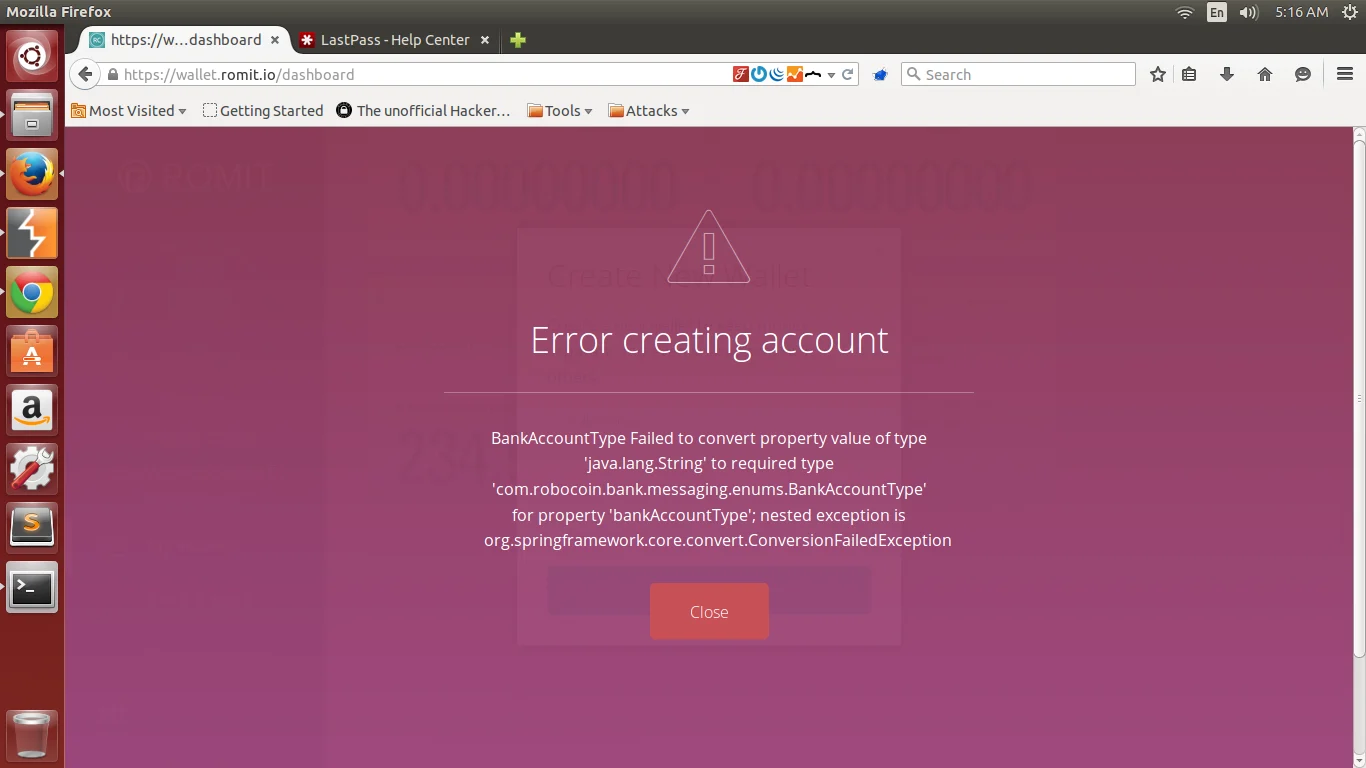
The server responds with error log of the server in the header of the response, see attached picture.
Thanks crab
Attachments
What the report shows
The target is a wallet creation feature. The researcher, credited as tmfelwu (signing the report "crab"), found that a malformed value in the account creation request causes the server to return its own error log in the response header.
The reproduction is three steps:
- Create a new wallet.
- Intercept the request using a proxy tool.
- Edit the
bankAccountTypeto anything other than CHECKING.
The report does not include the raw request, so the exact endpoint, HTTP method, headers and body are not shown. The only parameter named is bankAccountType, and the only value named is CHECKING, which is described as the expected one. Sending any other value makes the server respond with an error log of the server in the header of the response.
The report was disclosed on 26 November 2015 under the Information Disclosure weakness and paid a bounty of 50.00 USD. No severity rating or CVSS score is given, and the report does not describe a fix.
The attached screenshot, robocoin_id.png, is referenced by the report as the picture showing the error log returned in the response header. The report text does not describe its contents further.
Root cause
The report does not state the root cause; it only shows that an unexpected value produces an error log in a response header. The server responds with its error log in the header of the response.
Impact
As the report puts it, a poorly protected response can provide a gold mine of information to an attacker, disclosing sensitive details such as function and file names. That information may let an attacker immediately, or later, compromise the entire application.
The report keeps this hedged: the leak is described as potentially enabling compromise, not as a demonstrated path to it. The report describes the leak as potentially disclosing sensitive information such as function and file names.
How this kind of bug works
Web frameworks and application code often have a debug or verbose error mode. When an exception is thrown, the handler serialises the exception, a stack trace, or an application log into the response so that developers can diagnose problems. If that mode is left on in production, or if a custom handler copies log output into a header, any input that triggers an error becomes a channel for reading internal state.
Headers are an attractive place for this to hide because they are easy to overlook: testers watch the body, status code and timing, and a header carrying a stack trace or log lines can pass unnoticed. Some proxies and clients also log headers, spreading the leak further.
Enumeration fields are a common trigger. Code frequently assumes a parameter holds one of a small set of values and indexes a map, switches on a string, or passes the value to a downstream service without a default branch. An unexpected value then raises an error that the verbose handler exposes.
The defences are straightforward: validate input against an allowlist and reject unknown values with a generic error; run production with debug output disabled; and make sure error handlers emit a stable, non-revealing message and correlation identifier rather than internal detail, in the body and in every header.
How to test for it
- Map the features that take enumerated or typed parameters: account and wallet creation, payment type selectors, currency and country codes, status fields, role fields.
- Send each request through a proxy and capture the full response, including all headers, not just the body.
- For each enumerated parameter, replace the expected value with a plausible but unaccepted one: a different string, an empty value, a very long value, a value of the wrong type, or a special character.
- Compare responses. A positive result is a response whose headers contain stack traces, file paths, function or class names, SQL fragments, log lines or framework version banners that do not appear in normal responses.
- Repeat with malformed JSON or form encoding, missing required fields, and boundary values, since different code paths raise different errors.
Common false positives: a generic error code or request identifier in a header is not a leak; a framework name in a Server header is low value on its own; and reflected input echoed back in a header is a different bug class. Confirm that what you see is internal detail the application did not intend to expose, and capture the exact request and full response as evidence.
How it is fixed
- Validate
bankAccountTypeand similar fields against an explicit allowlist, rejecting anything else with a generic error. - Disable debug and verbose error output in production.
- Rewrite error handlers so they return a fixed message and a correlation identifier, and never copy exception text or log content into response headers.
- Review every place where logs or exception details are attached to a response, including headers, and remove them.
- Add tests that assert error responses contain no internal names or paths.
Hunting notes
This bug class tends to hide in older or custom-built endpoints, in features with many enumerated options, and in error paths that developers rarely exercise. Registration, wallet and account creation, checkout and payment selection, and admin toggles are good starting points.
Recon signals: responses that differ in header set between success and failure, framework-specific debug headers, and endpoints that return different status codes for different invalid values, which suggests branching logic worth probing.
What happened, in plain words
A wallet is a place inside an online service where a user keeps funds and account details. Creating one means filling in a form, and the browser sends that form to the server as a request: a message asking the server to do something, made of a method (the action), a URL (where), headers (small labels with extra information) and a body (the data).
The researcher, credited as tmfelwu and signing the report "crab", was looking at the wallet creation feature. One of the parameters in the request is bankAccountType. The expected value is CHECKING. The researcher changed it to something else, and the server did not simply say "that value is not allowed". Instead it put its own error log into a response header, the part of the reply that carries labels and metadata rather than the page itself.
An error log is the internal record a server keeps of what went wrong. None of that is meant for visitors. The report calls a poorly protected response like this a gold mine of information, because names of functions and files help an attacker understand how the application is built and may let them compromise it, immediately or later.
The reproduction is three steps:
- Create a new wallet.
- Intercept the request using a proxy tool.
- Edit the
bankAccountTypeto anything other than CHECKING
Step 2 matters because a proxy tool sits between the browser and the server and lets you pause a request, read it and change it before it is sent; without it you would only see the form, not the message underneath.
The report does not include the raw request, so the exact URL, method, headers and body are not shown. The only parameter named is bankAccountType, and the only value named is CHECKING, described as the expected one. Sending any other value makes the server respond with an error log of the server in the header of the response.
The attached screenshot, robocoin_id.png, is the picture the report points to as showing the error log returned in the response header. The report text does not describe its contents further.
The report was disclosed on 26 November 2015 under the Information Disclosure weakness and paid a bounty of 50.00 USD. No severity rating or CVSS score is given, and the report does not describe a fix.
In general, how this kind of bug works
Information disclosure means the application reveals something about itself that it should keep private. Here the leak is the server's own error log, which the report says may disclose sensitive information such as function and file names.
The usual cause is a debug or verbose error mode. When something goes wrong, the code raises an exception, a signal that an operation failed. A helpful handler catches it and writes the details into the response so developers can see what happened. That is fine on a developer's machine and dangerous on a live server, because any visitor who can trigger an error can then read internal detail. Headers are a favourite hiding place: testers look at the page body and the status code, and a header carrying log lines slips past unnoticed. Some proxies and clients also record headers, so the leak can spread further than the original response.
Fields with a fixed list of allowed values are a common trigger. The code assumes the value is one of a few known strings and looks it up in a table or passes it onward, with no branch for anything else. An unexpected value then raises an error, and the verbose handler exposes it.
The defences are simple. Check input against an allowlist, a list of accepted values, and reject anything else with a generic message. Turn debug output off in production. Make error handlers return a fixed message plus a correlation identifier, a random reference number that lets support find the matching log entry without showing it to the visitor, and never copy exception text or log content into the body or any header.
In general, how to test for it
- List the features that take a value from a fixed set: account and wallet creation, payment type selectors, currency and country codes, status fields, role fields.
- Send each request through a proxy and capture the full response, including every header, not just the body.
- For each such field, replace the expected value with a plausible but unaccepted one: a different string, an empty value, a very long value, a value of the wrong type, or a special character.
- Compare responses. A positive result is a response whose headers contain stack traces, file paths, function or class names, SQL fragments, log lines or framework version banners that do not appear in normal responses.
- Repeat with malformed JSON or form encoding, missing required fields and boundary values, since different code paths raise different errors.
Watch for false positives. A generic error code or request identifier in a header is not a leak. A framework name in a Server header is low value on its own. Input echoed back in a header is a different bug class. Confirm that what you see is internal detail the application did not intend to expose, and keep the exact request and the full response as evidence.
Glossary
- Wallet: a place inside an online service where a user keeps funds and account details.
- Request: the message a browser sends to a server asking it to do something, made of a method, a URL, headers and a body.
- Response: the server's reply to a request, made of a status code, headers and usually a body.
- Header: a small label in a request or response carrying extra information, separate from the page content.
- Parameter: a named value sent with a request, such as a form field.
bankAccountType: the parameter the researcher edited in the wallet creation request.CHECKING: the expected value of that field, according to the report.- Proxy tool: software that sits between browser and server so you can pause, read and change requests and responses.
- Intercept: to stop a request in a proxy before it reaches the server, so it can be inspected or edited.
- Error log: the internal record a server keeps of what went wrong, including function and file names.
- Information disclosure: a bug where the application reveals internal detail it should keep private.
- Exception: a signal raised by code when an operation fails.
- Verbose error mode: a setting that makes the application include diagnostic detail in error responses.
- Allowlist: a list of values that are accepted, with everything else rejected.
- Correlation identifier: a random reference number returned to the user so support can find the matching log entry without exposing it.
- Stack trace: a list of the functions that were running when an error occurred.
- False positive: a finding that looks like a bug but is not one.
- Bounty: a payment made by a programme to a researcher for a valid report.
- CVSS: a standard scoring system for the severity of a vulnerability.



